Today I'm starting an interview series with people I've found interesting in the Crypto space. The first interview in this series is with @art_xbt, a Crypto trader I discovered on Twitter last year. I find it very helpful that he will reflect deeply on his trading and do monthly summaries. As an example, just look at the 7 reflections in this tweet he posted.
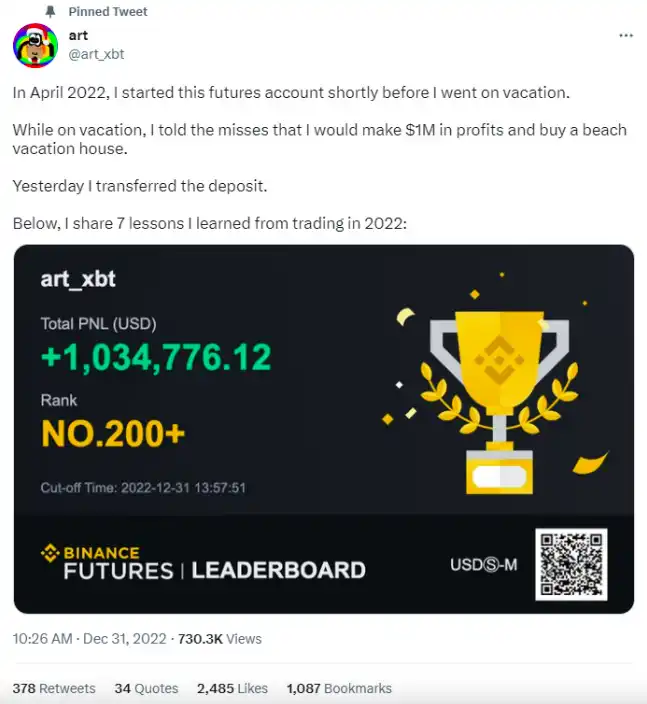
One of the reflections that stood out to me was: "Technical analysis is a mystery: I was initially repelled by trading, thinking it wasn't for me. Surprisingly, I did very well without any technical analysis." OK. The most I do is support/resistance impact on entry/exit trades.”
So, what is Art_XBT's formula for success? Let's get straight to the point of this interview.
First, how did you get attracted to the deal? Did you have a normal 9 to 5 job before?
To be honest, the money you can make trading is the main reason I got into trading. I never had a real full-time job because I started playing online poker when I was young. So after school I moved abroad and continued to do so for a while until I started running other online businesses.
For me, learning how to manage and risk money from the poker years made it easy to transition to trading.
Before trading Crypto, were you involved in trading other markets? How long have you been trading?
I started dabbling in the Crypto space in 2017, but didn't start actively trading until early 2022. Before that, I was primarily a buy-and-hold spot investor. This strategy worked well in the bull market, but in the bear market after that, I lost all my gains.
This is the main reason why I started trading actively in 2022 because I knew buying spot packs would not bring me good results. So I started using shorts as a hedge for spot positions, and later, for most of 2022, I only traded currency pairs.
I learned via Twitter that you are a news/narrative trader and that you don't use technical analysis. How has your trading strategy evolved over the years? What setup/criteria do you use before entering/exiting a trade?
At first, I thought technical analysis was an enigma. I find it hard to believe that drawing a few lines on the chart will give you any reasonable advantage in this market, so I'm focusing on the narrative, which makes perfect sense for currency pair trading.
I long for digital currencies with uptrends and contextual reads, while shorts are overvalued virtual assets with very high market caps or valuations and no apparent catalysts or hype.
After that, I added real-time information to my trading toolbox and used simple technical analysis (support/resistance levels) to find better entry and exit times. After participating in the trading community, I met many people who made a lot of money from technical analysis alone, and I changed my perspective.
I keep an open mind and learn as much as I can from those who do make money. In the world of digital currencies, there are many ways to make money, you just have to find the one that works best for you.
The most important criterion is that I always know what my risk is, usually 1% of my portfolio. I also try to patiently look for "cheap" entry opportunities. Unless it's urgent news, I'd rather "miss" the opportunity by not taking a trade than chasing a rally with a bad entry.
How do you practice risk and money management? Do you resize trades when you feel you have an edge?
Honestly, this is my weakest point. I have missed many opportunities by over-sizing trades and sometimes under-sizing them. Risk and money management are paramount, as maximizing expected value in these situations will have the greatest impact on returns.
For example, when news broke that Elon Musk was proposing to buy Twitter and it was anyone's guess as to whether it would happen, the risk/reward ratio was excellent.
In this case, if a deal is made, the price of Doge will surge rather than plummet. Furthermore, the prediction market has a takeover probability of 75%.
Attached below is an image of the basic formula I used for the calculation. I'm not a math genius, so the numbers may be wrong. However, this is my default frame when making decisions.
When looking back on this event, I underestimated its rise (up about 150%) and also made a mistake because more Liquidity was available and the probability of a deal was higher, but I didn't take a bigger action.
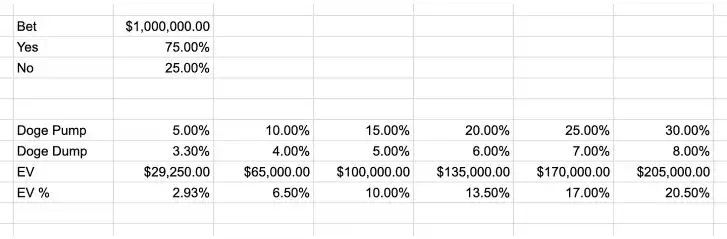
I considered taking bigger action, but the bear market frightened me, and I didn't have the guts. If I had applied the Kelly formula, it would have been a much bigger bet and could have put the majority of my portfolio into it so it only took 1-3 trades like this a year to make huge profits.
Would you trade with all your Crypto capital? Or how much capital do you have allocated to spot long, staking or mining earnings?
Up until this week, I had put all my money into one portfolio to keep things simple. But this affects my trading because it is difficult to distinguish between short and long positions, especially if they are traded in the same account. I now divide my funds into three portfolios and manage them individually:
· Long-term spot portfolio
· Short-term spot portfolio
· Futures trading portfolio
We will observe the performance of this management style in the next few months. But from the feedback I've seen on CT, almost everyone feels that their performance has improved by managing a different combination.
Additionally, I routinely withdraw profits and invest them in other assets and financial products to protect the wealth I am building.
How long do your deals typically last? What are your thoughts on shorting or hedging a position?
Generally, trade times range from a few minutes to a month, and I would wait longer if there is a specific catalyst. However, these longer time trades are always hedged if the market direction is not clear.
I rarely do directional shorts, and this is a big hole. For some reason, most people, myself included, don't like to be short. However, I am gradually acclimating and gaining confidence by taking the smallest size directional shorts. This is an invaluable skill that can take your portfolio to all-time highs even when the market is falling.
In message-based trading, speed is everything. How do you feel about the use of bots? What services/tools/bots do you personally use to improve your trading efficiency?
Bots are a great resource to improve trading efficiency. I mostly use them to get alerts on blockchain activity or to keep track of specific things I want to monitor.
However, the most valuable bots are those built for your specific needs, as publicly available bots can quickly become overcrowded.
Finding your strengths and building a custom robot as an accessory is the key to amplifying your strengths. Usually, this means you need to learn about new things early on (like NFTs with bots or extracting value on new protocols/chains/apps).
If you use a public bot, you're competing with hundreds of other people who have access to the same content, so again the playing field is evened out and you don't gain much advantage. It's very different if you're the only one doing it.
In 2022, it doesn't make a lot of sense to be long spot as we keep falling. However, in 2023, the situation has changed and it has become a lot easier to take a long spot position, and people no longer have to monitor the PnL of the perpetual contract. How do you adjust your mentality to maximize the profits you earn from the market?
Here's another bug that caught me off guard in early 2023. I don't believe in this pull, so enter the market slowly, wait for a pullback and take my chances.
Looking back, it was almost always better to add to the position immediately. Initial reversals have the best risk-reward ratio when the trend has been going on for a long time. If you are wrong, you can stop losses quickly, but if you catch the reversal early, you can hold for the long term.
In the future, I will pay more attention to these things and deploy quickly and forcefully instead of adding slowly. Because when I am ready to deploy with all my strength, the core of the market has already been completed. It's better to put all your chips in right now and take bigger risks.
How long did it take you to make money? Are there any major milestones where things start to go smoothly all of a sudden?
I was lucky to be profitable from the start. This beginner's luck boosts my confidence because things almost always go well. This allows me to place bigger bets with confidence. Of course, things changed after my first major loss.
Sometimes I wonder what would have happened if I hadn't been so lucky in the first place. I might give up and stick with traditional investing. I really don't know, but I'm grateful for how it's been so far.

What do you usually do in a day? How much time do you usually spend online in a week?
It's hard for me to balance these times like normal people. I either go all out (minimum 12 to 16 hours a day) or relax (0 to 8 hours). It depends on how hot the market is, or whether there are exciting things to do.
When the market is boring, I have a very healthy routine: get up early, have coffee/lunch/dinner with friends, work out 3-5 times a week.
When the market is hot, I'm like a goblin, clicking my mouse at home in my underwear all day.
Unfortunately for me, there is no intermediate state. Not surprisingly, the longer I put in, the more attractive the break-even ratio became. At any time, familiarity with the market is definitely a big advantage. Over the past few months, I've focused on building healthy habits, and it's very evident in my breakeven.
Who do you learn from when it comes to trading?
I probably learned the most from GCR and Tree of Alpha because they are the ones with public records.
It is much easier to learn from smart and successful people than behind closed doors. So I reverse engineered what they did and tried to do the same thing. It makes perfect sense to me because if I did the same thing as them I would get similar results.
So, whenever I see someone making a lot of money, and there is proof, I learn as much as I can and apply my own methods for myself. I apply this model to all areas of life, not just trading. This applies to virtually any skill you want to learn.
What does "fuck you money" mean to you? Also, when many people enter the Crypto market, they will leave if they want to make enough money. Is this your plan too? Do you have a mental price point?
"fuck you money" doesn't exist. We are addicted to making money and I don't think that will stop. The bar will always be raised, and there will always be new stakes. This state of mind (or disease) is why most of us are where we are. I believe you wouldn't have gotten to this point without the addiction.
What's your best deal? Not necessarily the one that made the most money.
Go long TRX and short LUNA. Based on perspective: 30% APR is better than 19% APR.
What advice would you give to someone who wants to reach your level? Are there any books, resources or tips to share?
I did not use any books or resources on trading. Everything I know I learned for free from people on Twitter. There are no hidden Alpha on Twitter, everything is public — especially small accounts that take real Alpha seriously.
You need to be able to recognize who is role-playing and who is not. Then learn the winners and create your own strategy based on that.
Why are you successful in trading? What qualities do you think you have that will allow you to earn over 10,000 a month? Are there other qualities that a trader should have? Are you trying to become a better trader?
The most important thing is to have confidence in your abilities and work ethic. I am not a very smart person, nor a good poker player, nor an average trader at best. But I know I have a very strong work ethic and can at least beat other not-so-smart traders.
Have you ever made any big mistakes? Ever feel like giving up on trading altogether?
My biggest mistake was not starting trading sooner. I think trading is the devil's drug and should not be touched because almost everyone I know has lost a ton of money. I thought the market was too efficient and invincible, and didn't realize that the market was actually very ineffective.
Sometimes when things don't go my way, I lose interest, but I won't give up until I find something new and exciting. I really enjoy solving problems and making money. For me, it's like playing a game.
Where can we learn about you?
Twitter: https://twitter.com/art_xbt
Binance leaderboard: https://www.binance.com/en/futures-activity/leaderboard/user? encryptedUid=A33E019F1D8B8AEE1919221DA6C9121D
The recent performance on Binance has not been very good, because my focus in the past few months has been trading spot, not futures. Also, I started trading on other exchanges to mitigate risk in case any of the FUD materializes. I wouldn't take any chances after what happened with FTX.