Original Author: Jaleel , Jack , BlockBeats
Original editor: Jack, BlockBeats
This morning, BlackRock, one of the world's largest asset management groups, submitted a document application for a spot bitcoin ETF to the US SEC through its subsidiary iShares, which aroused great concern in the English community. According to the application documents, the ETF is named "iShares Bitcoin Trust", and its assets are mainly composed of bitcoins held on behalf of the trust custodian, while the "custodian" is implemented through the custody of the cryptocurrency trading platform Coinbase.
Under the recent SEC regulatory pressure and multiple spot bitcoin ETFs that have not been approved, the bitcoin ETF application of the world's largest asset management giant is very surprising. Variant Fund consultant and practicing attorney Jake Chervinsky (@jchervinsky) wrote on Twitter: "The SEC has firmly refused to approve a spot bitcoin ETF for many years. Still hoping to get a Bitcoin ETF listed on Nasdaq. Every one of us should know how important this is, right?"
As an asset management company with an asset management scale of more than US$10 trillion, BlackRock's assets under management even far exceed Japan's GDP of US$4.97 trillion in 2018. BlackRock, Vanguard Group, and State Street Bank were once known as the "Big Three", controlling the entire index fund industry in the United States. Therefore, BlackRock submitted an application for spot bitcoin ETF documents to the US SEC, which aroused considerable discussion in the community.
BlackRock Files for Bitcoin ETF, Crypto Community Responds Negatively
Although for the industry, BlackRock's spot ETF application is a huge positive. However, some practitioners in the encryption industry do not seem to support BlackRock's application for a spot bitcoin ETF. According to the rules of the Bitcoin spot ETF, the fund company is responsible for buying, selling and storing physical Bitcoins and creating corresponding ETF shares for trading on the stock exchange. Therefore, the Bitcoin ETF is only used as an asset to track the price of Bitcoin. Investors buying a Bitcoin ETF is equivalent to indirectly investing in Bitcoin. What they own is a tradable Bitcoin fund share, not a direct holding of Bitcoin. This goes against the spirit of encryption to some extent: "Your keys, your bitcoin. Not your keys, not your bitcoin".
In addition, BlockBeats found that for BlackRock's "contrarian operation" against regulatory pressure, most people in the English community did not regard BlackRock's Bitcoin ETF application as a positive signal in the past. Words such as "traditional financial giants", "financial elites" and even "Operation Choking Point 2.0" appeared frequently in the comments on the Twitter platform about the Bitcoin ETF application.
The well-known KOL AutismCapital (@AutismCapital) believes that BlackRock's choice to launch ETFs under the regulatory pressure of the US Securities and Exchange Commission (SEC) may mean that the SEC may be conducting a clean-up operation. The goal is to clear the "low-level liars" in the encryption field, so that the "elite giants" of traditional American finance can rebuild the game platform according to their own rules.
Hsaka (@HsakaTrades) listed several incidents of traditional financial giants entering the encryption industry on Twitter, implying the "giant financial" attribute of BlackRock's application for Bitcoin ETF:
- BlackRock’s filing for a spot bitcoin ETF;
- Soros Fund Management says TardFi is ripe for cryptocurrency acquisitions;
-Citadel-backed cryptocurrency exchange EDX is rumored to go live later this year;
Earlier, Dawn Fitzpatrick, CEO of Soros Fund Management, spoke at the Bloomberg Investment Summit, saying that the time for encryption technology to be acquired by traditional finance (TradFi) is ripe. Dawn Fitzpatrick said that cryptocurrencies are here to stay, and there is currently a huge opportunity for existing traditional financial companies to really lead the industry. In addition, financial giants including Citadel Securities, Charles Schwab and Fidelity Digital Assets announced the launch of the cryptocurrency exchange EDX Markets, which many believe is the latest evidence of Wall Street's progress in digital assets during the crypto winter.
Scimitar Capital partner thiccy (@thiccythot_) pointed out that the US Securities and Exchange Commission has approved quite a few bitcoin futures ETFs, but no spot ETFs, and there are very few spot ETFs currently trading in the US stock market. In thiccy's view, spot ETFs are "junk," and the SEC has long denied spot ETFs, citing concerns about market manipulation and a lack of oversight-sharing agreements between a "huge regulated market" and regulated exchanges. “There is some validity to this concern as Coinbase and other US exchanges account for less than 10% of bitcoin spot trading volume,” thiccy tweeted.
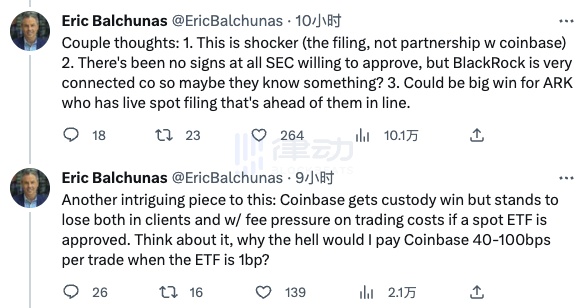
Eric Balchunas (@EricBalchunas), senior ETF analyst at Bloomberg, doesn't see any indication that the SEC will approve the application, but given their close ties, maybe BlackRock knows something? Another interesting point: Coinbase has a custody win, but if the spot ETF is approved, it will lose customers and transaction cost fee pressure. Come to think of it, why am I paying Coinbase 40-100bps per trade when the ETF is 1bp?
The real regular army wants to enter?
BlackRock's application for a spot bitcoin ETF is not without warning. As early as the beginning of 2021, BlackRock CEO Larry Fink publicly stated that he is "optimistic that Bitcoin will become a global market asset." Its chief investment officer for fixed income, Rick Rieder, also later stated that BlackRock has begun to get involved in Bitcoin.
That same year, BlackRock said its global allocation fund gained some exposure to bitcoin through CME's bitcoin futures offering. Two fund companies under BlackRock, "BlackRock Global Allocation Fund (BlackRock Global Allocation Fund)" and "BlackRock Funds V", stated in the investment prospectus (497 Prospectus) submitted to the US Securities and Exchange Commission that one of its subsidiaries These funds can participate in the trading of futures contracts based on Bitcoin. The investment prospectus also stated that not all bitcoin futures contracts are available for investment, but bitcoin futures that are registered with the US Commodity Trading Commission (CFTC) and settled in cash.
Source: BlackRock Funds V 497 Prospectus
Interestingly, BlackRock's partnership with Coinbase, in addition to its experience in gaining exposure to Bitcoin, is not new.
BlackRock's past cooperation with the "crypto regular army": Coinbase and Circle
On August 4, 2022, BlackRock announced an agreement with the crypto exchange Coinbase to provide institutional investors with cryptocurrencies, starting with Bitcoin. According to a Coinbase blog post, BlackRock will use Coinbase Prime to provide the service, and Coinbase Prime will give its Aladdin institutional clients access to crypto trading, custody, prime brokerage and reporting capabilities.
On August 11 of the same year, BlackRock launched a private trust to provide spot bitcoin exposure to U.S. institutional clients. The trust will be offered to institutional clients in the U.S. and will be BlackRock's first product to provide direct exposure to the price of bitcoin. "Despite the sharp decline in the digital asset market, we are still seeing strong interest from some institutional clients in how we can leverage our technology and product capabilities to efficiently and affordably access these assets," BlackRock said in a statement.
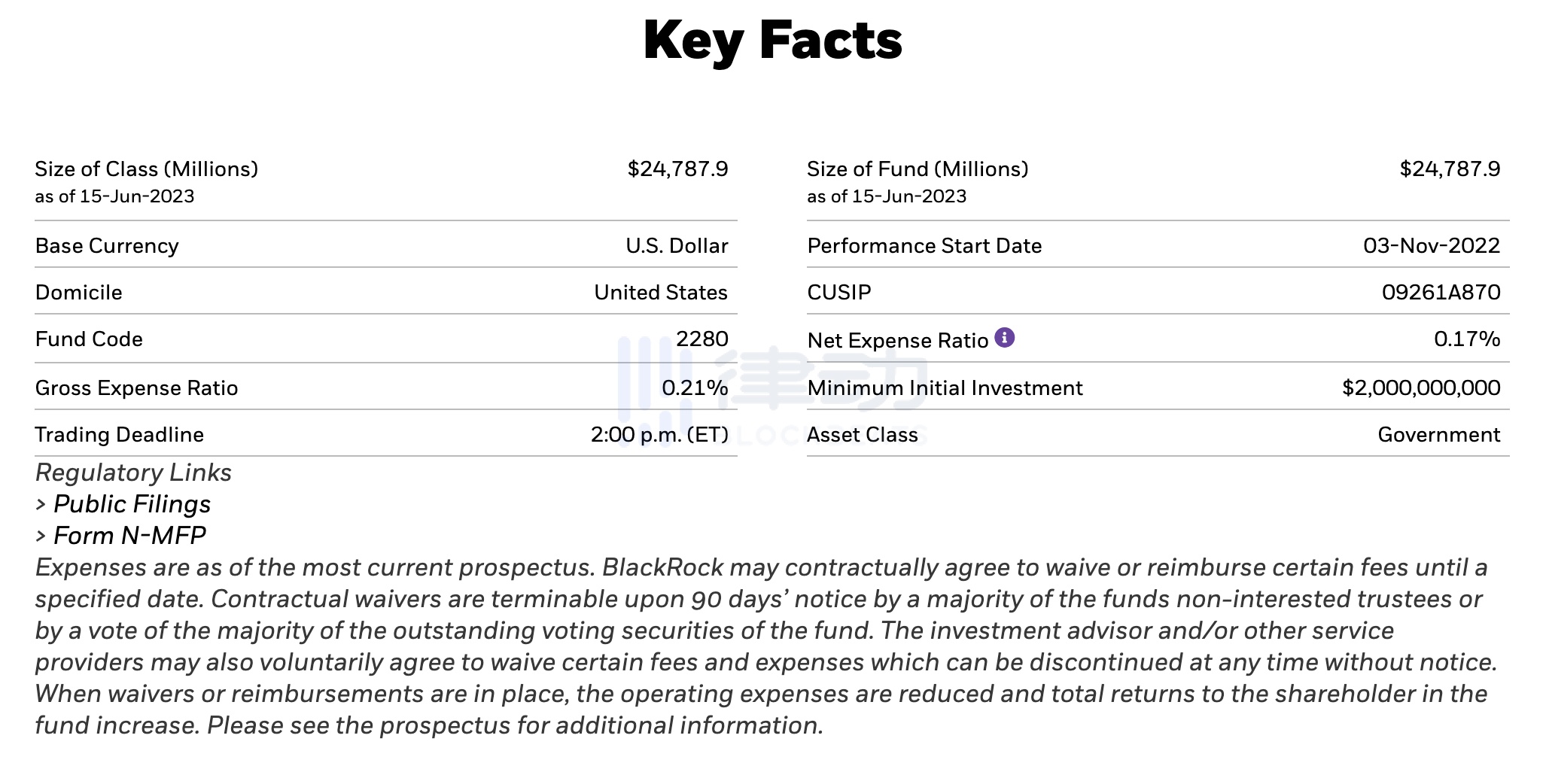
In terms of USDC issuer Circle, BlackRock participated in Circle’s $400 million round of financing in the second quarter of 2022, and Circle also invested most of its reserves in government money market funds managed by BlackRock. Circle Reserve Fund”. As of writing, according to the official pages of BlackRock and Circle, the asset size of Circle Reserve Fund has reached 24.787 billion US dollars, accounting for about 86% of Circle’s total reserves (28.5 billion US dollars), and the remaining funds will be temporarily reserved for banks deposit.
In January of this year, the Bank Policy Institute (BPI), a well-known financial think tank, also published a research article stating that USDC may become a "Backdoor Central Bank Digital Currency" (Backdoor CBDC) with the help of BlackRock.
The study found that BlackRock had planned to apply to allow the fund to use the Fed's Overnight Repurchase Agreement Facility (ON RRP). Once approved, this means that anyone who wants to hold an equivalent amount of reserve dollars in the Federal Reserve can do so by purchasing USDC, and USDC will thus become a "Backdoor CBDC", and anyone in the world can use USDC ON RRP in the fed system.
Previously, BlockBeats reported that USDT encountered FUD in the Curve 3 pool recently, and the trading pair used by both selling and arbitrage is USDC. (Related reading: " USDT Faces Serious Selling Pressure, Are Market Makers Exiting? ")
Operation Choke Point 2.0
In the discussion about BlackRock's spot ETF application, another popular view in the community is "Operation Chokepoint 2.0" (Operation Chokepoint 2.0). Well-known KOL and serial entrepreneur Andrew (@AP_Abacus) pointed out the subtle timing of BlackRock's ETF application in his tweet:
- The US Securities and Exchange Commission has sued four large cryptocurrency trading platforms, including Gemini, Coinbase, Binance US, and Kraken. That means they could be investigated for alleged violations of U.S. securities trading laws.
- Meanwhile, the Federal Reserve shut down Silvergate Bank and Signature Bank, two banks well known for servicing cryptocurrency businesses.
- Furthermore, the Federal Reserve is deciding whether to approve the related requests of two cryptocurrency-friendly banks, Custodia Bank and Protego Trust.
-At this time, BlackRock began to apply for Bitcoin ETF.
Since February this year, rumors about the US authority's intention to strengthen supervision have begun to increase. First, Coinbase CEO Brian Armstrong revealed that there are rumors that the US SEC may ban cryptocurrency staking services for retail investors. Then, multiple sources said that the Federal Reserve and financial regulators are taking large-scale actions to put pressure on the banking industry to prevent encrypted companies from getting bank accounts, thereby cutting off the connection between cryptocurrencies and banks.
In March, several U.S. banks were forced into bankruptcy and liquidation. Afterwards, it was discovered that several banks that were liquidated, including Signature Bank, Silicon Valley Bank, and Silvergate Bank, were all friendly to the encryption industry. Among them, a large part of Signature Bank 's daily business is related to the encryption industry. Many people believe that the Biden administration is now implementing what appears to be a coordinated plan across multiple agencies to block the flow of funds from banks and crypto companies, calling this trend "Operation Choking Point 2.0."
The name "Operation Choke Point 2.0" comes from a program launched by the US Department of Justice (DOJ) in 2013 to combat fraud and illegal activities such as money laundering and drug trafficking. The U.S. government is preventing certain businesses from accessing financial services by putting pressure on banks that do business with high-risk merchants. The measure caused some controversy at the time because it led to a severe Liquidity crisis for many legal but deemed high-risk businesses and was seen as an Obama-era effort to remove legal but politically Unwelcome banking movement.
After the bankruptcy of several crypto-friendly banks mentioned above, U.S. crypto companies seem to have become “homeless” in terms of banking services. According to CoinDesk, most banks are silent on the issue, and some banks have made it clear that they are not willing to accept encrypted customers.
Will Clemente (@WClementeIII), co-founder of digital asset research firm ReflexivityRes, said on Twitter that if BlackRock's spot ETF application is approved, "Operation Choking Point 2.0" is most likely orchestrated. Aims to drive out crypto-native companies and bring in large legacy companies that have partnered with the U.S. government in an attempt to rein in Bitcoin and cryptocurrencies.
Of course, these views are all unilateral speculations by the community, and there is no authoritative official document as actual evidence.
Will BlackRock's spot ETF application go through?
Another topic that has sparked discussion in the community is whether the BlackRock Bitcoin ETF can pass. The SEC has previously approved a number of futures-based bitcoin ETFs but never an attempt to open a spot bitcoin ETF, including Jacobi Asset Management, Bitwise, Valkyrie, Kryptoin, SkyBridge, NYDIG, GlobalX Digital Assets, One River , WisdomTree, etc.
In April last year, Cathie Wood's Ark Investment Management and Swiss investment product provider 21 Shares tried to list a bitcoin spot ETF in the United States, but were rejected. Subsequently, the two companies resubmitted an application in May, which was rejected a second time. The reason for the rejection was that "the Cboe BZX Exchange, which this ETF plans to list, failed to demonstrate that its proposal complied with the SEC's requirements to prevent fraud and other malicious acts." behavioral requirements."
Image source @thiccythot_
In October 2021, Grayscale also submitted a 19 b-4 document to the US SEC to apply for a Bitcoin spot ETF, hoping to convert GBTC into a Bitcoin spot ETF, but was also rejected. SEC Commissioner Mark Uyeda said on the sidelines of the ICI Global Asset Management Asia Forum in Singapore: "We have received a lot of applications so far, and none of them have been approved." Circumstances” are taken into consideration.
After Grayscale's Grayscale application was rejected, it even started a court debate with the SEC in the District of Columbia Court of Appeals. The SEC believes that the Bitcoin futures ETF is more resistant to manipulation than the spot market, and used this as one of the reasons for rejecting the Grayscale spot ETF application. Judge Rao questioned this: "The SEC needs to explain how it understands the relationship between Bitcoin futures and spot prices. A future is essentially just a Derivatives. They are together 99.9% of the time, so in the SEC's view Come on, what is the difference between the two?" The SEC also argued that "99% correlation does not equate to causation, and futures data only refers to once-daily prices, not intraday prices. In the SEC's view, Bitcoin spot The market is undisputedly decentralized, in stark contrast to Bitcoin futures that only trade on the Chicago Mercantile Exchange (CME).”
To date, the SEC has not approved any bitcoin spot exchange-traded funds (ETFs) to list. Therefore, VanEck CEO Jan believes that investors are unlikely to see Bitcoin spot ETFs in the United States soon, and may not be listed in the United States in the next year and a half. Interestingly, the founder and CEO of CustodiaBank also launched a poll:
If the BlackRock Bitcoin Spot ETF application is approved, what do you think the US government is?
1. Corrupt;
2. Conscientious and problem-free
Among them, more than 80% of the voters believed that if the ETF application is approved, it will further reflect the corruption of the US authorities.
On the issue of "whether BlackRock's application will be approved", Scimitar Capital partner thiccy (@thiccythot_) believes that as the largest and most respected asset management company, BlackRock may establish a special relationship with the SEC. In addition, the pressure on Gensler from the Republican Party is increasing, and the SEC may make some arbitrary decisions. In thiccy's view, if BlackRock's ETF is approved, it will be a huge boost to the encryption industry.