What is Blur V2? Blur is one of the leading Non-Fungible Token Marketplace platforms on the market today with up to 60% of Non-Fungible Token Trading Volume . Recently Blur also launched Blur V2 version with special features announced. So what are the changes in Blur V2 compared to the previous Blur V1 version, let's find out with Hak Research in this article.
Before entering the article, people can refer to some of the following articles to better understand:
- What is Blur? Blur Cryptocurrency Overview
- What is Blend? Perpetual Lending Protocol for Non-Fungible Token
- What is Non-Fungible Token Marketplace? Operation mechanism and some prominent Non-Fungible Token Marketplace
- What is the Non-Fungible Token (Royalties fee)? The secret to helping Blur surpass OpenSea
What Is Blur?
Overview of Blur
Blur is an Non-Fungible Token Marketplace Aggregator platform on Ethereum designed with professional traders in mind. Blur aggregates data from many different Non-Fungible Token exchanges such as: OpenSea , LookRare , X2Y2 , ... so that users can trade Non-Fungible Token on only one place with the best price.
Blur was launched in October 2022 and quickly rose to become one of the top Non-Fungible Token Marketplaces on Ethereum. Blur's goal is to build a platform that is fair and empowers the community. Holders of the BLUR Token (the main Token of the platform) can participate in governance decisions, earn rewards, and access exclusive features.
Blend - Non-Fungible Token Lending Platform Implemented on Blur
Blend is a Lending protocol for Non-Fungible Token implemented on the Blur platform. Blend adopts a P2P Lending model that allows users to borrow against their Non-Fungible Token collateral with any lender willing to offer the most competitive rates on the loan.
Blend stands for Blur Lending developed by Blur Core Contributor in partnership with Paradigm , providing users with the best loans at interest rates determined by the market.
Buy Now Pay Later (BNPL) - Buy Non-Fungible Token Blue Chip with a small amount of upfront payment
Buy Now Pay Later (BNPL) allows users to pre-purchase Non-Fungible Token Blue Chip with borrowed money. The user will have to pay a certain amount of interest compounded daily with the interest rate depending on the loan value that the user borrows.
For example: The current price of Azuki is 7.33 ETH and Alice wants to buy Azuki in the form of BNPL. Alice will have to pay a minimum of 0.43 ETH and borrow 6.9 ETH at an interest rate of 3.06%/day. This is a very high interest rate and Alice can choose to pay 2.42 ETH and borrow 4.91 ETH at only 0.01%/day.
Overall, BNPL is an interesting solution that allows users to own Non-Fungible Token Blue Chips with a much smaller upfront payment than buying Non-Fungible Token. However, in order to have full access to Non-Fungible Token, the user needs to repay his loan.
In addition, this can also be a speculative solution as users can buy Non-Fungible Token and resell them when they increase in price to repay the loan. The profit earned comes from the difference between the Non-Fungible Token buy and sell price.
Blur Points Earning Model
What are Blur Points?
What are Blur Points?
Blur Points are the points of users who are active on Blur through activities such as: Bidding, Non-Fungible Token listing,... Blur will be rewarded with BLUR Token based on each person's points. ) through Airdrop.
How to check Blur Point on Blur . platform
There are currently 3 ways to earn points on Blur including: Bidding points, listing points and lending points. All points are of equal value so 1 Bidding Point = 1 Listing Point = 1 Lending Point.
For bidding points:
- Points are awarded to users who bid on collections based on a collection's 24-hour volume.
- In a collection, the highest “risk” bids earn the majority of points. That is, if the floor price of a collection is 1.01 ETH and 100 people bid at 1 ETH. If Bod bids at 0.99 ETH then Bod won't earn much because there are 100 bids in front of him. But if Bod bid at 1.01 ETH he will earn even more points because now Bod is taking the most “risks”.
- The longer a user's bid is active, the more points the user gets. Once a bid is accepted, it will stop earning points.
Some users who attempt to bid far from the current floor price of a collection will not receive Blur Points. Points only reward users who bid closest to the floor on active collections.
For listing points:
Listing points work differently than bidding points. Here are some ways to help users earn more Blur Points through listing points:
- The more Non-Fungible Token a user lists, the more points they get.
- Listing of Non-Fungible Token Blue Chips.
- Use all the listing tools that Blur provides such as: List price floor, price floor feature and ladder list.
In addition to avoiding fraud, Blur has used the system to analyze and remove traders with unnatural listing activity (constantly listing Non-Fungible Token at unrealistic prices, or listing custom collections). episode is no longer active).
For loan points:
On some collections that support the loan method, the listing score has been replaced with a loan score. Therefore, users cannot check both listing and lending points at the same time. For example, if a collection earns the following points each day before the loan is activated:
- Listing: 50 points per day
- Bidding (Bidding): 50 points per day
So users can earn up to 100 points towards this collection. If the collection then supports the loan method, the score will change to:
- Listing: 0 points per day
- Lending: 50 points per day
- Bidding: 50 points per day
So the user still only earns up to 100 points with this collection and there will be no point dilution compared to other collections. In addition, users can also earn both bidding and lending points at the same time using the same ETH in their pool.
There are 2 ways to determine the Blur Points that users receive from Lending including:
- Maximum Loan: This is the maximum amount of ETH that someone can borrow with a single Non-Fungible Token . The taller Max Borrow, the better.
- APY - This is the interest the user earns from his loan offer after accepting the loan. The lower the APY, the better.
Users can also make multiple loan offers on the same collection with different loans and APYs and earn points for all of them. Example: If a collection has a floor price of 10 ETH, you can offer an offer with a maximum loan of 9 ETH with an APY of 50% and another offer with a loan of up to 5 ETH with an APY of 20 % and earn Blur Points for both of these offers.
In addition to the 3 ways to earn points above, Loyalty (loyalty) is also a factor affecting the user's Blur Points. If the user's wallet address only makes transactions and lists Non-Fungible Token on Blur, the Loyalty index will reach 100% and then users will have more incentives to earn Blur Points.
About Blur V2
What is Blur V2?
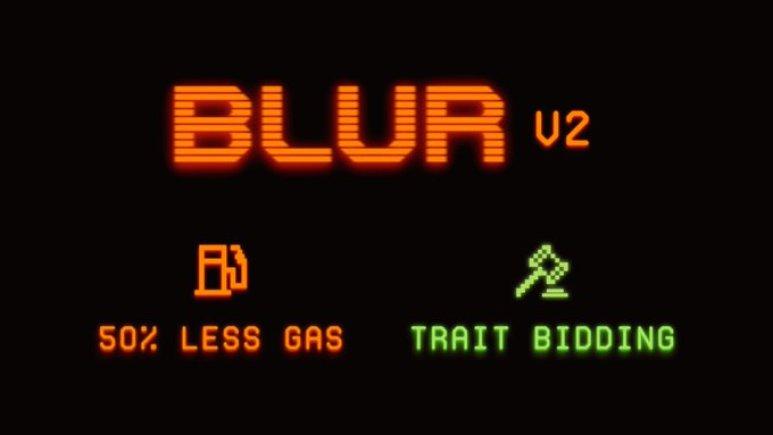
On July 5, 2023, Blur announced the official launch of Blur V2 version with two important major updates:
- Non-Fungible Token transaction with 50% less Gas Price than Blur V1 version: This makes it possible for users to save most of the cost during the transaction. For example, in Blur V1 version, users need up to 32 USD for each Non-Fungible Token purchase, now users only have to pay 16 USD to buy Non-Fungible Token on Blur V2.
- Trait Bidding - Bidding with properties included in a collection: With Blur V1 only applying Collection Bids (collection bids) Blur V2 supports Trait Bids (bidding for special features). points in the collection). In general, Trait Bids works similarly to Collection Bids except that it allows users to bid on specific characteristics rather than the entire collection. However, currently, Trait Bidding only applies to 12 Non-Fungible Token collections on Blur. People can refer here .
Let me give an example so that everyone can better understand Trait Bidding:
With the current Azuki collection for a floor price of 7,468 ETH. In version V1, users can only bid on collection and data on Blur is represented as Order Book as shown below.
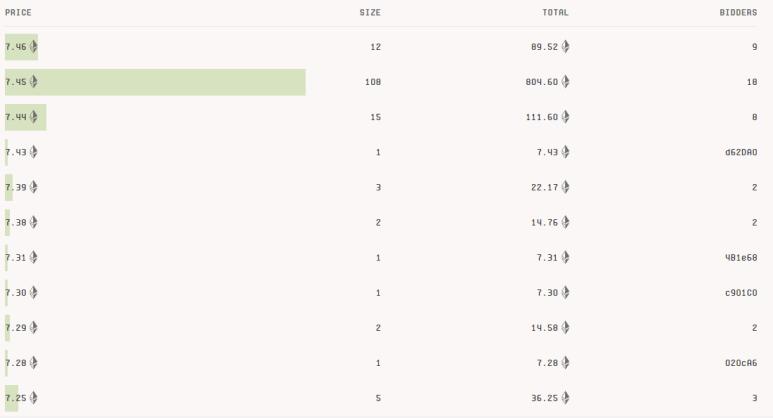
Collection Bids in Blur V1
In Blur V2, users can bid on features in the collection. With Azuki, users can bid for the Background feature such as: Dark Purple with a bid of 6.2 ETH, Red with a bid of 6.2 ETH or for the Clothing feature with Golden Cat Kigurumi: 27 ETH,....
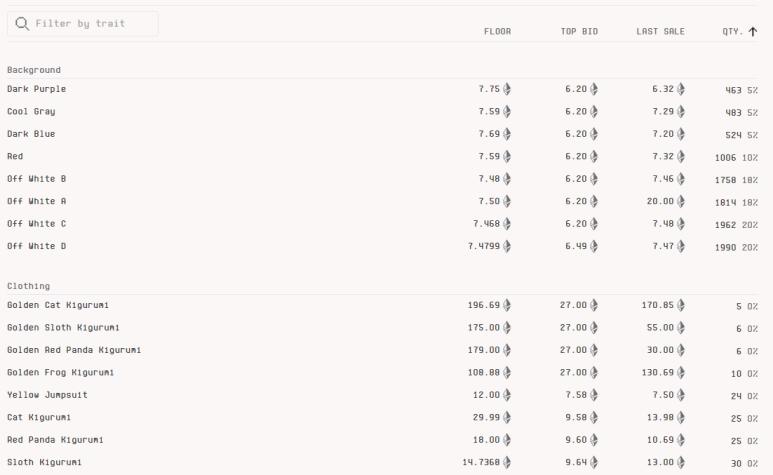
Trait Bids in Blur V2
How to calculate Trait Bidding Points on Blur:
Bidding points have been updated to incorporate Trait Bids. The Blur Points allocated for Trait Bids will not be much different from Collection Bids. This means that if a collection has been allocated 100 bid points per day before, when there is Trait Bids, that collection will only be allocated 100 bid points per day. The only difference is that those points are distributed across collection bids and feature bids. Here is how Blur Points for Trait Bidding are calculated on Blur:
- Trait Bids Score = (Trait Bids Price /Top Collection Bid) x ( Non-Fungible Token with that trait).
- The higher a user's Trait Bid price and the more items there are in that trait (the more Non-Fungible Token in that trait), the more points the user gets.
- The weight that Trait Bids can get based on its price is limited. This means that users cannot bid 1000 times the floor price of an Non-Fungible Token collection, they will not receive any Blur Points.
- Bidding with Medium features will likely get more points than a rare trait bid.
Review of Blur V2
Blur changes Non-Fungible Token transaction participant role
Before reviewing Blur V2, let's take a look at the user role change when participating in Non-Fungible Token transactions:
- Prior to Blur, OpenSea was where most of the Trading Volume in the Non-Fungible Token market was concentrated. And due to the high royalty fee for each collection, most users participate in buying and selling as Collector or Holder.
- When Blur came out with special tools and a no-royalty or royalty-free movement that could be customized by the merchant, it made it easier for Non-Fungible Token traders to pay less as the trade from there appeared more to the market. The third user is Trader.
- When Blur launched the Blur Points program to reward users for participating in transactions on the platform, a new user object, Farmer, appeared.
When talking about Collector, Holder or Trader everyone has a basic image of them. So in this article, I will focus on Farmer on Blur.
Farmer has three ways to earn points on Blur including: Bidding, listing and lending. Most farmers choose to bid for points because it only requires users to bid in ETH on collections.
Farming Strategy on Blur
Usually, farmers are just trying to farm Blur Points rather than buying and holding Non-Fungible Token so they will bid far enough to not get matched but close enough to get a fair amount of Blur Points.
In case of order matching, the Non-Fungible Token asset just bought on Blur will be locked for 1 hour before it can be listed and sold. The farmer can then list on Blur at a high price or sell it for ETH and continue bidding.
Benefits and harms that farmers bring to Blur
The appearance of the Farmer helps the Liquidation source for Blur is huge. This also makes it possible for users to buy and sell Non-Fungible Token quickly and execute orders instantly.
However, this is a virtual source of Liquidation created by Farmers and always moving to achieve the highest profitability. Farmers will not be loyal to any particular platform or asset. Instead, they look to where they can get the most profit, and this can affect the price of collections on Blur.
In addition, collections on Blur are also more susceptible to manipulation by MMs or whales and sharks because in addition to participating in price control and distribution, they can earn bonus points with Blur Points.
How Blur V2 affects Farmer
Blur V2 offers a feature called Trait Bids that allows users to bid on features in a collection. This means that the total score for the collection does not change but will distribute to Collection Bis and Trait Bis.
In this case it will be difficult for Farmers to earn as many points as in Blur V1 because the points are distributed across the collection and they will have to bid on both Collection Bids and Trait Bids and bidding. in so many places that they have no control over their bids.
Immediately after the appearance of Trait Points on Blur, Farmer No. 1 on Blur - who accounts for 10% of TVL Blur and 8% of total Blur Points decided to withdraw 7842 ETH, Blur Pool and quit Farming.
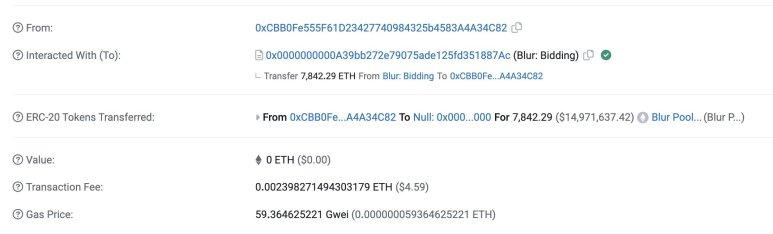
The #1 Farmer on Blur quits Farming
Overall, Blur V2 has also impacted Farmer somewhat in terms of points they earn, but the Liquidation will be spread more evenly across a collection.
summary
Blur V2 brings new features to help users transact with less Gas Price and be able to bid on features in a collection. Although it has more or less impact on farmers, in general Blur V2 helps the Liquidation flow more evenly into the collection, not just focusing on the floor price as before. Above is all the information I want to introduce about Blur V2, hope everyone has received useful knowledge.
The post Blur V2 With Ambition To Change The Game In The Market Non-Fungible Token first appeared on HakResearch .