TL;DR
From Layer1 to Layer2
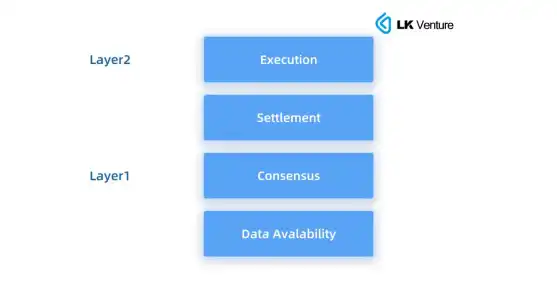
How to achieve expansion technically? Ethereum regards Rollup as the only Layer 2 solution, because it realizes the expansion of Ethereum without losing decentralization and security. From the perspective of modularization, Layer2 is responsible for execution, while settlement, consensus, and data availability are all handled by Layer1.
From Layer2 to Layer3
What is the difference between Layer2-Layer3 and Layer1-Layer2? Although Rollup technology solves the computing bottleneck of Ethereum, it does not solve the problem of data availability. The upper layer needs to compress the transaction data to pass to the lower layer, but the compression cannot be repeated, and the performance of Layer2-Layer3 cannot bring a significant improvement.
With Layer2, why do we need Layer3? Layer 2 will maintain decentralization and provide composability as a general computing layer, while Layer 3 should be an application-specific chain to meet the unique needs of different applications, such as: compatibility, efficiency, privacy, etc.
It is also the application chain ecology, what is the difference between Layer3 and Cosmos? Layer 3 relies on the Ethereum ecosystem, making it easier to obtain users and funds, but due to its high connection with Ethereum, it also loses some sovereignty, such as the value capture of tokens.
From Layer3 to LayerX?
Layer 3 development status: Arbitrum released Orbit Chain on June 22; zkSync announced on June 26 that it will launch ZK Stack within a few weeks; Madara of the Starknet ecosystem has helped a project deploy within 24 hours during the hackathon. A Starknet Layer3 application chain.
Layer3 is here, will Layer4 and Layer5 be far behind? LK Venture believes that from a technical point of view, Layer3 has been unable to achieve a leap in performance through simple stacking. Although the ecology between Layer1-2-3 is closely related (Ethereum ecology), and the interoperability is stronger than that between traditional heterogeneous chains (Cross-chain is cheaper), they still cannot fully inherit the ecology from each other. The narrative of Ethereum expansion may end at Layer3.
From Layer1 to Layer2: Scaling
There is an impossible triangle in the blockchain, that is, security, decentralization and scalability cannot be realized at the same time. Ethereum has chosen the former two, and has insufficient support for the latter. On weekdays, a swap in Ethereum requires a Gas Fee of $3-$4, and in a bull market with high transaction volume, a swap even requires a Gas Fee of nearly $100, and the congestion phenomenon is very strong.
Relying on the huge ecology established by the first-mover advantage, although many new public chains that focus on extensible suites have continued to emerge since 2018, Ethereum still occupies an absolute dominant position in the market. The expansion plan built on the above.
Among them, sidechains, Validium and Rollup are widely used, each with different trust assumptions.
A sidechain is an independent blockchain that is executed independently of Layer 1 and is connected to the Ethereum mainnet through a two-way bridge. The side chain can have separate block parameters and consensus algorithms , which can efficiently process transactions, but it does not inherit the security attributes of Ethereum.
Validium uses off-chain data availability and computation, processes transactions off-chain to increase throughput, and releases Zero-knowledge Proof to the chain to verify off-chain transactions on Layer 1 for security.
Rollup performs calculations off the chain, but uses Layer 1 as the data availability layer. By releasing fraud proofs or validity proofs to the chain, and verifying them in the Layer 1 smart contract, it inherits the security of Ethereum.
Ethereum regards Rollup as the only Layer 2 solution, because it realizes the expansion of Ethereum without losing decentralization and security. From the perspective of modularization, Layer2 is responsible for execution, while settlement, consensus, and data availability are all handled by Layer1.
According to different submission certificates, Rollup can be divided into Optimistic Rollup and ZK Rollup.
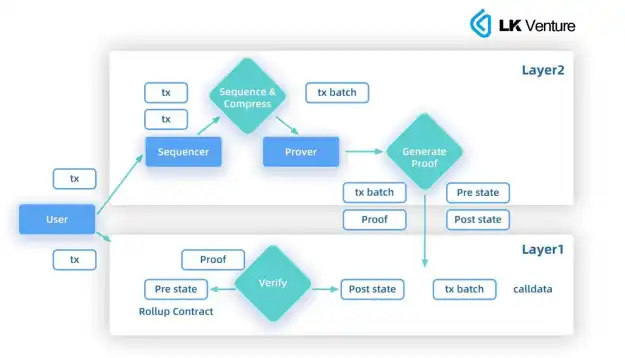
For Optimistic Rollup , Rollup executes transactions in batches, and sends the batch transactions, pre-execution state and post-execution state to the Rollup contract deployed on Layer1. Layer1 does not verify the state transfer process, as long as the initial state submitted by Rollup is the same as that stored in the Layer1 contract, it will optimistically transfer the state to the new state submitted by Rollup . The prevention of fraud is guaranteed by fraud proofs. During a period of dispute, other verifiers can challenge the state root and transmit fraud proofs to Layer1's Rollup contract. This will cause the Rollup state to return to the definite state before the dispute, and recalculate the legal state, and punish the verifier according to the result. In practice, fraudulent situations rarely occur, so optimistic state transitions actually save a lot of verification resources.

The difference between ZK Rollup and Optimistic Rollup is that the state transfer needs to be verified. It is not the Rollup contract of Layer 1, but the Validity Proof is verified in the contract. After the verification is completed, the state transfer immediately obtains finality without waiting for a long time. dispute period of up to one week.
Among the projects using Optimistic Rollup technology, the most mature ones are Arbitrum and Optimism, both of which have been implemented on the Mainnet. Among them, Arbitrum has implemented fraud proofs, but only for whitelists submissions, while Optimism's fraud proofs are still under development. Both are actively promoting decentralization, including the decentralization of orderers and validators.
Further reading: popular science|How many types of Rollup are there? In addition to Validity, Optimistic and..
According to L2Beat, as of June 26, 2023, the TVLs of Arbitrum One and Optimism are $5.81B and $2.25B, respectively. Other projects using Optimistic Rollup technology include Boba Network, Zora Network, Layer2.finance, Fuel, BNBOP, Coinbase, etc., some of which are developed using the open source OP Stack of the Optimism team.
Among the projects using ZK Rollup technology, the main ones that support virtual machines are zkSync Era, StarkWare, Polygon zkEVM, etc., which are currently on the Mainnet, with TVLs of $618M, $68.11M, and $42.65M. Those that only support specific types of transactions include dydx, Loopring, zkSync Lite, etc., with TVLs of $350M, $98.47M, and $97.69M. The current development direction of ZK Rollup is better compatibility with Ethereum. The zkEVM projects under development include Taiko, Scroll, Linea, etc.
From Layer2 to Layer3: Customization
Layer2: 100x, Layer3: 100x^2=10000x?
From Layer1 to Layer2, the cost reduction is 1/100. So it is natural to think that if the same operation is performed on Layer2 to build Layer3, the cost of Layer3 will be reduced to 1/10000. Unfortunately the answer is no.
Rollup does solve Ethereum’s computing problem by moving the execution off-chain: L1 nodes no longer need to execute each transaction in the batch to verify the correctness of the state transfer. Thanks to the recursive proof technology in cryptography, computing can Recursively for unlimited performance, however data availability does not stack. Layer2 needs to transfer the packaged transaction data to the smart contract in Ethereum in the form of calldata. Although the packaged transaction data is compressed, the data cannot be compressed twice by the same method. The transaction data of Layer3 must eventually be submitted to Layer1 (otherwise the security cannot be inherited), but the degree of compression of transactions cannot be lowered, so the data availability level cannot be reduced by stacking.
Therefore, Layer3 cannot take the path of simple stacking. The solution proposed by the StarkWare team is customization, allowing Layer3 and Layer2 to undertake different functions.
With Layer2, why do we need Layer3?
Ethereum provides security and decentralization, and Layer 2 provides scalability. It can be said that it solves the trilemma of the blockchain. Why do we need Layer 3?
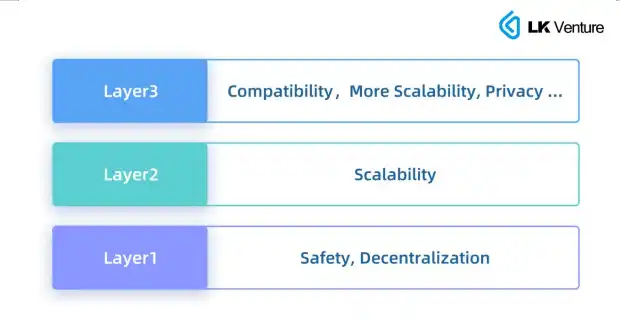
The concept of Layer3 was first proposed by the StarkWare team in the article " Fractal Scaling: From L2 to L3 ". The StarkWare team believes that this hierarchical structure and the idea of encapsulation are also the core essence of maintaining the vitality of computer science. In addition, Layer 2 of the Layer 2 virtual machine will maintain decentralization as a general-purpose computing layer to provide composability, while Layer 3 should serve as an application-specific chain to meet the unique needs of different applications. Turing's completeness has laid a good foundation for layering. Once Turing's completeness is achieved, any possible application can be established on it in theory.
In fact, in order to maintain its versatility, Layer2 must make some trade-offs, which cannot meet the needs of all applications. The most direct manifestation is that in order to generate proofs more efficiently, StarkWare developed the Cairo language and CairoVM, which are not compatible with Ethereum. At this time, a Layer3 chain can solve its security.
Possible Layer3 use cases include:
- Compatibility : Compatibility with other virtual machines by implementing an interpreter for other languages on the Layer2 virtual machine
- Efficiency : If the application pursues ultra-high TPS (such as games, social networking), you can consider giving up part of the security, use the Validum solution, and settle on Layer 2; the application can also customize the transaction format according to its own needs to achieve higher Compression ratio.
- Privacy : A privacy chain is specially built to settle on Layer2, but it cannot be publicly observed.
In addition, since the application chain is dedicated and will not be directly affected by other applications, the performance and cost of the chain are relatively certain. At the same time, the bridging transaction does not need to be transmitted directly on Layer1, and the cost is lower, and the bridging between L2-L3 and L3-L3 is cheaper. Layer3 also has an obvious advantage in submitting transactions in batches. The fixed Gas required to submit a batch of transactions is lower, and there is no need to wait for a long time for more transactions to be submitted together to reduce the average Gas, which can significantly alleviate the problems existing in Layer2. Acknowledge the dilemma between time and cost.
The same is the application chain ecology, what is the difference between Layer3 and Cosmos?
Cosmos can be said to be the first project to propose the concept of application chains. Through the Cosmos SDK, users can easily customize and issue their own application chains. Cosmos IBC is even more benchmarking against the TCP/IP protocol in the Internet, providing native interoperability for application chains built using the Cosmos SDK. Simply put, the vision of Cosmos is to build a blockchain universe interconnected by thousands of chains.
Layer3 has also worked hard on interoperability. Due to the same technical architecture and low transaction costs, the Cross-chain between Layer3 will be trustless, fast and cheap, so it can be considered that the Liquidity between Layer3 is shared. From an interoperability standpoint, Layer3 and Cosmos bring almost the same functionality.
Further reading: Bankless: Will Cosmos be the ultimate form of blockchain?
The LK Venture investment research team believes that the biggest difference between Layer3 and Cosmos lies in its connection with the Ethereum ecosystem, which is both an advantage and a disadvantage.
When it comes to advantages, it mainly lies in the huge Liquidity and user volume of the Ethereum ecosystem.
Although Cosmos has powerful technology and is the first choice for many giants, it still cannot escape the fate of low market share. According to DeifLlma's data, as of June 26, 2023, the TVL of Ethereum is $26.2B, while the entire Cosmos ecology adds up to only nearly $1B. For Layer3 to succeed, the Ethereum ecosystem is a key element.
When it comes to disadvantages, it mainly lies in the high connection with Ethereum and the loss of some sovereignty.
For the use of the Cosmos chain, the token model is completely designed by the project party according to the needs, and the token empowerment is strong. However, the native token of the Layer3 chain will be limited by Ethereum. Although the project party can empower the native token as Gas tokens, it is undeniable that the final transaction data submitted to Ethereum consumes $ ETH. Therefore, if the Gas token is not $ETH but the native token issued by itself, the project party needs to continuously convert the native token into $ETH for submission, and the final empowerment is still transferred to $ ETH.
Another feature of Layer3 is that anything done on Layer3 can actually be migrated to Layer2, which only depends on the choice of the DA layer.
If Layer 2, which Layer 3 relies on for settlement, has a security breach or activity declines, Layer 3 can migrate to other Layer 2 at low cost, or even directly rely on Layer 1 for DA and settlement, and become Layer 2. Due to its high connection with the Ethereum ecosystem, many innovative gameplays may be born on Layer3.
Prospects from Layer3 to LayerX
Layer3 development status
On June 22, Offchain Labs released tools for issuing the Arbitrum Orbit Chain. Orbit Chain is Layer3 on top of Arbitrum Layer2, and you can choose to use one of the three Layer2s including Arbitrum One, Arbitrum Nova, and Arbitrum Goerli for settlement. Users can choose to use Rollup or Anytrust technology. The difference is that Anytrust uses DAC instead of submitting transaction data to the chain, which is cheaper but less secure. The advantage of Orbit Chain lies in its simple issuance process, interoperability with the Arbitrum ecosystem, Nitro's real-time updates, and the EVM + compatibility provided by Stylus (supports Rust, C, C++ writing, and executes on the WASM virtual machine). Users can customize and issue any Orbit Chain without permission, but they must be settled on Arbitrum Layer2, otherwise they need to contact Offchain Labs or Arbitrum DAO to obtain authorization.
On June 26, zkSync released an article, announcing that it will modify the existing open source code in the next few weeks and launch ZK Stack, allowing users to use its customization to build their own ZK super chain. Different from Arbitrum's Orbit Chain, ZK Stack emphasizes sovereignty and interoperability, and users can fully customize it according to their needs. The chain built using ZK Stack can achieve bridgeless interoperability. ZK Stack can be used to build both Layer2 and Layer3. There is no official restriction on it, and there is no requirement to settle on zkSync. From this point of view, the sovereignty provided by ZK Stack seems to be stronger.
Further reading: Matter Labs releases ZK Stack again, and its modular ambition is locked in "L2+L3"
As the first StarkWare team to propose the Layer3 concept, it is also vigorously cultivating the development of Layer3 in its Starknet ecosystem. Madara is testing for the public-facing Stack. In the @PragmaOracle hackathon, a team used Madara to complete the release of Lisk within 24 hours. However, due to Starknet's unique zk-STARK proof technology, the technology maturity is relatively low, and it may take a longer period of development to improve the product, and then release the Starknet Stack to the public.
The current Layer3 ecology is still in the early stage, but with the launch of various Layer2 convenient blockchain tools, it is believed that Layer3 will be officially implemented soon. When the infrastructure is gradually improved, how to attract users has become the most concerned issue of all chains.
Layer3 is here, will LayerX be far behind?
From a technical point of view, Layer3 has been unable to achieve a leap in performance through simple stacking. Of course, Layer3 can gain specific advantages through customization, but the loss of versatility will make further superposition difficult. Of course, as long as you want, this kind of hierarchical superposition can be carried out infinitely. However, the LK Venture investment research team believes that at present, this kind of superposition cannot meet any needs, and will lead to a geometric increase in system complexity.
The most important point is that although the ecological relationship between Layer1-Layer2-Layer3 is closely related (Ethereum ecology), interoperability is stronger than that between traditional heterogeneous chains (Cross-chain is cheaper), but they still cannot achieve each other. The complete inheritance of ecology. Contracts deployed on Arbitrum One cannot be called directly on Orbit Chain; the Liquidity of DEX deployed on zkSync cannot be directly aggregated to ZK Stack.
The current situation is that the shopping malls have been built and are getting higher and higher, but there are not many vendors and customers. Although the bottom floor is full of merchants (Ethereum), people are still reluctant to go to the high-level shopping malls for consumption, because the number of merchants on the upper floors is not as large as that on the lower floors.
Therefore, the LK Venture investment research team believes that before the blockchain technology is applied on a large scale, it may be difficult for Layer3 to obtain a high number of users. As for Layer4, Layer5...LayerN, even if there are specific requirements for individual applications, I believe it will not be promoted under the banner of LayerN.
An old saying goes: Dao begets one, one begets two, two begets three, and three begets all things. The narrative of Ethereum expansion, or will it end at Layer3? It may take time to test.