Author: Mihai Grigore . Compilation: Cointime.com QDD
main insights
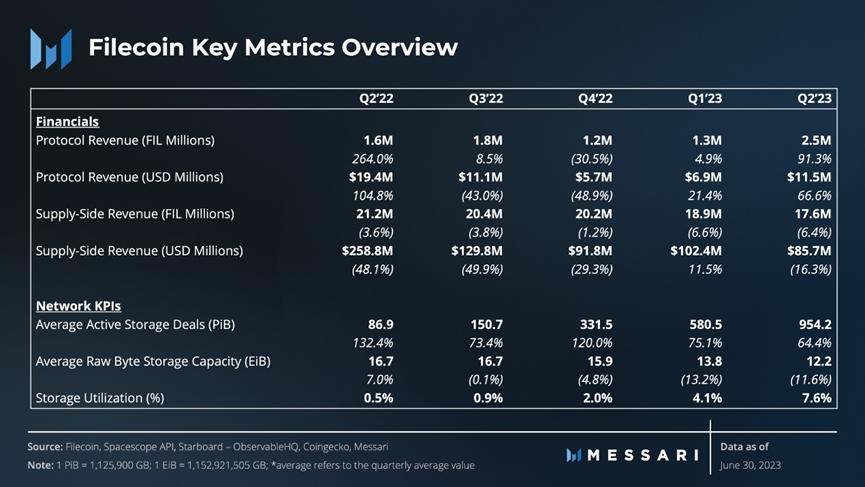
l Filecoin's storage market continues to grow in the second quarter of 2023, with a 64% increase in active transaction volume quarter-on-quarter.
l Storage utilization increased from approximately 4% in Q1 2023 to nearly 8% in Q2 2023 due to a 12% reduction in storage capacity.
l Fee revenue increased by 91% (67% in US dollars) in the second quarter of 2023, mainly driven by a 64% increase in active storage transaction volume and a 60% increase in the number of large data set customers.
l The Filecoin Virtual Machine (FVM) introduces Ethereum-style smart contracts, enabling new use cases such as liquid stake mortgages, permanent storage, and decentralized computing.
Introduction to Filecoin
There is one major disadvantage of relying on centralized data storage: it is difficult to systematically verify the integrity of stored data. The Filecoin storage network is a peer-to-peer version of Amazon's S3. It is built on top of the Interplanetary File System ( IPFS ), which serves as the distributed data storage and sharing layer for the Filecoin network. Filecoin periodically verifies the storage of data and uses transactions based on supply and demand dynamics to price storage rather than a fixed pricing structure.
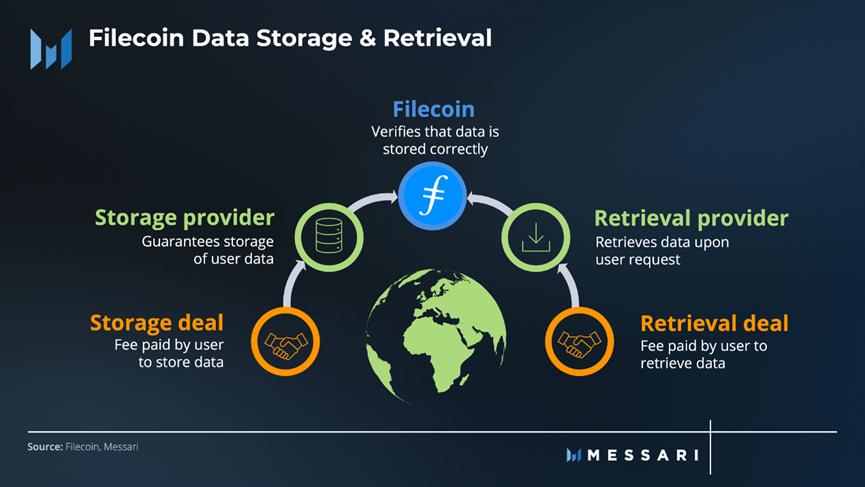
A storage deal is similar to a contract with a service level agreement ( SLA ) - a user pays a storage provider to store data for a specified period of time. In order to protect data security, Filecoin adopts an encryption economic incentive model, and regularly uses zero-knowledge proof to verify storage. To incentivize storage providers to participate in transactions, Filecoin rewards them with FIL as the network's native token. Storage providers are also penalized if they fail to provide reliable uptime or perform malicious actions on the network.
To retrieve data, Filecoin users pay retrieval providers to obtain the data. Unlike storage transactions, which involve on-chain transactions, retrieval transactions use payment channels to settle payments off-chain, allowing for faster retrieval.
Launched in March 2023, the Filecoin Virtual Machine (FVM) brings Ethereum-style smart contracts to Filecoin, enabling new use cases such as liquid stake staking, permanent storage, and decentralized computing.
Key indicators
performance analysis
The Filecoin blockchain is used by both the demand side (i.e. storage users who need data storage) and the supply side (i.e. storage providers with excess capacity) of the network. Both storage users and storage providers generate revenue for the protocol.
income
Filecoin's revenue framework is similar to Ethereum in that its Gas system is based on EIP-1559 . The Gas system includes network fees used to compensate resource usage.
Agreement income
According to Messari's revenue analysis , Filecoin's protocol revenue includes the following parts:
l Base Fee - Determined based on message congestion and required for any proof of storage.
l Batch Fee - Used to bundle proof of storage.
l Overestimation fee - The fee required to optimize Gas usage.
l Penalty fees - for storage provider errors.
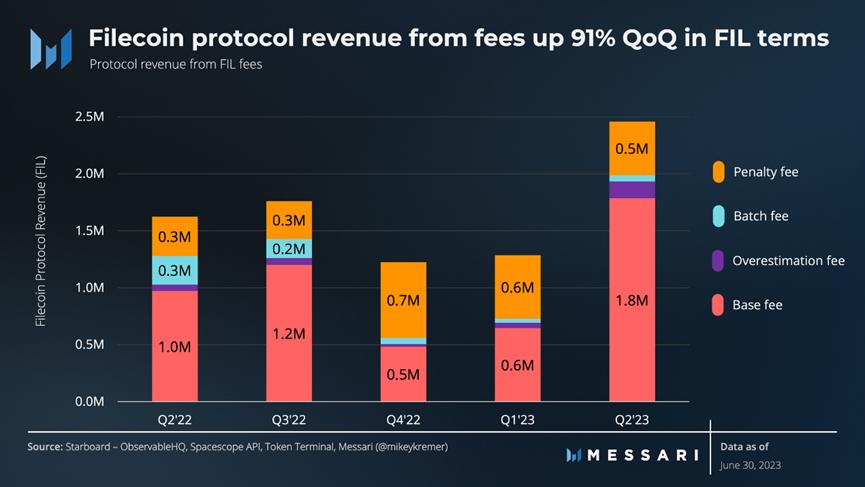
Protocol revenue from FIL fees grew 91% to FIL 2.5 million (up 67% in USD to $11.5 million). The growth in protocol revenue is consistent with a 64% increase in active storage transaction volume and a 60% increase in the number of customers with large datasets live.
Although the FIL base fee has increased by about 3 times from the previous quarter, the penalty fee has continued to decline, down 17% from the previous quarter, and 29% from the peak of US$700,000 in the fourth quarter of 2022. Past escalations in penalty fees may have been caused by storage providers terminating storage units (i.e., the basic unit of storage) before the agreed storage transaction period. One potential explanation is that the FIL/USD price dislocation affects the profitability of storage providers.
FIL fees not burned by the protocol consist only of "tips" collected by block miners. This mechanism is used to speed up transactions on the supply side of the network. Therefore, this "tip" counts as supply-side revenue.
supply side revenue
Filecoin's supply-side revenue includes:
l Block rewards distributed by the network to storage providers.
l Payment through storage transactions anchored by legal contracts.
l "Tips" for expediting transactions.
Block rewards accounted for over 99.9% of supply-side revenue in Q2'23, while "tips" accounted for only a small fraction. The minting mechanism of new FIL tokens relies on the following two models:
l Exponential decay model (30% of tokens): Initial block rewards are the highest to stimulate participation, and then decay exponentially over time.
l Baseline model (70% of tokens): As storage capacity grows, block rewards are distributed gradually.
Combining these two models helps Filecoin maintain participation after the distribution of block rewards in the early stages of the network (see Exponential Decay Model). It also helps to continuously reward the added value created for the network by increasing storage capacity (see benchmark model).
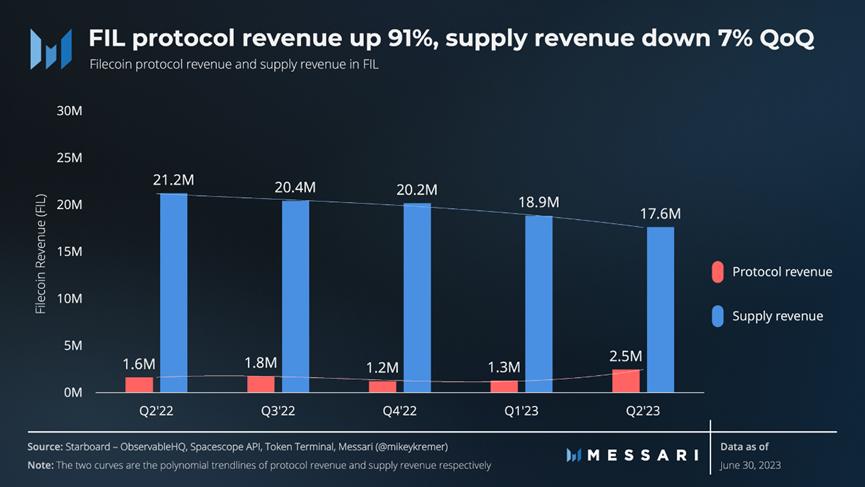
Unlike demand-side revenue, supply-side revenue fell 7% in Q2'23 to 17.6 million FIL(down 16% in USD terms). This decrease is due to the overall decrease in FIL reward issuance due to the exponential decay model and the baseline minting model. The decrease in FIL reward issuance is likely to continue in the coming quarters.
Usage
Demand for Filecoin storage is reflected in the active transaction volume of storage between storage users and storage providers, which includes both Web2 and Web3 customers.
trade
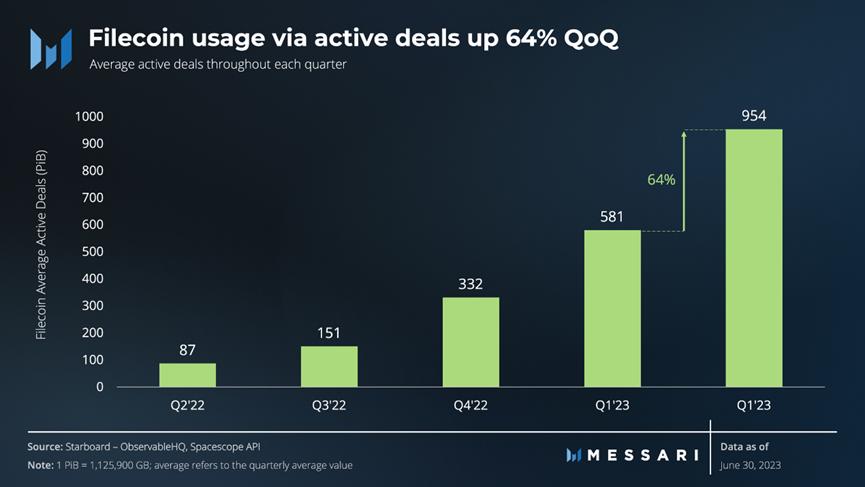
Storage providers with storage fees reduced to near zero may further encourage users to store data through Filecoin transactions. In the second quarter of 2023, nearly 954 PiB of data were stored on the Filecoin network through active transaction storage, a quarter-on-quarter increase of 64%.
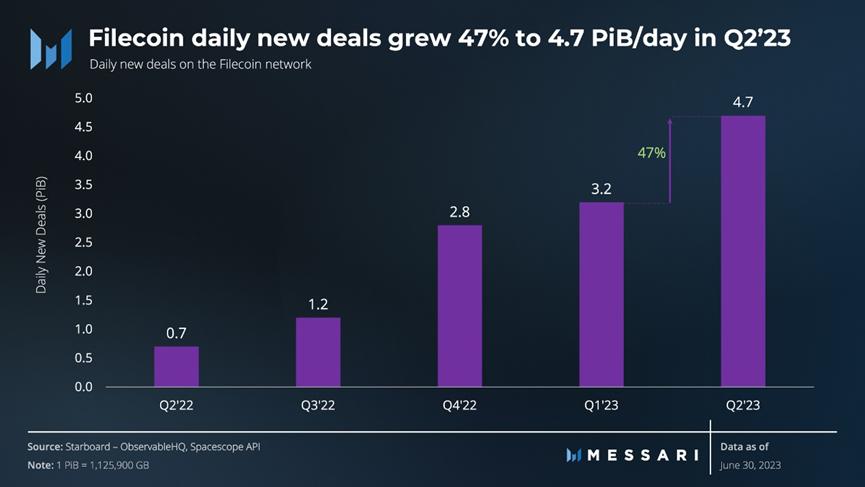
Daily new transaction volume increased by 47% in the second quarter of 2023, mainly due to the promotion of the FilecoinPlus (Fil+) program. The program provides increased rewards for storage providers participating in transactions that require verification data (i.e. Fil+ verification transactions). This dynamic encourages new storage transactions using real data and prevents manipulation of network rewards. It also encourages storage providers to undercut competitors' fees.
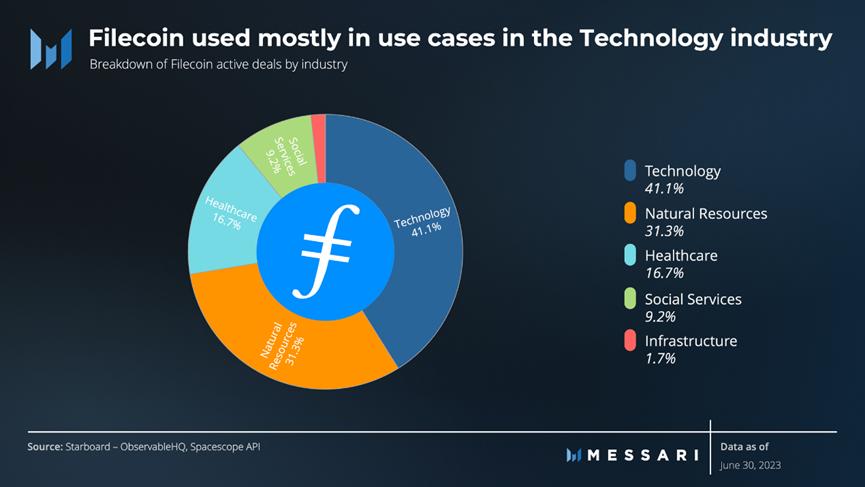
A breakdown of active storage transactions by industry use case shows that the industries most commonly using Filecoin are technology (41%) and natural resources (31%).
Serve
To further facilitate usage, Filecoin offers two services - NFT.Storage and Web3.Storage . They provide an easy user interface to the end user and act as an aggregator for bundling and storing data of multiple users.
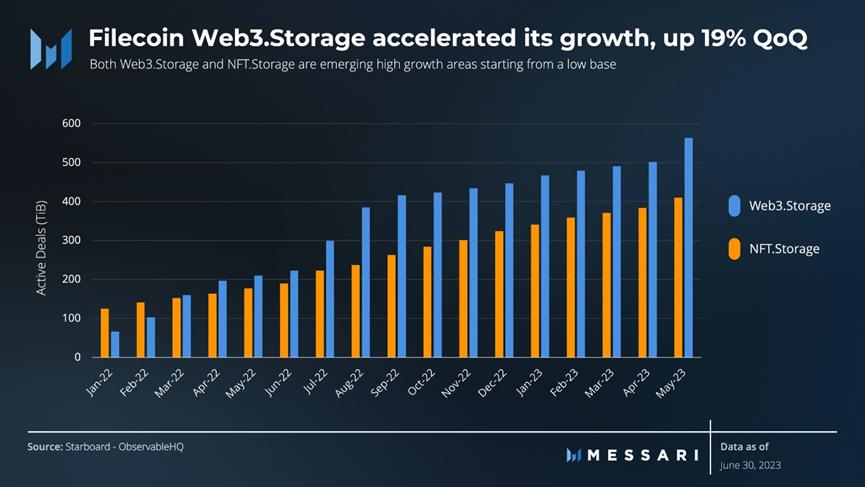
The NFT.Storage service provides a simple user interface for storing NFT content and metadata on Filecoin. Instead, Web3.Storage simplifies the process of storing and retrieving Web3 data for Filecoin developers and end users. Through participation in the Fil+ incentive program, these two services can provide free Filecoin storage to end users. Overall, in the second quarter of 2023, both services recorded significant growth in active transaction data. NFT.Storage increased by 12% month-on-month, while Web3.Storage increased by 19%.
client
According to Messari's guidelines for decentralized storage networks, Filecoin is geared towards providing cold storage solutions (such as archiving and recovery) for enterprises and developers. Its competitive pricing and easy accessibility make it ideal for Web2 customers looking for a cost-effective alternative to storing large amounts of archived data.
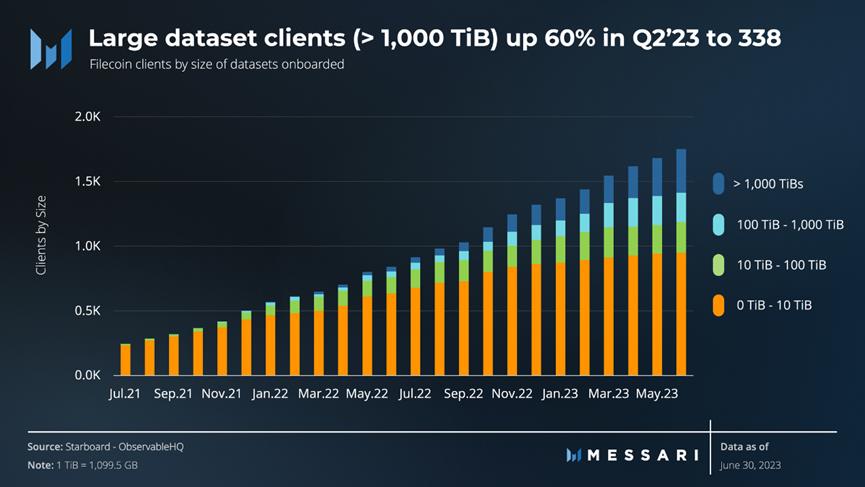
As of the end of the second quarter of 2023, a total of1,750 customers have launched datasets on Filecoin. Among them, 338 customers have launched large data sets (storage capacity exceeding 1000 TiB), an increase of 60% from 211 in the first quarter of 2023. These clients range from those of New York City and the US Holocaust Foundation to Web3 platforms such as OpenSea. Other notable efforts to bring data into the Filecoin network include:
l UC Berkeley cooperates with Seal Storage to store physics research data
l GenRAIT uses Estuary to store key genomic data on Filecoin
l Research center Starling Lab stores sensitive digital records of human history
l Ewesion (the fastest growing photo, illustration and vector file host in China) uses Filecoin for data protection.
This trend of accelerating usage growth is further reflected in Filecoin's overall utilization relative to storage capacity.
Utilization and Capacity
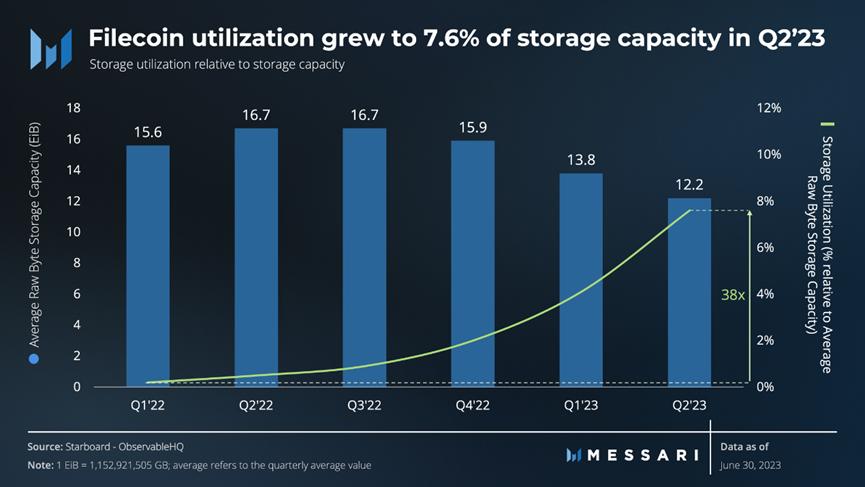
After reaching its all-time high in the second quarter of 2022, Filecoin experienced a 12% quarter-on-quarter decline and stabilized in the third quarter of 2022. Meanwhile, storage utilization relative to total available storage capacity increased to 7.6% in the second quarter of 2023, compared to 4.1% in the first quarter of 2023. This increase is a positive sign for Filecoin adoption.
retrieve
To meet storage retrieval needs, a content delivery network (CDN) for Filecoin and IPFS - called Project Saturn - is currently under development. Saturn aims to serve Filecoin's retrieval marketplace with fast and low-cost content delivery. Its node operators are incentivized to fulfill retrieval requests by earning FIL from a pool of approximately 30,000 FIL per month.
In terms of performance, Saturn aims to be equal to or even exceed IPFSGateway . It focuses on improving the speed and performance of retrieval, where most of the data is mirrored from IPFS.
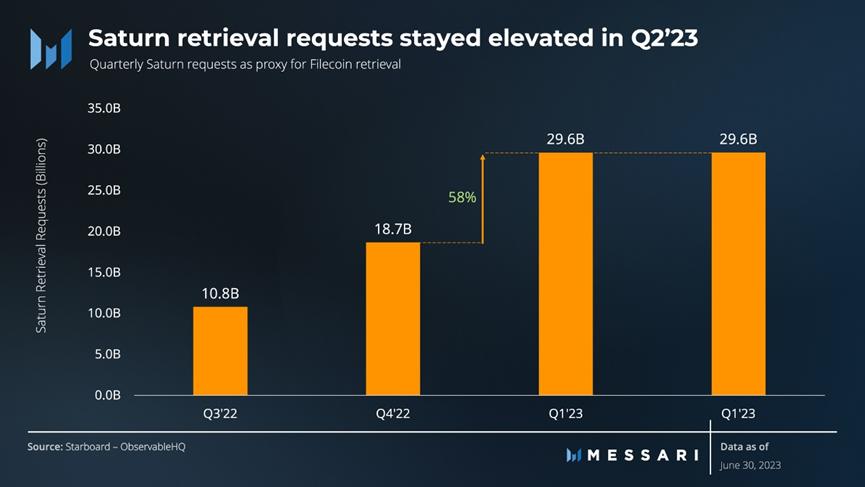
In the second quarter of 2023, Saturn's search requests reached a level similar to that in the first quarter of 2023, a 58% increase from the fourth quarter of 2022. By the end of the second quarter of 2023, the number of nodes reached 3444 , an increase of 148% from 1391 at the end of the first quarter of 2023. These nodes are distributed as follows: North America (40%), Europe (27%), Asia (24%) and other regions (9%). An overview of Saturn’s performance will be provided in Messari’s State of Filecoin Q3 2023 report.
FVM use
The Filecoin Virtual Machine (FVM) brings Ethereum-style smart contracts to Filecoin. FVM can help storage providers gain access with FIL as collateral, enabling use cases such as liquid stake mortgage, permanent storage, and decentralized computing.
As of June 30, 2023, more than 2,300unique contracts have been deployed on FVM. They generated over 250,000 transactions and accounted for more than 7% of Filecoin gas usage in Q2 2023. It’s worth noting that, according to DeFi Llama, Filecoin has already started accumulating TVL from liquid equity collateral (such as GLIF and STFIL ) and DeFi applications on FVM. According to the data that the total contract balance on June 30, 2023 exceeds 2 million FIL, liquid equity mortgages account for 80%, DeFi applications account for 5%, and other services account for 15%. A detailed overview of fuel usage, charges and TVL following the launch of FVM will be provided in an upcoming quarterly report.
As Filecoin continues to attract new users and launch valuable datasets, it could become the basis for developing commercially viable FVM-based use cases around the data. Furthermore, since FVM is compatible with Ethereum, existing Ethereum-based applications can be brought to the Filecoin network without major code changes.
Ecosystem overview
The Filecoin ecosystem has been actively developing the developer and builder process. It regularly participates in events such as hackathons, accelerators, grants, mentoring and growth support. This process is designed to help early-stage projects and teams mature enough to receive funding and investment from Protocol Labs or an affiliated entity. The ecosystem aims to attract a variety of use cases: from data infrastructure, media streaming, metaverse to gaming, and more.
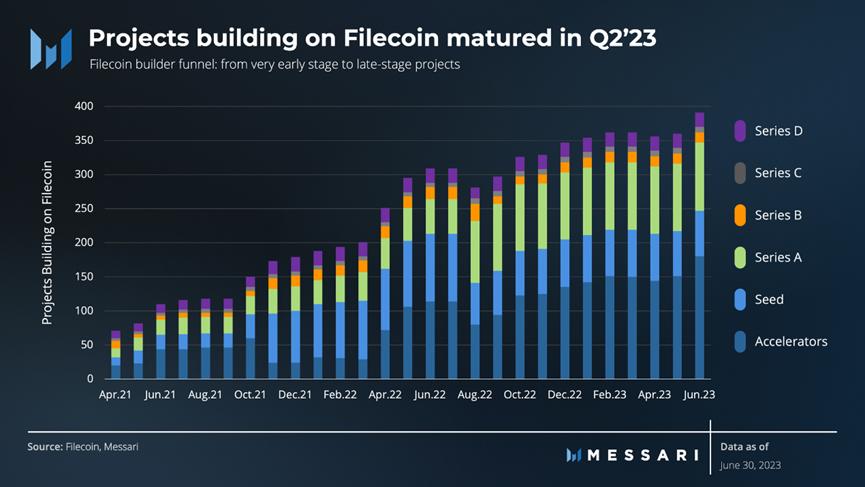
As of July 2023, 391 projects are known to be developing on the Filecoin, IPFS, and Protocol Labs Network ecosystems. In June 2023, the number of projects hatched by the accelerator reached 180, up from 150 in March 2023. Most applications and protocols utilizing Filecoin provide data services:
l Ocean Protocol : Development tools and platforms for data marketplaces.
l Lighthouse : Permanent data storage service with one-time payment pricing model.
l Slate : A search engine that processes and shares personal data.
l Berty : Secure messaging and social media application.
l Dether : cash upstream and downstream and diversified financial transactions.
l Tableland : Decentralized cloud database.
Media and entertainment-focused agreements include:
l Mona : A 3D art gallery in the Metaverse.
l NFTwitch : NFT casting platform for Twitch content.
l Huddle01 : Decentralized video conferencing.
l OP Games : NFT minting from games.
l FileMarket : Web3 store builder and marketplace.
l Xone : Metaverse solution connecting artists and fans.
There are also use cases designed to leverage Filecoin's infrastructure for specific data needs:
l Koios : No-code data DAO platform.
l ZKsig NFTs : access control market.
l DataMarket : data purchase and checkout function.
The Filecoin Virtual Machine is expected to further drive the growth of the Filecoin ecosystem as developers build applications on the network and integrate externally with it.
qualitative analysis
release
Filecoin Data Tools
In order to improve users' experience in data online, Filecoin launched the Filecoin Data Tools (FDT) project. FDT is a set of technologies designed to simplify the storage and management of data on Filecoin, which can handle large-scale customer data online, and aims to provide a practical cloud developer experience (DX) comparable to Web2 cloud.
Interplanetary Consensus (IPC)
Filecoin launched the first public deployment of the Interplanetary Consensus (IPC) framework for scaling performance. IPC addresses the challenges of transaction volume and application heterogeneity by creating hierarchical subnetworks that can execute transactions in parallel. It also facilitates transactions across subnets.
Lassie
In May 2023, Filecoin released Lassie , a retrieval client that enables users to retrieve content address-based data (using CIDs) from Filecoin or IPFS without running a separate node. Developers can also use Lassie in their applications as a data retrieval library.
V19 and V20 network upgrade
The V19 network upgrade (Lightning) is an implementation of FIP-0060 that improves block verification times and overall network performance. The upgrade addresses chain quality degradation and sync stability issues reported by users of the network. V20 network upgrade (thunderbolt) is the implementation of FIP-0061 , which introduces the patch release network upgrade of LotusV1.22 . The implementation of FIP-0052 will be completed in a future network upgrade.
ecosystem
With the launch of FVM, the Filecoin ecosystem continues to expand. Notable integrations include Brave Wallet support for FilecoinFVM and IPFS backup for NFTs, as well as Spheron ’s Filecoin integration. Additionally, Axelar and Celer Network launched bridging support with Filecoin, making it interoperable with networks like Ethereum, BNB Smart Chain, and Polygon.
So far, several applications have reportedly been deployed on FVM, covering infrastructure tools, storage and cloud services, education, science and public goods, media and entertainment, and Filecoin.
Click here for a list of projects deployed on Filecoin's FVM so far.
Key Events and Initiatives
SEC calls Filecoin a security
In response to the SEC's statement that Filecoin was classified as meeting the definition of a security, Protocol Labs issued a statement via Twitter , saying that Filecoin is a decentralized file storage network, not a security.
Hack FS and FVM Dataverse Hackathon
Protocol Labs partnered with EthGlobal to host HackFS23, offering $125,000 in prizes and other prizes to participants of the online hackathon. Filecoin also launched the FVM Dataverse Hackathon program to encourage developers to build applications on FVM.
Bug bounty program
Filecoin updated its bug bounty program on Immunefi , increasing rewards for critical issues (up to $500,000). It also expanded the scope of the program to include programmable features.
route map
IPC: A full release of IPC, including developer tools and documentation, is planned for Q3 2022.
Axelar Integration: The Axelar team released details of their integration with the Filecoin Virtual Machine (FVM). It is designed to provide application developers of any connected blockchain ecosystem with the ability to access FVM functionality, including storage, funding and verification data, and processing fees. The integration aims to increase the liquidity of FVM DEX and AMM by using Axelar-wrapped assets as the canonical representation of bridging assets in the Filecoin ecosystem. It will also leverage AxelarGMP to enable any on-chain smart contract to call Filecoin functions.
Long-term roadmap: Future long-term improvements include L2 functionality, hierarchical consensus, and encapsulation as a service. Through FVM, Filecoin aims to forge new partnerships and strengthen product growth with the data infrastructure community.
Summarize
Filecoin experienced accelerated growth in storage usage in Q2'23, with active storage transactions increasing by 64% quarter-on-quarter. Storage utilization increased from 4.1% in Q1'23 to 7.6% in Q2'23 despite a 12% sequential decline in storage capacity. Meanwhile, FIL fee revenue grew 91% (67% in USD) in Q2'23, driven by a 47% sequential increase in new storage transactions.
Although decentralized storage is still in its early stages, there are already signs of potential growth. For example, successful adoption of the Filecoin Virtual Machine could enable next-generation applications beyond storage. Notable examples include permanent storage (similar to Arweave), uncollateralized lending to storage providers, and decentralized computing. If Filecoin continues to attract demand, it is expected to become a significant provider of decentralized storage and cloud services for Web3 and traditional applications.