Written by: GABE TRAMBLE
Compiled by: TechFlow TechFlow
The speculative atmosphere of Gamblefi in the crypto space is well summed up by Youlikexuelike, where traders are driven by daily 100x returns, rugs, and liquidity withdrawals. Meme coins have unique appeal in this space, especially as traders follow the market and promoters promoting these coins on Twitter. Platforms like Banana Gun have emerged to provide users with the basic tools needed for high-speed trading.
Maestro was ahead of the curve a few years ago, initially gaining attention under its original name of Catchy. Maestro is an essential platform for traders seeking to profit from short-term market fluctuations. Then came Unibot, which improved the space by focusing less on sniping and more on regular users who were frustrated by Uniswap’s less than user-friendly interface. They strategically focus on referral fees to drive rapid growth, a strategy similar to what we've seen with platforms like Rollbit and Stake.
Recently, Banana has entered the field, offering a product that competes with the Maestro in terms of sniping capabilities and is more cost-effective. Banana seems destined to win the hearts of "degen" traders, those willing to take extreme risks for potentially huge rewards.
This fluid landscape underscores the constant evolution of platforms and strategies within the crypto-Gamblefi underworld, each striving to meet the changing needs and risk appetite of its user base.
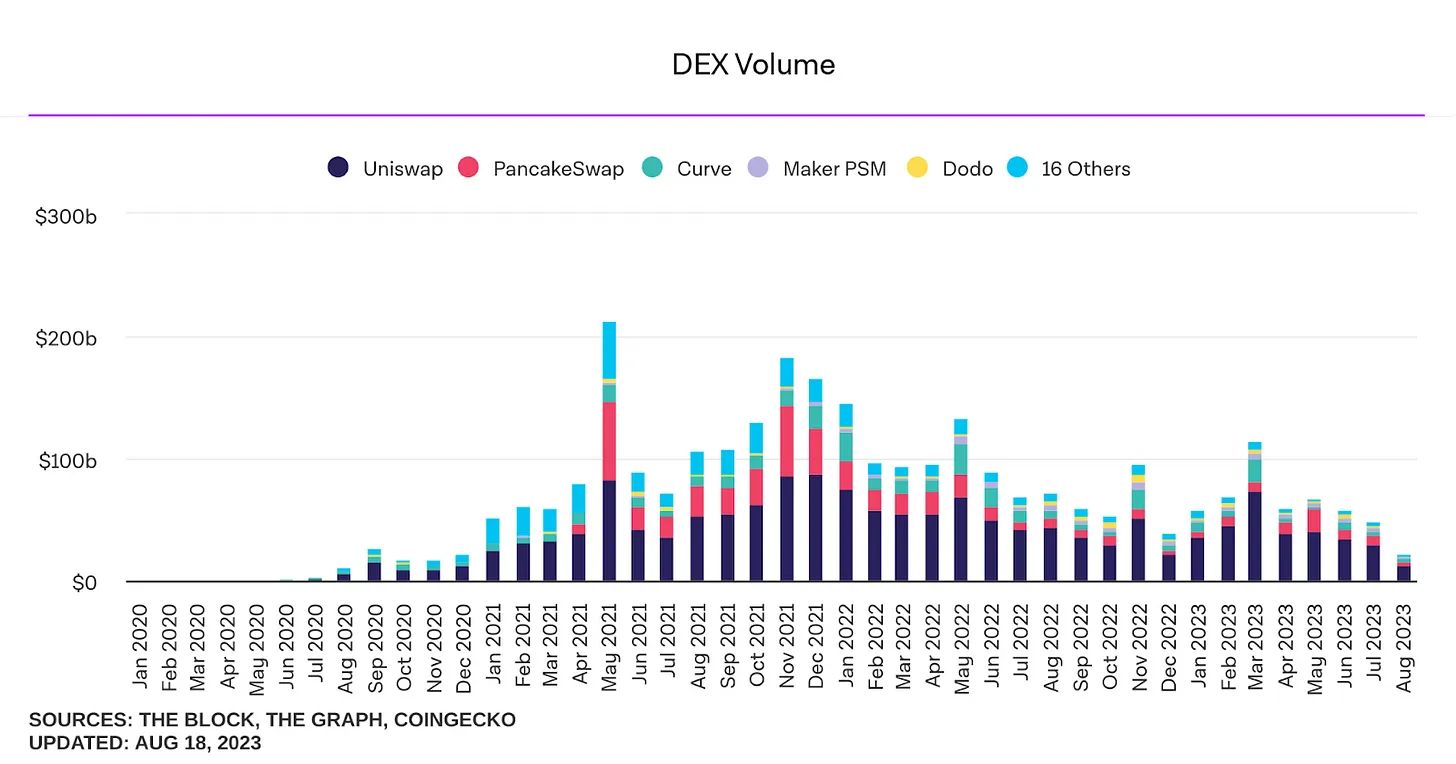
Amid a bear market and historically low DEX trading volumes since 2020, hundreds of ERC-20 tokens are being deployed every day. For some traders, observing the meme coin market is a full-time job. If a project grows 100 times, it will be able to recoup its costs and make a good profit. Traders can participate in a variety of ways, including presales, rush sales, and spot purchases of tokens.
Presale : Allocating funds before a token is released.
Snap Buying (Sniping) : Use bots to automatically purchase tokens as they are released.
Spot : Tokens purchased directly on exchanges such as Uniswap or Coinbase.
Traders tend to determine their strengths and select a few categories to focus their efforts on. In this process, we will mainly focus on the rush buying stage; let’s dig into it.
Token Sniper
Before the emergence of Telegram Bot, this game was purely based on professional knowledge. Meme coin contracts are carefully analyzed by top coin snipers and bot operators to identify key functions that trigger coin launches, maximum transaction volumes and any measures implemented by developers to deter early buyers. With the advent of telegraph bots like Banana Gun and Maestro, this method has been largely replaced.
Simply put, Token Snipers are automated trading bots that enable users to execute fast buy and sell orders on newly issued tokens on decentralized exchanges like Uniswap. Many of these bots use Telegram as a platform. Developers prefer Telegram because it’s where trading ideas thrive and it’s a crypto-native messaging app. Token Sniper’s product market fit is clear as users adopt them at an increasing rate. Shopping bots can also purchase issued tokens with similar speed and efficiency, which accounts for the majority of their trading volume.
These top snap-up bots can now simulate the entire contract functionality, allowing users to bypass the user interface of platforms like Uniswap and simply decide how much ETH they want to deploy. This shift makes the rush-buying landscape more user-friendly, but also more competitive.
For example, in the case of Maestro, users still need to enter the maximum trading volume, and some knowledge of contract methods is required in non-advanced mode. This is what sets Banana apart from its competitors – no such expertise is required and the process is even simpler and more straightforward.
Contrast this with platforms like Uniswap, which recently removed expert mode. While this change may benefit retail traders by adding a layer of security against high-impact trades, it leaves skilled traders with the need to manually adjust their strategies, which they are now forced to do. The removal of Expert Mode had an impact on experienced traders, who built their own front-ends to improve the experience. This highlights why Telegram snapping bots like Banana Gun, designed for a more mature user base, are gaining traction in the fiercely competitive ERC-20 token trading landscape. By using these bots, traders not only optimize their strategies but also avoid the limitations imposed by decentralized exchange interfaces for retail traders.
How do these sniper robots work?
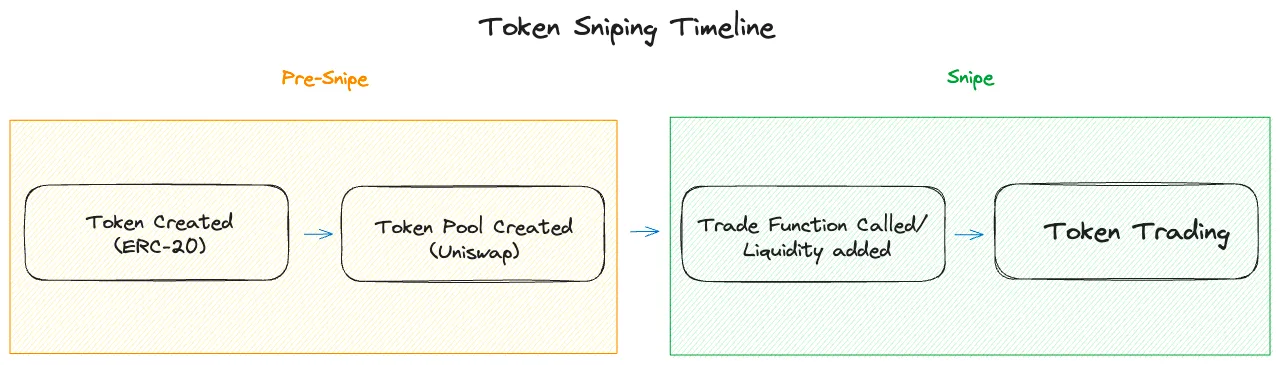
Imagine a trader staring at the release of $TOKEN in a few days. They just need to load the Telegram app and put the smart contract into the token snapper. After specifying the amount of ETH they are willing to risk, it's a waiting game. Once the token enters the DEX pool, the Telegram snapper is triggered, executing predefined trading parameters. If all goes according to plan, the trader enters with a market cap of 10k (hypothetical example) and in a matter of seconds explodes to a market cap of 200k - a full 20x profit. But it's not that simple anymore. The effectiveness of these snapping bots has resulted in an influx of traders using the same strategy, often using 10 or more wallets to beat their competitors.
That’s why just having a snap-up bot isn’t enough these days; timing is crucial. Enter the Banana Gun. Unlike other platforms that require manual input or specific monitoring, Banana Gun optimizes the entire process. Once a contract is added to the bot before trading of a token begins, Banana's sniper will automatically look for smart contract triggers like "EnableTrading" to snap up /buy the token once it is released.

Sniper can also monitor "Liquidity Add" transactions, now that there is liquidity to enable trading.
Banana Gun
The Banana Gun democratizes the sniping landscape in the crypto space. Previously, sniping was an exclusive activity reserved for individuals with advanced technical skills and the ability to read and configure smart contracts. Banana Gun opens the door for everyone by automating much of the rush buying process. Their platform is designed to be very easy to use: you paste in a contract and let the bot handle complex tasks like determining method IDs, tax rates, and maximum transaction volume. This feature sets them apart from competitors like Maestro, where users need to manually read contract addresses and configure settings.
The cornerstone of Banana Gun's unique value proposition is its user-focused focus on automating and preventing most Rug scams. Not only is Banana Gun automated, each transaction is executed privately with an Ethereum bribe set by the user. This clever mechanism provides you with an extra layer of security. In an environment where someone is trying to execute a Rug with expensive gas charges, the Banana Gun allows you to preempt it at a good price. The private trading feature also ensures you'll never get pinched or robbed. A sandwich attack is a way for traders (bots) to exploit trade ordering by placing trades before and after user trades. In fact, Banana Gun takes it a step further and will reverse your trade if it detects that it is at risk of being pinched—even if it was executed privately. Even competitors like the Maestro lack such subtle features.
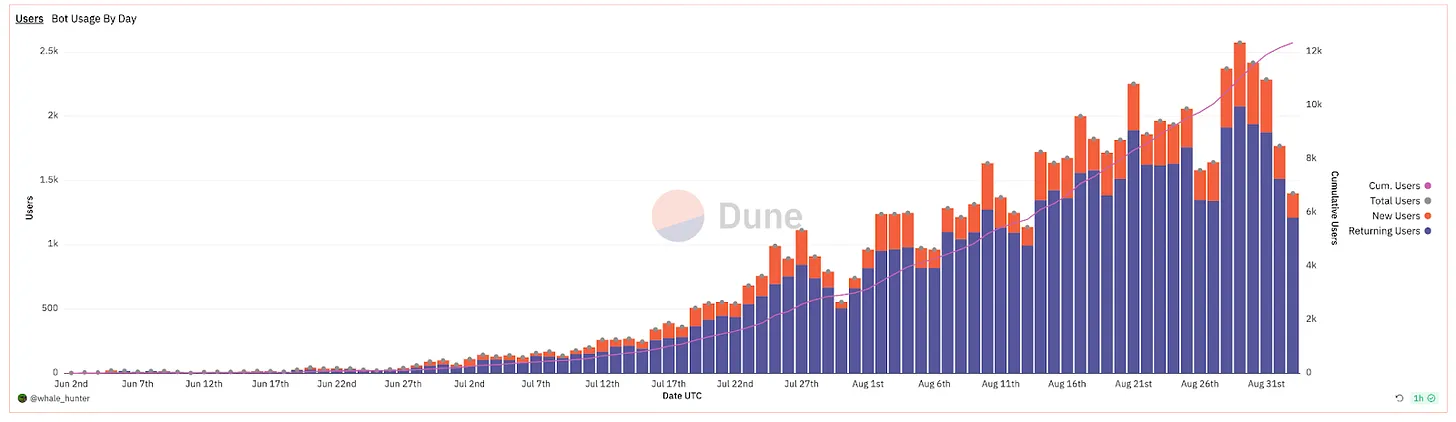
Speed is of the essence, and Banana Gun is currently one of the fastest retail snapping robots on the market. It first launched in early June and has attracted about 700 daily active users and more than 12,000 cumulative users.
When a user makes a purchase, the interface moves to the sell channel and the user can focus on the sales mechanism. Typically, other snap bots buy and sell in a single interface.
Core functions
0 block bribe
Bribery is an important feature of Banana Gun, but it's worth noting that Maestro originally pioneered the concept of collective bribery. Maestro’s system makes it extremely difficult for a single bot user or sniper to defeat the collective bribery of a group of participants, effectively democratizing the process.
However, Banana Gun takes this approach forward in a whole new light. While Maestro may have introduced collective bribery, Banana Gun perfected it by appealing to a smaller but more sophisticated and experienced user base. These guys know the mechanics of snapping inside out and know how to beat even a collective group.
Banana Gun uses custom RPC, a dedicated node that communicates directly with the blockchain, allowing faster data transfer than standard providers like Infura or Alchemy. In this high-speed environment, pending deals from Banana Gun Elite Sniper are bundled into one deal package. This packet is then forwarded to the block generator, the validating node of the Ethereum network responsible for grouping transactions.
When the package enters the block generator, the battle becomes intense. Banana Gun’s snipers participate in blind bribery, where each participant provides a hidden bribe, also known as a “tip,” to ensure faster transaction confirmations. Take user A as an example, he purchased X tokens for 0.20 ETH and included a bribe of 0.10 ETH. This bribe directly incentivizes the block generator to confirm User A's transaction faster. If the tokens are subject to transaction taxes, User A may initially lose money until the tokens increase in value.
The blind nature of these bribes adds a layer of strategy and unpredictability to the transaction process. Since you can't see other people's bribes, and they can't see yours, your experience and savvy become your greatest assets. This explains why Banana Gun consistently leads the race for Block 0 despite having a smaller community. The combination of rapid customization of RPCs, bundled transactions, and blind bribery provides Banana Gun with a unique competitive advantage, making it a powerhouse in the token rush space. This unique trio streamlines the trading process and creates an environment where skill, strategy and speed blend, setting Banana Gun apart from its competitors.
Maximum cost
Banana Gun has made a key update to address one of its original flaws: the lack of user control over sniper limits. In the early stages, the bot will automatically buy any amount set by the user. However, this leaves some traders vulnerable to a sandwich attack.
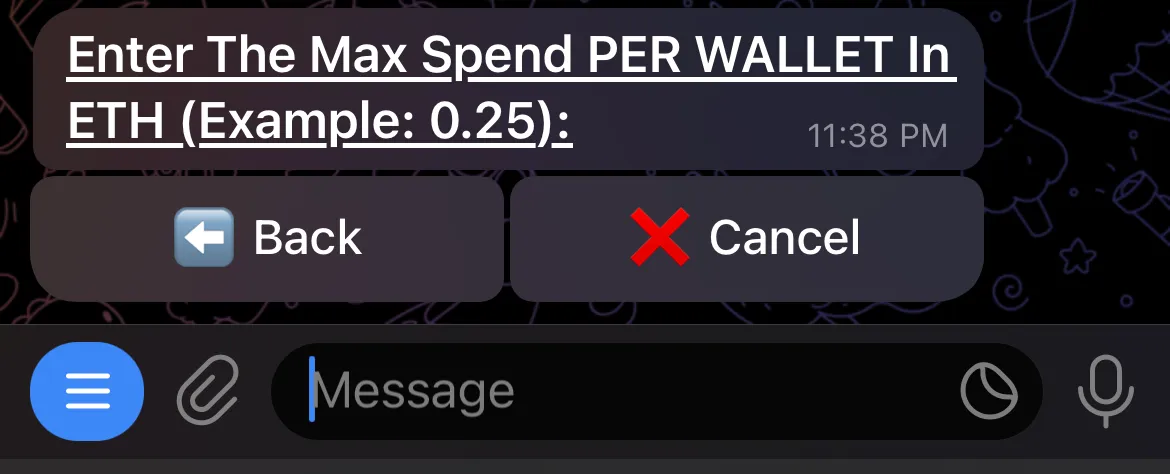
To address this issue, Banana Gun has added slippage control and limit orders to its trading package. Users can now define "max spend" limits in ETH, which will limit the amount of tokens and gas they are willing to spend. This is especially beneficial when dealing with tokens that have a maximum trading volume, meaning that the token contract code limits the maximum amount that can be purchased in one transaction. For example, if a user's spending cap is "0.25 ETH", the bot will keep total spending (including gas) below this limit. If the maximum allowed transaction volume is reached, any remaining ETH will be refunded to the user.
A major new feature based on user feedback ensures that if a transaction fails to meet the maximum allowed purchase amount, it will be automatically reversed. This protection is crucial to prevent situations where users receive a small amount of tokens but pay a high fee due to higher bribes from others. This update adds a layer of risk mitigation to make grab-and-go gameplay more strategic.
These improvements level the playing field, allowing Banana Gun users to feel more confident when navigating cutthroat and more cooperative trading scenarios.
trading income
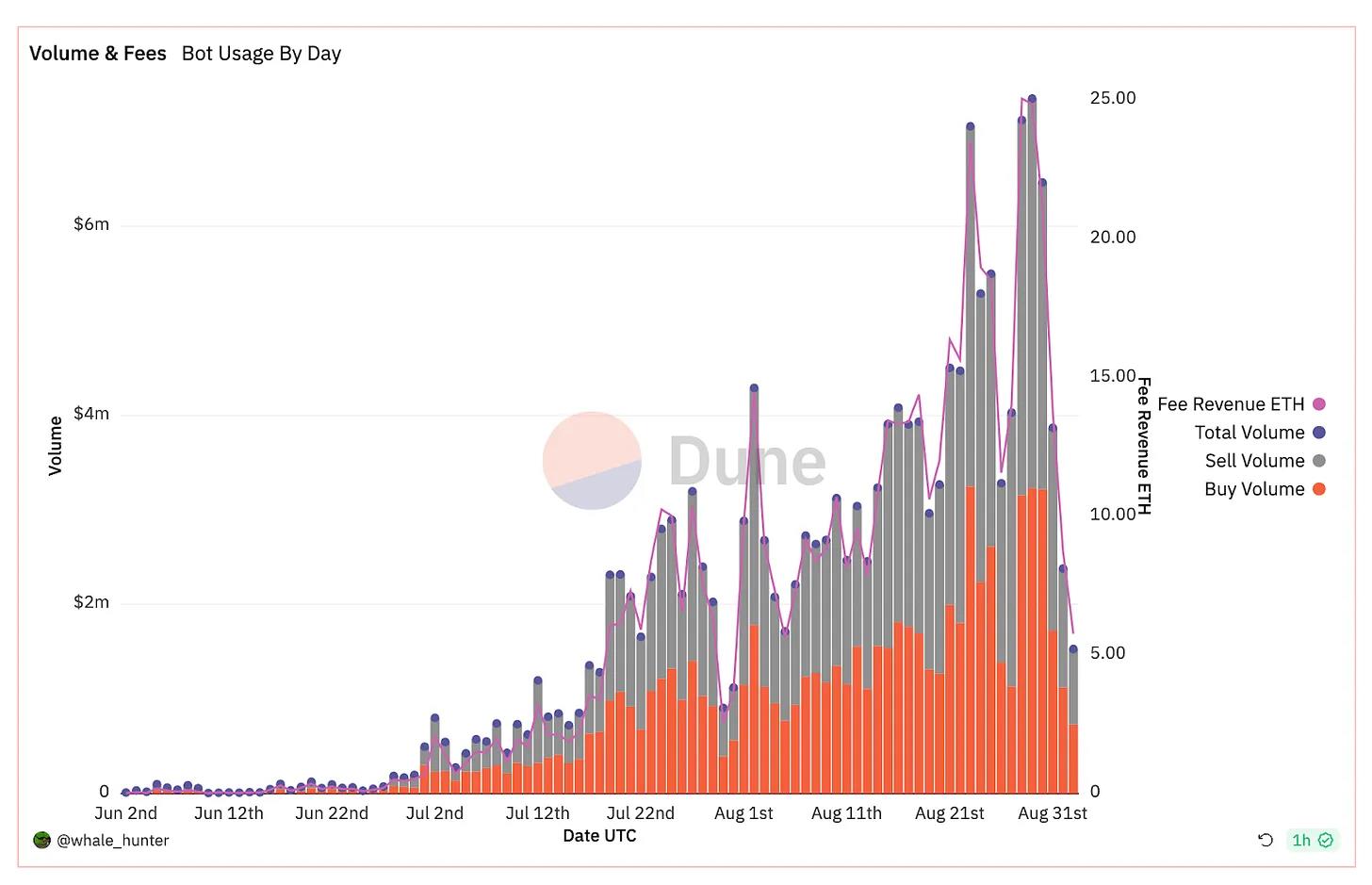
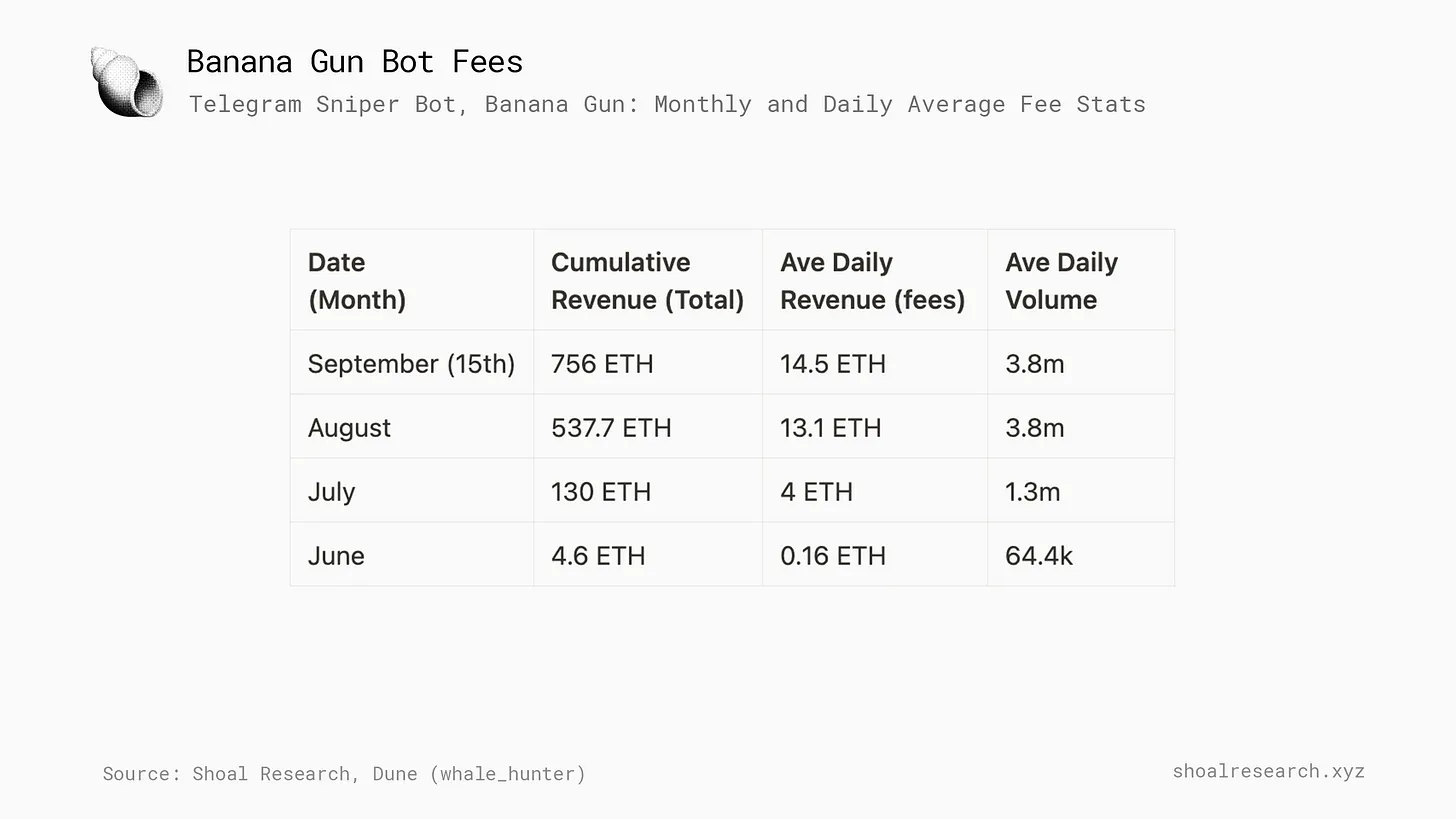
Traders use this product, but you may still be wondering whether developing trading infrastructure like Banana Gun is worth anyone's time. When it comes down to it, Banana Gun generates 10-25+ ETH per day through transaction fees. This is without token revenue (as of September 15), which for Unibot would add additional transaction fees to its trading volume.
competitive landscape
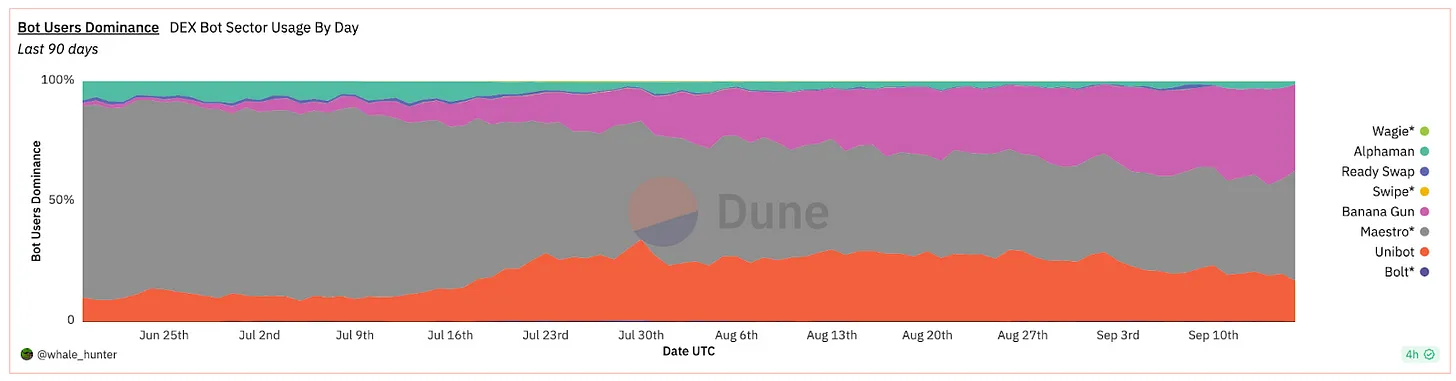
There are also several robots competing with the Banana Gun for space, including Maestro and Unibot, which are the largest snipers. Overall, Maestro has the largest user base. Looking at daily bot usage, Banana Gun has surpassed Maestro in recent days.
market structure
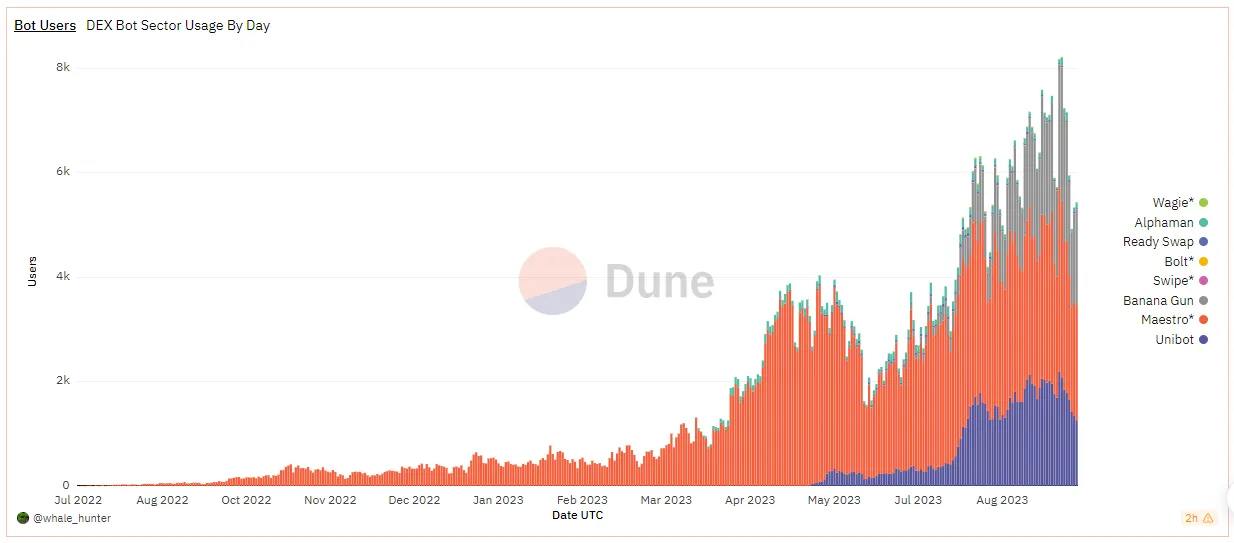
Currently, the total robot user base exceeds 100,000, and the number of daily active users since August has continued to exceed 4,000. A few leading products account for more than 90% of users - specifically Maestro, Banana Gun and Unibot.
Revenue and expense structure
As of September 15, 2023, Banana Gun reported transaction fee revenue of 756 ETH, over $1.2 million. Banana Gun uses a low-fee model, charging just 0.5% on total buys and sells, which is attractive to its smaller but more sophisticated user base.
Understanding the fee structure is important to understand why Banana Gun's average daily fee income is lower despite its trading speed and strategy advantages. By comparison, Maestro charges 1% on total buys and sells, and even offers a $200-per-month premium membership for extra features. Another competitor, Unibot, has a completely different model - its revenue comes from taxes as part of its fee structure.
The word "total" is crucial here. If you make a trade of 10 ETH and it ends (Buy 10 ETH/Sell 10 ETH), you will still be charged a fee based on the total trade volume. At Maestro you pay 0.1 ETH when buying and another 0.1 ETH when selling, for a total of 0.2 ETH. In the case of Banana Gun, you pay 0.005 ETH each when buying and selling, for a total of only 0.01 ETH. This stark difference in fee structure partially explains Banana Gun's lower daily transaction fee revenue, but also represents a competitive advantage for cost-conscious users.
Breaking down the fee difference, it can be seen that despite having fewer daily active users, Banana Gun offers an attractive alternative for experienced traders looking to maximize their strategy while minimizing costs.
Looking Ahead: Intent-Based Exchange
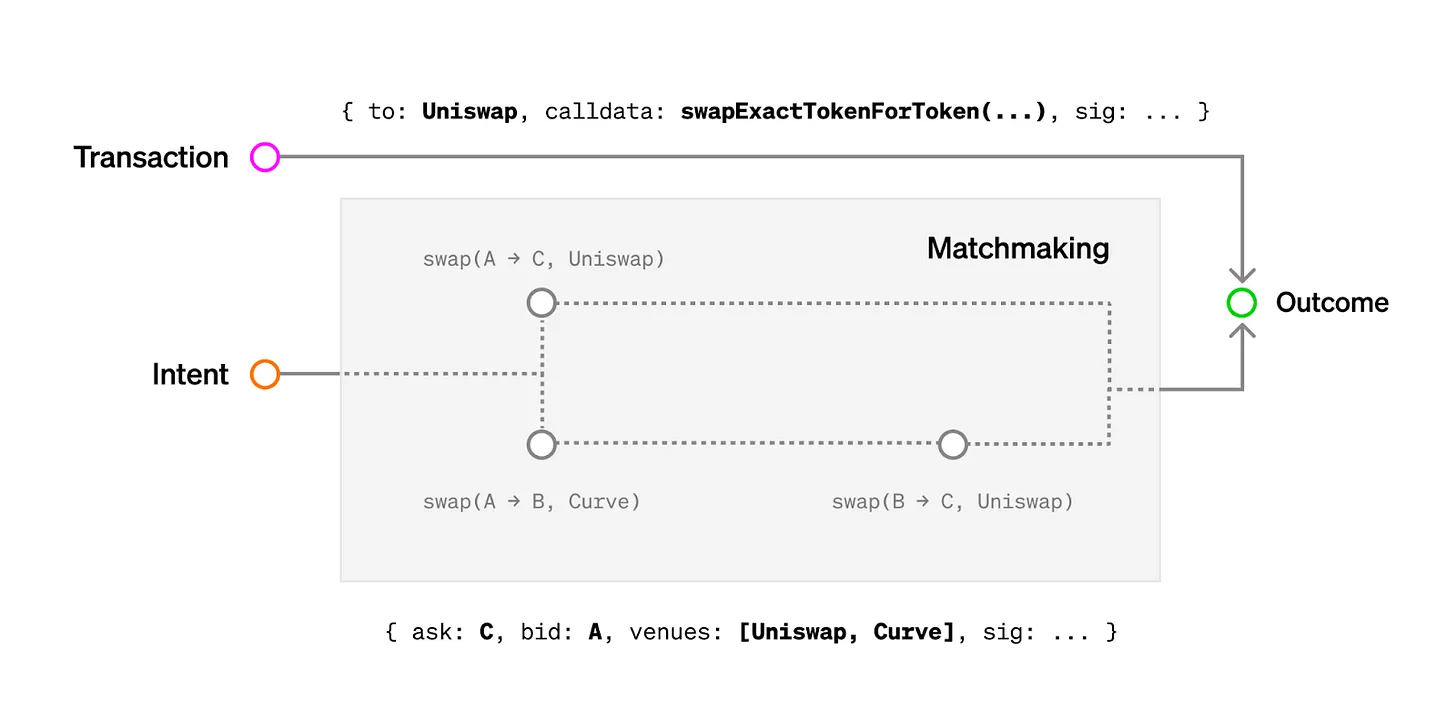
We predict that Telegram bot tools will trend toward “intent-based trading,” essentially acting as automated executors of a user’s specific transaction wishes—whether that’s exchanging x, executing y, or z.
The intention is to execute the signature of a transaction according to defined criteria, not a single transaction (TXN) or a path to the same outcome. By using intents, users have more flexibility in controlling the outcome of their transactions.
If a transaction says "Do A then B, pay C to get X in return," then an intent says "I want X, and I'm willing to pay up to C."
—— Paradigm
Because BananaGun does not route the exchange to a third party for execution, it is generally not considered an intent-based exchange. However, we may see tools like Banana Gun auctions or tools that fulfill exchange orders on behalf of users, or use a request for quotation (RFQ) model that allows users to submit an order for offline fulfillment. Banana Gun can now interact with block builders, allowing transactions to be processed faster, enabling launch rushes. In the future, Sniper may turn to off-chain solutions to fulfill early snap-ups or general exchanges. In theory, a user could sign a transaction confirming their willingness to spend
risk
Like most agreements, Banana Gun is not without risks. Risks are often similar across DeFi protocols, including economic exploitation or smart contract risks. Economic exploitation refers to the exploitation of the monetary system within the protocol mechanism, while smart contract exploitation may exist in unaudited code. Both risks may exist in sniper robots.
Security Risk
When it comes to Banana Gun, security risks are not limited to smart contract vulnerabilities. The bot has access to the user’s private keys, meaning the bot project team technically has control over the user’s funds. To mitigate this risk, most traders keep only enough funds in their Telegram wallet to execute transactions and transfer the remaining funds to more secure wallets.
There is always a risk that private key data may be accidentally exposed. However, it is worth mentioning that both Banana Gun and Maestro delete private keys in the Telegram user interface as soon as the user provides them or generates them in the app. For Banana Gun, if you forget or lose your private key, the platform cannot retrieve it for you. Private keys are stored on separate encrypted servers, accessible only to bots, and protected by multiple layers of security, including marshalling, hashing, and transformation. Marshalling packages data for secure storage, hashing converts this data into one-way, irreversible strings, and transformation further obfuscates the data into an unreadable format, working together to ensure the highest level of protection for private keys.
Bribery (tip)
There's a price to pay for being the fastest. Just like cheetahs can run very fast, the downside is that they need time to rest. With Banana Gun, users may over-bribe the tokens based on pure hype and speculation, thereby eroding profits. If "Sniper A" bribes 0.1 ETH, and competitor "Sniper B" bribes 0.2 ETH, then "Sniper A"'s buying point will be higher. In some cases, unreasonable bribes are added, resulting in losses for many parties involved. Tips are non-refundable and are sent exclusively to the block builder.
in conclusion
Banana Gun stands out for its speed, low cost and stability, with a primary focus on execution timing. Many trading successes can be attributed to Banana Gun's efficient and transaction bundling structure.
Banana Gun's continued growth deep into the bear market is a testament to the product's utility and demand. Despite the complexity of sniping, Banana Gun's user base remains strong, with over 700 daily users in just a few months, and revenue exceeding 10 ETH per day in recent weeks.
But the Token Sniper Bot user base is ruthless and has no brand loyalty, so the Banana Gun team must continue to iterate and ensure they have a competitive product.