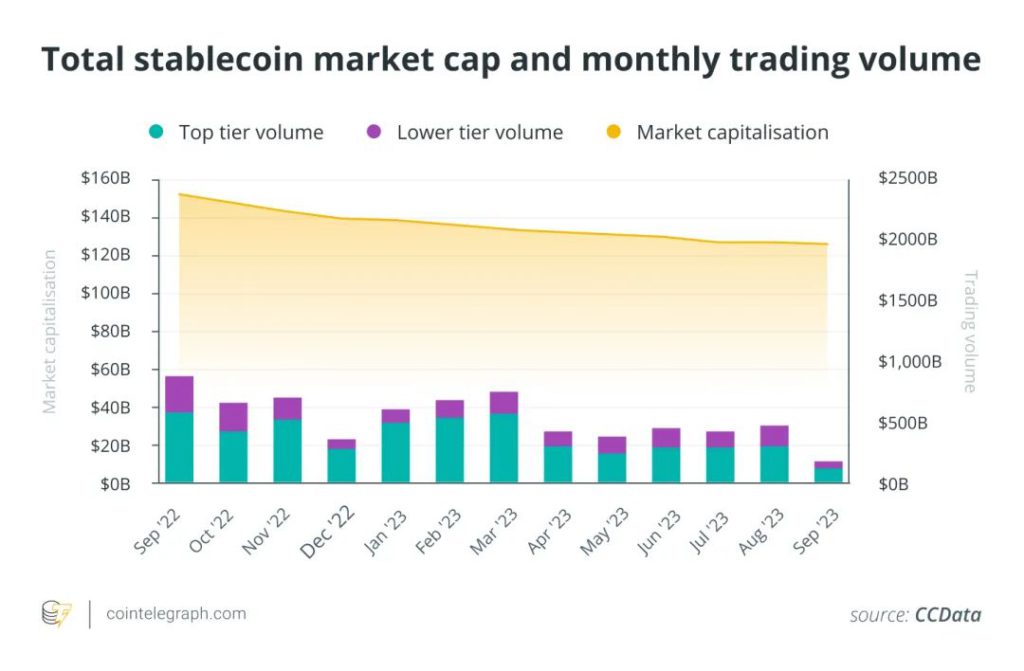
In a year filled with uncertainty for the cryptocurrency space, a new trend is taking shape: the exodus from stablecoins has now continued for 18 consecutive months, with stablecoins’ market dominance falling to 11.6%.
According to a report by CCData, the stablecoin industry's total market capitalization was $124 billion in July, with most major stablecoins affected by the 18-month decline. While Pax Dollar (USDP), USD Coin and Binance USD have all fallen, Tether USDT, the largest stablecoin by market capitalization, has been growing.
Stablecoins are a class of cryptocurrencies that attempt to maintain price stability through various methods. Most mainstream stablecoins are backed by fiat currencies, but some are backed by cryptocurrencies or commodities, or are algorithm-based.
Reasons for stablecoin outflows
The reasons for the recent exodus are not entirely clear and may be multifactorial.
The suspension of fiat deposits on Binance.US following a lawsuit filed by the SEC, and the removal of USDP from its reserves by MakerDAO due to a failure to generate additional revenue, have had an impact on the industry.
Further reading: Binance US trading volume evaporated 99% in half a year! Binance.US has three options left in the future..
According to CCData’s report, stablecoin trading volume increased by 10.9% in August to $406 billion, but trading activity on centralized exchanges is struggling and overall trading volume is “expected” to continue to decline in September.
CCData’s report noted that the U.S. Securities and Exchange Commission (SEC) filed lawsuits against leading cryptocurrency exchanges Binance and Coinbase, and the Bitcoin spot market is also scrambling to get listed. Competition for the listing of Bitcoin exchange-traded funds (ETFs) is a factor leading to increased stablecoin trading volume.
These factors suggest that stablecoins remain a safe haven for investors, meaning that the exodus may be related to other factors, such as investors cashing out stablecoins to buy traditional assets as they exit the cryptocurrency space, or taking advantage of fixed income securities gains chance of rate increase.
Take the 10-year U.S. Treasury note, for example, whose yields have been soaring as the Federal Reserve raises interest rates to curb inflation. In 2020, the yield on these bonds was below 0.4% and is now 4.25%.
Kadan Stadelmann, chief technology officer of blockchain platform Komodo, told Cointelegraph that one of the reasons why investors buy Treasury bills is that “there is greater certainty behind Treasury bills.” Even though "governments like the United States may face significant debt problems, the vast majority of people still believe that they are stable." Stadelmann added:
“At the same time, stablecoins are considered riskier because the cryptocurrency market remains largely unregulated. Additionally, stablecoin returns are not fully guaranteed. This means that if the interest rates of the two options are comparable, Investors are more likely to choose Treasury bills over stablecoins.”
Looking deeper, the decline in market capitalization of the stablecoin industry could have a significant impact on the broader cryptocurrency market. Stablecoins are often used as a medium of exchange and store of value in cryptocurrency transactions, which means that if demand for stablecoins decreases, it may reduce the liquidity and efficiency of the entire cryptocurrency market.
Long-term explosion in circulating stablecoin supply
While the stablecoin industry’s total market capitalization has declined for 16 consecutive months, CCData’s report details that transaction volume has not suffered the same fate.
Becky Sarwate, director of communications at cryptocurrency trading platform CEX.IO, pointed out in an interview with Cointelegraph that some changes in the stablecoin space, including USDT’s rise and slight decline in August, have historical precedents, indicating that demand is increasing.
Sarwate pointed out that several projects have experienced "significant volatility" this year, such as USDC, which decoupled after it was revealed that $3.3 billion was stranded in the financial institution after the collapse of Silicon Valley Bank in March. She said this “likely paved the way for Binance to shift its stablecoin holdings to BTC and ETH.” Sarwate added:
“At the same time, USDC’s ubiquity in the DeFi space has long pushed other stablecoins such as Dai to the fringes due to its over-collateralization requirements.”
She also noted that Binance’s flagship stablecoin, BUSD, continued to fall after Paxos was forced to stop issuing new tokens. Since then, Binance has adopted TrueUSD (TUSD) and First Digital USD (FDUSD), "the market capitalization of these two coins has increased by approximately 240% and 1950% respectively in 2023."
Further reading: Binance: Stop supporting BUSD in 2024! Is the stablecoin FDUSD expected to reach the top 100 market capitalization?
Thomas Perfumo, head of strategy at cryptocurrency exchange Kraken, told Cointelegraph that the stablecoin’s market capitalization is “in line with market demand,” adding:
“Over the past three and a half years, the supply of stablecoins in circulation has grown from approximately $5 billion to approximately $115 billion, a sign of stability given the appeal of hedging against volatility and the flexibility of being globally transferable around the clock. Massive growth of coins.”
Peli Wang, co-founder and chief operating officer of the decentralized financial options exchange Bracket Labs, pointed out that from June 2022 to September 2023, the market value of the leading stablecoins USDT and USDC fell by 23%, while from November 2021 From January to September 2023, the market value of the cryptocurrency field dropped from US$3 trillion to approximately US$1 trillion, a drop of as much as 66%.
In Wang's view, many cryptocurrency investors are "highly opportunistic and follow the direction of yields." They took advantage of better yield opportunities in cryptocurrencies when traditional finance rates were low, and now as traditional finance rates rise, they turn to traditional finance.
rate of return
Wang is not alone in this analysis, Kraken’s Perfumo told Cointelegraph:
“It is possible that the decline in stablecoin supply is related to the attractiveness of other cash equivalents (including government bonds) that earn higher interest.”
Perfumo added:
The Federal Deposit Insurance Corporation reported that U.S. banks are losing "more deposits than at any time in the past four decades" amid rising yields, likely as funds move to higher-yielding Treasuries or money market funds .
Pegah Soltani, head of payments products at fintech company Ripple, told Cointelegraph,
Back in 2020, when traditional financial interest rates were low, "there was almost no opportunity cost to hold funds in non-yielding stablecoins because yields on Treasury bonds and other fixed-income securities were close to 0%."
Soltani added that as interest rates rise, holding stablecoins instead of yield-generating instruments becomes less attractive:
“Now, with Treasury yields at +5%, there is a real cost to holding stablecoin assets compared to holding Treasuries. Risk is a more obvious factor, but economic dynamics may play a larger role in whether market caps are high or low.”
In the view of CEX.IO's Sarwate, there is "no doubt" that rising interest rates have made traditional finance more attractive to investors seeking fixed income. She added that the adoption of stablecoins was initially “an on-ramp for participants interested in cryptocurrencies to access more advanced services in the digital economy.”
Tokenized fiat currency
In 2023, major stablecoins USDC and USDT stopped trading at one point, shaking investor confidence. Coupled with the recent collapse of the cryptocurrency exchange FTX and Terra ecosystems (which included an algorithmic stablecoin that lost almost all value), it is clear that the stablecoin market faces serious challenges that are still fresh in the minds of many industry players Still new.
Sarwate concluded:
These industry players want to feel secure while seeing investments grow, which means that until stablecoins can "meaningfully solve both of these problems, we will likely continue to see underperformance for this specific use case." Or lackluster."
On whether the move to fixed income securities is temporary or a sign of a longer-term trend, Soltani told Cointelegraph that tokenized assets like fiat currencies “have greater utility than non-tokenized assets,” especially in high-performance blocks Assets issued on the chain:
“Tokenized fiat is the wave of the future — whether issued by banks, circles, Tether, or others remains to be seen. The move to Treasuries signals economic and regulatory success, both in the short and long term.”
She added:
If stablecoins can provide the same yield as Treasury bonds while maintaining the same compliance, many cryptocurrency users may want to hold assets in stablecoins because stablecoins are easier to move and trade.
Simply put, the incentive to hold stablecoins appears to be declining, while the incentive to hold cash and other traditional financial fixed-income securities is rising.
Can PayPal’s stablecoin turn things around?
In August this year, global payment giant PayPal launched a new stablecoin called PayPal USD. PYUSD is a stablecoin based on Ethereum and pegged to the U.S. dollar. It is issued by Paxos and is entirely made of U.S. dollar deposits, short-term treasury bonds and other cash. Equivalent support.
Extended reading: Viewpoint》With PayPal entering the market strongly with PYUSD, will the market usher in a “Spring of Stablecoins”?
The stablecoin is the first to be backed by a major U.S. financial institution, which could boost investor confidence in it. CEX.IO’s Sarwate noted that others are tired of its centralized nature and have raised concerns about some of its controversial features, including address freezing and fund wiping.
Sarwate added:
“Many see this kind of overarching control as antithetical to the promise of cryptocurrencies,” which she believes could explain why PYUSD has struggled to gain traction so far.
However, PayPal’s stablecoin may help the industry recover, even by bringing in new users who have never used cryptocurrencies. Erik Anderson, senior research analyst at ETF company Global X, said in an interview with Cointelegraph that PYUSD may lower the barrier to entry for cryptocurrencies:
"We believe that the launch of PayPal has the potential to make the technology more accessible and less intimidating to its large user base (approximately more than 430 million active users), which will greatly benefit the adoption of the technology."
Sarwate seemed to agree with this assessment, saying:
PayPal’s name behind the stablecoin could “become a selling point for newcomers to the space and help establish PYUSD as a gateway cryptocurrency.”
Ripple’s Soltani felt the same way, saying:
If the stablecoin is listed and available in the broader cryptocurrency ecosystem and is accepted by merchants that work with Tether, it can "create substantial inflows into the stablecoin and significantly change existing market share." .
In Soltani’s view, the stablecoin market will naturally “consolidate into a few trustworthy names,” otherwise “liquidity will be too fragmented.”
Ultimately, the reasons for the flight from stablecoins appear to be the relative stability of the cryptocurrency market and investors fleeing to yield-producing assets during periods of cryptocurrency market consolidation, thus feeling safe holding on to them.
It remains to be seen whether stablecoins will start to offer the yields derived from the fixed income securities behind them, or whether their on- and off-ramps will become so seamless and efficient that markets start to move wildly.