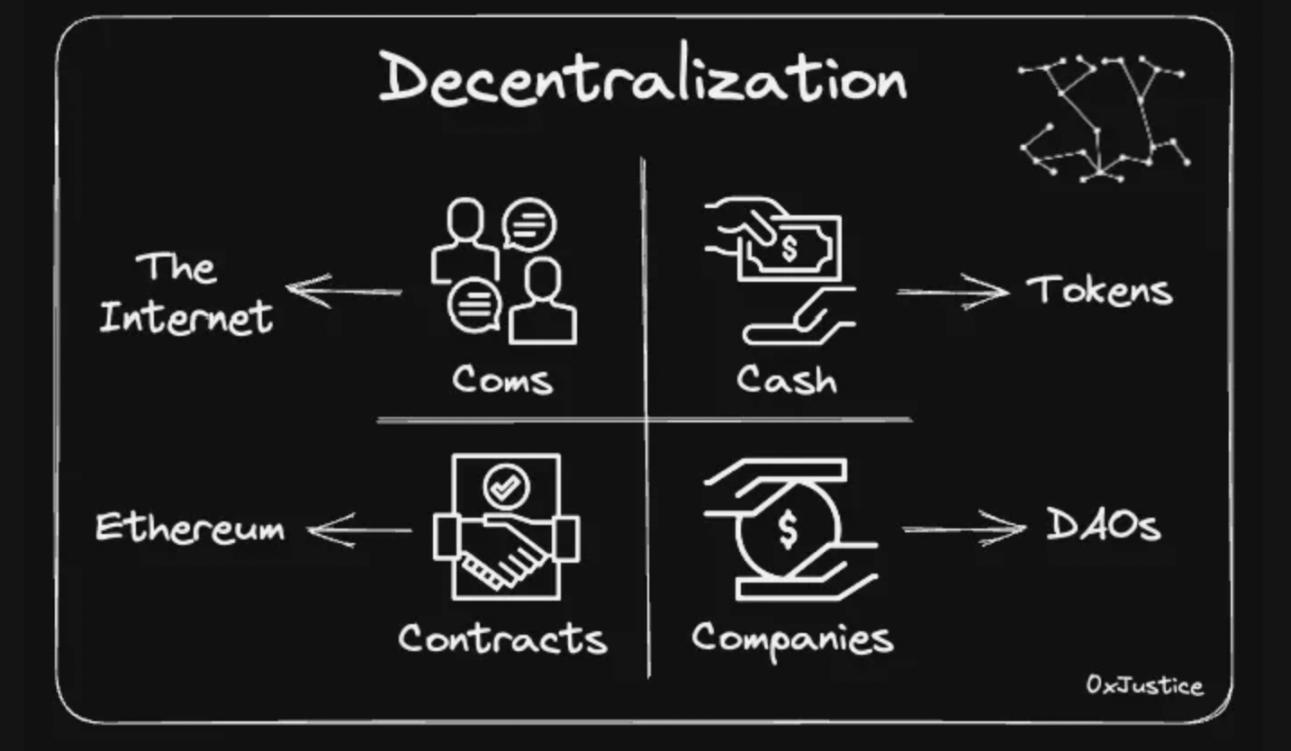
The four key areas of disintermediation are: communications, money, contracts and companies.
Written by: 0xJustice.eth
Compiled by: Luffy, Forsight News
Decentralization is to prevent valuable systems from being exploited. Decentralization is not an end in itself. You can break a mirror to "disperse" it, but that doesn't make it any more valuable.
For almost all of human history, the state has served as the ultimate intermediary, completely free of competitive pressures. Books like "The Sovereign Individual" predicted that the invention of the microprocessor and the Internet would fundamentally change this status quo.
The author of the book believes that we cannot imagine a world without the rule of the state, just as people in the Middle Ages could not imagine a world without the rule of the Roman Church. While they failed to predict the complete collapse of the Church as an institution, they did predict the end of the state as a mediator of human activity.
"The government ultimately has no choice but to treat the people in the areas it serves more like customers than like organized criminals treat victims of extortion."
- Sovereign individual
One way to facilitate this shift is to identify key areas of disintermediation. This article will explore four such areas and conclude with extrapolations about what may happen in the future. The four key areas of disintermediation are: communications, money, contracts and companies.
Decentralized communication
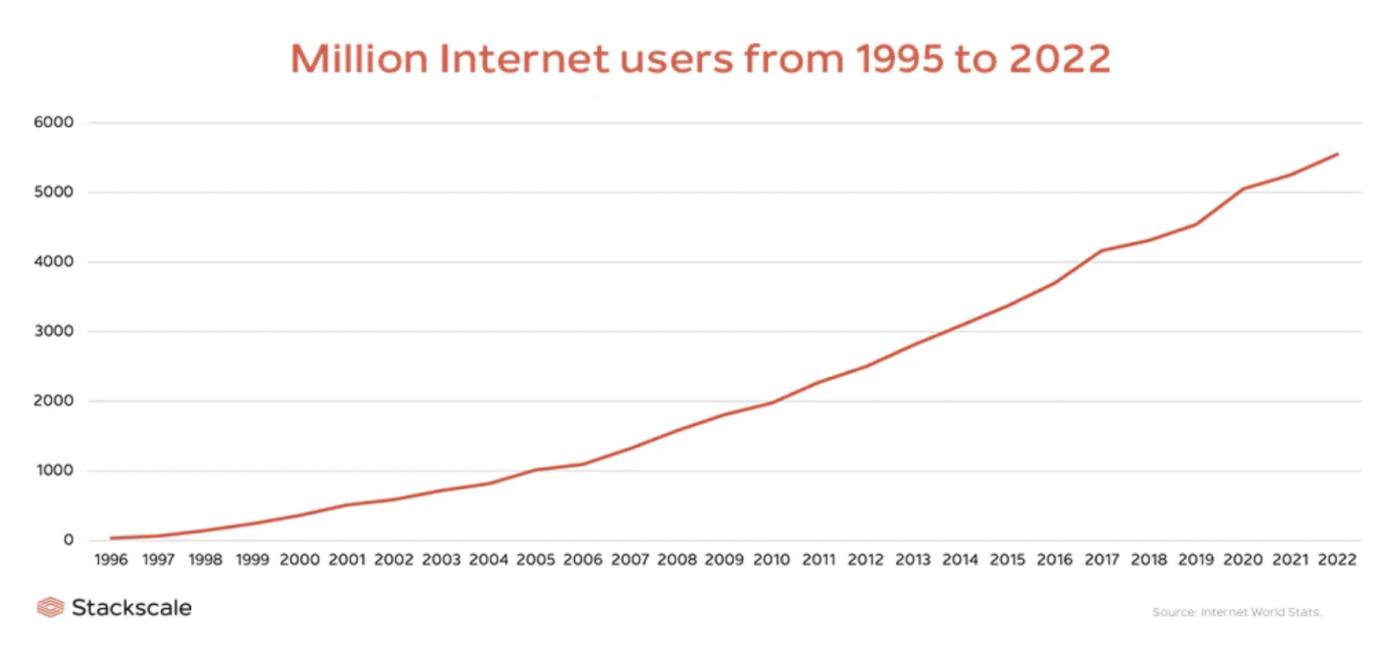
The first major turning point in this saga happened on the Internet. On January 1, 1983, ARPANET was officially changed to the TCP/IP standard, and the Internet was born. This event was the first major disintermediation event because it suddenly democratized all data and information sharing.
Anyone can build a website, and anyone can talk to other people in the world. By the 1990s, everyone was speculating on the effects of globalization. Wikipedia replaced Encyclopedia Britannica, and the era of three news channels and one newspaper was replaced by thousands of news sources and countless citizen journalists.
https://www.stackscale.com/blog/internet-evolution-statistics/
Nazi Germany, the Soviet-induced famine in Ukraine all relied on the state's ability to sense and control various forms of communications and news media. The Internet has decentralized the power of "narratives," and the state must compete with other sources to determine what is relevant and legitimate.
decentralized currency
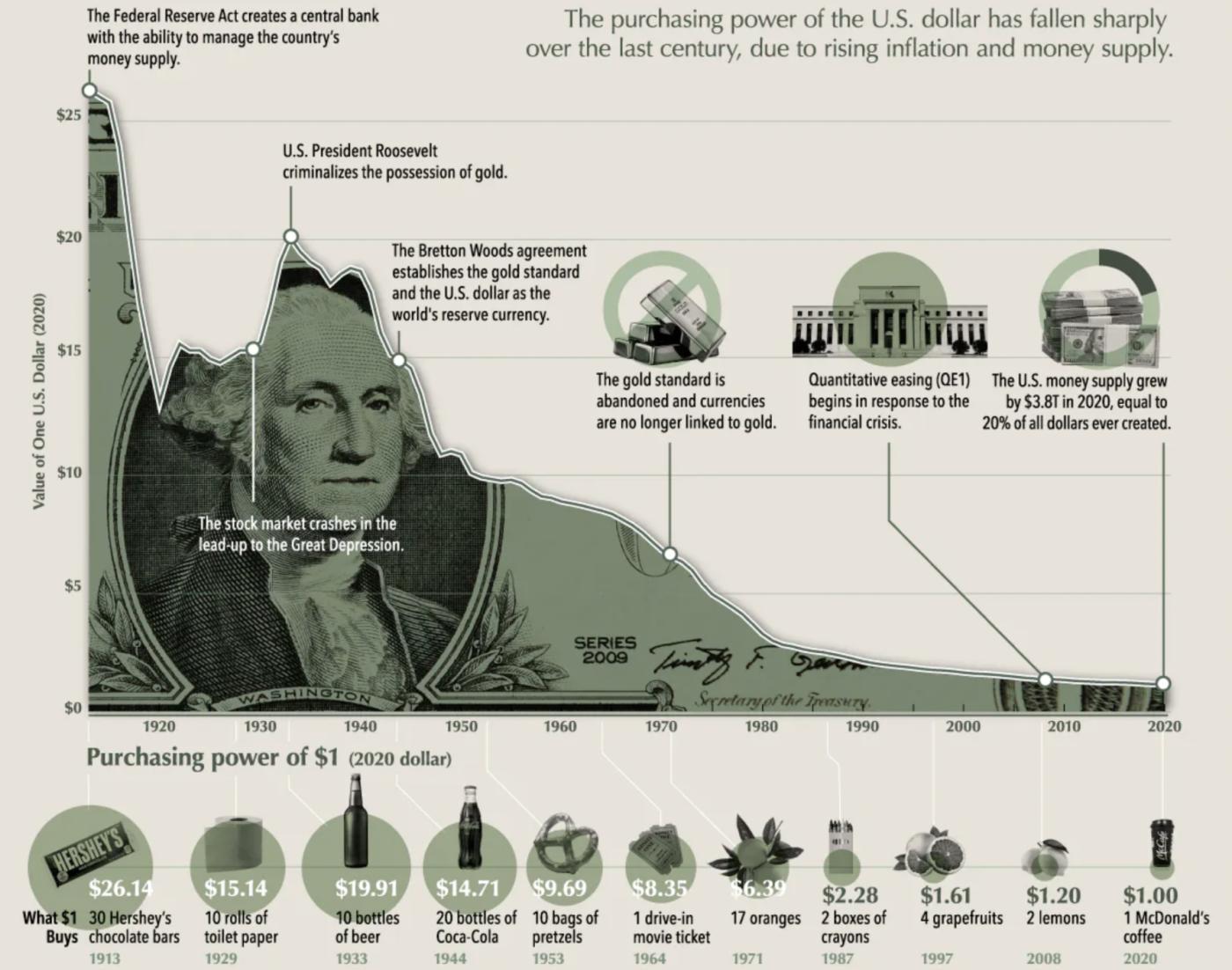
Milton Friedman predicted it, and the cypherpunk Satoshi Nakamoto delivered it: digital cash. Before this, almost all global currencies were under the control of the state. No country could resist the temptation of the money printing press. This was a perfect trap.
Unlike the private sector, mismanagement and misappropriation do not bankrupt a country. When politicians can use endless money to buy voters, even democracies are not immune. The dollar has devalued nearly four times in my lifetime, and the government has printed 80% of the dollars in circulation in the past three years. The trend is so alarming and unsustainable that celebrities like Balaji placed a $1 million bet on the U.S. dollar collapsing in June of this year .
https://www.visualcapitalist.com/purchasing-power-of-the-us-dollar-over-time/
Bitcoin changes all that. It demonstrates a new way to create a currency that is tamper-proof and does not privilege one participant. By making everyone a bookkeeper, it prevents any one party from manipulating the system. Bitcoin, and the many technologies that follow decentralized currencies, decouple money from the state.
The world's superpowers are being affected by it as it disrupts the previous world order. BlackRock CEO Larry Fink reiterated this post-statocentric reality, saying in a statement: “Bitcoin is an international asset that is not based on any one currency, it is a currency that people can use as Substitute assets.”
Decentralized contracts
Digital cash is important, but the world runs on contracts. The earliest contracts, called covenants or treaties, were solemn oaths. Participants would make a solemn promise to do something, and if the promise was not kept, they would be cursed by the gods.
Much later, when civil institutions such as governments and courts emerged to enforce and arbitrate such agreements, legal contracts were born. For most of human history, contracts have been the primary means of coordination.
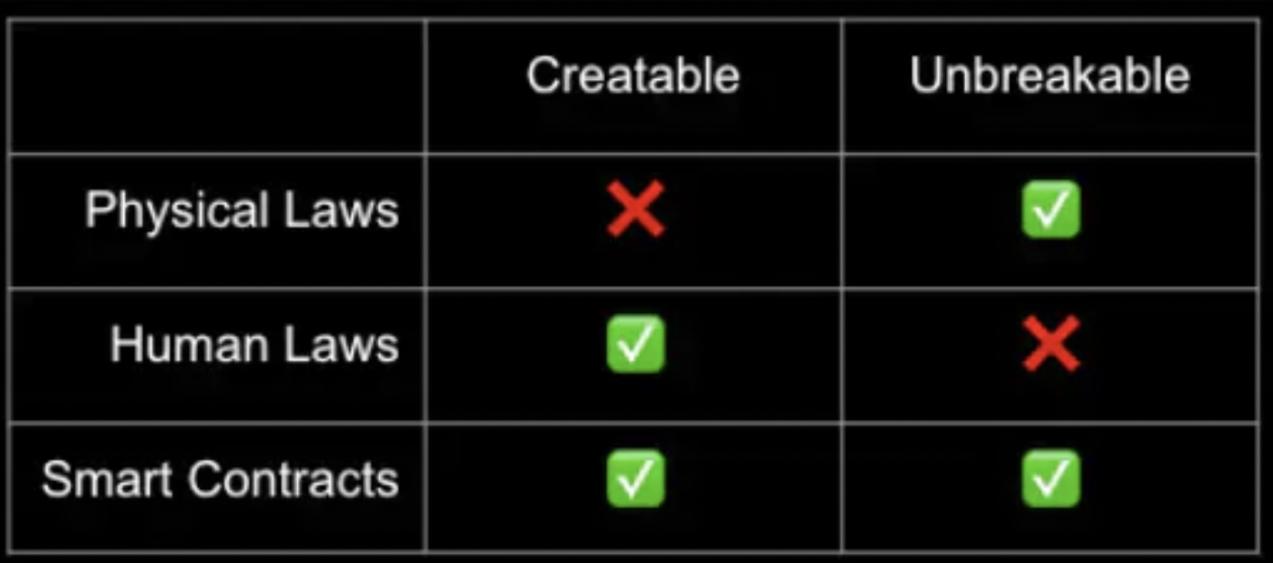
This history took on new meaning when Nick Szabo introduced the idea of smart contracts. A smart contract is a set of promises encoded in a blockchain platform that are executed if predefined conditions are met. This ability means it can release funds to the appropriate parties on its own after a settlement, rather than filing a claim in court. Even if human arbitration is needed to back it up, we can code it into smart contracts.
https://twitter.com/singularityhack/status/1651281961108004864
In my other writings I have called this the Third Law of Nature, and I think that is no exaggeration. The disintermediation of contracts is a giant leap forward for human coordination. We cannot overstate the access, speed and efficiency this technology brings. Smart contracts are disrupting the entire regulatory and legal landscape. Since the launch of Ethereum, more than 720 million smart contracts have been deployed, an increase of nearly 300% in 2022.
Decentralized company
Humanity can only go further if we work together. Even creating something as simple as a pencil requires thousands of professional actors to create everything from erasers to graphite to wood, assembling and distributing it at scale.
The basic idea is that if you align people under a single mission and incentive structure to reduce transaction costs, you can build more complex things, and do so at a lower cost. Known as the theory of the firm, this idea is that the stakeholders of an organization are linked by contracts and claims (shares) to future value.
The Dutch East India Company in the 17th century was the first prominent example of this type of joint-stock organization. Most importantly, only the state can enforce individual claims on shared assets. A company only exists if it is registered with and recognized by the government. The same goes for company stocks. As long as the intermediary says it exists, it exists. All of this changed with the emergence of DAO.
For the first time in history, a group can have joint ownership of an asset or business without an intermediary. This attribute of shared ownership is a fundamental feature of DAO. Using smart contracts, you can pool funds with others to purchase an asset, jointly control that asset, and share in the appreciation. This model is independent of any government and is purely based on unstoppable code.
in conclusion
The saga has a natural progression, with each level being a prerequisite for the following level. Once we opened the lines of communication, we needed a way to send value (currency); thus, commerce was born. On this basis, we create more complex agreements regarding future commitments (contracts) and mutual interests (DAO).
Whitehead famously said: "Civilization advances by increasing the number of important operations we can perform without thinking." This is what every advancement does. It removes potential complexity, creates future assurance, and enables automation possibilities. So where is this all going?
Computer scientist and science fiction legend Vernor Vinge was one of the first to popularize the concepts of the singularity and cyberspace. His book Rainbows End envisions a world where self-enforcing digital contracts become common and available to everyone.
As the book says, these "affiliations" are smart contracts that can be used as freely as we use language. They are temporary alliances formed for a specific purpose, may last only a few minutes, and are created and ended in a haphazard fluidity. They are used in a variety of ways, and characters operate through ad hoc groups formed for specific purposes without government or corporate involvement.
This fictional story is becoming reality. Simon de la Rouviere, one of the main contributors to the ERC20 standard, has been touting the advantages of tokenization since 2013. Through the tokenization mechanism, we can coordinate with code in the way Vinge imagined.
“Do you think it makes sense to collectively create ownership in just a song? Tokenize attention? Tokenize contracts directly? Tokenize memes? Tokenize people? Tokenize this blog post? Tokenizing public goods? How granular are blockchain tokens? What is the minimum bandwidth orchestration system allowed for a blockchain token? 10-second organizations? Creative spin-offs? Meme spin-offs?"
- History Is Rhyming: Fitness Functions & Comparing Blockchain Tokens To The Web
These are new and unimaginable realities for dispersed, autonomous populations. Countries likened to Leviathan will not disappear willingly or quietly. They look to every possible mitigation technique, from global psychological warfare campaigns to the elimination of civil liberties.
It’s a worthy battle and one that the cypherpunks are looking forward to. Our solace is that our weapons are not physical but electronic, cryptographic, and meme-based. We are witnessing the final throes of Leviathan.