


Written by: @Jesse_meta, Researcher, SUSS NiFT
The market was relatively sluggish in the third quarter. After a period of low volatility, the market made a brief correction. This was also expected, as third quarter performance historically has been poor. Only deep cleaning can concentrate the chips into the hands of diamond hands with faith. Even as financial markets cool down, we're still seeing exciting industry advances and new applications. Let us review the eight hot spots in Q3.
Ripple — a phased victory for the crypto market
On July 13, the U.S. Federal District Court for the Southern District of New York ruled against the SEC’s accusation against Ripple, holding that XRP, as a digital token, itself is not a “contract, transaction or plan” that reflects the requirements of the Howey test, that is, XRP is not securities. The use of XRP pairs to invest, issue grants, transfer money to executives, and sell order books on exchanges are not considered securities. But it’s securities that go through institutional sales, OTC, ICO, IEO.
If XRP, which is more centralized, is not a security, then other more decentralized digital currencies are even less securities. Affected by this news, XRP surged by 90%, BTC and ETH followed suit, and SOL and MATIC, which were previously recognized as securities by the SEC, all surged. Coinbase subsequently relisted XRP. This is a major victory for the cryptocurrency industry in the face of strong SEC regulation in recent years. This temporarily clears the air for the crypto industry and indirectly supports the legality of cryptocurrency exchanges providing token transactions. (The SEC previously sued Binance and Coinbase for providing unregistered securities transactions.)
The SEC subsequently filed to appeal the ruling. The showdown between the SEC and Ripple is not over yet. Lack of clarity in regulatory policies has always cast a shadow over the crypto market. The market urgently needs regulatory clarity to reduce confusion. Only clear legislation can better protect investors. Industry practitioners should also actively dialogue with regulators to help regulators better understand the market and achieve a win-win situation.
Layer 2 — The ETH tokens in hand are not enough!
Ethereum's second-layer network continues to be popular and is developing in full swing. Many L2s have come online one after another. Even some competing L1s such as Celo have also moved towards the Ethereum L2 camp. Faced with such a large number of L2s, airdrop hunters expressed that the ETH tokens in their hands were not enough.
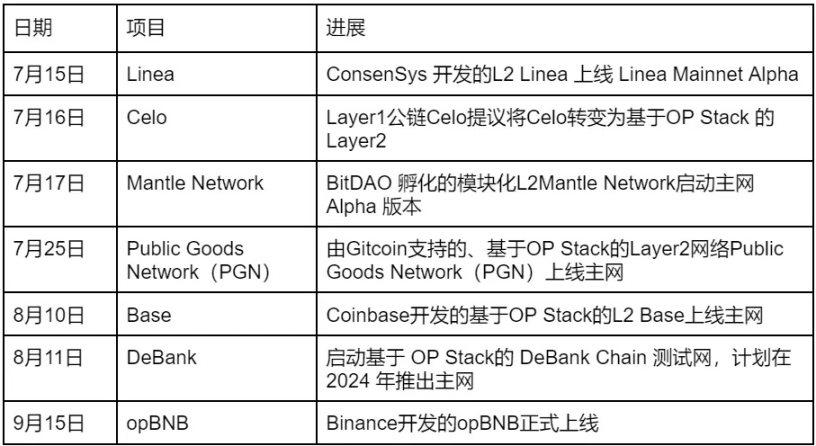
According to L2Beat data, 31 L2s are included, of which 18 have a TVL of more than 10 million US dollars. Arbitrum currently tops the list with a TVL of US$5 billion and a market share of 54.31%, far exceeding Optimism (25.31% market share) with a TVL of US$2.42 billion. ZkSync Era based on ZK Rollup ranked third with $428 million, but only gained 4.47% market share. It can be seen that OP Rollup has a clear first-mover advantage. But this does not mean that OP Rollup will have more development prospects, or that it will be developed separately from ZK Rollup. Some projects such as Polymer are trying to combine the advantages of ZK and OP to provide new solutions. L2 that currently uses OP Rollup may also be converted to ZK Rollup in the future.
Polygon co-founder Sandeep Nailwa said in TOKEN 2049 that today’s Ethereum is more like a user-to-chain model and is shifting to a chain-to-chain model. In the next 2-4 years, Ethereum will become the basic settlement layer, providing security, settlement guarantees and security functions to these chains.
Worldcoin – the savior of the artificial intelligence era?
On July 24, Worldcoin released an open letter signed by OpenAI co-founder Sam Altman, announcing that the WLD token was officially launched, and major exchanges immediately listed the token.
Worldcoin strives to create a new identity system and financial network that is owned by everyone. It aims to add new economic opportunities in the era of artificial intelligence and provide solutions to distinguish artificial intelligence from human identity. Explore a possible path to an AI-funded global basic income by issuing tokens to wallet addresses with verified unique human identities while protecting privacy.
In the era of artificial intelligence, it is foreseeable that a large number of laborers will be unemployed due to the improvement of productivity, and artificial intelligence companies will make a lot of profits. Woldcoin hopes to redistribute the profits of artificial intelligence so that every unique human individual who passes verification can obtain basic income.
To realize the ideal of Wolrdcoin, we must first achieve unique identity verification for each person to prevent fraud and repeated applications. After considering government ID, network trust and other models, Worldcoin finally chose biometric technology based on iris scanning. Worldcoin uses a special device Orb that uses iris scanning to detect whether the object is a real person, and can ensure that a real person intelligently registers an identity on Worldcoin. Orb uses a specially designed camera and algorithm to extract iris feature information, completes all processing on the local device, does not save user images, and only outputs signed iris codes. Decoupling from user wallets through zero-knowledge proof to avoid leaking user privacy. As of September 15, 2.298 million people have been certified on Wolrdcoin.
This is a very challenging and forward-looking project that has attracted a lot of attention from the community. But there are also critics, with Vitalik questioning the privacy, centralization, security and accessibility of the project. In addition, residents of some economically underdeveloped countries sell their own irises at low prices, causing the results to run counter to the original intention. On August 28, Kenya, one of the countries where Worldcoin was first launched, suspended registration in the country due to security, privacy and financial issues.
Telegram Bot – Innovation and Speculation in Crypto Trading
Unibot is a trading robot on Telegram. Its token market value has soared from about US$30 million on July 7 to US$2 billion on August 10, which has attracted widespread attention from crypto market players to Telegram robots and related tokens. .
Unibot allows users to interact with the bot, monitor liquidity pools, receive alerts on newly minted tokens, trade tokens, and perform follow-up orders. Unibot's transaction execution speed is six times faster than Uniswap. Token holders can receive 40% of transaction fees and 1% of total $UNIBOT trading volume as dividends. Unibot's high-speed execution, innovative features and robust revenue distribution model set it apart from its competitors. Especially in the current period when there is no new technological innovation and the mainstream market is in a downturn, some crypto users seek to trade Altcoin or Dogecoins to obtain high profits. Unibot just provides these users with services similar to centralized exchanges.
These robots are centralized while meeting the needs of degen players. With the success of Unibot, various types of trading robots have appeared on the market, such as LootBot, Bridge Bot, and MEVFree robots to provide different crypto services. The security risks cannot be ignored. Users importing private keys into the robot may result in asset theft.
According to CoinGecko data, Unibot's token $UNIBOT soared up to 27 times, but fell 70.47% from its all-time high just 27 days later. It once again proves that the encryption market is full of financial speculation while undergoing technological innovation.
Friend.tech — Reconstructing social networking for Web3
Friend.tech is a new social application launched on Base on August 10. Users can purchase tokenized shares of KOLs on Twitter to gain exclusive access to private group chats with these social celebrities.
In just the first week of launch, the trading volume on Friend.tech exceeded 7,000 ETH, demonstrating its strong market appeal. As of September 12, more than 210,000 users had completed 3.734 million transactions on the platform. This rapid growth is not only due to its close cooperation with crypto Twitter KOLs, but also its unique Progressive Web App (PWA). Users can experience it directly on the browser without downloading, making it easy for novices who don’t understand cryptocurrency to use it.
Friend Tech’s innovation lies in using tokens as ownership when interacting with crypto people. Owning a token is equivalent to owning shares in a specific company. An increase in holders of each token on Friend.tech will cause the token to rise. Trading tokens requires an additional 10% transaction fee, of which 5% goes to the protocol and 5% goes to the creator. In just one week, the creator's total revenue reached $13.25 million. On August 19, Friend.tech announced that it had received an exclusive $100 million in financing from Paradigm and introduced a points system to encourage user participation.
Although user growth has slowed, Friend.tech is still in the beta testing stage, and the launch of new features is expected to further stimulate user growth. In addition, subscription-based content platforms have proven their commercial value, allowing fans to participate in the construction of the creator economy. However, the sustainability of the growth of fan tokens requires detailed analysis of specific cases.
On August 21, it was revealed that the API provided by Friend.tech could directly query users' wallets and Twitter information, resulting in the leakage of more than 100,000 user data. Privacy issues still need improvement. Additionally, tokenized stocks have the potential to trigger SEC investigations.
PYUSD — Web2 Financial Payments Company Joins Stablecoin Battle
Stablecoins are an important value-preservation tool for cryptocurrency investors and an important part of the DeFi system. In addition to Tether and Circle, which are based on legal currency and have first-mover advantages, DeFi native protocols such as MakerDAO, Aave, and Curve use over-collateralized cryptocurrencies to mint decentralized stable coins to compete for market share. After abandoning BUSD, Binance began to support FDUSD, a stable currency issued by Hong Kong Trust Company.
Companies and protocols that issue stablecoins can enjoy the interest income generated by the underlying assets or minting. The current risk-free short-term U.S. Treasury bond yields are as high as 5%, which also attracted PayPal to announce its entry into the issuance of stablecoins on August 7, becoming the first major financial company in the United States to issue its own stablecoins.
PayPal uses Paxos as its issuer, and the underlying assets are fully backed by U.S. dollar deposits, short-term U.S. Treasury bills, and similar cash equivalents. Therefore, PYUSD can be regarded as a centralized U.S. dollar stable currency similar to USDT and USDC. But unlike USDT, which does not provide services in the United States, PayPal is open to American users.
As an established electronic payment company from Web2, PayPal has distribution channels that Web3 companies cannot match. Even if the usage scenarios on the chain are limited at the beginning, given its good reputation in the payment field, if PayPal takes efforts to stimulate the large number of existing users to use PYUSD, or reduces merchant fees to encourage merchants to support PYUSD payment, then PYUSD may become more popular. Quickly acquire more users than the stablecoin pioneers in a short period of time. On September 12, PayPal launched a cryptocurrency exchange service for U.S. dollars for U.S. users, providing crypto players with an option to withdraw funds safely. Therefore, we see that PayPal has the potential to promote cryptocurrency to further break out of the circle and make stablecoins a daily payment method for people.
Considering the high pressure on DeFi policy in the United States in recent years and the regulatory uncertainty of stablecoins, the development of PYUSD remains to be seen.
FTX Liquidation – Can the Market Take the Selling Pressure?
On September 14, according to CoinDesk, a judge ruled that FTX could sell, pledge, and hedge its cryptocurrency holdings to repay creditors. FTX currently has approximately $3.4 billion in liquid Class A cryptocurrency assets, including approximately $1.2 billion in SOL, $560 million in BTC, and $192 million in ETH. In addition, Class B assets such as SRM and MAPS are difficult to realize due to low liquidity.
In addition to cryptocurrencies, FTX has about 4.5 billion in venture capital. Equity investments include US$500 million in the AI star company Anthropic and US$1.1 billion in the important Bitcoin mining company Genesis. In addition to equity investment, FTX also cooperates with multiple funds in asset management and provides loans to financial technology companies. Given that some of FTX's investment projects have good fundamentals, there is the possibility of obtaining high valuation returns in the future.
According to Messari's statistics on September 11, the BTC and ETH held by FTX and Alameda accounted for approximately 1% of the weekly trading volume, and are expected to have little impact on the market. SOL and APT held by FTX account for 81% and 74% of the weekly trading volume respectively, but these assets are still in the unlocking period, which means that there may be long-term selling pressure in the future. In addition, liquidation also has a certain impact on TRX, DOGE, and MATIC, with FTX holdings accounting for approximately 6% to 12% of weekly trading volume. It is reported that FTX has a weekly liquidation limit of US$100 million. It is unlikely that a single currency will be liquidated within a week. The impact of actual liquidation on the market has already been priced in to a certain extent.
From the FTX liquidated assets, investors are once again warned to pay attention to the liquidity of investment products. Although Altcoin may have higher gains than mainstream assets such as Bitcoin during the rally, they should pay close attention to their liquidity, otherwise it will only be paper wealth. Decentralization is the value of Web3, and only sufficient decentralization will make it safer.
Snaps — MetaMask’s self-subversion
The MetaMask wallet, which is almost essential for crypto players, undoubtedly plays a pivotal role in the Ethereum ecosystem, providing users with the ability to access the EVM chain through RPC. Some non-EVM chains such as Cosmos, Solana, Sui, Starknet, etc. are loved by users and developers because of their unique technical advantages and ecological applications. However, when using these chains, users often need to use corresponding specialized wallets, which greatly affects the interactive experience.
In order to solve this pain point, MetaMask launched the Snaps API access specification to integrate non-EVM chain wallets, allowing MetaMask users to experience non-EVM chains in their original wallets and open up a new multi-chain world.
In addition to non-EVM interoperability, Snaps can provide clear transaction insights, allowing users to understand potential security risks before interacting. This can greatly reduce the likelihood of phishing attacks when self-hosting. Snaps can also obtain specific information you need to know in the wallet, adding communication capabilities to the wallet.
Snaps is MetaMask's self-subversion. By integrating various wallets, it transforms from the dominant EVM wallet to a traffic portal for full-chain wallets and decentralized applications. Developers can use their imagination to expand functions on MetaMask and create a new Web3 experience for users.
Although MetaMask conducts self-audits and third-party audits, there are still potential code risks inherent in Web3. However, Snaps currently only runs in a sandbox test environment and cannot access MetaMask account information, so the original MetaMask assets are isolated.




