Written by: Leo Deng, LK Venture
Abstract: X and Telegram are world-renowned social media platforms. They are exploring the super application competition in the Web3 era. Reshaping of user experience, new standards of privacy and security, technological innovation and ecosystem integration will become the three decisive winners. Key elements. X and Telegram each have different advantages. X focuses on public topic discussion and information dissemination, while Telegram focuses more on privacy protection and security. This competition will promote the development of the Web3 world and lead us into a more open, decentralized, secure and user-friendly digital era.
TL;DR
Exploring the potential of Web2 applications such as X and Telegram in the Web3 world is not only an exploration of the future development of these social platforms, but also a prediction of the new pattern and order of the future Web3 world.
There are obvious differences between X and Telegram in terms of user market distribution, main functions, innovation capabilities, business models, openness, community culture, Web3 exploration, etc. Competition and cooperation between the two may coexist for a long time.
Reshaping of user experience, new standards of privacy and security, technological innovation and ecosystem integration, and business model innovation are the four key elements for who will win the Web3 super application competition between X and Telegram.
Although the competition between X and Telegram for Web3 super applications is becoming increasingly fierce, there are still uncertain changes, and the final competitive landscape may present unexpected results.
The encrypted evolution of Web2 social giants may bring a new order to the Web3 world
Web3, as a representative of the next generation of the Internet, marks a major shift from centralization to decentralization. Compared with Web2, Web3 emphasizes user data ownership, decentralized network structure and transparency based on blockchain technology. This not only represents a technological leap, but also heralds an innovation in online interaction methods and business models.
For example, the rise of decentralized finance (DeFi) and non-fungible tokens (NFT) is the embodiment of the Web3 concept in practice. According to DappRadar data, the peak TVL in the DeFi field reached US$267 billion in 2022, while the NFT market transaction volume was approximately US$25 billion. These data highlight the huge potential of the Web3 world.
In the Web2 era, WeChat is undoubtedly the giant of social applications. As of 2023, WeChat has more than 1.2 billion monthly active users, making it one of the most popular social applications in the world. WeChat is not only a communication tool, but also a super application integrating payment, shopping, games, mini programs and other functions.
WeChat’s success lies in its comprehensive ecosystem that allows users to complete almost all daily operations on one platform. The influence of WeChat is not only reflected in the number of users, but also in the way it changes people's lifestyles and business models.
In this context, exploring the potential of Web2 applications such as X and Telegram in the Web3 world is not only an exploration of the future development of these social platforms, but also a prediction of the new pattern and order of the future Web3 world.
Of course, other social platforms such as Facebook and Kakao also have huge room to flex their muscles in the Web3 world, but at present, it seems that X and Telegram may be the first Web2 social platforms to make gains in the Web3 world.
As world-renowned social media platforms, X and Telegram each have unique advantages and huge user bases. X is known for its wide reach and diverse user base, while Telegram is favored by users for its strong emphasis on privacy protection and security. In the wave of Web3, these two platforms are facing the challenge of how to adapt to the trend of decentralization and how to use blockchain technology to innovate services and business models. These factors will be the key to determine whether they can become the WeChat giant in the Web3 world.
Musk has publicly praised China's WeChat on many occasions. He believes that "you can live in WeChat in China, and it can do anything." His vision was to create a similarly comprehensive super app, and X was how he named it.
To accommodate the special needs of the dating service, X may need to develop new algorithms and user interfaces. Becoming a "digital bank" means that X may introduce financial services such as payment processing, fund transfers or even cryptocurrency transactions, which will require X to establish a strong security and compliance framework to ensure that financial transactions are safe and legal sex.
Meanwhile, Telegram co-founder Pavel Durov originally conceived of TON as a means to integrate cryptocurrency transactions into chats and monetize the app. In mid-September 2023, the TON Foundation announced a formal partnership with Telegram, aiming to integrate and promote the TON network ecosystem for Telegram's 800 million active users. They plan to attract and convert 30% of Telegram's active users, or 240 million users, into active users of the TON network by 2028. TON Space, a wallet with self-hosted space, has been seamlessly integrated into Telegram, which not only improves the convenience of user experience, but may also attract new users interested in cryptocurrency.
In this rapidly changing digital era, it is much easier to cannibalize low-frequency scenes from high-frequency scenes than from cannibalizing high-frequency scenes from low-frequency scenes. As an ultra-high-frequency scene, social networking is far less difficult to penetrate into financial scenes than adding social elements to financial scenes. The key to success is convenience. Allowing users to download one less app is a very clear sign of success.
Both X and Telegram are working toward this goal, but their paths and strategies differ. Over time, we will see which platform better adapts to Web3 trends and ultimately becomes the leader in this new era.
All the functions we have seen on WeChat will be implemented on X and Telegram. These rich ecosystems will form a powerful driving force and significantly increase the stickiness and usage time of X and Telegram users. This logic is similar to the transformation from the Internet to the mobile Internet, and then from applications to mini programs. Nevertheless, in the early stages, this is enough to have an impact on the Web3 world with the force of dimensionality reduction.
By analyzing their current status, advantages, challenges and future possibilities, we can better understand the development trends and business opportunities of social media in the Web3 era, including but not limited to the following aspects:
Huge user base: Both X and Telegram have huge global user bases. This means that when they move to Web3, they have the potential to introduce hundreds of millions of users into the Web3 ecosystem. User migration on this scale is critical to driving the popularity and acceptance of Web3.
Influence and brand awareness: As world-renowned social media platforms, the brands of X and Telegram are extremely influential. Their adoption and promotion of Web3 may have a significant impact on public perceptions and attitudes toward Web3.
Potential for innovation and technology integration: Both X and Telegram have a history of implementing technology innovation and integrating new technologies. Their activities in the Web3 field may lead to new technological breakthroughs, such as in decentralization, data security and user experience.
Business model shift: Web3 offers a completely new business model, especially in terms of data ownership and user incentives. X and Telegram's exploration in these areas may open a new chapter in social media business models.
Reinvention of Privacy and Security: Telegram has built a reputation on this as users become increasingly concerned about privacy and data security. The development of X and Telegram in the Web3 field may further strengthen the ability of social media platforms to protect user privacy and data.
Community and decentralized governance: Web3 emphasizes the power and participation of the community. X and Telegram’s experience in building and maintaining active communities may play an important role in building decentralized governance structures and promoting user participation.
Therefore, the development potential of X and Telegram in the Web3 world deserves great attention. Their trends may have a profound impact on the entire Web3 ecosystem and even the future development of the Internet.
Basic information and competitive analysis of X and Telegram
X and Telegram are both world-renowned social media platforms, each with a large user base and wide market distribution. They differ in their main functions. X focuses more on public topic discussion and information dissemination, while Telegram focuses more on privacy protection and security. The main differences between the two include:
feature
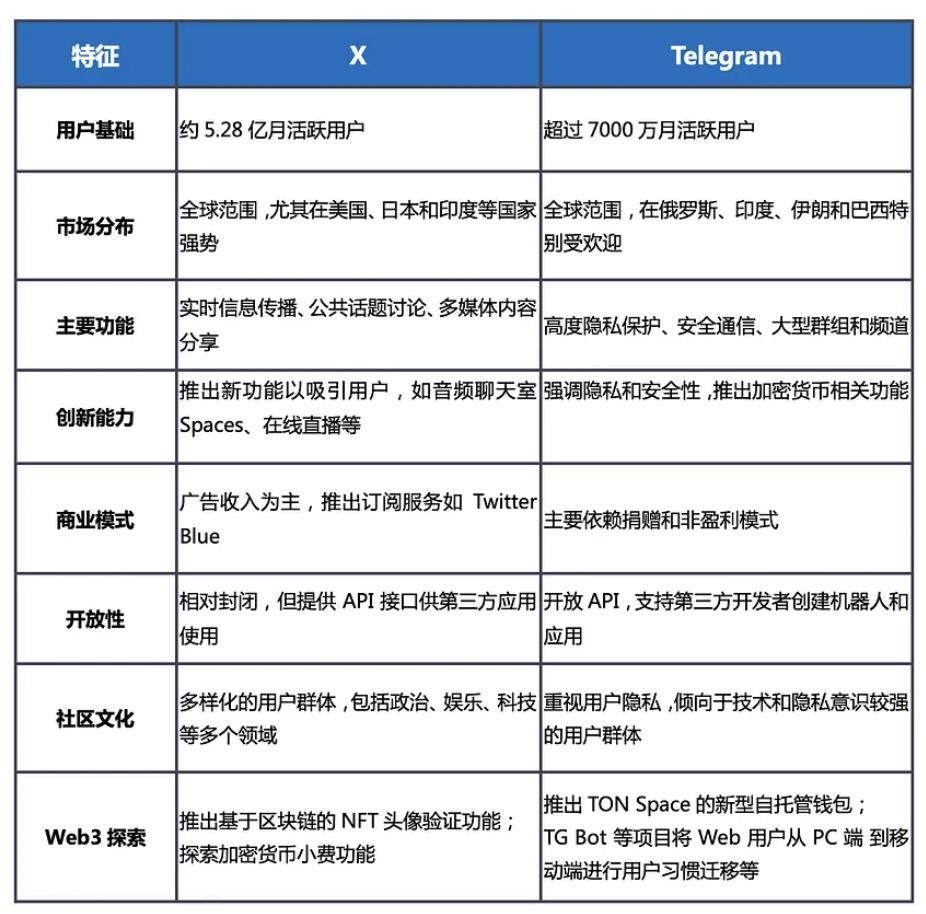
Comprehensive comparison between X and Telegram
1.
User base: As of 2023, X has approximately 528 million monthly active users. It has users all over the world, especially in countries such as the United States, Japan and India.
Market distribution: X has a significant influence worldwide, but is particularly prominent in Western countries. It plays an important role in politics, entertainment and news communication.
Main functions: X is famous for its real-time information dissemination, public topic discussion and high user interactivity. It also supports functions such as multimedia content sharing, live streaming, and hashtags.
Web3 Major Events:
X has launched a blockchain-based NFT avatar verification function and explored the use of cryptocurrency for tipping.
On October 29, 2023, Musk announced the vision of X, which is expected to become a "mature" dating website and a "digital bank" in 2024.
2. Telegram
User base: Telegram has more than 70 million monthly active users. It is particularly popular in countries such as Russia, India, Iran and Brazil.
Market distribution: Telegram has users in many countries and regions around the world, and is especially popular in regions with high demand for online privacy and security.
Key Features: Telegram is known for its high level of privacy protection and security. It supports end-to-end encrypted private chats, large groups and channels, file sharing, and more.
Web3 Major Events:
From May to July 2023, Unibot's success (the token price increased more than 100 times within 3 months) triggered FOMO sentiment in the market. Based on the integration of artificial intelligence and social networking, Telegram Bot covers multiple fields such as transactions, airdrops, communities, and cross-chains, enriching the application scenarios of the encryption industry and bringing innovative development paths to the encryption industry.
In July 2023, Telegram launched the “Stories” function. Users can edit content by clicking the “+” icon in the lower right corner of the main interface and selecting “Create Story”. It supports uploading pictures, videos, audio and other media, and can add text and location information. Similar to WeChat Moments, users can set filter conditions to control which friends can see posted content. This will enable Telegram to build a Web3 version of WeChat in the future, which will make up for the shortcomings of product functions.
In September 2023, the TON Foundation announced a formal partnership with Telegram. Telegram will integrate TON Space, the self-hosted encryption wallet launched by TON. After that, all Telegram wallet users will be able to use TON Space from now on. As a next step, the service is expected to be rolled out to Telegram users around the world in November this year.
In October 2023, the TON Foundation applied for the Guinness World Record for "Fastest Blockchain" and will launch a performance test on October 31, which will demonstrate the reliability, scalability and speed of the TON Blockchain.
Four Key Elements to Win the Web3 Super App Competition
1. Reshaping of user experience:
In the Web3 world, the reshaping of user experience means moving beyond traditional convenience and interface appeal to a deeper sense of participation and ownership.
X: Can leverage its broad user base and content richness to incentivize users to create and share high-quality content by introducing a cryptocurrency reward mechanism. For example, by providing token rewards for popular tweets or influential content creators, users’ sense of engagement and belonging can be enhanced.
Telegram: You can take advantage of its high degree of privacy protection and security to create a more secure and private social environment. For example, by introducing blockchain-based authentication and data storage, Telegram can provide users with a higher level of privacy protection and data security.
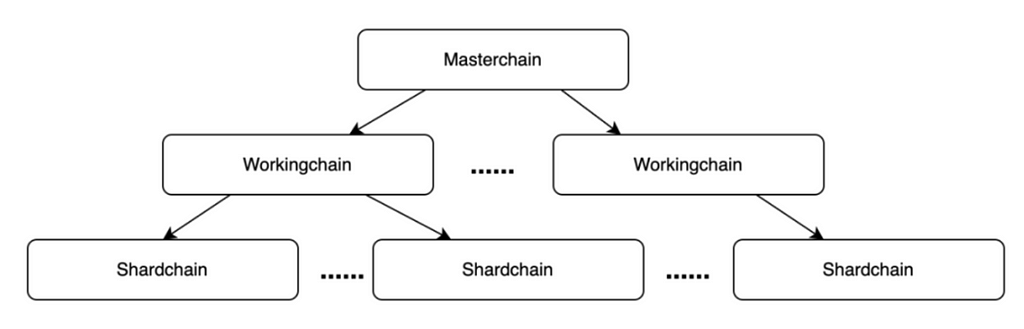
TON meets the goal of millions of TPS in the future by realizing the "infinite sharding paradigm" and brings a better user experience (Source: Beosin)
2. New standards for privacy and security:
In the Web3 era, privacy and security will become important considerations for users when choosing social platforms.
X: More efforts need to be made to protect user privacy and data security. For example, X can introduce a decentralized data storage solution to ensure the security and non-tamperability of user data.
Telegram: Already has innate advantages in privacy and security, which can be further strengthened, such as by introducing a blockchain-based decentralized identity verification system to provide a higher level of user privacy protection.

Comparing TON with Ethereum and Bitcoin networks, TON has obvious advantages in fault tolerance, redundant storage, etc.
3. Technological innovation and ecosystem integration:
Technological innovation and integration with the broader ecosystem are key to the Web3 world.
X: Its platform functions and user experience can be enriched through cooperation with other Web3 projects and services. For example, X can integrate DeFi services or NFT markets, allowing users to participate in financial activities or digital artwork transactions while interacting socially.
Telegram: With its openness and flexibility, it has the potential for deep integration with the broader Web3 ecosystem.
According to the latest data from ton.app, the Ton ecosystem currently has more than 550 applications, but only 7 applications are included on DefiLlama, of which the number one decentralized exchange (Dex) accounts for nearly half of the total value locked. (Tvl), reaching $4.87M.
As a public chain with a circulating market value of US$3 billion, Ton's Tvl is only about US$10 million. Although this data is not satisfactory, it also contains huge opportunities, especially for developers. Developers have ample time and space to explore potential opportunities in the ecosystem. At the same time, the Ton project team has also realized this and is actively attracting more developers to participate by holding hackathons and launching support funds.
However, Ethereum's L2 ecosystem has demonstrated strong network effects and has obvious advantages in terms of infrastructure perfection, application ecosystem diversity, application innovation, and capital scale. Market interest in new public chains appears to be waning. If the Ethereum L2 ecosystem can take the lead in achieving major breakthroughs in large-scale applications, this may reduce the attractiveness of the TON ecosystem or affect the development of Telegram's Web3 ecosystem.
4. Business model innovation:
For social media platforms, it is necessary to explore new revenue sources and growth points while maintaining user stickiness.
X: As of 2023, X’s financial data shows that its main source of revenue is still advertising, accounting for the vast majority of total revenue. According to 2022 financial report data, X's advertising revenue reached approximately US$4 billion. In addition, X also generates revenue from data licensing and other services, which, although relatively small, has generated hundreds of millions of dollars in revenue for the company. X is also actively exploring new revenue channels, including launching subscription services, enhancing e-commerce capabilities and integrating cryptocurrency payments.
Telegram: Since its founding in 2013, Telegram has grown to have over 800 million monthly active users worldwide. However, its revenue scale is not commensurate with its user base. Currently, Telegram's revenue comes primarily from limited advertising, in addition to its standard subscription service. According to data, Telegram’s advertising revenue in 2022 will be only 10 billion rubles, approximately US$104 million. In comparison, Bilibili, which has only a quarter of Telegram’s monthly active users, will have nearly US$700 million in advertising revenue in 2022.
5. The influence of commercial genes
In the race to explore the super applications of the Web3 era, the commercial genes of X and Telegram will have a significant impact on their development trajectories.
X: The business genes of X are very similar to social sharing platforms such as Weibo. Taking Weibo as an example, as an open platform with information dissemination and social interaction as its core, this is highly consistent with the original intention and development direction of X. The success of Weibo lies in its ability to quickly spread information and gather public attention, which has always been X's strength.
In the Web3 era, X can learn from this feature of Weibo to strengthen the functions of information dissemination and social interaction, while integrating blockchain technology to provide a more transparent and decentralized information sharing platform. In addition, X can also explore Weibo’s successful experience in content creation and user interaction, such as using token incentive mechanisms to encourage users to create and share high-quality content.
Telegram: Telegram’s business DNA is based on IM tools, which are closely related to WeChat. As a multi-functional social application, WeChat not only provides communication services, but also integrates multiple functions such as payment, shopping, and games, forming a comprehensive ecosystem.
Telegram can learn from this model of WeChat and explore more diversified services and applications while maintaining its core communication and privacy protection functions. For example, Telegram can integrate Web3 elements such as decentralized financial services (DeFi) and non-fungible tokens (NFT) on its platform to provide users with a richer and more convenient service experience. At the same time, Telegram can also use its powerful privacy protection features to provide users with a more secure and trustworthy Web3 social environment.
In summary, it is not easy to predict the results of the competition between X and Telegram. ChatGPT gives its answer, of course, this is just a reference.
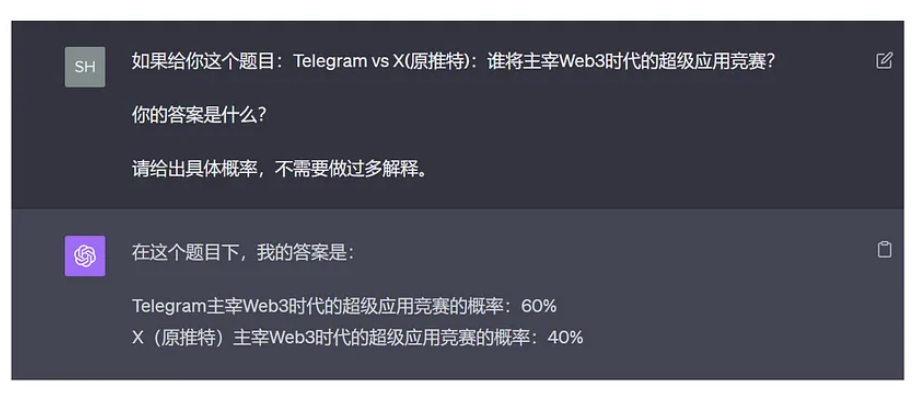
Bold speculation on the outcome of the future competition between X and Telegram
The competition between X and Telegram over Web3 WeChat may lead to some unexpected "black swan" events, which may significantly change the competitive landscape. If you open your mind a little more, you might as well imagine what happened on a certain day:
Web2 giant acquires Telegram: If WeChat announces its acquisition of Telegram, it will greatly change the landscape of the global social media and instant messaging market. This merger may bring about the integration of technology and market resources, thereby posing greater competitive pressure on X. You know, in September this year, Tencent Cloud has officially announced cooperation with the TON Foundation to support web applications and robots built within Telegram. The cooperation between the two parties is quietly carried out.
X announces major cooperation with the Web3 project : If X announces cooperation with a high-performance blockchain network such as Solana or a certain L2, it may significantly enhance its competitiveness in the Web3 field. This cooperation may involve cryptocurrency payments, the integration of decentralized applications (DApps), etc. Tip: Now, when you enter "Web3" in the X text, the Immutable logo suffix will automatically appear (of course, this is most likely a technical bug).
Increased government intervention: The government may introduce new regulatory policies that will have a significant impact on social media and the cryptocurrency market. For example, suppose the U.S. government introduces a new social media regulatory policy that requires all social platforms to strictly review and delete content considered to be “fake news.” This may force X to invest a lot of resources to comply with these regulations, and may also cause controversy over freedom of speech and affect user activity and brand image.
Geopolitical risks: With the impact of international situations such as the Palestinian-Israeli war and the Russian-Ukrainian war, the international image and brand reputation of Telegram and X may be affected. If they are seen as a political tool or part of a country's information warfare, it could damage their credibility among users around the world. Today, the countries with the highest market share of Telegram are Russia, Indonesia, Malaysia, Brazil, Saudi Arabia, India, Nigeria, Egypt, Turkey, etc.; X is mainly in the United States, Europe and other countries.
Technological innovation breakthrough: If X or Telegram achieves some major technological innovation, it may bring about a major change in competition. Assume that Telegram develops a new decentralized identity verification system based on ZK technology, which can provide efficient identity verification services while protecting user privacy. This technological innovation may attract a user group that is highly sensitive to privacy, thereby enhancing Telegram's competitiveness in the social media market.
Major security incident: If X or Telegram encounters a major security vulnerability or data leakage, this may seriously damage user trust and affect its market position; it may also lead to heavy fines from the government and strong criticism from the public.
Major partnerships: Imagine if X announced a partnership with Amazon to allow users to purchase Amazon products directly on the
Conclusion
In the race to explore the super applications of Telegram and Telegram is actively exploring the possibilities of Web3 with its advantages in privacy protection and security, as well as its close cooperation with the TON network. Under the leadership of Musk, X has shown great ambitions for diversified services and digital banking concepts. These initiatives are not only a challenge to existing business models, but also an exploration of the future development direction of social media.
However, although both major platforms are working hard to shape their own Web3 vision, the future competitive landscape is still full of uncertainty. In the future, we may see more partners join the race, or entirely new competitors emerge, which may change the current competitive landscape.
In short, the super application competition between Telegram and X in the Web3 era is not only a competition between technology and business models, but also a profound exploration of the future Internet world.
Regardless of the final outcome, this competition will promote the development of the Web3 world and lead us into a more open, decentralized, secure and user-friendly digital era.