Inventory of 21 EigenLayer ecological early projects.
Written by: 0XNATALIE
In March this year, EigenLayer, the Ethereum-heavy pledge protocol, became famous in the crypto world with its $50 million Series A financing led by Blockchain Capital. EigenLayer allows the re-pledge of ETH pledged on Ethereum. These secondary pledged assets can be used in data availability layers, oracles, middleware, Layer 2, etc., allowing these protocols to benefit from the security of Ethereum. At the same time, users who provide heavy pledges receive additional benefits from the protocol. Simply put, EigenLayer can re-pledge the pledged ETH to various protocols - AVS (Actively Validated Services), allowing Ethereum's verifiers to provide various security verifications of the protocol, thereby improving the security of the overall network and giving Ethereum Square validators provide more profit opportunities.
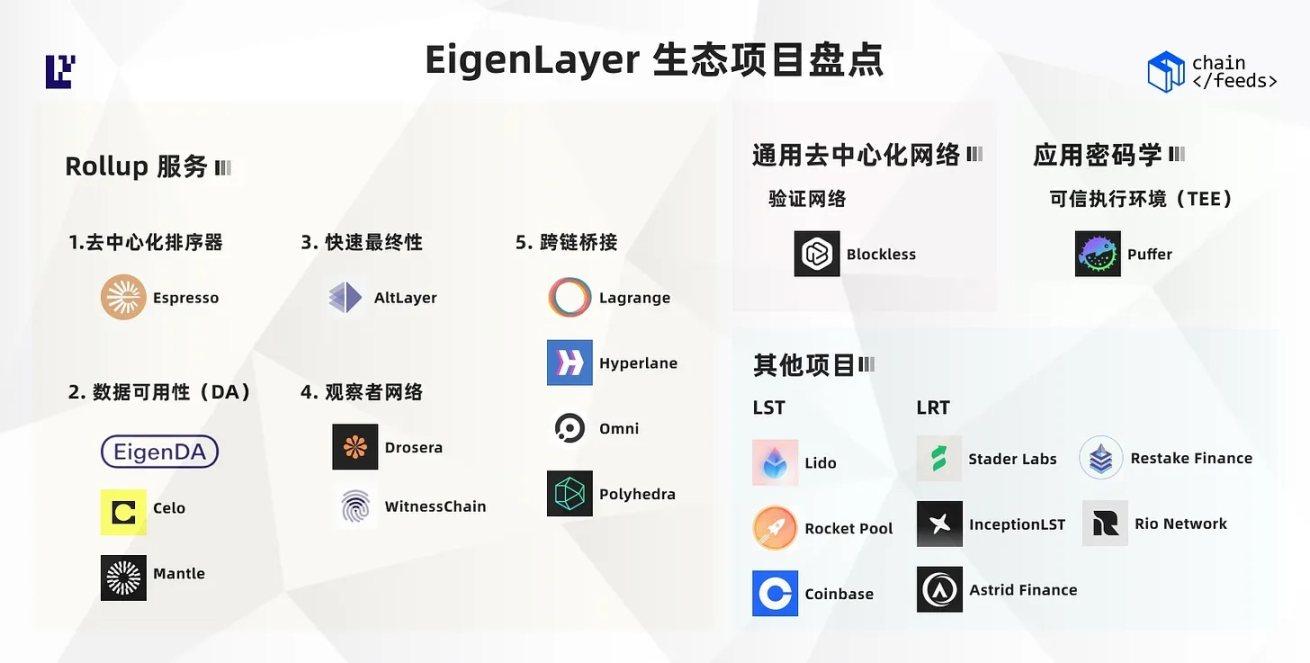
EigenLayer divides AVS into 5 types: Rollup service, applied cryptography, general decentralized network, MEV management, and AI inference. It has been more than half a year since the release of the EigenLayer white paper. During this period, many AVS have been built on EigenLayer infrastructure. This article will take stock of EigenLayer's ecological projects and explore early Alpha opportunities.
Rollup service
1. Decentralized sorter
Espresso
Espresso is creating a shared sequencer to enable rollup decentralization, improved interoperability, and a scalable data availability layer. EigenLayer utilizes heavy staking to optimize Espresso node usage and improve capital efficiency while ensuring neutrality, security, and fairness in transaction verification.
In a centralized sorter, almost all rollup values (eg fees, MEV) will be captured by the sorter. If L1 validators cannot capture the value generated by the rollup, there will be a lack of incentives to maintain and support the rollup, and L1 validators can be bribed to take harmful actions, such as forking the rollup smart contract state, to obtain more profits. EigenLayer's heavy pledge combined with Espresso decentralized sorter can alleviate this problem by giving L1 validators the power to participate in the sorter operation.
At the end of September, Espresso launched a public testnet called Cortado, which supports shared ordering of multiple rollup stacks. Users can now submit transactions for OP Stack and Polygon zkEVM rollup on Cortado. Espresso Sequencer is now a shared sequencer between these two different rollups, and users of both rollups can enjoy the fast pre-confirmation feature provided by Espresso Sequencer.
2. Data Availability (DA)
EigenDA
EigenDA is a data availability service that provides high throughput and economic security through Ethereum node operators and restakers. Based on the principle of danksharding, EigenDA aims to expand the programmable range of rollup while increasing the throughput upper limit, ultimately enabling expansion up to 1TB/s with minimal cost and technical overhead. Flexible token economics, reserved bandwidth, modifiable signature schemes, and other features enable EigenDA to support a variety of projects.
Celo
Celo is migrating from a standalone EVM-compatible Layer 1 to Ethereum Layer 2 to enable trustless liquidity sharing, decentralized ordering, and promote greater consistency with Ethereum.
Celo L2 will use off-chain data availability to keep transaction costs low, leveraging a data availability layer powered by EigenLayer and EigenDA to increase throughput, lower costs and reduce latency. EigenDA is a data availability solution that ensures high data availability by storing data on multiple nodes. This distributed storage method can reduce the cost of data storage and transmission, while ensuring that data is available when needed, reducing transaction processing costs.
Recently, Celo released a roadmap for L2. At present, the infrastructure required to build an iterative L2 development project has been completed. Select L2 that is suitable for the L2 stack technology and has core Celo functions (including handling gas fees, using CELO as a local token, and enabling use ERC-20 token for gas payment) is in progress. The mainnet is expected to be launched before the end of 2024.
Mantle
Mantle is building Ethereum Layer 2 to enable fast and cost-effective transactions through innovative rollup architecture and modular data availability. Mantle currently uses MantleDA, which is a modified version of EigenDA, which enables the Mantle ecosystem to provide high throughput and low gas costs for next-generation applications such as blockchain games and decentralized social networks.
Mantle Journey (MJ) is recently undergoing an upgrade that will allow users to track and calculate their MJ Miles directly from their profile, with MJ Miles calculated based on their activity and interactions on Mantle. Users can now add other verification options in addition to X/Twitter account verification, such as Discord, GitHub, and Steam to earn additional MJ Miles. In addition, Mantle Journey’s referral program is now active, allowing users to earn additional MJ Miles by inviting new users.
3. Rapid finality
AltLayer
AltLayer is building a Rollup-as-a-service (RaaS) tool that scales execution to provide flash rollup at very low cost. With the Rollup-as-a-Service product, developers can use a software development kit (SDK) or dashboard to launch a rollup for a specific application without having to find nodes to run the rollup, or building or maintaining any code. RaaS allows developers to focus on their applications without having to worry about the underlying technical complexities. AltLayer quickly validates state without permission by using the EigenLayer validator. Users can quickly start a rollup in a few minutes through AltLayer and specify the number of sequencers (that is, Ethereum validators who choose to serve AltLayer through EigenLayer) to operate the rollup.
AltLayer held an Altitude event to encourage community members to participate in its test network. The Altitude event was divided into four phases. The fourth phase ended on October 27. In the third stage, AltLayer invites users to start Flash Layer and use EigenLayer's heavy pledge mechanism to ensure its security and promote the decentralization of Flash Layer's sequencer. During this phase of the campaign, nearly 400,000 Flash Layers have been created. Participants contributed more than 21,000 rETH and 54,000 stETH to EigenLayer’s TVL on the Goerli testnet (approximately 95,000 rETH and 297,000 stETH).
4. Observer Network
Drosera
Drosera is the world's first Decentralized Automated Response Collection (DARC), a set of smart contracts built on EigenLayer that mitigates hacking attacks on consensus layer ETH validators. Drosera provides around-the-clock monitoring and incident response capabilities. Drosera takes zk automation to solve the emergency response problem on Ethereum by enabling hidden security intent and incident response infrastructure. The protocol defines emergency response logic and high-level validation checks for nodes to perform. EigenLayer cuts and rewards ensure honesty and accountability. This approach to security extends monitoring and bug bounty programs into dynamic models.
Recently, Drosera developer Groom Lake is conducting an operation called "OPERATION SANDY BEACH" with the purpose of tracking and recovering US$1.3 million in funds involved by a hacker.
WitnessChain
WitnessChain is building transparent middleware for blockchain. By leveraging Eigenlayer, WitnessChain is able to create a decentralized surveillance network for provable monitoring of AVS that will help the network provide the first line of defense against optimistic rollups.
5. Cross-chain bridging
Lagrange
Lagrange is building infrastructure for zk-based cross-chain state and storage proofs. EigenLayer's heavily staked Ethereum validators are combined with Lagrange's proof system to create a shared and permissionless secure zone for cross-chain state verification. The verifiers of EigenLayer will form the Lagrange State Committee, which is used to verify and confirm the proposal block state transition of optimistic rollup and generate zero-knowledge state proof. These zero-knowledge state proofs can be used by messaging or bridging protocols to enhance the security of their underlying state.
Omni
Omni is an infrastructure that creates interoperability for rollups. It serves as a unified layer for all rollups and enables mutual transmission of data. While rollup reduces transaction fees on Ethereum, it also causes users and funds to be scattered across multiple siled environments. Omni is dedicated to facilitating communication between different rollups, allowing developers to build applications that exist anywhere in the Ethereum ecosystem without being restricted to a specific rollup or execution environment. It is built on EigenLayer to enable secure rollup interoperability.
The Omni Testnet V2 Omni Overdrive phase is coming to an end. It has processed more than 4 million transactions, has more than 360,000 wallets, and processed more than 1 million cross-rollup activities.
Hyperlane
Hyperlane is a smart contract protocol for simple and secure messaging between different blockchains to achieve interoperability between chains, including asset bridging, remote smart contract interaction, and multi-chain application architecture. Hyperlane features include modular security and permissionless deployment properties. Modular security allows developers to configure their own security model for each communication channel, including optimistic, proof-of-authority, or economic security models. Permissionless deployment means Hyperlane can be deployed to any environment and interoperable with existing deployments.
Cross-chain interactions require stronger security. Hyperlane and EigenLayer jointly developed a cross-chain security module that will enable Hyperlane users (i.e., cross-chain application developers) to leverage EigenLayer's heavily pledged Ethereum validators to increase message security. sex.
On October 31, Hyperlane announced the launch of the app Nexus. Nexus leverages Hyperlane and Cosmos IBC technologies to enable interoperability and messaging between different blockchains. Allows users to transfer tokens between Hyperlane or any blockchain integrated with IBC in one interface. With Hyperlane's permissionless interoperability, any blockchain can join Nexus to access liquidity and cross-chain composability.
Polyhedra
Polyhedra is developing new zk-proof-based infrastructure (such as zkBridge) to enable trustless and efficient cross-chain interoperability through parallel and distributed computing. zkBridge is a highly secure framework for messaging and asset bridging between multiple L1s and L2s. Utilize EigenLayer's heavy staking to enhance security and efficiency, thereby reducing on-chain verification costs for EVM-compatible networks.
Currently, zkBridge is integrating with Arbitrum Stylus to improve the efficiency of smart contract verification, user accessibility, privacy protection, and enhance the security of zero-knowledge proof oracles on the Arbitrum chain.
Universal decentralized network
1. Verify the network
Blockless
Blockless is a general computing framework that supports verifiable execution, allowing developers to create and execute computing tasks that run on lightweight nodes, including everyday devices such as personal computers, for optimizing Dapps. Blockless ensures the security of off-chain execution by adopting zk and dynamic consensus verification methods. Utilize EigenLayer's distributed, trustless verification nodes to achieve high-performance trustless computing, while Blockless's secure operating environment prevents accidental cuts and protects validators from resource usage overload, thus protecting EigenLayer's heavy stakers. Benefit.
Recently, Blockless proposed the concept of nnApps (Network Neutral Applications). The core idea is to create a modular application architecture that enables dApps to transcend the rules and limitations of the network they run on. nnApps uses an automated workloads orchestration mechanism to ensure that each workload is processed by the node most suitable to execute it, supporting dynamic selection of the most appropriate consensus (such as pBFT, RAFT) and verification algorithms (such as zero-knowledge proven) to meet the specific needs of the application.
applied cryptography
1. Trusted Execution Environment (TEE)
Puffer
Puffer is building a trust-minimized and permissionless liquidity staking protocol. Puffer’s Secure Signer technology is funded by the Ethereum Foundation and is designed to improve validator security and reduce risk. Secure Signer is a remote signing tool that utilizes Trusted Execution Environment (TEE) and secure isolation technology to limit access to validator keys, eliminating the risk of consensus client errors or user errors leading to cuts. At the same time, by incorporating this new technology into the liquid staking protocol, Puffer will safely reduce the validator staking requirement from 32 ETH to just 2 ETH, promoting the decentralization of Ethereum.
other projects
1.LST
The re-pledged assets in EigenLayer can be ETH or LST. EigenLayer has provided three types of LST re-pledge: stETH, rETH and cbETH. Last week the community voted to select the next LST to be added to the heavily pledged pool. There are 8 types of LST participating in the election: wBETH (Binance), sfrxETH (Frax), SETH2 (Stakewise), AnkrETH (Ankr), mevETH (mev.io), EthX (Stader), oETH (Origin ETH). The voting ended yesterday, and 6 projects received more than 15,000 ETH votes, and EigenLayer will gradually add them to the heavy pledge pool.
Lido
Lido is currently the liquid staking protocol with the largest market share, allowing users to pledge any amount of ETH to Ethereum and obtain equivalent stETH, which can be used or pledged again in the DeFi market. Lido is not a permissionless protocol, and its node operators are selected by the Lido DAO through governance.
Rocket Pool
Rocket Pool is a liquid staking protocol that lowers the participation threshold from 32 ETH to 0.01 ETH, allowing holders to deposit their ETH to earn rETH. Rocket Pool's node operators are permissionless. Anyone can become a node operator by creating a minipool and depositing 8 ETH, with the remaining ETH coming from user deposits.
Coinbase
cbETH, launched by Coinbase on June 16, 2022, allows users to pledge ETH through Coinbase in exchange for cbETH to conduct various DeFi transactions.
2. LRT
Once Liquid Staked Tokens (LST) are locked on EigenLayer, they serve as collateral and cannot be traded. Liquidity Heavily Collateralized Tokens (LRT) provide a solution to deposit LST through the Liquidity Heavily Collateralized Token in exchange for LRT for use in other DeFi ecosystems.
Stader Labs
The liquid heavy-staking token rsETH launched by Stader aims to provide users with staking rewards Ethereum while retaining liquidity and the ability to participate in DeFi.
At present, rsETH has been launched on the test network, and the liquid pledged token called ETHx launched by Stader is currently competing for voting to be listed on EigenLayer.
*rsETH testnet: https://lrt-testnet.staderlabs.com/
InceptionLST
InceptionLST is a Layer 2 heavy pledge platform that can bring higher liquidity and income to pledged assets. Users re-pledge LST supported by EigenLayer on InceptionLST in exchange for inrETH (LRT). InceptionLST will increase staking rewards by selecting EigenLayer node operators with the best returns.
*Official guide for participating in the testnet: testnet guide
Astrid Finance
Users deposit stETH or rETH (LST) into Astrid Finance and receive rstETH or rrETH (LRT) in return. These tokens are then staked to EigenLayer and distributed to node operators by Astrid DAO. Rewards earned are compounded automatically.
*Official guide for participating in the testnet: testnet guide
Restake Finance
Restake Finance is the first protocol to launch modular liquidity re-staking for EigenLayer. Users deposit LST into Restake Finance and exchange LST for rstETH (LRT) at a ratio of 1:1 in return. Holding rstETH can earn Ethereum rewards (estimated at 3%-5%) as well as EigenLayer's additional rewards (estimated at more than 10%).
*rstETH test network: https://app-beta-retakefinance.web.app/
Rio Network
Rio Network is a network that issues LRT, and its first product is reETH. Rio Network aims to provide risk management of ETH total returns without sacrificing liquidity. Trade-off between re-staking risk, re-staking income and underlying ETH liquidity. Expand the heavily collateralized ecosystem and reduce the cost of capital for AVS by providing optimal risk management. The testnet has not been launched yet.