This article will introduce the #Dmint update of #Atomicals and introduce you to a new way of using POW for BTC asset issuance.
The Atomics protocol has updated the NFT minting method Dmint, and introduced a large number of Bitcoin-like POW mining Bitwork into the design.
This is very in line with the Bitcoin culture and also stimulated the excitement of the community. Because there were too many people downloading and installing the environment, it even pushed Atomics' github code base to the eleventh place in the overall list.
So, what is Dmint? Why should you care about Dmint?
In addition to issuing Tokens like #BRC20 , Atomics can also be used to create NFTs where all data is stored on BTC. Of course, the method is different from #Ordinals .
Atomics' NFT minting method is called Dmint, which is a fairer and more decentralized way to launch NFTs.
The NFT deployer needs to number each NFT image in the series (such as 0000 to 9999). The Atomics protocol will calculate the hash value of each image file and generate a separate json file for each image.
The protocol will then calculate the hash value of the above image through a Merkel tree to calculate a proof, which can be used to verify any NFT in the series.
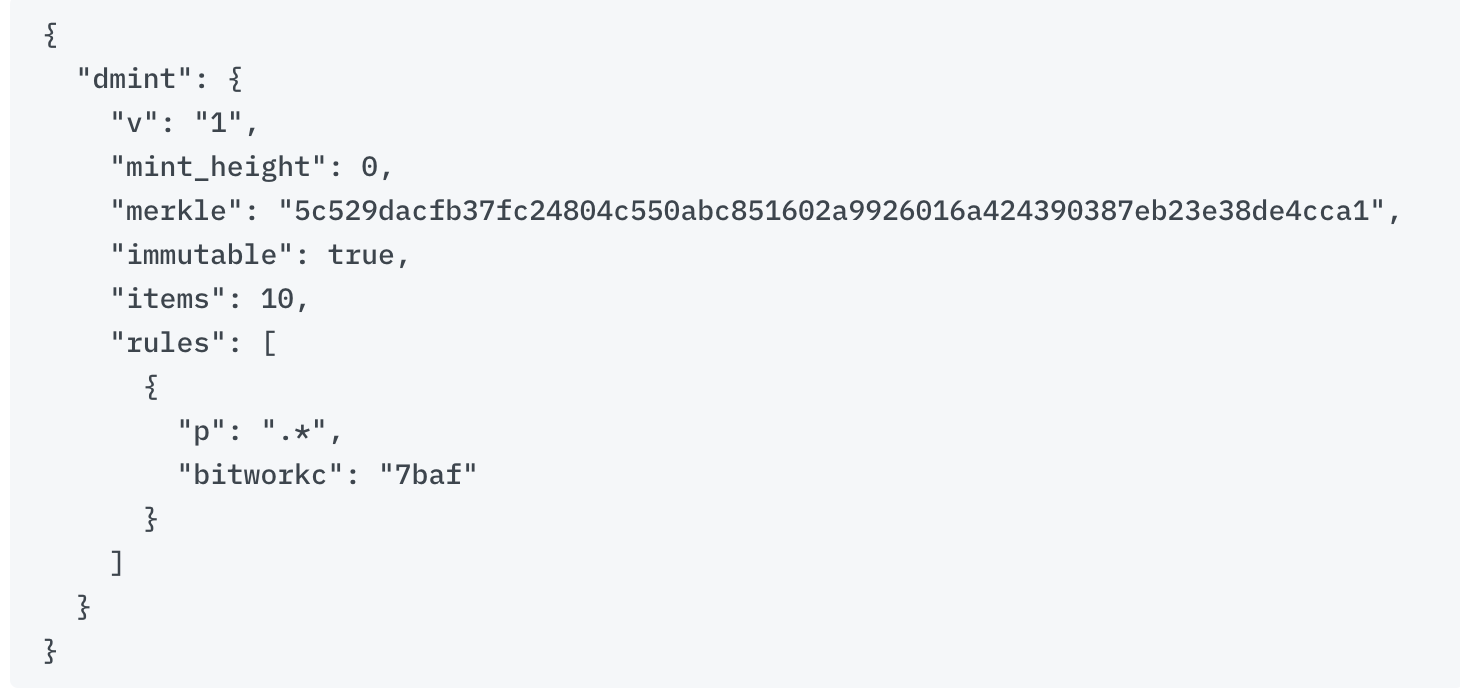
The deployer of the NFT series writes this certificate into a transaction together with the NFT's name, description, logo, mining difficulty and other data, and sends it to the Bitcoin network to complete the registration of the series.
Therefore, the deployer only needs to send the proof of the NFT image during the registration process, rather than each NFT image itself. Even if a series of 10 million images is deployed at one time, it will not cost many sats.
The NFT project party then discloses the picture and json file of each NFT. After the user selects it, he or she sends a Bitcoin transaction, engraves the picture data and json into the BTC block, and completes the casting (claiming) of a single NFT.
The hash values of these NFT images can be mutually verified with the Merkle tree proofs in the registered transactions.
This completes the issuance and casting of NFT into a series.
Of course, the highlight is still the fair launch part of NFT. The innovations introduced by Dmint here mainly include two points:
Mint is only available after Bitwork mining, and multiple difficulties can be customized in a series;
Accepts specific UTXOs to send minting transactions, which can be used to collect #ARC20 tokens or paid to projects on request
The first is Bitwork mining, which is a fair emission method unique to the Atomics protocol. The deployer can set a prefix of a specific length for casting. The minter must use a computer to exhaustively collide with a hash value that matches the specific prefix. , can be cast.
First of all, properly set Bitwork effectively lengthens the mint window time, giving average players more opportunities. The casting of Dmint NFT cannot be done in batches, nor can we obtain a large amount of chips just by raising gas. One CPU has one chance, and it is distributed relatively fairly.
Furthermore, in the same NFT series, different Bitwork difficulties (accurate to each one) can be set for different NFTs, such as:
whiteboard
Set the difficulty of the last 8,000 NFTs in the series to 4 digits
(calculates for 1 minute)
green outfit
The difficulty of NFT with serial numbers 1000-1999 is set to 5 digits
(Calculated 16 minutes)
purple outfit
The difficulty of NFT with serial numbers 100-999 is set to 6 digits
(calculate 256 minutes, which is 4 hours)
legend
The difficulty of NFT with serial numbers 0-99 is set to 7 digits
(Counting 3 days)
If you agree with the value of Bitcoin POW, then the value is also refined through Bitwork calculations, which undeniably records the rarity of NFT.
Obviously, the easiest thing to think of with this variable difficulty design is the issuance of domain names: short domain names have fewer numbers and are more valuable, corresponding to the higher Bitwork difficulty, so large miners can try to mine and earn a lot of profits; long domain names have more numbers and are relatively more valuable. Lower, corresponding to the lower difficulty of Bitwork, any ordinary person can spend a few minutes to cast one for themselves.
In a public network without a center, how can domain names belonging to all mankind be fairly distributed?
Pure calculations like Bitwork are the ones that can best gain consensus.
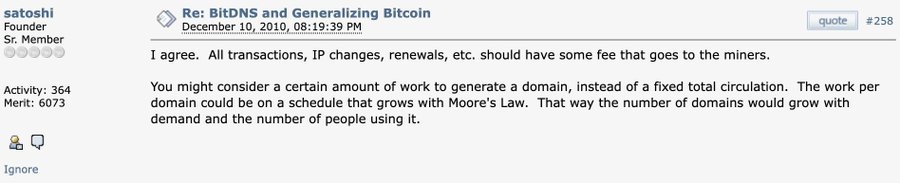
This design also seems to echo the idea of Satoshi Nakamoto 13 years ago. The following are his original words: "Miners should be given some compensation, and you can consider using a certain amount of work to generate a domain name."
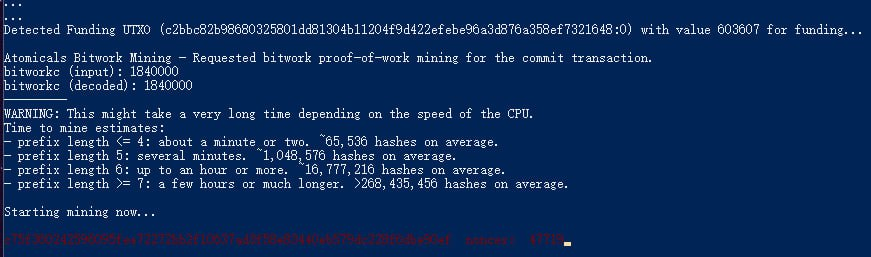
The mining of NFT MINT is just the beginning of Atomics. The creation team is also considering introducing variable difficulty bitwork into the issuance of arc20 tokens by modifying the index, which is really exciting.
Bitwork itself is calculated at the application layer of BTC and requires the protocol to pass in various environmental parameters, so it is not feasible to completely separate mining and sending transactions.
The current limit of involution is the competition for GPU graphics cards. Large mining pools and even ASICs will not appear. Therefore, in the short term, there are still a lot of opportunities for ordinary home computers to compete with Bitwork. Of course, I expect that services for selling computing power will also be launched soon.
The second interesting innovation is that, not just BTC, the Atomics protocol also allows the acceptance of specific UTXOs to send NFT minting transactions, which means that some kind of #ARC20 token can be collected while minting NFTs.
This is the advantage of the colored coin design of the Atomics protocol. The native UTXO of 1 arc20 = 1 sat gives it better programmability.
Without any additional development, Atomics' NFTs can naturally have a "matryoshka" relationship with #ARC20. Use arc20 to mine new NFTs (arc20 itself can also be set up for bitwork mining), or even use old series of NFTs to mine . mint's new series of NFTs actually offer huge possibilities.
More and more inscription protocols are beginning to introduce bitwork-like mining mint functions.
When the strings jump, the texture visually is completely different.
The renaissance movement of BTC culture is overwhelming all consensus in the crypto world.
People have already developed a strong first consensus on "fair distribution" during the inscription craze. In the process of exploring "fairer distribution" and finding value in memes, there will inevitably be a second consensus on POW itself.
This will bring a new round of big development to the Atomics protocol, and any protocol willing to try it, Dmint is just a wedge.