Since Ethereum transferred from POW to POS in September last year, the miner community has been actively looking for new POW tokens. Kaspa, a POW public chain based on the GHOSTDAG protocol, has emerged. The Kaspa token KAShas increased by more than 1,600% in the past year. , the current market capitalization has reached US$2.89 billion, ranking among the top 30 cryptocurrencies by market capitalization.
KLS fork coin comes out
While many people are frustrated because they missed KAS, Kaspa’s fork project Karlsen Network (KLS) has recently appeared on the market, quickly attracting attention in the mining community. According to the official white paper, this fork project supports GPU mining. , as ASIC mining farms are becoming the dominant solution to make it easier for individuals to participate in mining because GPUs are more versatile than dedicated ASIC mining machines.
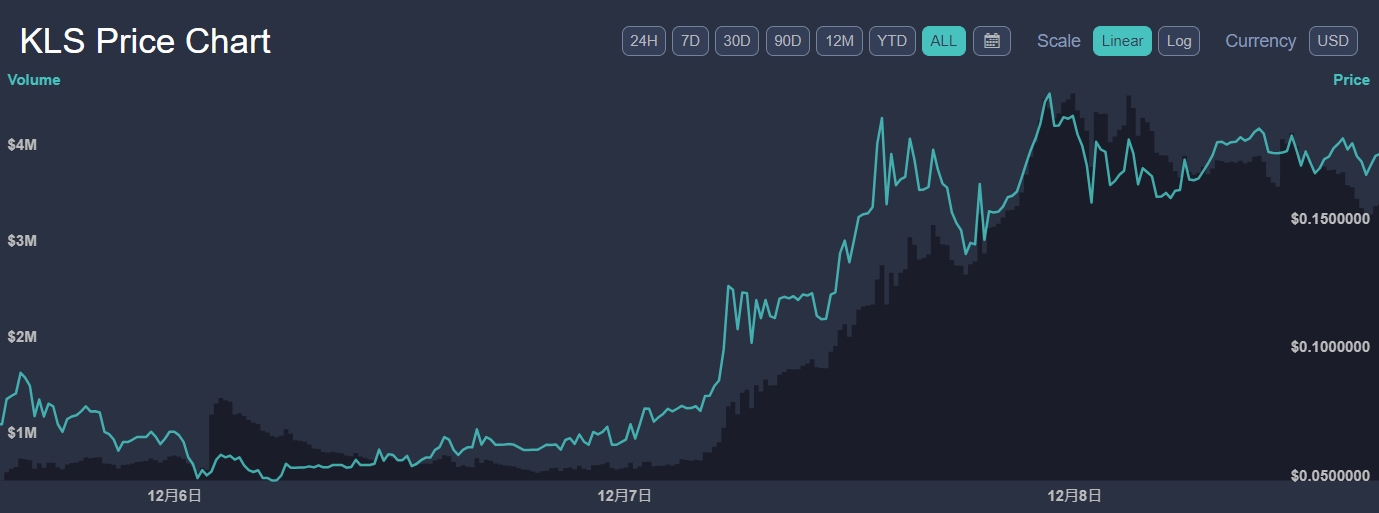
The maximum supply of KLS is approximately 5 billion coins, with no pre-sale or pre-mining. According to livecoinwatch data , KLS is only listed on non-mainstream exchanges such as TradeOgre, XeggeX, and NonKYC Exchange. The currency price has risen from approximately US$0.05 in the past two days. To the current US$0.175497, the trading volume in the past 24 hours is US$3.36 million.
 The mining community is crazy
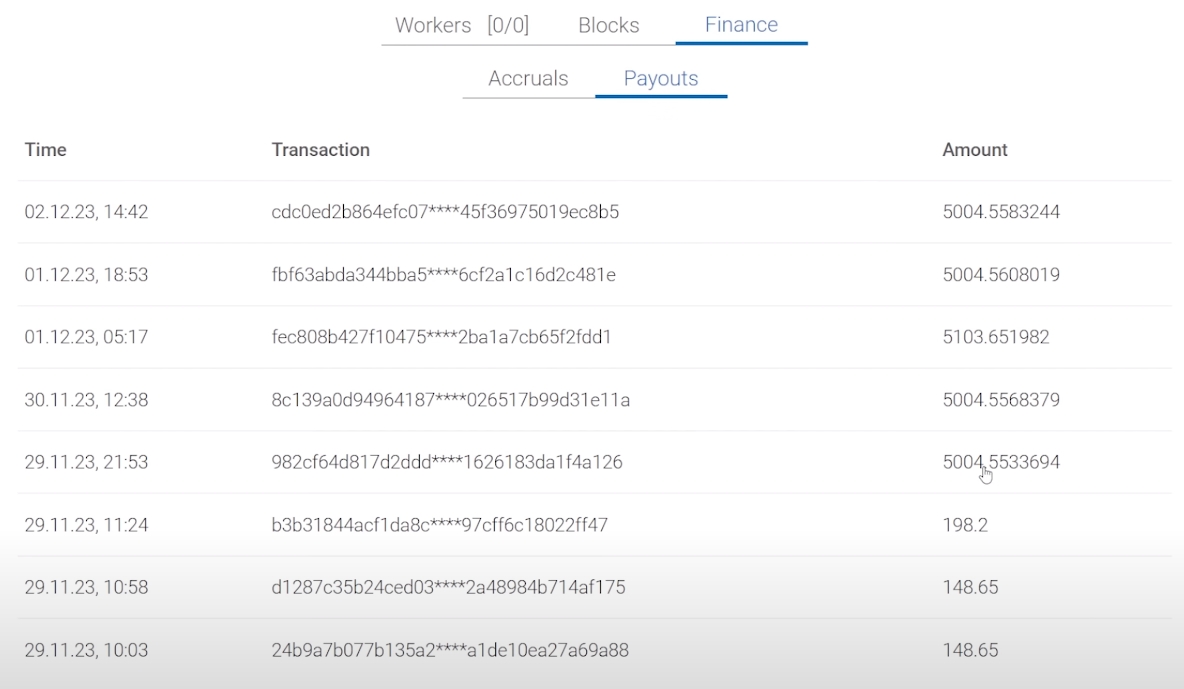
Although the KLS token has only been online for a few days, it has already attracted attention in the mining community. A mining KOL "Red Panda Mining" followed by 233,000 people shared that before the KLS token was listed on the exchange, he tried I mined with a graphics card for 4 days, and I have made a profit of up to US$3,000 so far.
Mining expert Zifeng wrote an article and pointed out that KLS is extremely crazy. There are a lot of people who have seen the high price at the opening, but the price has never returned. There are also people who have seen the opening without any news, climbing step by step to value, total output Among the top few, it is rare to see a company whose value and total output rise to the top five within a few days of opening:
Now, because it has not been listed on a major exchange, the trading volume is relatively low (compared to the total output value and trading volume). It feels like it was like when ETH first came out, with a bunch of imitations of the same algorithm, but the block generation was changed. It’s just a matter of time and block production.
As for whether Kaspa's ASIC can upgrade the firmware to mine this mine, it is unknown. The new currency has just been released, and the risk is relatively high. If the mining machine is already mining, you can play with it. As for moving the mining machine out again to mine, it is Don't be busy, maybe it will be taken back in a few days.
Income calculation
According to Hashrate.no data , currently including Huida’s RTX 4090, 4080, 4070 Ti, 3090, 3080 Ti, 3080, 3070 and other mainstream graphics cards, or AMD’s RX 7900 XTX, RX 7900 XT, etc., the highest mining profits The projects have all become KLS. Currently, the 4090 graphics card can mine $5.94 per day, with a profit of $5.28.
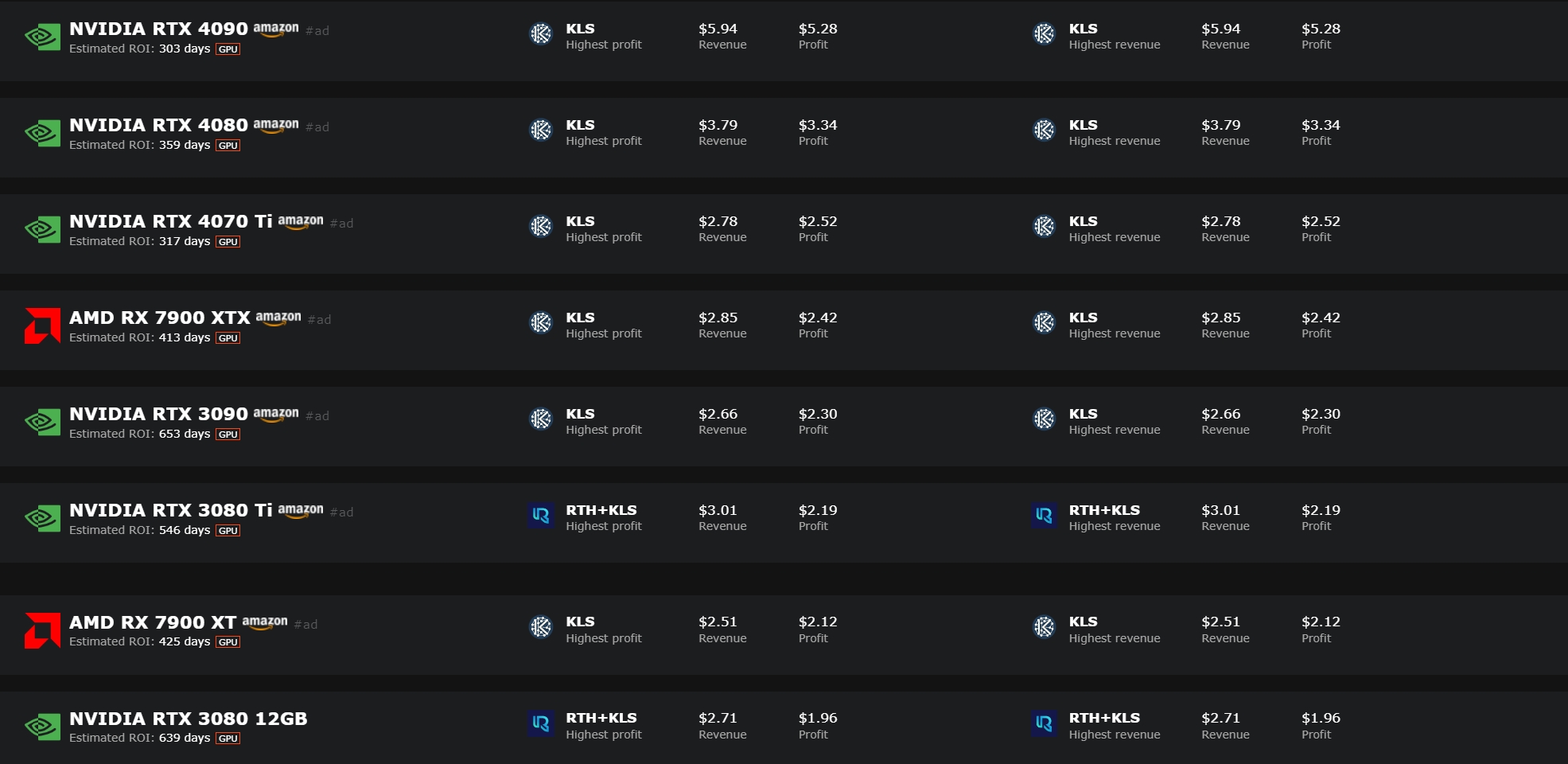
If we take the relatively affordable RTX 3070 graphics card as an example, its computing power is 1050 Mh/s, its current 24-hour daily average output is US$1.63, and its average daily income is US$1.36. If calculated based on an eight-card mining machine, the daily income It can reach US$10.88, and a 3070 graphics card with a second-hand price of US$250 can pay for itself in about 184 days.

It should be noted that so far, the founder of the KLS token is not known yet. The new currency carries certain risks. Please do your own verification and risk management.