Author's opinion
Interlay is a cryptocurrency project with three narratives at the same time: "Bitcoin DeFi", "Polkadot Ecology", and "Bitcoin Layer 2".
Interlay is one of the Polkadot parachains. It won the tenth Polkadot slot auction in early 2022. Its main job is to bridge Bitcoin to other chains in a decentralized manner so that Bitcoin can also participate in DeFi. iBTC is Its main products are currently mainly within the Polkadot ecosystem, and will also be connected to ecological networks such as Ethereum and Cosmos in the future.
The Interlay project team has also recently developed the Bitcoin Layer 2 network: Build on Bitcoin (BOB) and proposed the BRC-21 protocol, which will bring more crypto assets to the Bitcoin ecosystem (such as bringing DAI into Bitcoin network).
At present, the community attention of the project is not very high. There are more than 20,000 followers on Twitter, and the market value is not high. At the time of writing, it is only more than 20 million US dollars. It is still a relatively unpopular small coin at this stage, but its three-fold narrative There are opportunities for interesting developments in the future. This article will introduce Interlay, and also think about what interesting sparks these narratives can collide with.
Interlay in one sentence
Interlay: Bring Bitcoin cross-chain to other public chain ecosystems to participate in DeFi in a decentralized manner, and will expand to more other cryptocurrencies besides Bitcoin in the future.
The XCLAIM paper written by Interlay founder Alexei Zamyatin in 2018 is a paper on cross-chain transfer of cryptocurrency assets in a trustless manner. It has passed peer audits and accumulated hundreds of citations. The XCLAIM asset cross-chain framework + the cross-chain interoperability of Polkadot parachains are the two core weapons for Interlay to achieve its goals.
Interlay / $INTR Small file
Currency name | INTR |
The public chain where it is located | Interlay (Polka Parachain) |
Market capitalization ranking | At the time of writing, CMC’s market capitalization ranked 1326th. CoinGecko ranks 1447 |
Listing date | Won the tenth Polkadot slot auction in February 2022 Interlay mainnet will be launched in March 2022, and the INTR token will be listed on March 12 2022/August launch of iBTC cross-chain encapsulation of Bitcoin One-stop Bitcoin DeFi platform launched in 2023/July |
Total Token Supply | The total supply of the uncapped inflation model is 1 billion in the first four years of its launch, and will be allocated to the vault for future development and maintenance at an inflation rate of 2% every year. |
Token usage |
|
Official website and App | Official website: https://www.interlay.io/ Official App: https://app.interlay.io/ |

What is Interlay - Project Introduction
-Interlay
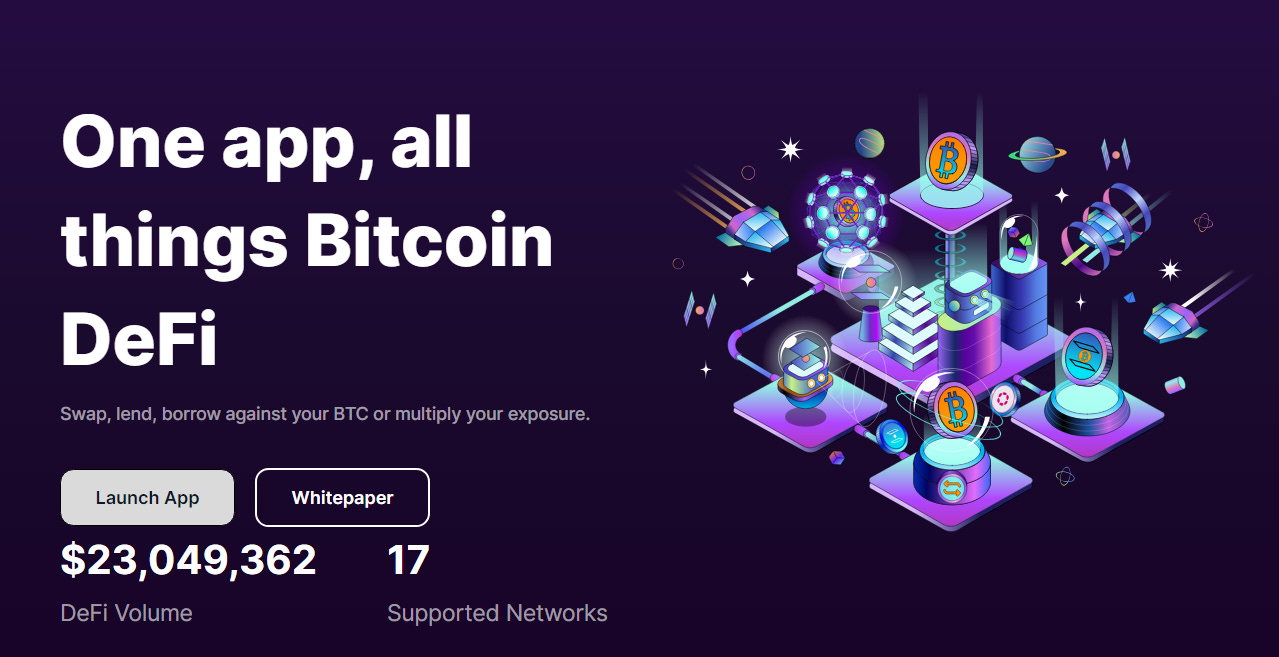
One-stop Bitcoin DeFi platform, Interlay introduces itself on its official website.
The Bitcoin network does not support complete smart contracts. The method adopted by Interlay is to encapsulate Bitcoin cross-chain to other chains. The Bitcoin encapsulated by Interlay cross-chain is called iBTC. iBTC can currently be used in the Polkadot ecosystem. It has been circulated on several Polkadot parallel chains and participated in DeFi operations such as lending or mining.
Cross-chain encapsulation of Bitcoin has appeared four or five years ago. Currently, the most well-known ones are WBTC and ERC-20 Bitcoin on Ethereum. The main framework used by Interlay to cross-chain is XCLAIM, which was introduced by Alexei Zamyatin, the founder of Interlay, in 2018. The paper I wrote discusses a decentralized way to transfer assets across chains.
If you are interested in the detailed process and technology, you can refer to this paper directly:
XCLAIM: Trustless, Interoperable Cryptocurrency-Backed Assets
Let’s try to simplify the explanation here. If you want to cross-chain Bitcoin to Ethereum, the traditional cross-chain method is to lock a Bitcoin on the Bitcoin network through cross-chain protocols such as cross-chain bridges, and then lock it in Ethereum. The risk of casting an encapsulated Bitcoin on the Internet lies in whether there will be problems with the cross-chain bridge, and you need to bear the risk of the cross-chain bridge.
XCLAIM adopts a mortgage method, similar to MakerDAO's method of issuing decentralized stable currency DAI. First, someone runs the vault (Vault), and excess collateral must be mortgaged to run the vault. People who want to encapsulate Bitcoin across chains choose the vault and transfer the Bitcoin The coins are locked in the vault and iBTC is minted on the target chain. Even if something goes wrong with the vault, and the vault owner runs away with the locked Bitcoins, or is stolen or hacked, the user will receive collateral as compensation. Everyone can participate in the vault. If you don’t trust others, you can open your own vault and lock the Bitcoins yourself. In comparison, this is a decentralized cross-chain casting method without the risk of a centralized cross-chain bridge.
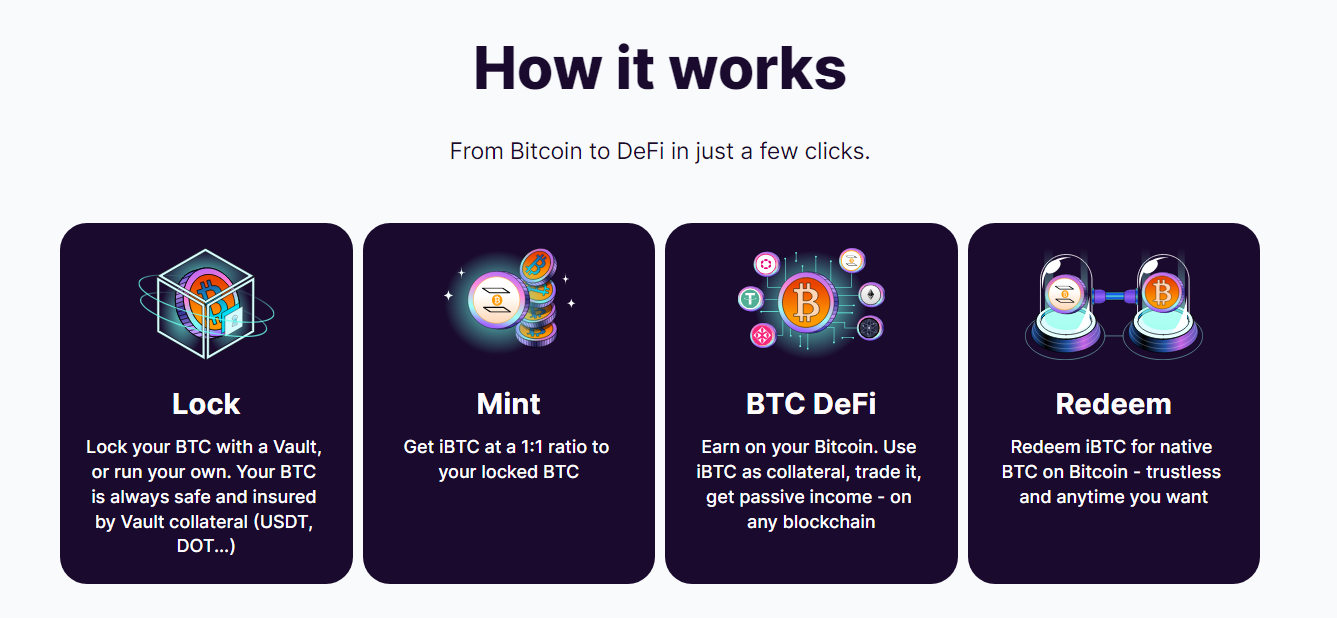
The design of the vault and collateral is similar to MKR's issuance of DAI. The rest of the process is similar to the general cross-chain, which is also locking > minting. Bitcoin is locked at a ratio of 1:1 to mint iBTC. When redeemed, the reverse is true. The protocol will ensure that every iBTC can be redeemed. When exchanging one Bitcoin, if something goes wrong, there will still be collateral available as compensation. The mortgages are all over-collateralized. When something goes wrong, a liquidation mechanism will be activated to ensure that iBTC holders can obtain assets of equal value. This cross-chain method is theoretically It can be used on various crypto assets, not just Bitcoin.
iBTC is Interlay’s main product and the DeFi Hub that can use iBTC. In addition, Interlay is integrating with more ecosystems to bring iBTC to more other chains. At the same time, the Interlay project team is also actively developing the Bitcoin ecosystem. In mid-2023, it proposed the BRC-21 protocol, which can encapsulate more encrypted assets cross-chain into the Bitcoin chain, and announced the creation of a Bitcoin layer that supports Rust and EVM smart contracts. 2 BOB is also compatible with the Lightning Network and plans to bring more applications in the Bitcoin ecosystem.
-Introduction to INTR Token Economy
Interlay’s main token has three main uses:
governance
On-chain transaction fees
Can be used as collateral
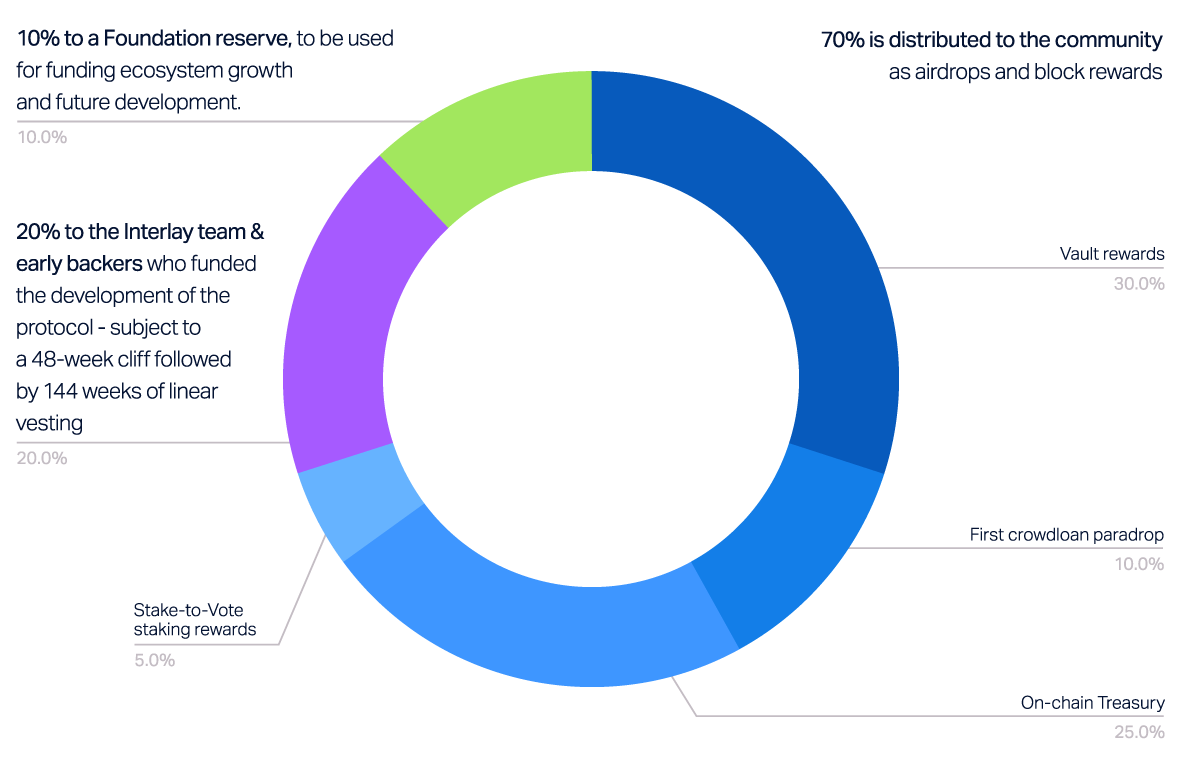
A total of 1 billion will be issued in the first four years, 70% of which will be distributed to the community in the following manner:
30% as treasury reward
10% first slot auction bonus
25% is placed in the project treasury
5% as staking voting reward
Among the remaining 30%,
20% belongs to the team and early investors, and will be unlocked linearly in 144 weeks after the half-year lock-up period.
10% is used as foundation reserve for future ecological development.
Starting from the fifth year, additional issuance will be issued at an inflation rate of 2% per year, and this 2% will be distributed to the community. The current token issuance status can be seen on the blockchain browser:
Although INTR is a governance token, you need to pledge INTR to participate in governance. Voting rights are allocated according to the VINTR obtained through pledge. The more tokens and the longer the period of pledge, the more VINTR you can get. This part is somewhat similar to the common ve governance model. .
-Interlay chain
Interlay is the tenth Polkadot parachain, winning the tenth slot auction in 2022/3. Polkadot is a cross-chain ecosystem, and all parallel chains are isomorphic chains. Blockchains built using the Polkadot architecture enjoy better interoperability and can have fast, cheap and safe cross-chain operations.
The security of the parachain itself is provided by the Polkadot main chain. As long as the market value of Polkadot is large enough, there is basically no need to worry about the security part. Compared with running DApps on public chains of other platforms, running applications on self-created application chains is more customized and can ensure better performance.
Because of this chain, Interlay is not just a DeFi or encapsulated Bitcoin protocol, it is also a chain.
Interlay Financing History
Established in 2019, the founders are Alexei Zamyatin and Dominik Harz. So far, Interlay has completed 2 rounds of financing totaling US$9.5 million.
Completed seed round in July 2021, led by IOSG Ventures, amounting to US$3 million
DeFi interoperability platform Interlay completed a US$3 million seed round of financing, led by IOSG|Anue Juheng
Completed the second round of financing in December 2021, led by DFG Capital, amounting to US$6.5 million
DeFi interoperability platform Interlay completes US$6.5 million in financing, led by DFG Capital
In addition to financing, Interlay also received funding from Polkadot’s official development agency Web 3 Foundation in March 2020
Interlay Receives W3F Grant to Build Trustless BTC-Polkadot Bridge
Interlay Features
Polkadot Parachain - Polkadot provides security and can easily interoperate with other Polkadot ecological chains across chains. It can also be connected to other ecosystems in the future and is highly scalable.
Decentralize assets across chains - The XCLAIM decentralized cross-chain framework, which has been audited by peers, provides trustless Bitcoin cross-chain assets.
Bitcoin Layer 2 that supports EVM - named BOB (Build on Bitcoin), is still under development. The public test network has just been launched in December 2023. More iBTC usage scenarios can be added after it goes online.
Technology aside, Interlay is not a complex project. What it wants to do is simple: first bring Bitcoin across chains for use in more places, and then follow the same model to bring more assets across chains to more places.
So there are two core focuses: How to make cross-chain safe and convenient? How to make cross-chain assets have more application scenarios?
The former is achieved through the XCLAIM framework and Polkadot's architecture. Polkadot itself is a cross-chain architecture, providing cross-chain interoperability & shared security. The latter is achieved through ecological development. The ecological development of Bitcoin itself is closely related to The ecological development of Polkadot.
Compared with other cross-chain encapsulated Bitcoin assets, the main feature of iBTC is that it adopts a decentralized cross-chain framework, without the risk of a centralized cross-chain bridge, and is a relatively low-risk encapsulated Bitcoin. Coupled with Polkadot's architecture, iBTC can easily cross-chain to other parallel chains or other public chain ecosystems.
Is Interlay safe? Is it a scam?
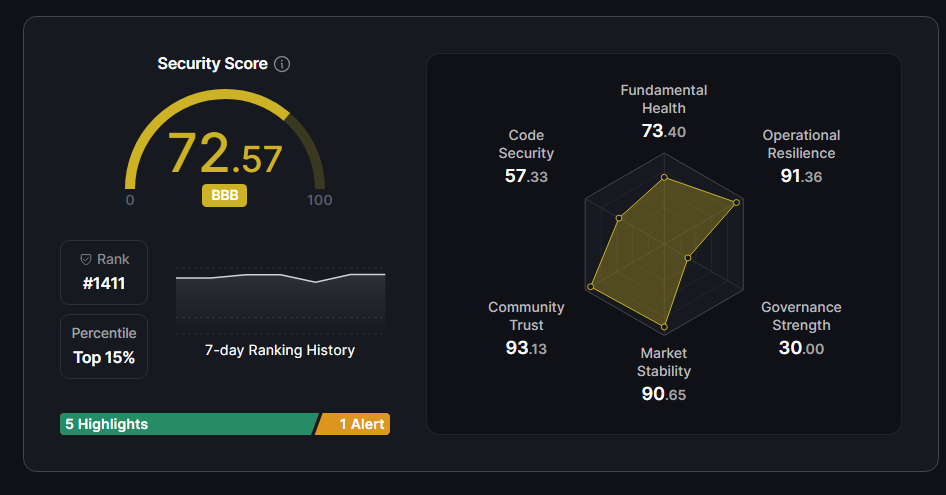
According to blockchain security company Certik on Certik Skynet, they rated Interlay security as BBB with a score of 72.57, putting it in the top 15% of projects - source .
Interlay's code has also been audited, and the company that performed the audit and its audit records are listed on the official website
Interlay was founded in 2019. It is a real and operating project, but be sure to connect to the correct official website when using it for the first time!
Official website:
Official Twitter: https://twitter.com/interlayHQ
Official App:
INTR currency price trend and Interlay current development
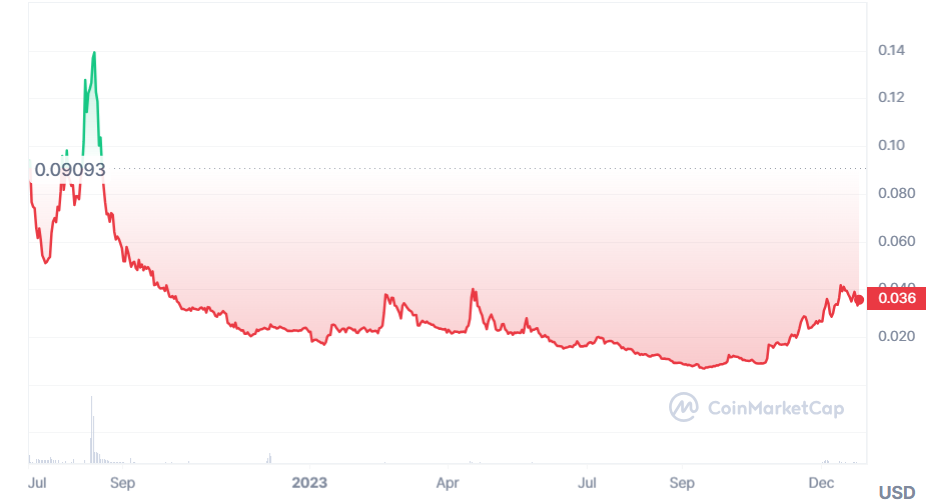
The current currency price of INTR, which was listed during the bear market, has not exceeded the period when it was first listed. The price did not perform outstandingly during the bear market, but it has increased by 40% in the past month.
If you consider that although INTR has been on the market for more than a year, its functions have been gradually launched, and the DeFi platform will not be launched until July 2023. The currency price has not changed significantly in the past year or so, and it seems very reasonable that there was no reaction until recently.
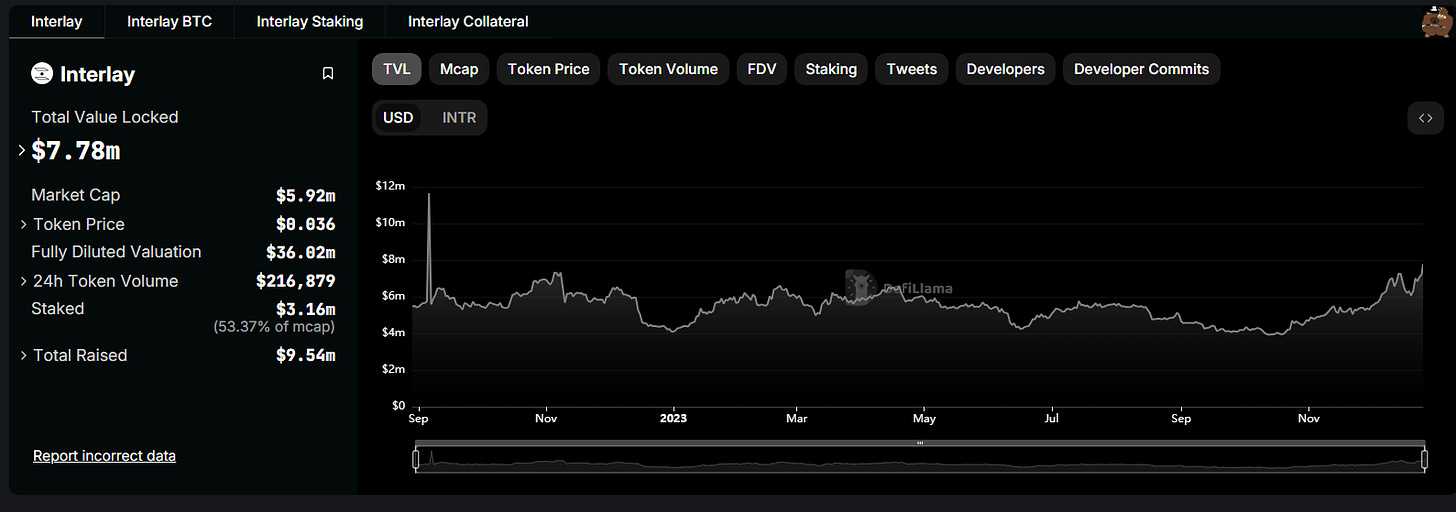
The data on DeFiLlama currently includes locked Bitcoins and treasury collateral. The total locked value of Interlay reaches more than 7 million US dollars (more than NT$200 million).
According to official data from Interlay, more than 73 iBTC have been minted so far, a number that has increased by 20% since the fourth quarter of this year.
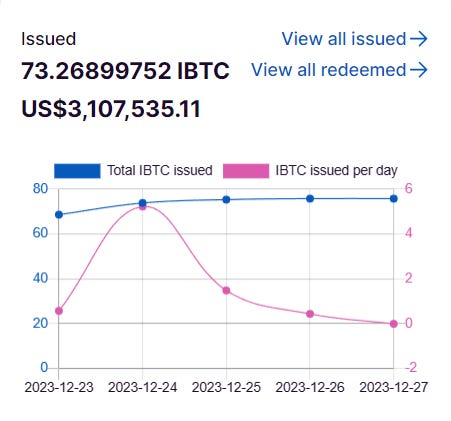
There are currently several other encapsulated Bitcoin minting quantities and issuance periods:
WBTC: 155,730, four and a half years
tBTC: 1,353, more than three years old
sBTC: 274, more than four years
renBTC: 304, more than three years
In comparison, iBTC has only been online for more than a year, so it is still a rising star, and there is still a lot of room for growth in terms of minting quantity.
Interlay’s recent important development milestones
2023/May - Proposed BRC-21 token standard (able to bring other assets to the Bitcoin chain and be used in the Lightning Network)
2023/July - Launch of Bitcoin one-stop DeFi platform
2023/August - Announcing the launch of Bitcoin layer 2 BOB (Build on Bitcoin)
Continue to integrate with various Polkadot parachains and bring iBTC to other parachains. At the time of writing, iBTC is already circulating on Acala / Astar / Moonbeam / Hydra / Parallel and other parachains.
2023/December - Release of BOB public testnet
Regarding Bitcoin Layer 2 BOB, officials currently say that they will combine BOB with Interlay to increase the usage scenarios of iBTC. However, it is not yet clear whether the INTR currency will have a function in BOB and whether it can capture the value on BOB. This part needs to wait for the project Fang will have more specific instructions in the future.
Interlay operation tutorial
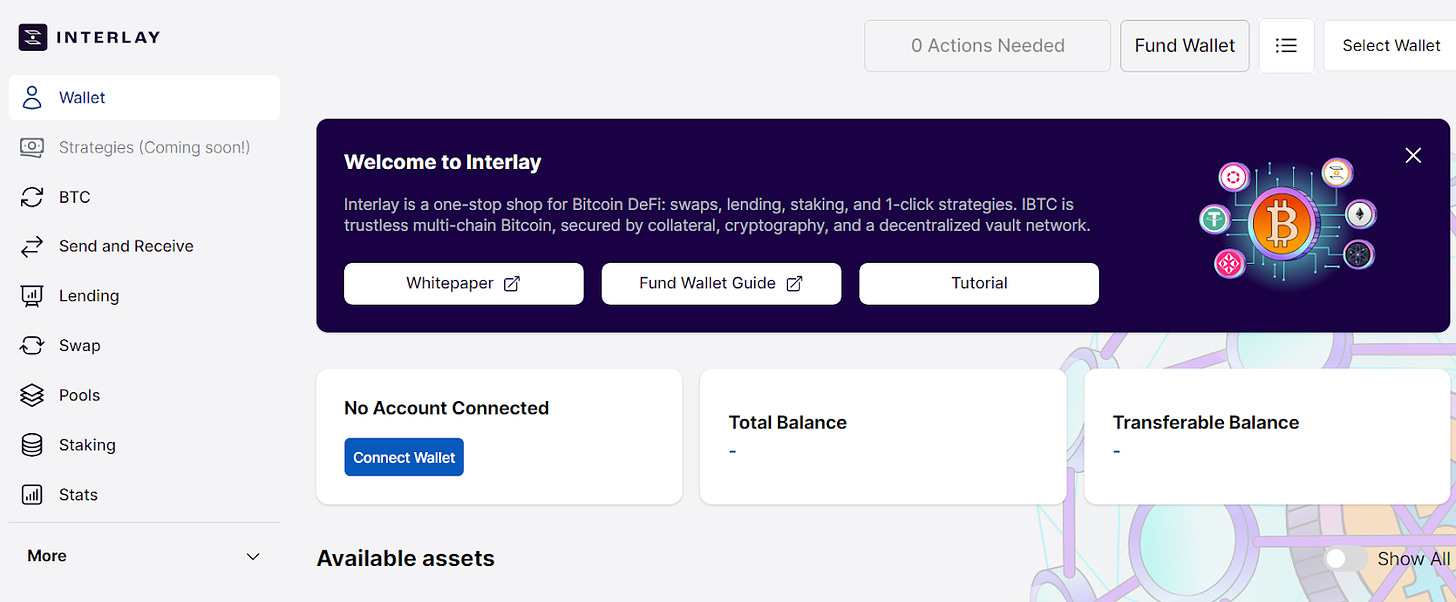
Interlay DApp:
Interlay is a Polkadot parachain. The operation must be combined with the Polkadot ecological wallet. When using it, press the upper right corner to connect the wallet. For the Polkadot ecological wallet, you can refer to these three: Polkadot.js / Talisman / Subwallet. The first one is the native Polkadot. Official wallets, the latter two are wallets that also support the EVM chain. If you already have many assets on the EVM chain, you can consider installing the latter two directly.
For information about Polkadot wallet teaching, please refer to this article. The article provides an introduction and basic teaching of these three wallets:
Does Polkadot also have the inscription ordinal? Dotordinals / Dota Polka Inscription Tutorial
As a DeFi platform for Bitcoin, Interlay's DApp basically provides the function of minting iBTC & basic DeFi. As Interlay cooperates with more projects, iBTC can be transferred to other chains to perform more operations in the future.
The following introduces the basic functions and simple tutorials on Interlay DApp:
How to mint iBTC via BTC?
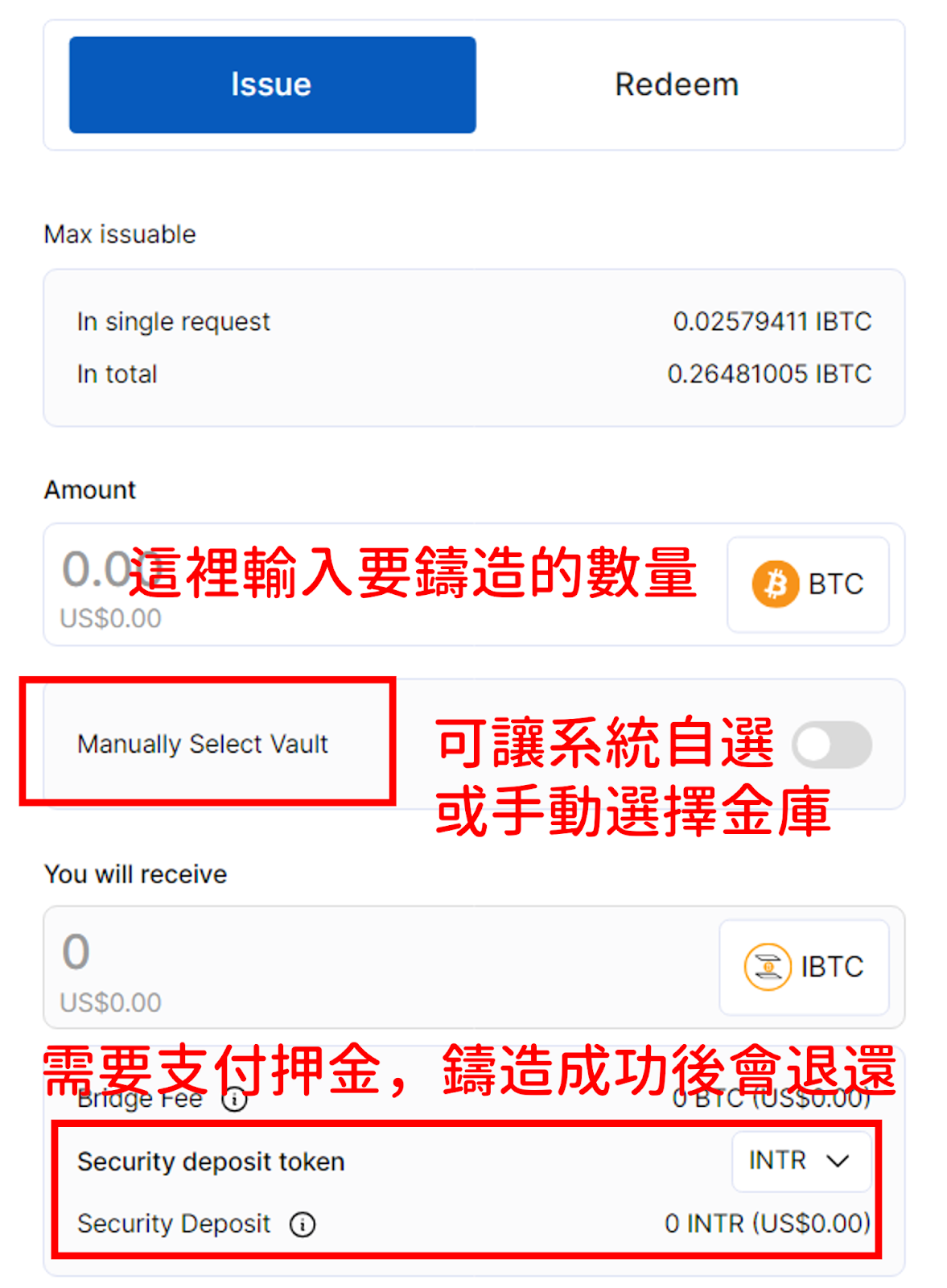
To cast iBTC, you need to lock the same amount of BTC. The process is to apply here first, enter the amount you want to mint, and let the system choose the vault or manually select the vault. The corresponding deposit must be prepared before casting, and the deposit will be refunded after the casting is successful.
After completing the send transaction, a window will pop up. The window will display the locked address to which the Bitcoin will be sent. It will not be completed until the contract is locked and iBTC will be minted.
Send and Receive
Cryptocurrency transfer is similar to the wallet operation interface. Transfers can be operated here, and cross-chain transfers (between Polkadot parallel chains) can be performed.
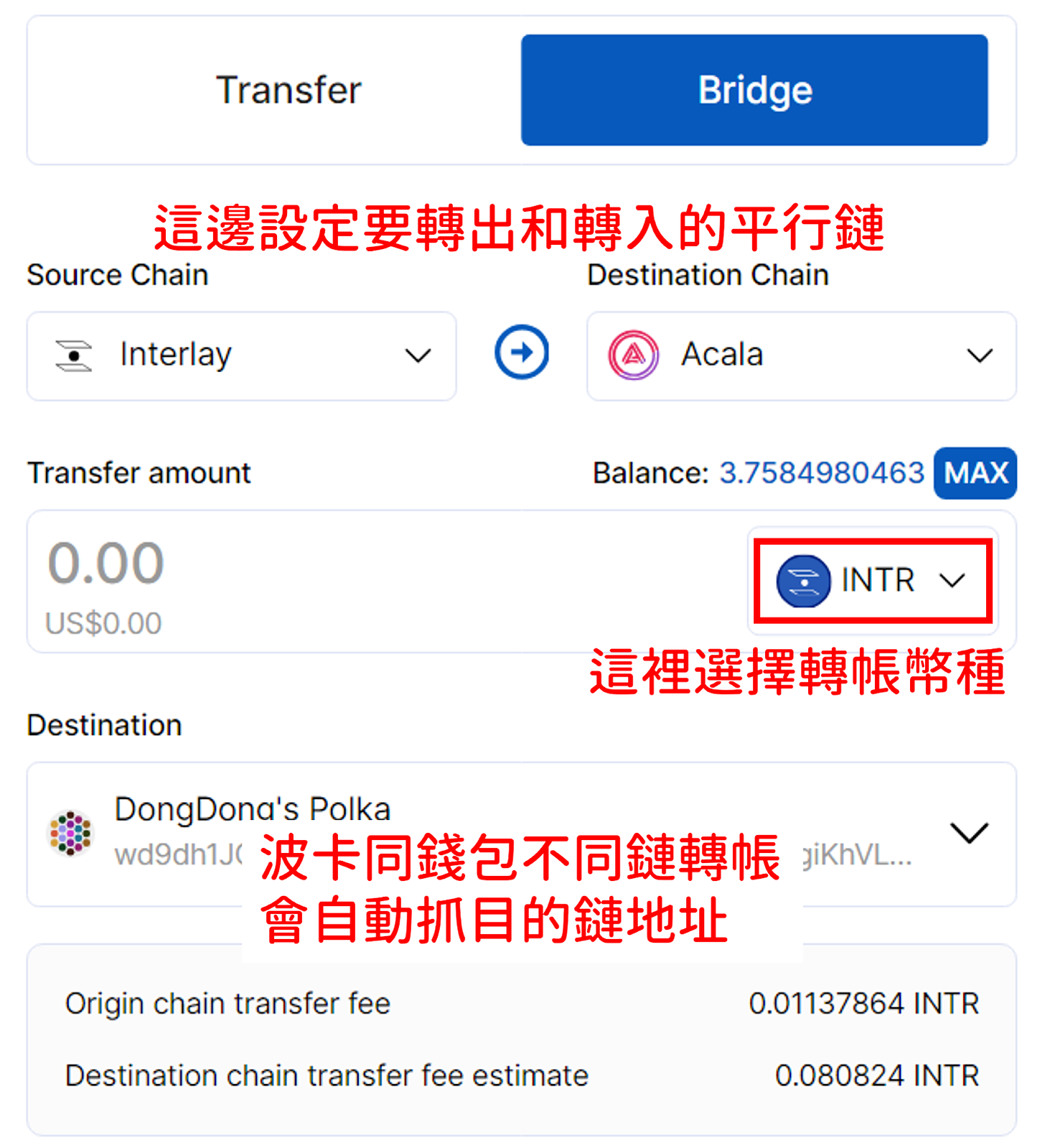
Cross-chain transfers between Polkadot chains are done through Polkadot XCM, which is fast, low-fee and highly secure.
Lending
It is a common DeFi loan, but currently it does not support many currencies.
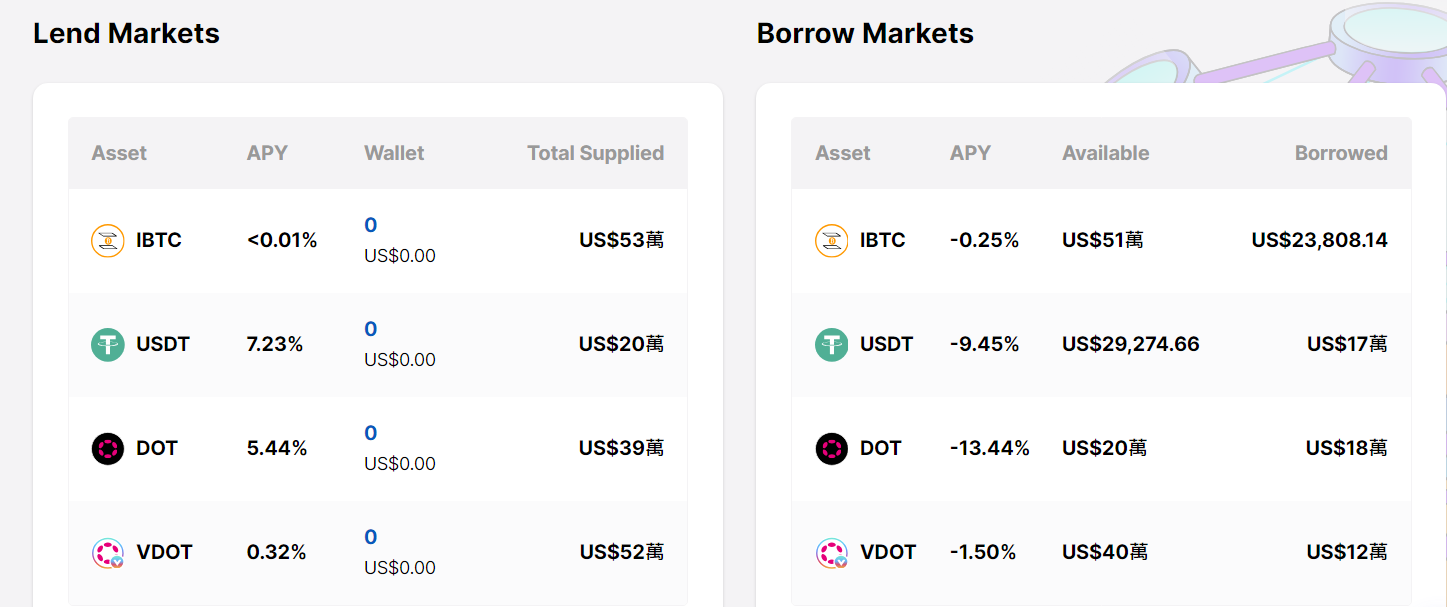
If you want to deposit money (left) or borrow money (right), select the corresponding currency and press it.
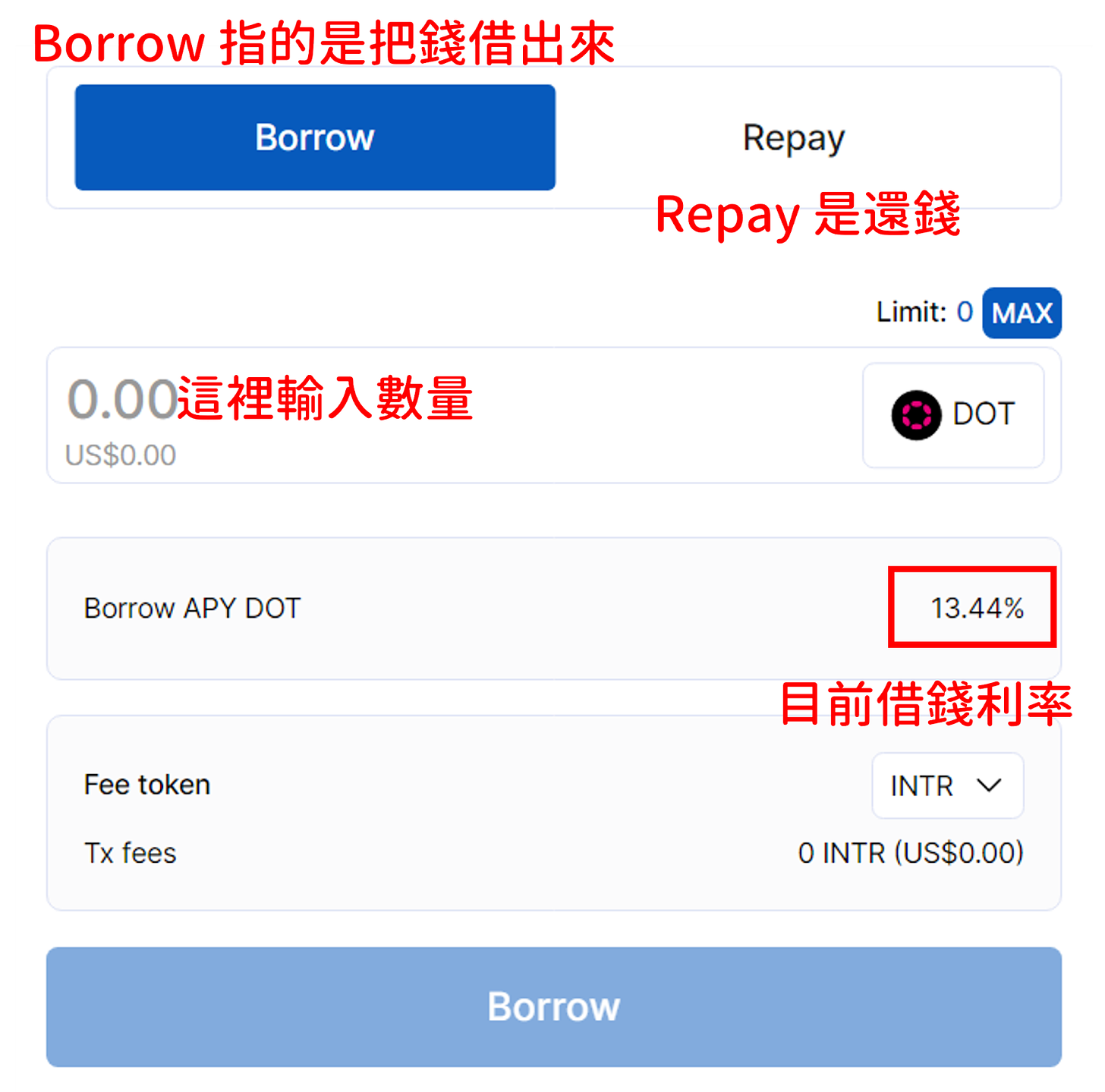
Just like a general loan agreement, you must first have a deposit as collateral to borrow money. If the collateral is insufficient, it will be liquidated.
Swap
It has the same trading functions as common DEX, but currently supports not many currencies, mainly Polkadot and INTR.
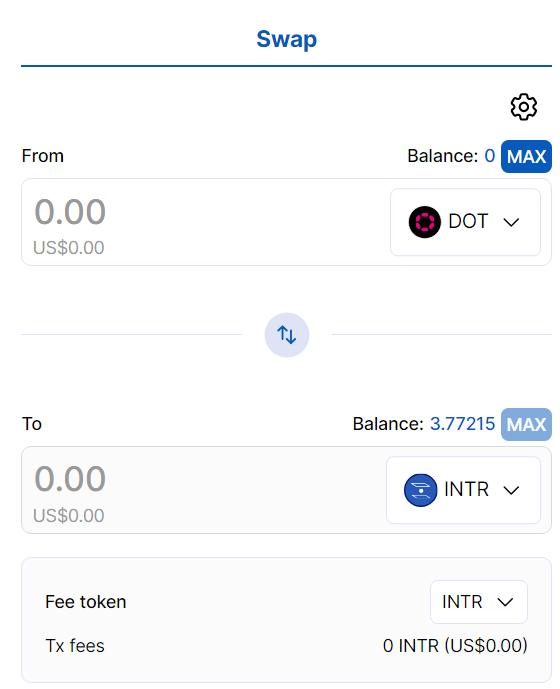
Ways to purchase INTR coins will be mentioned later. One of the ways is to use Polkadot wallet, transfer Polkadot coins across the chain to the Interlay chain and then purchase them on this page.
Pools
This part is the same as the general AMM type DEX. It is also a liquidity pool and can also be used for liquidity mining. There are currently four pools:
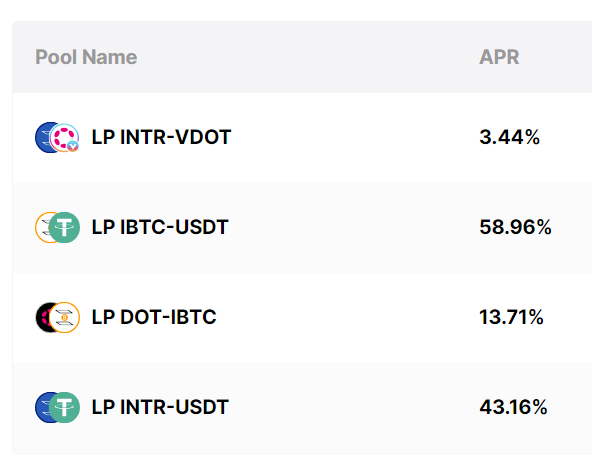
Click on the pool you want to participate in.
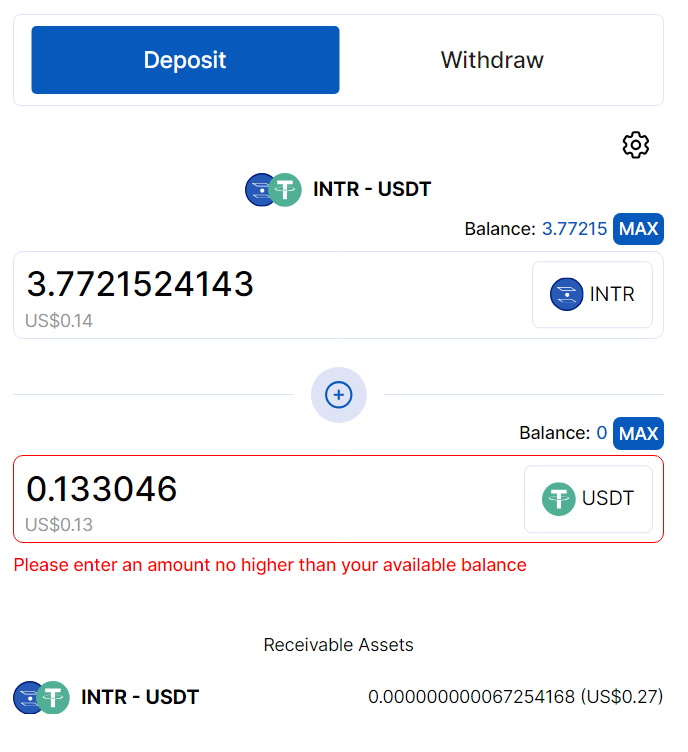
Adding liquidity requires dual currencies. Adding liquidity in a single currency is not supported. At the time of writing, Interlay does not provide additional liquidity rewards. The income comes from transaction fees. You only need to add liquidity to enjoy the benefits of transaction fees, and there is no need to pledge LP.
Reference reading about liquidity mining:
What is liquidity mining? How much profit can you make? What is Impermanent Loss?
Staking
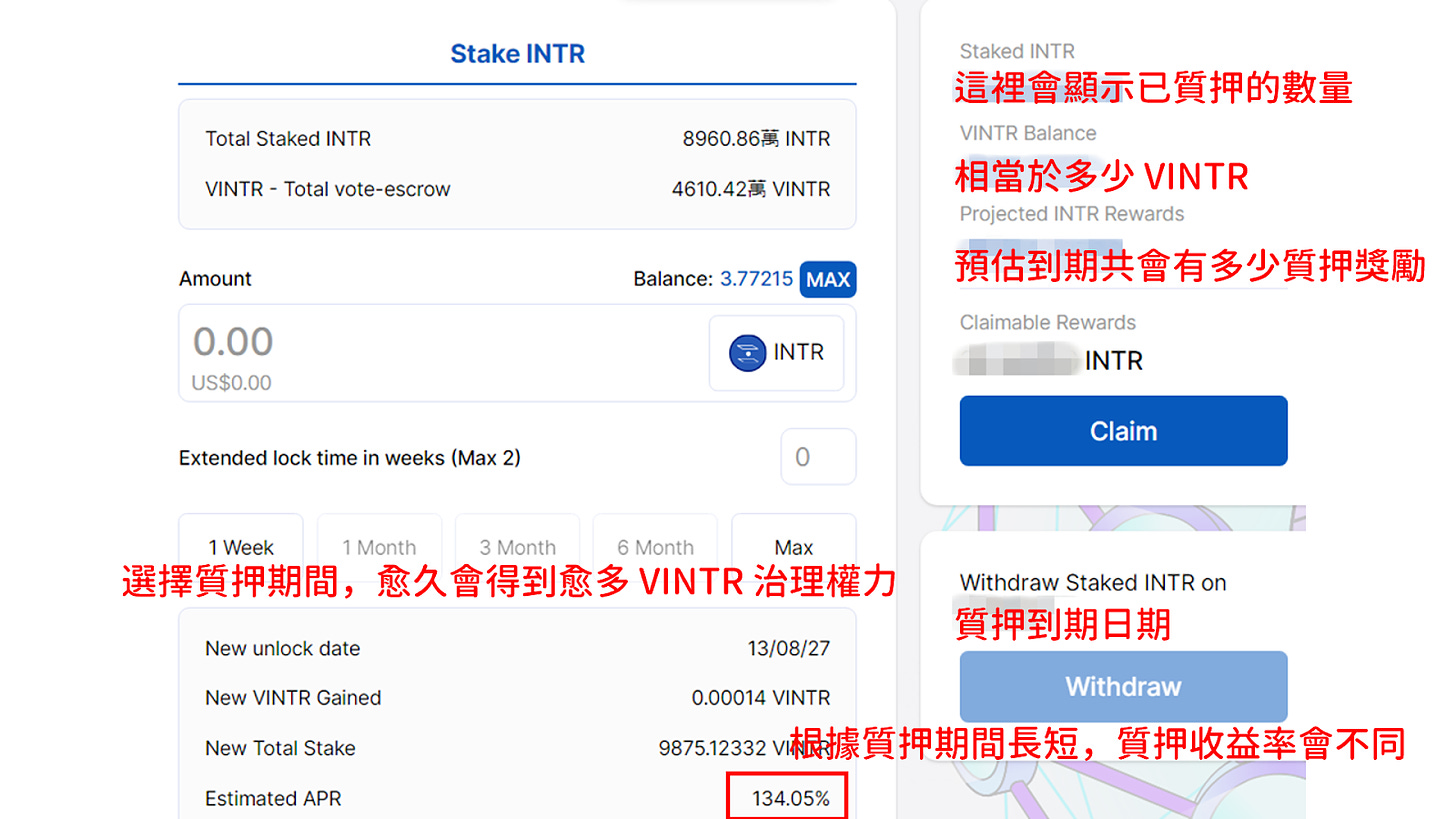
INTR is the governance token, and actual governance is achieved through VINTR obtained by staking INTR. Similar to the general ve governance model, the longer the staking period, the more VINTR you will get, and the higher the staking yield. The staking yield is not fixed, but changes, and changes with the conditions of participating in the pledge.
However, this kind of governance pledge cannot be released in advance. The tokens will be locked until expiration and cannot be used. The staking rewards are issued with the block and can be claimed at any time.
If you want to learn more about Interlay governance, you can refer to the official documentation:
How to buy INTR coins
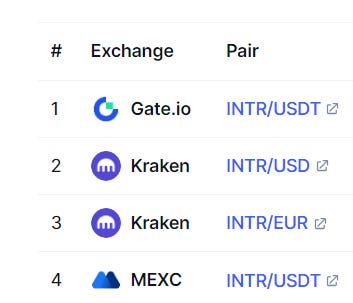
Currently, INTR coins can be purchased on three exchanges. Gate.io, Open Sesame Exchange/MEXC MEXC are both exchanges known for their large number of listed currencies. Kraken is a long-established American cryptocurrency exchange. These three happen to be the exchanges ranked eighth, ninth, and tenth in spot trading in 2023 compiled in this article:
Kraken / Gate.io / MEXC are not scams. The correct official website link can be found in the article.
If you want to use the DeFi method to purchase, you need to have a cryptocurrency wallet. There are two ways to purchase:
Use an EVM wallet such as Metamask Metamask to purchase DEX on the Astar/Moonbeam chain
Use a Polkadot wallet such as js/Subwallet/Talisman to transfer Polkadot coins across the chain to the Interlay chain and purchase them in the Interlay DApp
For wallet tutorials, please refer to the following articles:
▌Polka Ecological Wallet
Does Polkadot also have the inscription ordinal? Dotordinals / Dota Polka Inscription Tutorial
(The article contains the introduction and basic teaching of Polkadot ecological wallet)
It is quite convenient to buy INTR coins at present. Three exchanges have listed it, but none of the top exchanges have yet. If you are willing to lock in the longest period, the official staking yield at the moment of writing is very high (more than 100%). This You need to use the Polkadot ecological wallet. If you want to participate in staking, you can consider installing the Polkadot ecological wallet and purchase directly using the DeFi method.
Summary - 2024 will be a very lively year in the cryptocurrency field. Bitcoin, DeFi, and Polkadot should all see some interesting developments in the three major tracks.
Bitcoin is about to usher in its fourth halving in 2024. As for the Bitcoin spot ETF, regardless of whether the deadline in early January is passed or not, it is conceivable that this topic will continue to be heated until it is passed.
Coupled with the recent inscription craze of Bitcoin, it has also triggered the imagination of more applications of Bitcoin. Regarding Bitcoin Virtual Machine (BitVM, BVM), Bitcoin Layer 2, etc., the Bitcoin ecosystem will have more developments in the future. Appear.
Polkadot was once a star project among star projects. Although it was relatively quiet during the bear market, the pace of development has not stopped. Polkadot 2.0 will be gradually implemented in 2024, and asynchronous support, official cross-chain bridges, core time, etc. will be launched. At present, the Polkadot ecosystem has dozens of parallel chains and hundreds of DApps, covering almost all aspects of applications. The most lacking thing in the ecosystem is liquidity. When Polkadot can connect to other ecosystems through official cross-chain bridges, it will bring more How will the multi-liquidity Polkadot ecosystem develop?
Not to mention DeFi. Since the DeFi Summer of 2020, DeFi has been one of the areas where various innovations have appeared most frequently and been applied in practice. Although the activity has dropped significantly due to the subsidence of funds during the bear market, as the market conditions improve, it will also In immediate response, CZ, the founder of Binance, the world’s most famous exchange, once said:
"DeFi is the future, and its current trading volume is equivalent to 5% to 10% of CeFi's trading volume... The next bull market is likely to make DeFi surpass CeFi in scale."
Interlay's several main businesses: cross-chain encapsulation of Bitcoin, Bitcoin DeFi, and Bitcoin Layer 2, just cover these three areas. Will Bitcoin be able to have more applications smoothly in the future? Can more funds on the Bitcoin chain be brought into the Polkadot ecosystem? In this part, you have to pay close attention to the next development of Interlay.
|Follow the development of the Bitcoin ecosystem with the community. Welcome to join the Daily Biyan Chinese exchange group !