Low demand is not a problem, but cost may be a long-term issue.
Written by: @smyyguy
Compiled by: Luccy, BlockBeats
Editor's note: In this article, @smyyguy discusses Celestia's remarkable success in integration and marketing, pointing out the large number of RaaS-launched chains that will emerge in the coming months. @smyyguy believes that Celestia is an excellent choice for people building Rollups, and there are multiple options for using it. But he also pointed out that most RaaS-built rollups don't provide much for users. BlockBeats compiles the original text as follows:
I've spent some time working with the Celestia data and have some ideas for what the future holds.
Main points
- There is currently minimal demand, but this is not a problem and the team has completed the RaaS integration.
- Cost may be a long-term issue, where will sustainable demand come from?
- First-price auctions are inefficient, and Manta is proving why
Users can access the full dashboard
background
Celestia is purpose-built to serve as a DA network. Compared with the current industry's largest DA layer Ethereum mainnet, the data cost of Rollups it provides is reduced by 99.9%.
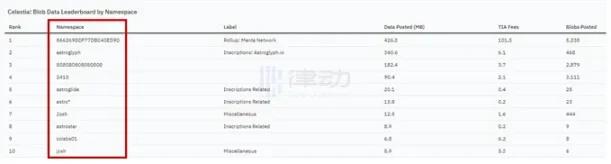
Users can publish arbitrary data to "blobs" using the assigned "namespace". The blob contains data and other key information, including the namespace as the blob's ID. Users can then access the data by querying Celestia's "blobspace" and filtering on specific namespaces.
The namespace can be a hex-encoded, base64-encoded, or plain text string. Application developers can directly use plain text strings to know directly which namespace the rollup is published to.
Current on-chain activity
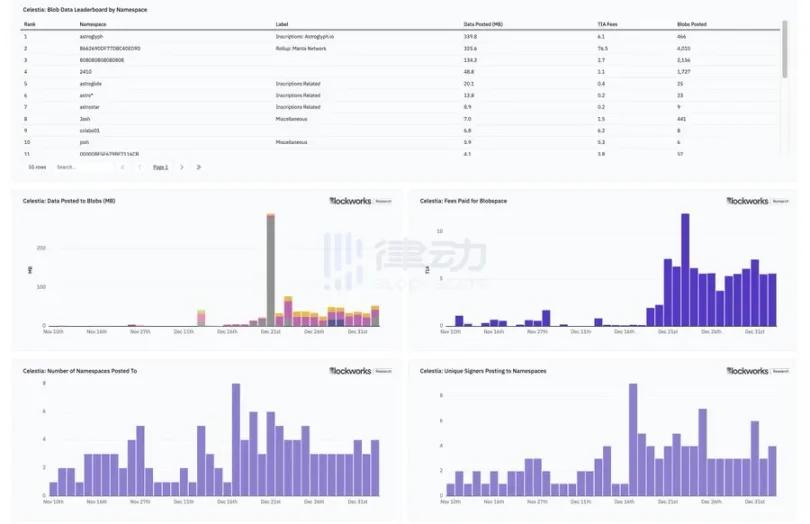
Celestia launched just two months ago. To date, users have published data to a total of 56 namespaces. We see users publishing 30-50 MB of data to 3-6 namespaces per day.
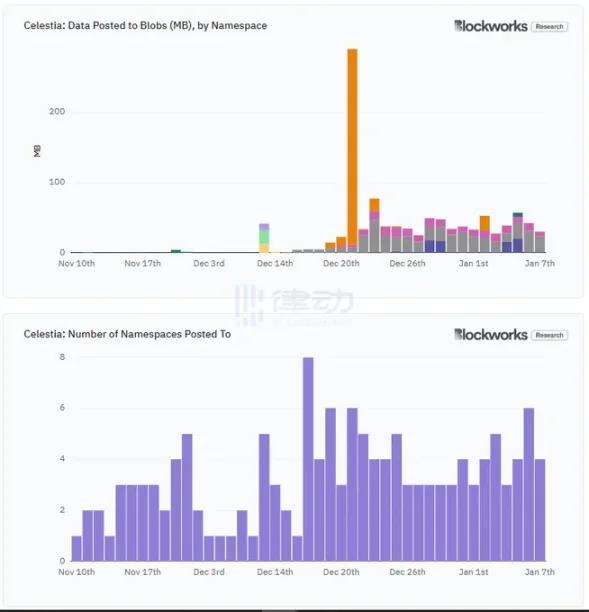
87% of all data published to Celestia is sent to 3 namespaces:
@astroglyph_io, the inscription service that allows users to publish arbitrary data to Celestia · @MantaNetwork, the OP Stack rollup started with @Calderaxyz · 808080808080808, an unknown namespace but looks like a rollup
In comparison, the Ethereum mainnet currently has about 15 rollups and releases 700 MB of data every day. The Arbitrum and OP mainnet release about 120 MB/day and 80 MB/day respectively. After EIP-4844 goes live, Ethereum will initially support a maximum of 5,400 MB/day.
Ethereum prioritizes scarce block space, while Celestia is built on abundant block space. The network has a block time of 15 seconds, a block size of 8 MB, and currently supports up to 46,080 MB/day. In other words, Celestia is currently using only 0.1% of its data capacity. Coming from a chain that was created two months ago, I wouldn't take a 0.1% tracking as a worrying sign of lack of demand.
cost
With current data usage of 0.1%, total charges are significantly lower. Celestia incurs approximately 5 TIA or $65 per day. This means that Celestia users pay 0.024 - 0.24 TIA per MB of data published, or $0.31 to $3.12.
Fees are low today, but what about the future? If Celestia achieves a full year of 46,080 MB of daily data capacity at the $13 TIA price, the network will generate annual fees of approximately $5.2 million. This would be 65 times the data currently posted to Ethereum.
If growth continues, users will be forced to engage in bidding wars, so fees will increase as users' price tolerance increases. The network can vote to increase the block size from 8 MB, but is limited by the number of light nodes and the Cosmos SDK bottleneck maximum size.
User needs
So where will the 65x increase in demand come from?
- High TPS universal chain?
- A bunch of application-specific rollups?
- A game-focused chain?
It's hard to say, but even so, the fee is still minuscule relative to current valuations. But just because you can't point to a source of demand today and say unequivocally that's the reason for Celestia's future growth, doesn't mean it won't happen.
My guess is that gaming + high TPS rollup will be fine. EIP-4844 doesn't seem to get L2 for sub-cent deals, but Celestia does.
IMO this is a big problem. It's clear that we will see an influx of chains launching using Celestia's RaaS in the coming months. The Celestia team absolutely masters their integration and marketing. Anyone building Rollup knows that Celestia+ has the option to use it
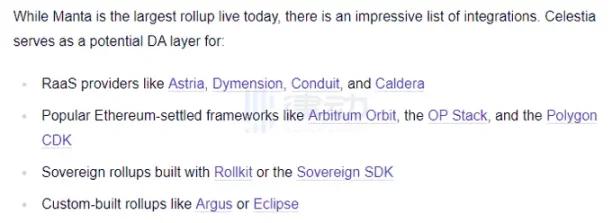
But early on, most RaaS-built rollups don't offer much to users. So where does the sustainable demand for DA come from?
Charging model
You may also notice a difference in how much users pay to publish their data. It's completely powered by @MantaNetwork who pays about 10x more than anyone else!
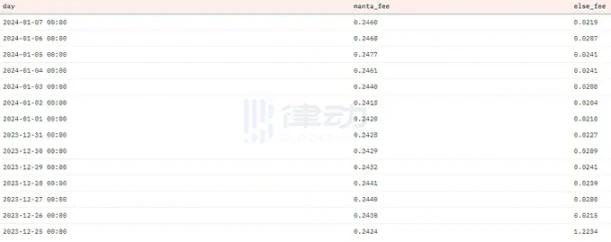
Celestia uses a simple first-price auction fee mechanism, similar to Ethereum prior to EIP-1559. This sub-optimal design fails to provide users with an easy way to bid for a fair inclusion price, resulting in bidding wars and users overpaying for block space.
Because Celestia is built specifically for DA, there are no competing transaction types or high-value DeFi transactions that would increase the gas cost of issuing DA, alleviating most concerns about the fee model.
Once the existing data capacity is maxed out, more powerful mechanisms can be prioritized.
All in all, I'm excited about what Celestia is doing. They have a strong team, a strong vision, and a strong product. I'm not worried about undercharging today, but I think they need to reiterate this going forward. It might make sense to integrate other products