The listing of Bitcoin ETF makes BTC more convenient for fund managers to use as an allocation item in their asset portfolios. Well, Wall Street fund managers will soon realize that BTC can serve as a very effective enhancing factor. Just adding a small amount to its portfolio can significantly improve the Sharpe ratio of the entire portfolio.
Sharpe ratio (English: Sharpe ratio), also known as Sharpe index or Sharpe value, in the financial field measures the relative performance of an investment (such as a security or a portfolio) relative to a risk-free asset after adjusting for risk. Performance. It is defined as the expected value of the difference between an investment's return and the risk-free return, divided by the investment's standard deviation (i.e., its volatility).
Everyone knows that returns are directly proportional to risks. However, for the same amount of risk, some investments can bring huge returns, while other investments are less than satisfactory. Simply put, the return per unit of risk is the Sharpe ratio. This indicator describes whether a risky investment is worth it.
In Modern Portfolio Theory , it is assumed that investors are risk-averse investors. If two assets have the same expected return, investors will choose the one with less risk. Investors will take greater risks only if they can obtain higher expected returns.
In other words, if an investor wants to achieve greater returns, he or she must accept greater risks. A rational investor would choose the portfolio with the least risk among several portfolios with the same expected return. Another situation is if several investment portfolios have the same investment risk, investors will choose the one with the highest expected return.
Such a portfolio is called an Efficient Portfolio. [wikipedia]
The risk of the secondary market is price volatility. Volatility squared is the portfolio variance. In other words, the square root of the variance is volatility.
In 1952, American economist Markowitz first proposed the portfolio theory and won the Nobel Prize in Economics.
His theory contains two important contents: mean-variance analysis method and portfolio efficient frontier model.
In Markowitz's model, the set of all optimal portfolios (Efficient Portfolio) is called the Markowitz Efficient Frontier. The sky blue curve in the figure below is the Markowitz efficiency frontier, and the investment portfolio on this curve is the optimal investment portfolio.
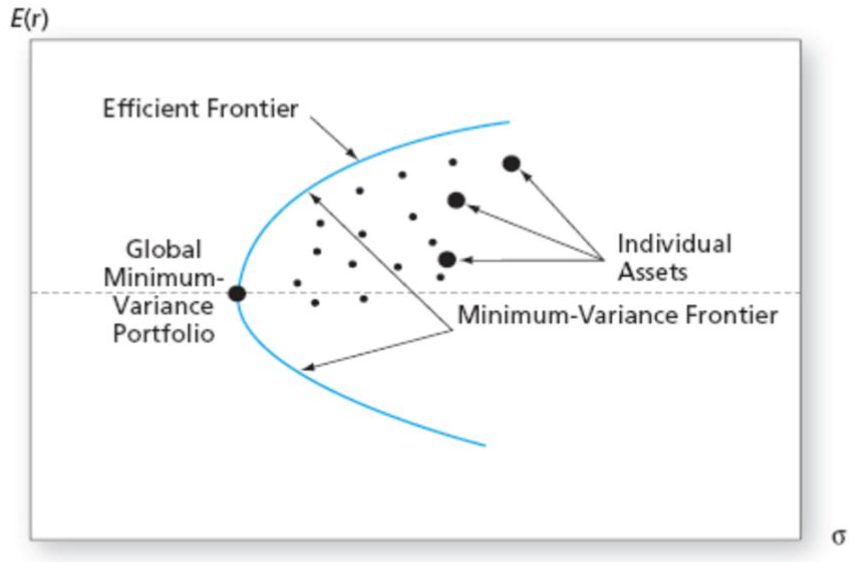
The Markowitz model frontier encompasses all optimal portfolios. The Sharpe Ratio is the excess return (return above the risk-free rate of return) provided by each asset portfolio divided by the risk (measured as standard deviation) it entails. The higher the Sharpe ratio, the higher the return per unit of risk. The optimal portfolio with the highest Sharpe ratio on the Markowitz efficiency frontier curve is called the Market Portfolio.
An allocation strategy that Jiaolian learned about is to use a portfolio composed of a large proportion of cash (such as 98%) and a small proportion of BTC (such as 2%) to compare the performance of US stocks such as the S&P 500 Index.
Preliminary research found that using a four-year cycle and any time window, this investment portfolio has a high probability of significantly outperforming the S&P 500 Index.
Using Markowitz's model calculations, some students used their little hands to calculate a few simple conclusions:
If you want to be stable and withstand the lowest volatility, then the BTC allocation ratio should not exceed 2%.
If you want the highest risk-to-reward ratio, that is, the Sharpe ratio, then the BTC allocation ratio can be increased to 6%.
If you want to obtain the best investment return without suffering the volatility of the S&P 500 Index, then the BTC allocation ratio can continue to be increased to 10%.
(Note: This is not my calculation. Friends who are interested and capable can use Markowitz's formula to check it.)
While many novice investors are still envious of U.S. stock returns, Markowitz has told us that outperforming U.S. stocks is actually very simple, as long as adding a little BTC is enough.
Don't All In. A little is enough. stable.
(Public account: Liu Jiaolian . Knowledge Planet: The public account replies "Planet")
(Disclaimer: None of the content in this article constitutes any investment advice. Cryptocurrency is an extremely high-risk product and may return to zero at any time. Please participate with caution and be responsible for yourself.)