1. Key points of the research report
1.1 Investment Overview
The NEAR protocol is committed to providing a Web 2-like user experience through its complex sharding architecture, and its team's development capabilities and vision are at the forefront of the entire industry. Its zkWASM collaboration with Polygon, its fast settlement sorter with EigenLayer, its independently built NEAR DA, and its ultimate goal of chain abstraction and its continuous iteration and improvement in sharding architecture, as well as its emphasis on consumer applications, are all It illustrates and proves its pragmatic attitude in the process of thinking and exploration, as well as its dedicated pursuit of technology.
It can be observed from the on-chain data that NEAR’s TVL has entered positive growth, and the number of developers, transaction volume, and active users have also hit new highs (except for the inscription market). Although the data are all caused by volume-based applications, It reflects its ecological diversity and compatibility. Combined with what it is doing, NEAR will have the opportunity to seize narrative points such as Layer 1, ZK virtual machine, DA, and chain abstraction in the future, and gain higher attention and expectations in the market.
1.2 Valuation description
The highest point of NEAR in the last bull market was $20.15, with a market capitalization of approximately $6 billion; the current price is around $5.6, with a maximum of approximately $6.2, which is nearly twice the increase compared to the two cycles. Calculated based on the 1 billion circulating tokens, NEAR has now reached The same market capitalization as the previous bull market. This is only the performance under the current main market situation of ETF. It is expected that when the main rise of the new bull market cycle comes, NEAR will have a better growth performance, which is likely to be much higher than that of ETH. In view of the possibility of an overall correction in the current market, it is recommended that investors refer to multi-dimensional factors for judgment and decision-making.
1.3 Main risks
- Legal risks, similar to other projects in the industry, if NEAR faces issues such as being regarded as securities, it may put pressure on the token itself;
- The narrative is not in place. Under the overall trend, if the market does not recognize NEAR’s narrative or fails to demonstrate its ecological vision, it is likely to lead to weaker momentum for token price growth;
- The progress is not as good as expected. The second phase of NEAR has been postponed from 2023 to 2024. At present, the implementation of subsequent development is uncertain and there is a possibility of delay, which will have a hard impact on the market's recognition and perception of it;
2. Basic situation of the project
NEAR is a Layer 1 based on sharding technology, which aims to make the process of processing transactions more efficient, scalable, and affordable. This architecture is what distinguishes the Near blockchain from other blockchains such as Ethereum.
2.1 Business scope
NEAR is positioned as Layer 1. It strives to make the unfamiliar and difficult-to-understand blockchain approachable. Through the scalability of the bottom layer, the optimization of the middle layer, and the mature tools of the application layer, it provides developers and users with simple and friendly use. experience, hoping to provide high TPS and a user experience that is no different from Web2. At present, the ecology is diversified, and the overall data has shown good upward development.
2.2 Founding Team
NEAR will lay off 40% of its team in January 2024. Currently, there are about 40 team members. The company's organizational structure is Near Protocol, NEAR Foundation and the development team Pagoda. Polosukhin said that despite the layoffs, the Near Foundation's finances "remain strong and well managed," including $285 million in cash, 305 million Near tokens, and $70 million in investments and loans.
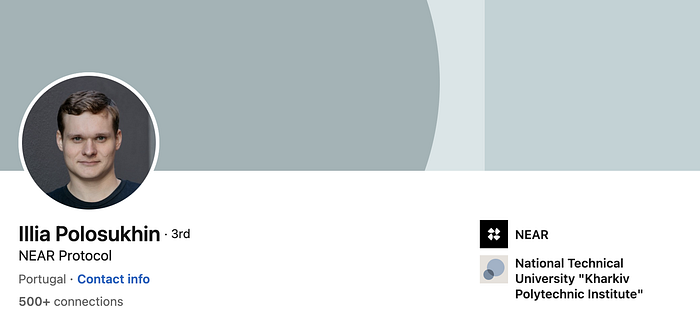 Illia Polosukhin: Co-Founder, received bachelor's and master's degrees in computer science from Kharkiv Polytechnic Institute. In 2014, he served as the engineering manager of Google's research department, responsible for deep learning. NEAR was established in June 2017.
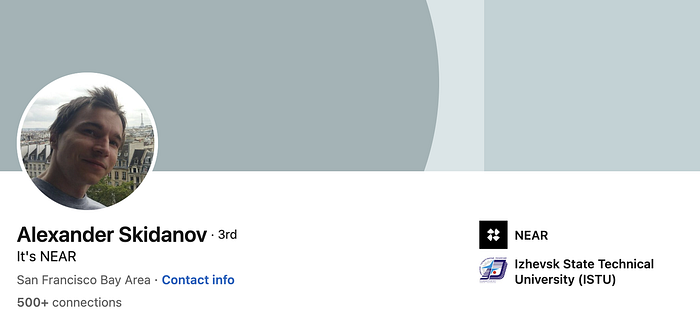 Alexander Skidanov: Co-Founder, received a master's degree in computer science from Izhevsk State Technical University. He once worked as a software development engineer at Microsoft, and then studied MemSQL at a database company for five years, mainly studying distributed databases. Blockchain technology lays the foundation. NEAR was established together with Illia in June 2017.
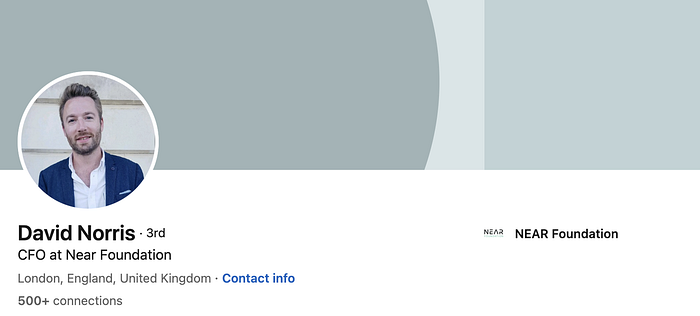 David Norris: CFO NEAR Foundation, received a bachelor's degree in mathematics, accounting and financial management from Loughborough University in the UK, and has about 20 years of working experience in finance and accounting. He has worked as a financial analyst in KPMG, European Arab Bank, Unilever, Royal Bank of Scotland and other companies. He joined NEAR as financial director in June 2022 and was promoted to CFO in January 2024.
2.3 Investment background
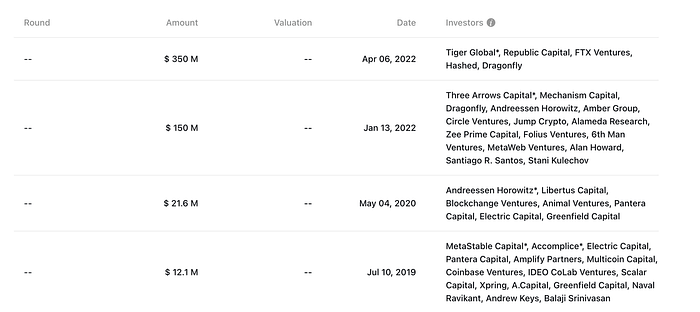 NEAR's most recent financing was in April 2022, with a financing amount of US$350 million. Its investment institutions have a wide coverage, including most of the leading VCs in the industry. The main leading investors are Three Arrows Capital, Tigar Global, A16Z, etc.
Three Arrows Capital's assets were liquidated due to the Luna incident. Currently, a total of 13.9 million of its NEAR assets have been liquidated by Genesis.
2.4 Project development route and history
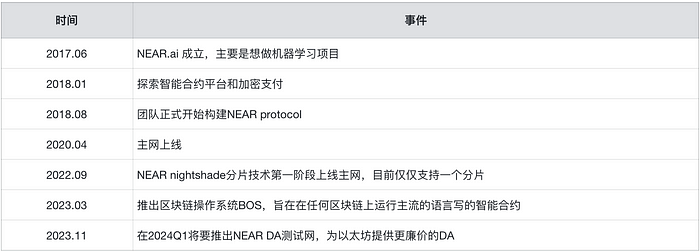 The team originally expected to release the second phase of sharding in 2023, but it was delayed until January 2024 to release the second phase of the test network. There are some delays in its roadmap. In 2024, the team hopes to mainly improve the usability, scalability and decentralization of NEAR:
- Stateless verification, which tweaks the original Nightshade sharding design to avoid implementing fraud proofs while significantly improving the performance of each shard by putting state into memory. The team expects that the rollout of stateless verification will also significantly improve the performance of each shard. sharding throughput and preparation for continued growth in NEAR usage (expected to be delivered in Q2);
- Congestion control and transaction prioritization, it is important to provide a good user experience when the network experiences short-term congestion, including localizing congestion so that gas price increases do not affect the entire network, and allowing users to prioritize their transactions during congestion if they Willingness to pay more transaction fees);
- Supporting account aggregation and allowing users to use one NEAR account to control accounts on different chains is an important pillar of the abstract vision of the NEAR chain. It requires signing payloads via MPC and a new API to facilitate the asynchronous nature of chain signing;
- zkWASM, aims to build a prover for WebAssembly smart contracts. This can be used as part of an initiative to prove NEAR state transitions in ZK proofs, zkWASM also provides wasm as an alternative execution environment for L2's EVM;
- Data availability improvements, NEAR launched NEAR DA in early November 2023, and the team plans to carry out some work to further improve the efficiency of NEAR DA. These improvements include the introduction of KZG commitments to avoid data availability fraud proofs, and real-time bridging to allow verification of Ethereum data availability on;
- Ethereum wallet support, native support for wallets such as MetaMask on NEAR can attract more users to use NEAR and be more consistent with Ethereum. This requires changes to the protocol to natively support Ethereum addresses and support the processing of RLP serialized Ethereum transactions;
- To study the future of sharding, the exploration directions include synchronous sharding and ZK-centered sharding. Synchronous sharding can realize synchronous execution of smart contracts and solve the pain points of asynchronous execution. Zero-knowledge proofs can be used to verify different shards with ZK as the center. The state transition of slices can improve the scalability and decentralization of the protocol;
3. Business situation
3.1 Official website data
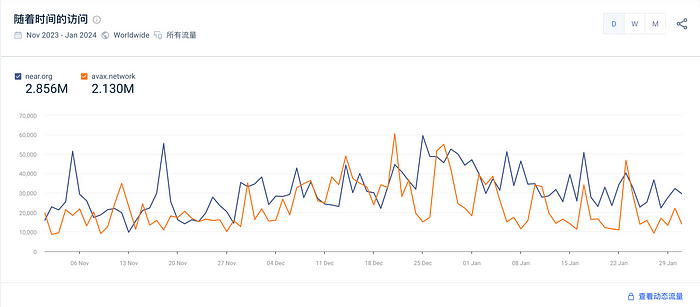
 We compared AVAX and NEAR and found that NEAR's website traffic in the past three months was 34% higher than AVAX's, with daily pageviews of about 31,000. The top three traffic came from Indonesia, the United States and India.
3.2 Social media data
 3.3 Social data
 3.4 Cooperation status
- Cooperating with EigenLayer, we are jointly developing a fast settlement sorter network based on Ethereum Layer 2. And the NEAR-Ethereum Rainbow Bridge built by NEAR will also use EigenLayer's avs service, and the testnet is expected to be launched in the first quarter of 2024;
- Cooperate with Polygon to jointly research zkWASM, which is expected to be launched in 2025. Developers building with Polygon's open source Chain Development Kit (CDK) can use zkWASM as a prover. NEAR can generate state transition proofs through zkWASM, reducing the ZK running burden on shard nodes, improving the efficiency of proof generation and thus improving sharding throughput;
4. Product and competition analysis
4.1 Track potential
In the new market cycle, public chain narrative is an unavoidable theme, and chain abstract narrative may become an important branch of the implementation evolution. In view of its current upward trend in the overall market and the rotation performance of each sector, NEAR is basically in Under favorable circumstances, there will be better expectations and performance in the new market cycle, and it will become an important part of the public chain track.
4.2 Competitive Landscape
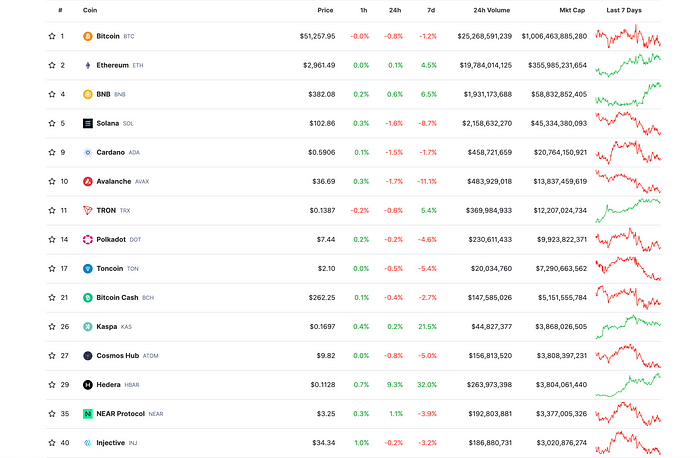 coingecko Layer1 rankings by MC
NEAR is a public chain project that appeared in the last cycle, and its benchmark public chain project is Avalanche. NEAR is currently relatively far behind in the ranking, but there are also more opportunities.
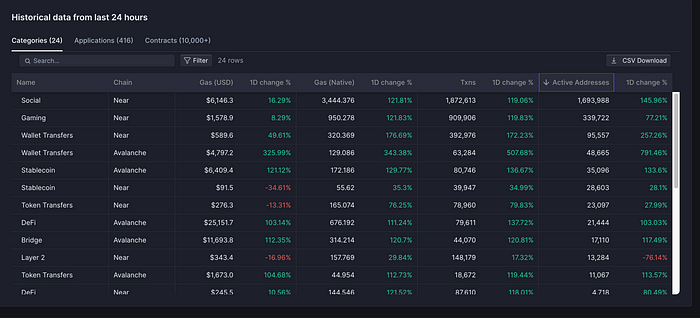 Comparing the number of active addresses, NEAR's ecology is significantly better than AVAX. NEAR has gradually formed its own unique ecological environment characterized by diversified projects.
4.3 Product features
ShardingNightshadow
The main technical feature of NEAR is sharding technology, which is also the key differentiating factor of the NEAR protocol.
Nightshade, launched in November 2021, frees validators from the task of processing every incoming transaction and only processes transactions within a specific shard, paving the way for theoretically unlimited scalability.
On January 30, 2024, the NEAR team decided to launch the second phase of the sharded test network. The main feature is the stateless implementation. The NEAR validator no longer needs to maintain the status of the shards locally and can retrieve verification from the network. All the information needed for state changes or “state witnessing”, which will be officially launched on the mainnet in May.
The team is currently also studying the inclusion of ZK technology in the sharding improvement roadmap, which can realize the mutual cooperation between the nodes generated by ZK proof and the light nodes that verify the proof.
The original roadmap of Ethereum was to implement sharding technology, which is essentially the distributed storage of database information. However, because the technology was too complex, it was abandoned and switched to the Layer 2 technology route.
Chain abstraction:
Chain abstraction is a further abstraction of account abstraction. It hopes to hide the chain used by specific users, reduce users' perception of using blockchain infrastructure, hide the infrastructure, and give users the same experience as web2 without having to worry about which application is which chain. As well as a series of complex operations such as signatures and private keys, the details are as follows:
- BOS supports multiple languages running on multiple blockchains. In the future, the chain abstraction function will be implemented. NEAR, as the entry chain, can call accounts bound to other chains for signing. In other words, users in NEAR can use Uniswap and Ethereum. The account performs signature transactions;
- Super Wallet supports one wallet to browse all DApps without switching chains;
- Account aggregation technology is used to initiate the intention of any chain through NEAR, and then sign the signature transaction of any chain through MPC technology;
zkWASM:
The planned development of NEAR is influenced by ZK technology, and it is planned to introduce ZK technology compression state into future sharding technology. zkWASM is its virtual machine technology that can support mainstream development languages, run smart contracts developed in mainstream languages within the virtual machine, and then generate zero-knowledge proofs.
zkWASM will become one of the three optional virtual machines for Polygon's zk Layer2 development and CDK development in the future, and zkWASM will also run on NEAR to help nodes generate zero-knowledge proofs and reduce the generation burden of shard nodes.
It can be seen from the progress of product planning that the NEAR team has not been significantly affected by the market cycle. It has been exploring the industry and following the latest technology in the industry to improve NEAR's future research and development direction. Sharding technology is currently in its second stage and is expected to be online in Q2-Q3, which can greatly improve the efficiency of verifiers; chain abstraction is an "End Game" type concept, giving users a web2-like experience; zkWASM is the future NEAR It is to be developed to improve the ZK proof efficiency of shard nodes, and it can also be used as a ZK virtual machine operating environment for Layer 2.
4.4 Developer situation
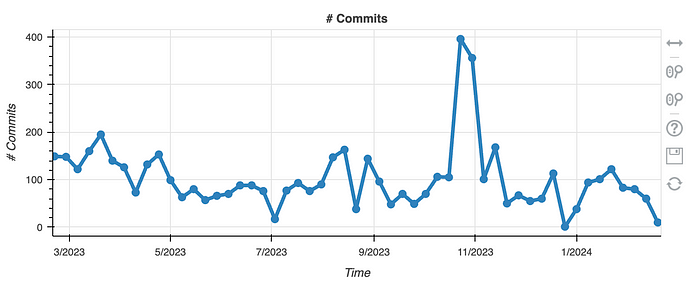
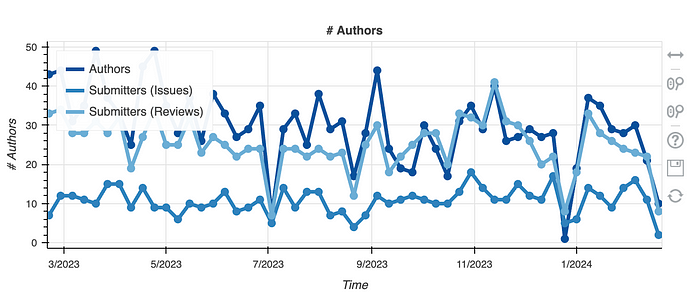 Judging from code submissions and activity data, NEAR's development progress still maintains a smooth development pace, and it has obviously not been affected by layoffs.
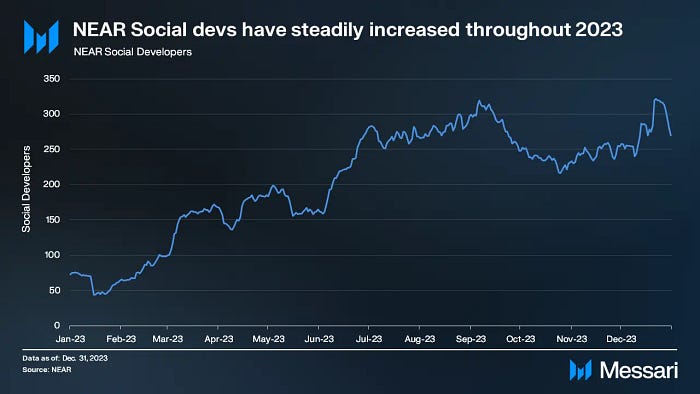 In addition, in Messari statistics, starting from January 2023, the number of developers developing based on NEAR is continuing to grow.
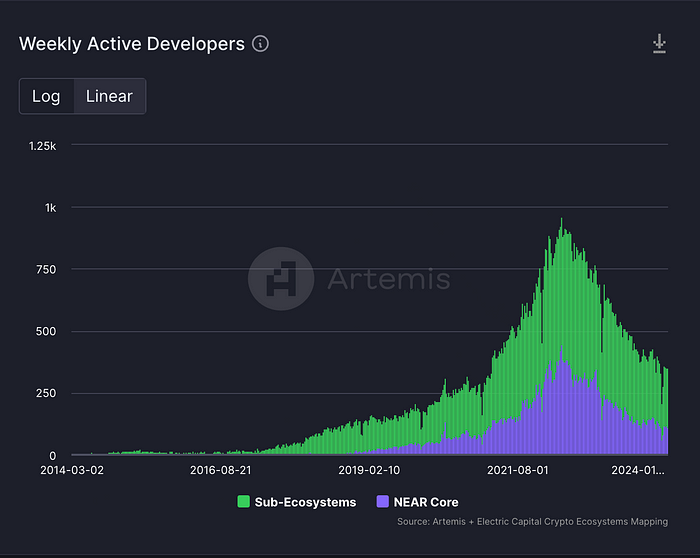 In Elecric Capital's extended cycle, we found that developers in all chains in the industry have experienced a significant decline. Active developers have dropped by 1/2 from the peak of the previous cycle, while NEAR developers have only dropped by 1/2 from the peak of the previous cycle. 3. It is in a downward channel and needs to continue to be observed.
4.5 Ecological development
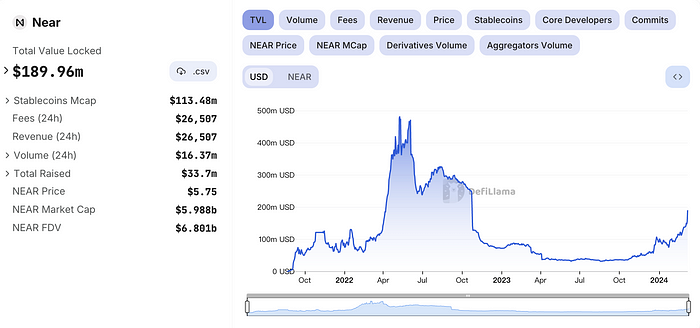 As of March 7, 2024, the TVL of NEAR's DeFi ecosystem is approximately US$190 million, and has maintained a relatively strong growth trend recently.
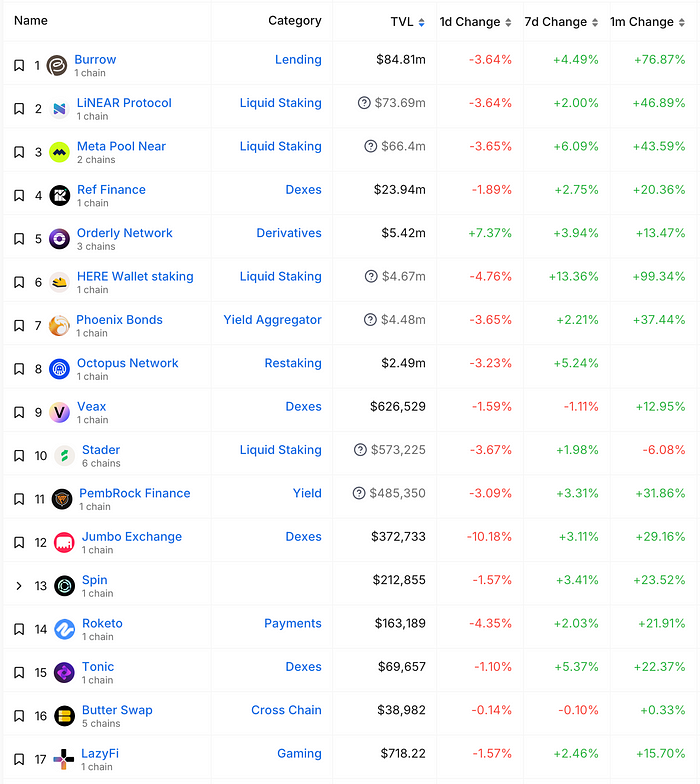 NEAR's ecological diversity also performs well. Its main projects include Burrow (lending), LiNEEAR (LSD), Ref Finance (DEX), etc.
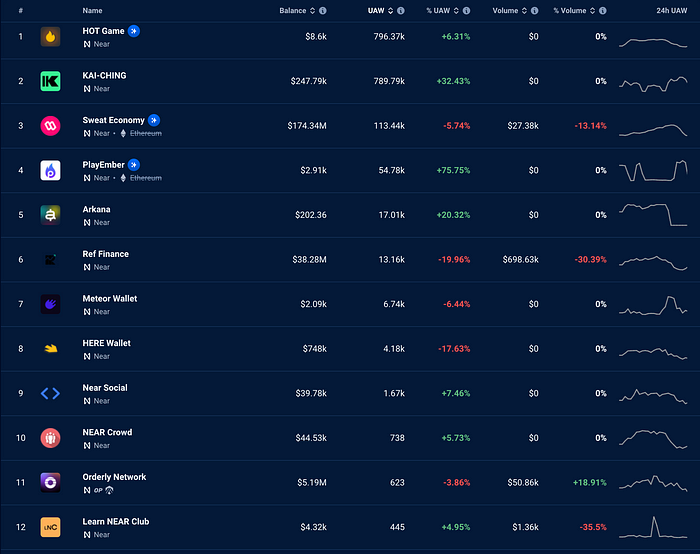 Dapp Radar statistics:
- The project with the highest weekly active addresses is Hot Games, a wallet on Telegram built on NEAR;
- Next is KAI-CHING (KAIKAI), a shopping software that can purchase some products at lower prices;
- Ranked third is Sweat Economy, a Walk-To-Earn software;
In addition, KAIKAINOW is also a project based on KAI-CHING tokens. It mainly provides users with lock screen wallpapers and can reward users with tokens through advertisements. According to NEAR official statistics, this project has contributed a large proportion of data to the DAU of the NEAR chain. .
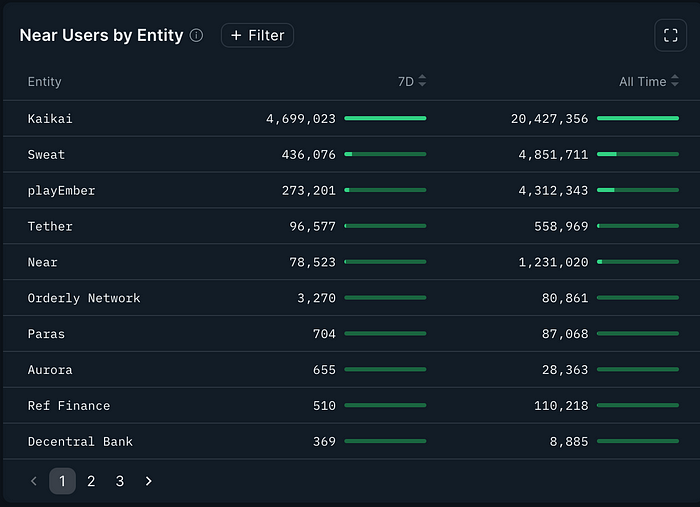 The main users of NEAR are brought about by the KAIKAI project, and the number of daily active addresses has been showing positive growth. Although in essence, the value of these transactions is not high, and they are more volume behaviors, they can Seeing that the chain has gradually moved towards consumer applications rather than pure DEFI applications, this is a significant change that is different from most industry projects.
5. Token circulation and distribution
5.1 Total volume and circulation
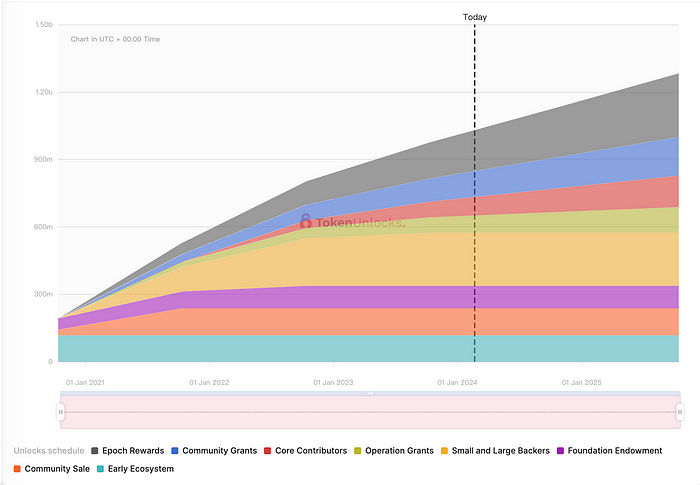 The native token NEAR provides support for smart contracts executed on the network, similar to ETH in the Ethereum network. However, it uses a unique fee burning mechanism where 70% of transaction fees are burned and the remaining 30% is used directly for the original contract (developer rewards), which is a key difference compared to other smart contract blockchains , because they don’t have direct developer incentives “baked into” the protocol.
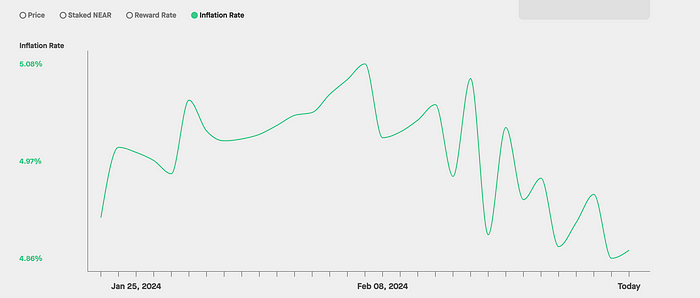 The current market value of NEAR is approximately US$5.863 billion, FDV is US$6.658 billion, the number of circulating tokens is 1,039,156,88, and the total tokens are 1,180,233,734. The current annualized inflation of the tokens remains at around 5%. The current Staking income is around 9.1%, the net staking rewards is about 4.1%, and the staking ratio accounts for 49.43% of the total amount (582 million pieces).
5.2 Market performance and window period forecast
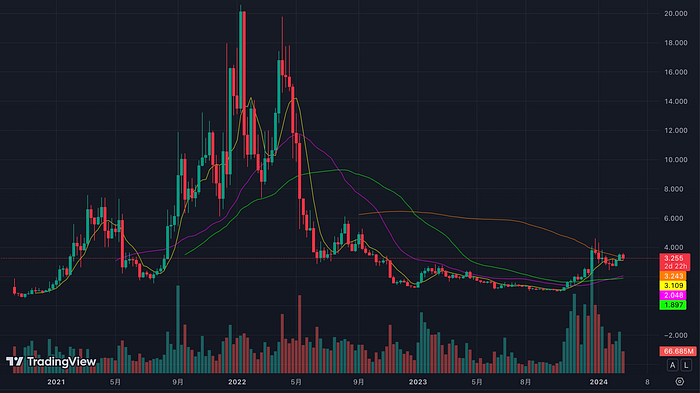 The highest point of NEAR in the last bull market was $20.15, with a market capitalization of about $6 billion; the current price is about $5.6, with a maximum of about $6.2, which is nearly twice the increase compared to two weeks ago. Calculated based on the 1 billion circulating tokens, the current price It has the same market capitalization as the previous bull market. This is only the performance under the current main market situation of ETF. It is expected that when the main rise of the new bull market cycle comes, NEAR will have a better growth performance, which is likely to be much higher than that of ETH. In view of the possibility of an overall correction in the current market, it is recommended that investors refer to multi-dimensional factors for judgment and decision-making.
6. Summary
Recently, NEAR has experienced a sharp rise in the market. However, its overall market value as a public chain project is still relatively small, and there are few market actions combined with narratives such as Layer1, ZK virtual machine, DA, and chain abstraction. It is expected that it will As the overall market conditions rise, the performance will be even more impressive. But its risk points are also related to these, especially the matching of narrative performance and product progress with expectations, which requires continuous attention and comprehensive analysis.
As a Layer 1 public chain project, NEAR has entered a mature stage. The sharding technology developed by its founder (one of the authors of the Transformer paper) is the most important advantage of the project. It has withstood the test in the Inscription market, with an average TPS of Around 300. And the number of developers in the past three months has shown obvious signs of recovery, which means that the NEAR ecosystem is slowly recovering and becoming active. In the future, with the gradual advancement of sharding technology, zkWASM and the final chain abstraction vision, NEAR will inevitably have broader prospects and growth possibilities.