1. Report Overview
1.1 Investment Logic
The NEAR Protocol is committed to delivering a Web 2-like user experience through its complex sharding architecture, with its team’s development capabilities and vision leading the industry. Collaborations such as zkWASM with Polygon, rapid settlement sorters with EigenLayer, independently developed NEAR DA, and the ultimate goal of chain abstraction, along with its continuous iteration and improvement in sharding architecture and focus on consumer applications, all demonstrate and prove its pragmatic attitude in thinking and exploring, as well as its dedicated pursuit of technology. From on-chain data, it can be observed that NEAR’s TVL has entered positive growth, with developers, trading volume, and active user numbers all hitting new highs (excluding Memecoins). Although the data is mainly driven by high-volume applications, they reflect the diversity and compatibility of its ecosystem. Combined with what it is doing, NEAR has the opportunity to capture more attention and expectations of the market in the future, focusing on narrative points such as Layer1, ZK virtual machine, DA, chain abstraction, etc.
1.2 Valuation Explanation
NEAR reached its highest point in the previous bull market at $20.15, with a market cap of about $6 billion; the current price is around $5.6, reaching as high as about $6.2, nearly doubling compared to the previous two cycles. Considering the circulating supply of 1 billion tokens, it currently has the same market cap as the previous bull market. This performance is only under the current ETF main trend, and it is expected that when the next bull market cycle’s main uptrend arrives, NEAR will have better performance, possibly far exceeding ETH. Considering the possibility of an overall market correction, it is advisable for investors to consider multiple factors for judgment and decision-making.
1.3 Key Risks
- Legal risk: Similar to other projects in the industry, if NEAR faces issues such as being considered a security, it may exert pressure on the token itself.
- Narrative not in place: Under the overall trend, if the market does not recognize NEAR’s narrative or fails to demonstrate its ecological vision, it may weaken the upward momentum of token prices.
- Progress below expectations: NEAR’s Phase 2 has been delayed from 2023 to 2024, and the implementation of subsequent developments is currently uncertain, with the possibility of further delays, thus potentially negatively impacting market acceptance and perception of it.
2. Project Basic Information
NEAR is a Layer1 protocol based on sharding technology, aiming to make transaction processing more efficient, scalable, and affordable. This architecture sets NEAR blockchain apart from others like Ethereum.
2.1 Scope
NEAR positions itself as a Layer1 protocol, striving to make blockchain technology accessible to the masses. Through scalable infrastructure at the core, optimized middleware, and mature tools at the application layer, NEAR aims to provide developers and users with a simple and user-friendly experience, hoping to offer high TPS and a user experience comparable to Web2. The ecosystem is currently diverse, and overall data shows positive growth trends.
2.2 The Team
In January 2024, NEAR underwent a 40% reduction in team size, with approximately 40 team members remaining. The company’s organizational structure consists of Near Protocol, NEAR Foundation, and the development team Pagoda. Polosukhin stated that despite the downsizing, the NEAR Foundation’s finances remain “strong and well-managed,” including $285 million in cash, 305 million NEAR tokens, and $70 million in investments and loans.
Illia Polosukhin: Co-Founder. He holds a Bachelor’s and Master’s degree in Computer Science from Kharkiv Polytechnic Institute. He served as an engineering manager at Google’s research department in 2014, responsible for deep learning. He founded NEAR in June 2017.
Alexander Skidanov: Co-Founder. He holds a Master’s degree in Computer Science from the Izhevsk State Technical University. He previously worked as a software development engineer at Microsoft and spent five years researching MemSQL at a database company, focusing on distributed databases, laying the foundation for his blockchain technology expertise. He co-founded NEAR with Illia in June 2017.
David Norris: CFO of NEAR Foundation. He holds a Bachelor’s degree in Mathematics, Accounting, and Financial Management from Loughborough University in the UK, with approximately 20 years of experience in finance and accounting. He has worked as a financial analyst at firms such as PwC, European Arab Bank, Unilever, and Royal Bank of Scotland. He joined NEAR as Chief Financial Officer in June 2022 and was promoted to CFO in January 2024.
2.3 Investment Backgrounds
NEAR’s most recent funding round was in April 2022, with a total funding amount of $350 million. Its investor base is quite extensive, including many top VC firms in the industry. The main lead investors were Three Arrows Capital, Tigar Global, A16Z, among others.
Due to Luna causing asset liquidation, Three Arrows Capital’s assets, totaling 13.9 million NEAR tokens, have been liquidated by Genesis.
2.4 Project Development Roadmap
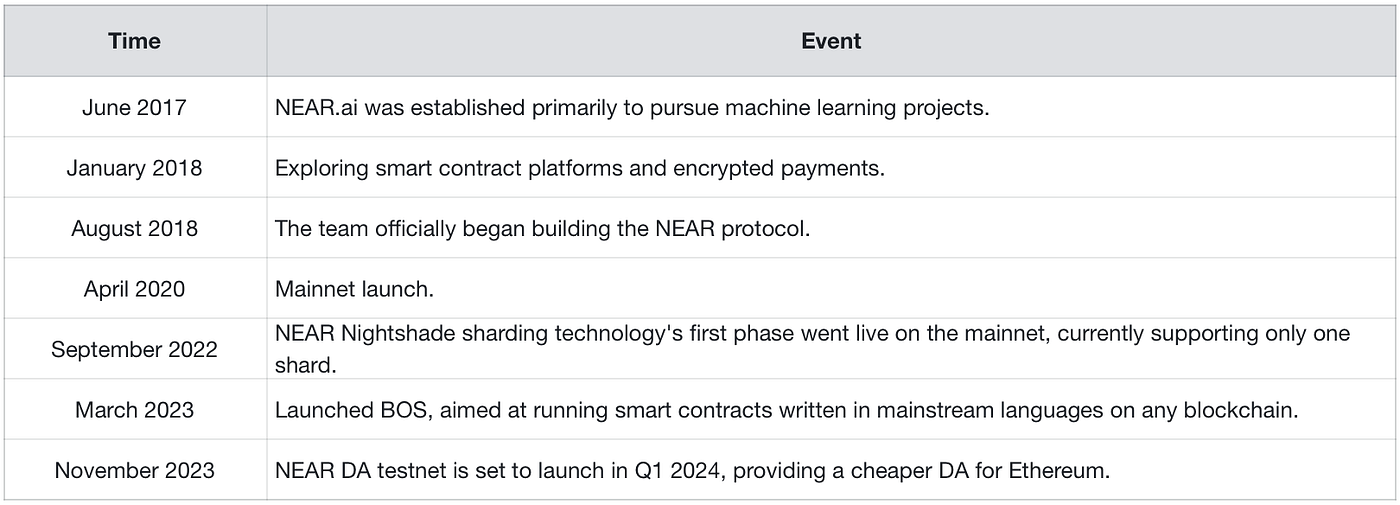
The team originally planned to release the second phase of sharding in 2023, but it was delayed until January 2024 to launch the testnet for the second phase. There have been some delays in their roadmap. In 2024, the team aims to primarily improve NEAR’s usability, scalability, and decentralization:
- Stateless validation: Adjusting the original Nightshade sharding design to avoid implementing fraud proofs, while significantly improving the performance of each shard by placing the state in memory. The team expects the introduction of stateless validation to significantly increase the throughput of each shard, preparing for the continued growth in NEAR’s usage (expected delivery in the second quarter).
- Congestion control and transaction prioritization: Providing a good user experience is crucial during short-term network congestion, including localized congestion to prevent a surge in gas prices from affecting the entire network and allowing users to prioritize their transactions during congestion (if they are willing to pay higher transaction fees).
- Account aggregation support: Allowing users to control accounts on different chains with a single NEAR account, which is a key pillar of NEAR’s chain abstraction vision. It requires signing payloads through MPC and a new API to facilitate the asynchronous nature of chain signatures.
- zkWASM: Building a prover for WebAssembly smart contracts. This can be used as part of the measures to prove NEAR state transitions in ZK proofs, and zkWASM also provides wasm as an alternative execution environment for L2’s EVM.
- Data availability improvements: NEAR launched NEAR DA in early November 2023, and the team plans to further enhance the efficiency of NEAR DA, including introducing KZG commitments to prevent data availability fraud proofs, and real-time bridging to allow verification of data availability on Ethereum.
- Ethereum wallet support: Native support for wallets like MetaMask on NEAR enables attracting more users to use NEAR, making it more consistent with Ethereum. This requires protocol changes to natively support Ethereum addresses and support processing RLP serialized Ethereum transactions.
- Researching the future of sharding: Exploring directions such as synchronous sharding and ZK-centric sharding. Synchronous sharding can achieve synchronous execution of smart contracts, addressing the pain points of asynchronous execution, while ZK-centric sharding uses zero-knowledge proofs to verify state transitions in different shards, improving the protocol’s scalability and decentralization.
3. Business Situation
3.1 Official Website Data
We compared AVAX and NEAR and found that the website traffic for NEAR exceeded AVAX by 34% in the past three months. The daily traffic is around 31,000 visitors, with the top three countries contributing to the traffic being Indonesia, the United States, and India.
3.2 Social Media Data
3.3 Community Data

3.4 Collaborations
- Collaborating with EigenLayer, jointly developing a sorter network for fast settlement based on Ethereum Layer2. Further, NEAR’s NEAR-Ethereum Rainbow Bridge, which is being constructed, will also utilize EigenLayer’s avs services. The test network is expected to launch in the first quarter of 2024.
- Collaborating with Polygon, jointly researching zkWASM, expected to be launched in 2025. Developers utilizing the open-source code library Chain Development Kit (CDK) from Polygon will be able to use zkWASM as verifiers. NEAR will be able to generate state transition proofs through zkWASM, alleviating the ZK computational burden on shard nodes, improving proof generation efficiency, and thereby enhancing shard throughput.