Author: TechFlow TechFlow
The AI track continues to be hot.
Many projects are trying to make themselves AI, with the new proposition of "helping AI do better", hoping to fly higher with the trend of AI.
However, most of these old projects have already discovered value in past cycles, and new projects like Bittensor are no longer “new”. We still need to look for projects that have not yet realized their value and have narrative potential.
In the encryption project "helping AI do better", improving privacy has always been an attractive direction:
One is because protecting privacy naturally resonates with the concept of equality in decentralization. Second, to protect privacy, it is inevitable to use technologies such as zk and homomorphic encryption.
With a correct narrative concept and advanced technology, the development of an AI project will most likely be successful.
And if such a serious project could also add the gameplay of Meme coins, wouldn’t it be more interesting?
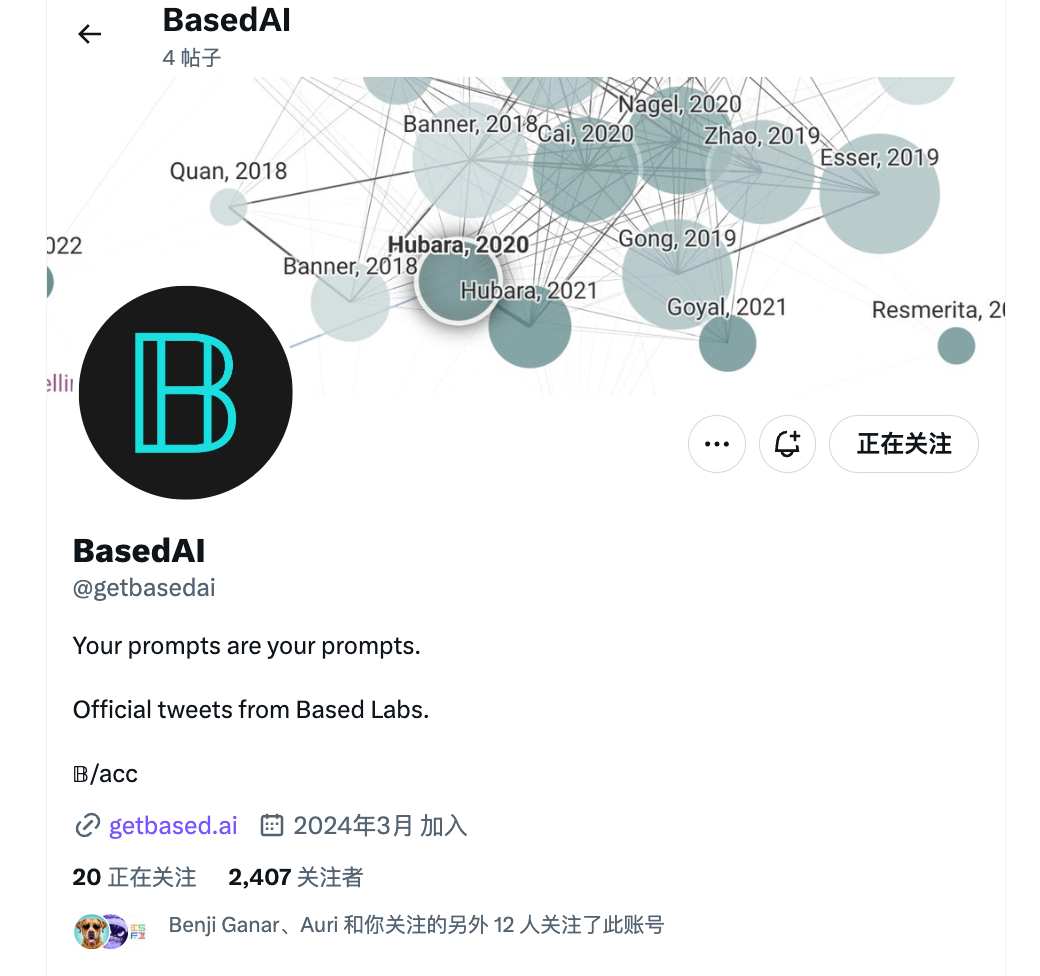
At the beginning of March, a project called BasedAI quietly registered an account on Twitter, but apart from reposting it, it only posted two serious tweets; at the same time, its official website looked extremely simple--except for one In addition to a lofty thesis version of the white paper.
Some external KOLs have already started the analysis first and said that the project may be the next Bittensor.

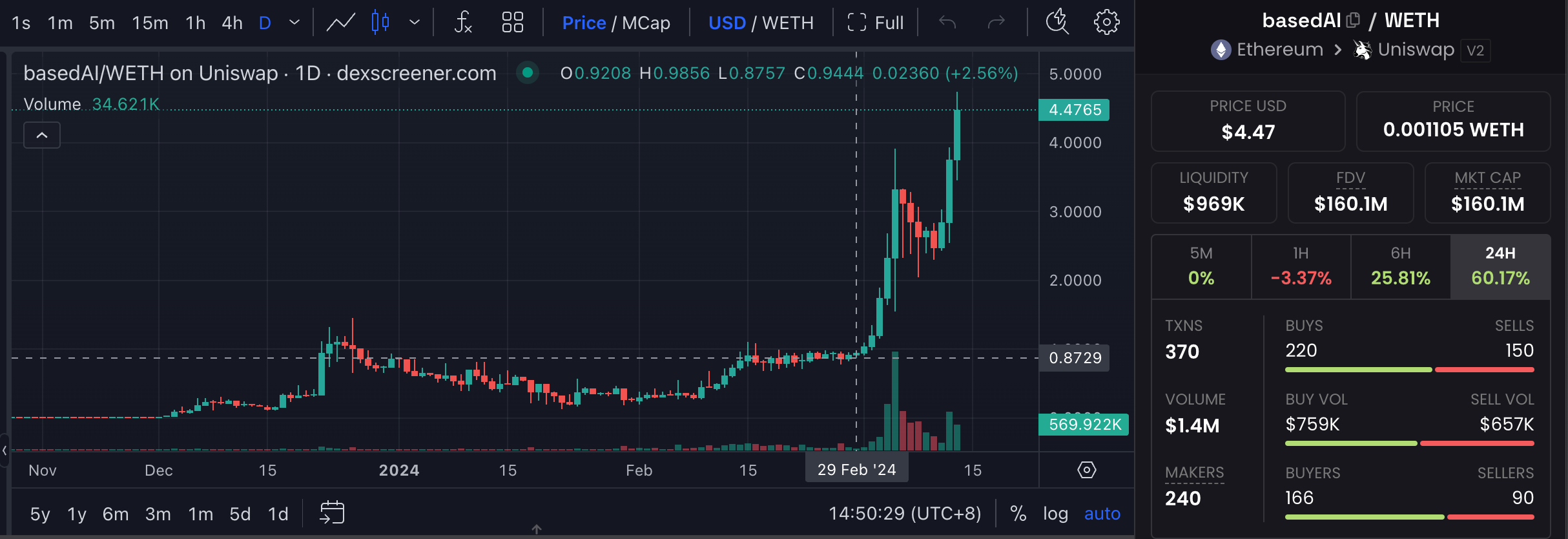
At the same time, its eponymous token $basedAI has been growing rapidly since the end of February, with an increase of more than an exaggerated 40 times.
After carefully studying the project’s white paper, we found that BasedAI is an AI project that integrates large language models, ZK, homomorphic encryption and Meme coins;
While recognizing its narrative direction, we are also impressed by its exquisite economic design, which naturally links the scheduling of computing resources with the use of other Meme coins.
Considering that the project is still in a very early stage, we will interpret it in this issue to see if it has the potential to become the next Bittensor.
When serious science meets memes
What exactly is BasedAI doing?
Before answering this question, you might as well take a look at who made this BasedAI.
Public information shows that BasedAI was jointly developed by an organization called Based Labs and the founding team of Pepecoin in an attempt to solve privacy issues when using large language models in the current AI field.
The former Based Labs does not have much public information, and its official website is very mysterious, with only a string of Matrix-style technical keywords ( click here to access ); and Sean Wellington, a researcher in the organization, is the author of the white paper published by BasedAI:

At the same time, Google Scholar information shows that Sean graduated from UC Berkeley. Since 2006, he has also published a number of papers related to clearing systems and distributed data. He is good at AI and distributed network research. He seems to be a well-known person in the technical field. A man with research.

On the other hand, pepecoin is not the currently popular PEPE coin, but a meme that was originally launched in 2016. At that time, it had its own mainnet L1, and it has now been migrated to Ethereum.
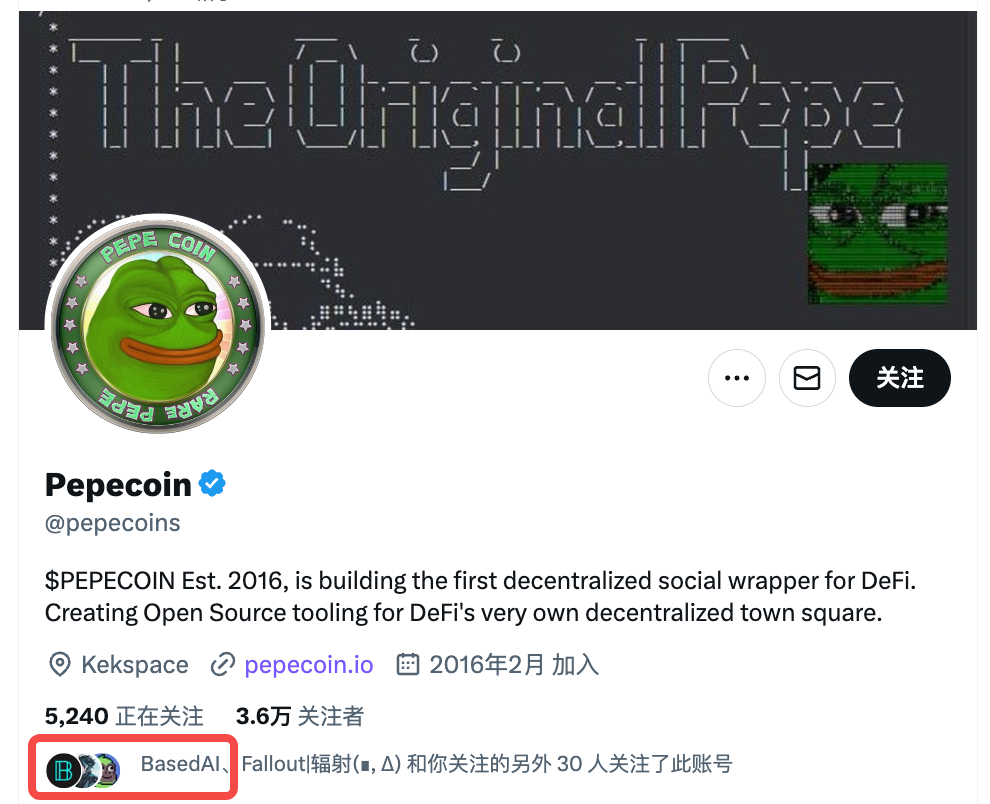
You can say this is an OG Meme, and you also understand the development of L1.
But on one side are the serious AI scientific paper bosses, and on the other side is the Meme team; how do these two groups of people, who seem to have unrelated businesses, create sparks in Based AI?
ZK and FHE take into account AI computing efficiency and privacy
If you put the Meme component aside, BasedAI’s Twitter introduction actually directly points out the narrative value of the project:
“Your prompts are your prompts.”
This actually emphasizes the importance of privacy and data sovereignty: When you use an AI large language model such as GPT, any prompt words and information you enter will actually be received by the opposite server. Essentially, your data privacy is exposed to OpenAI or other model providers.
Although this seems harmless, there are privacy issues after all, and you can only unconditionally trust the AI model provider not to misuse your conversation records.
Excluding the obscure mathematical formulas and technical designs in the BasedAI white paper, you can simply understand what BasedAI is going to do as:
Encrypt anything you talk to a large language model, without exposing the plaintext , and let the model complete the calculation and ultimately return a result that only you can decrypt.
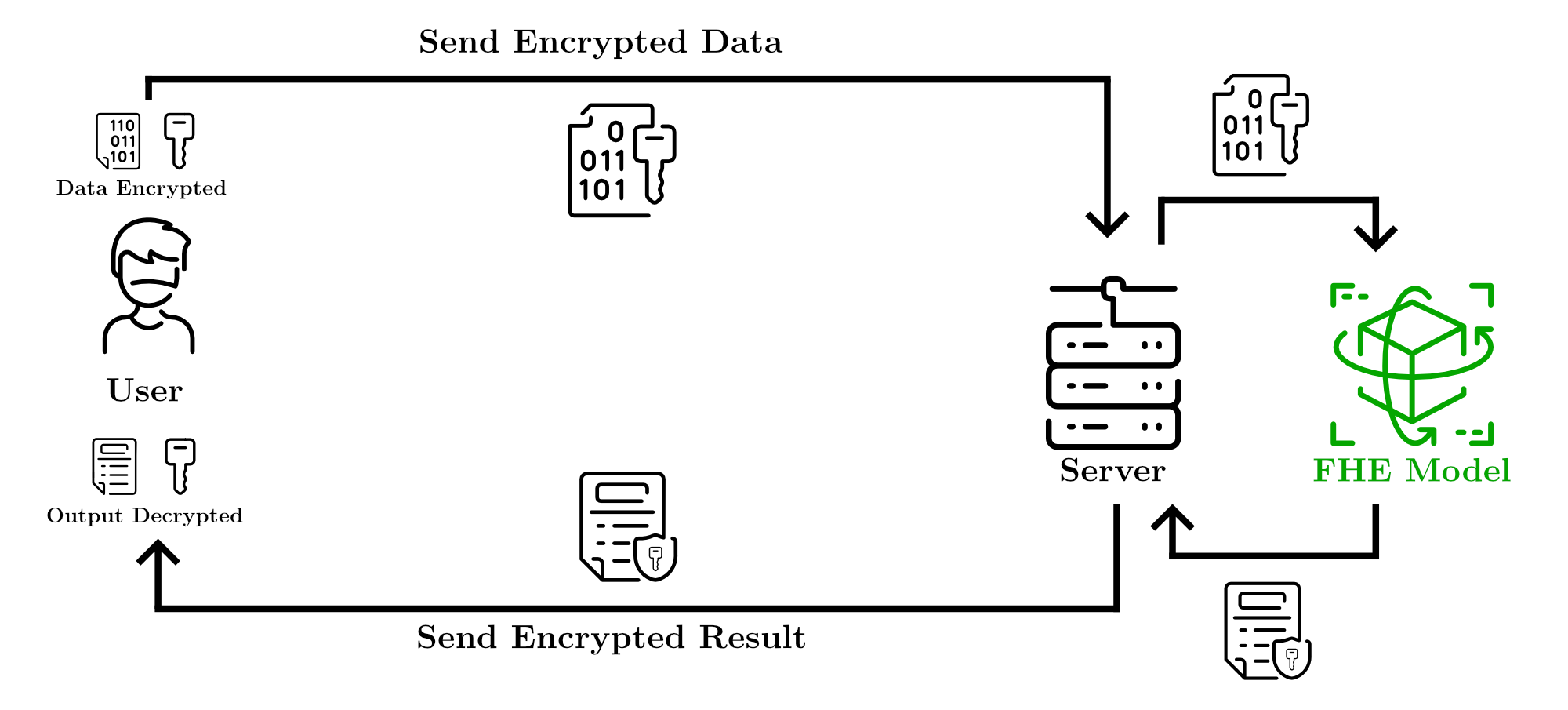
You must have a hunch that to achieve this effect, it is the turn of the two privacy technologies ZK (zero-knowledge proof) and FHE (fully homomorphic encryption) to appear.
ZK allows you to verify the truth or falsehood of something without exposing the plain text;
FHE allows you to perform calculations on encrypted data without encrypting it.
Once the two are combined, it can be achieved---your prompt words are submitted to the AI model in encrypted form, and the model returns an answer to you, but the relevant parties in the middle do not know what question you asked and what the result of the answer is. .
This sounds good, but there is a key problem---executing FHE technically requires a lot of computing resources and waiting time, and is less efficient.
However, large LLM models such as GPT are user-oriented and require fast display of results. How to deal with the contradiction between computing efficiency and privacy protection?
BasedAI specifically emphasized the " Cerberus Squeezing " technology it proposed in its paper and demonstrated it with complex mathematical formulas:
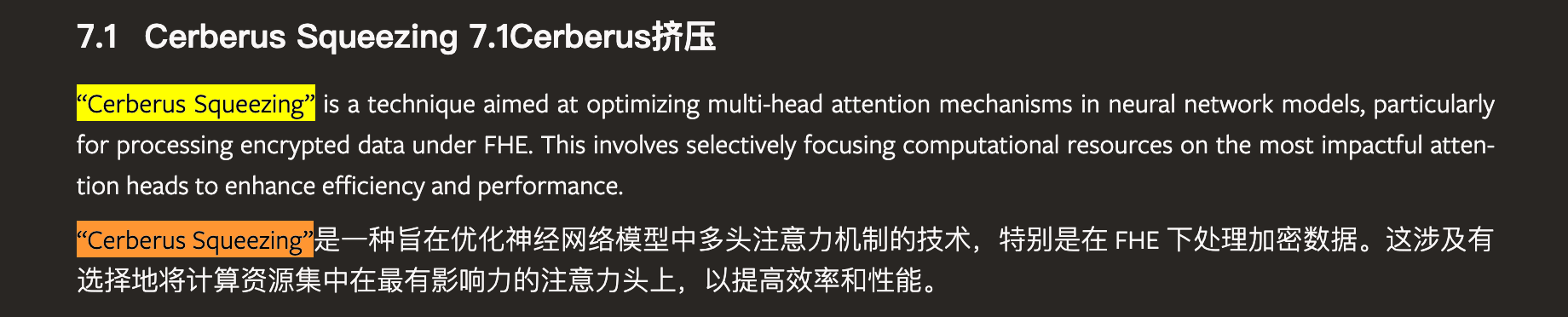
We are unable to professionally evaluate the mathematical implementation of this technology, but what it does can be simply understood as:
Optimize the efficiency of processing encrypted data in FHE (Fully Homomorphic Encryption), selectively focus computing resources where they have the most impact, and quickly complete calculations to display results.
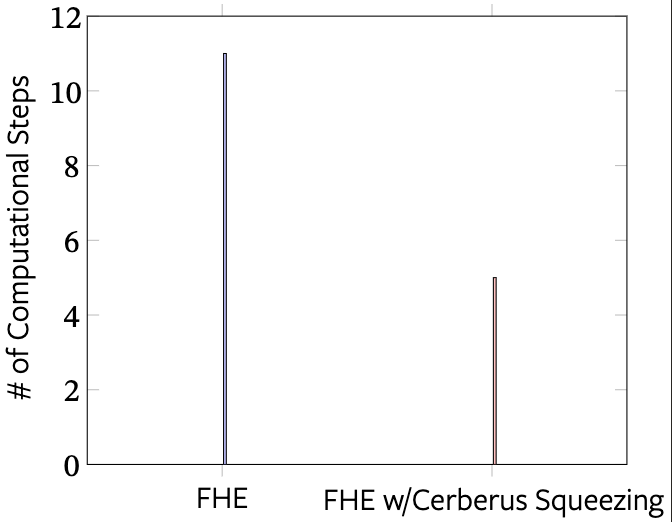
At the same time, the paper also uses data to demonstrate the efficiency improvement brought about by this optimization:
When Cerberus Squeezing is used, the computational steps required for fully homomorphic encryption can be reduced by nearly half.
At this point, we can quickly simulate the entire process of a user using BasedAI:
Users enter prompt words asking for analysis of the emotions shown in a transcript of someone's conversation, but want to keep the transcript private.
Submit this data in encrypted form through the BasedAI platform, and specify the AI model to be used (such as a sentiment analysis model).
Miners in the BasedAI network receive this task and use their own computing resources to execute the specified AI model and process this batch of encrypted data.
The network node completes the calculation task without decrypting the data and returns the encrypted processing results to the user.
The user receives the encryption result, decrypts it using his own key, and obtains the data analysis results he needs.
“Brains”, miners and validators
In addition to technology, what are the specific roles in the BasedAI network to implement technology and meet user needs?
The first thing that needs to be introduced is its self-created concept of "brain" .

A “Brain” from Based Labs
Generally speaking, for AI encryption projects, several factors that cannot be escaped are:
Miners: Responsible for performing computing tasks and consuming computing resources
Validator: verifies the correctness of the work done by miners and ensures the validity of transactions and computational tasks in the network
Blockchain: The results of the calculation and verification tasks performed are written and saved on the ledger, and the behavior of different roles is stimulated through the native tokens of the chain.
Based on these three elements, BasedAI also adds a layer of "brain" concept:
“ You must have a brain to install the computing resources of miners and validators, so that these resources can calculate and complete tasks for different AI models .”
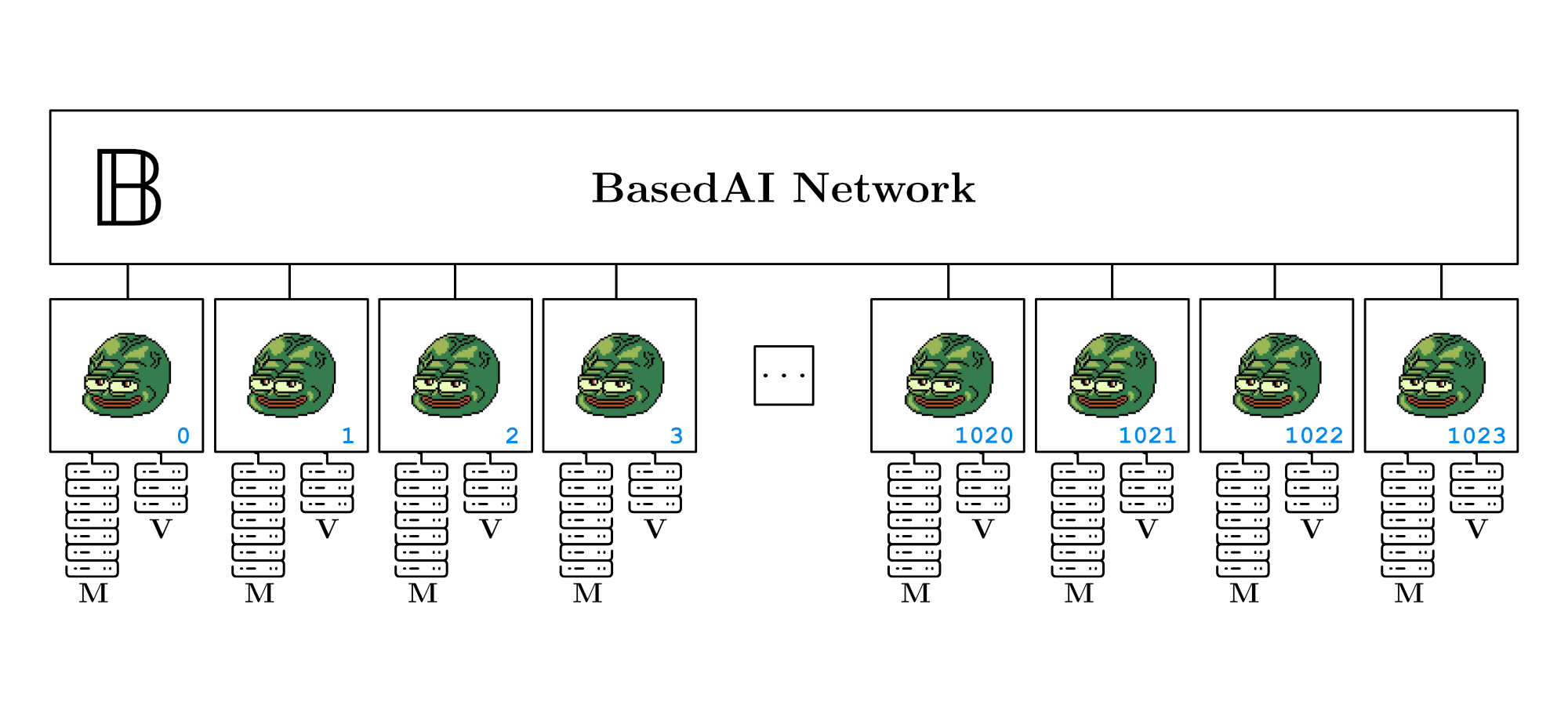
To put it bluntly, these "brains" serve as distributed containers for specific computing tasks and are used to run modified large language models (LLMs). Each "brain" can choose the miners and validators it wants to be associated with.
If you think this explanation is abstract, you can think of having a brain as having a "license to develop cloud services":
If you want to recruit a group of miners and verifiers to do encryption calculations on large language models, then you must hold an operating license, which reads:
Where is your business address (number)
What is your business scope (using AI for sentiment analysis, Vincent Chart, medical assistant...)
How much computing resources do you have and how powerful are your capabilities?
Who specifically did you bring in?
How much reward can you get for doing this?

As can be seen from the Based AI paper, each "brain" of BasedAI can accommodate up to 256 validators and 1,792 miners, while the system only has a total of 1,024 brains, which invisibly increases the scarcity of brains.
To join a certain brain, miners and validators need to do this:
Miners: Connect to the platform, decide the GPU resources to be allocated (more suitable for computing), deposit $BASED tokens, and start computing work
Verifier: Connect to the platform, decide the CPU resources to be allocated (more suitable for verification), deposit $BASED tokens, and start verification work
The more $BASED tokens deposited, the more efficiently miners and validators run on their brains, and the more $BASED rewards they receive.
Obviously, a brain represents certain power and organizational relationships, which also opens up space for token and incentive design (more on this later).
But does the design of this brain look a bit familiar?
Different brains are somewhat similar to different subnets in Bittensor, performing different specific tasks and using different AI models;

In Polkadot, which was popular in the last cycle, different brains are like different "card slots" to run parallel chains and perform different tasks.
BasedAI officials also gave an indication of how the "medical brain" performs tasks:
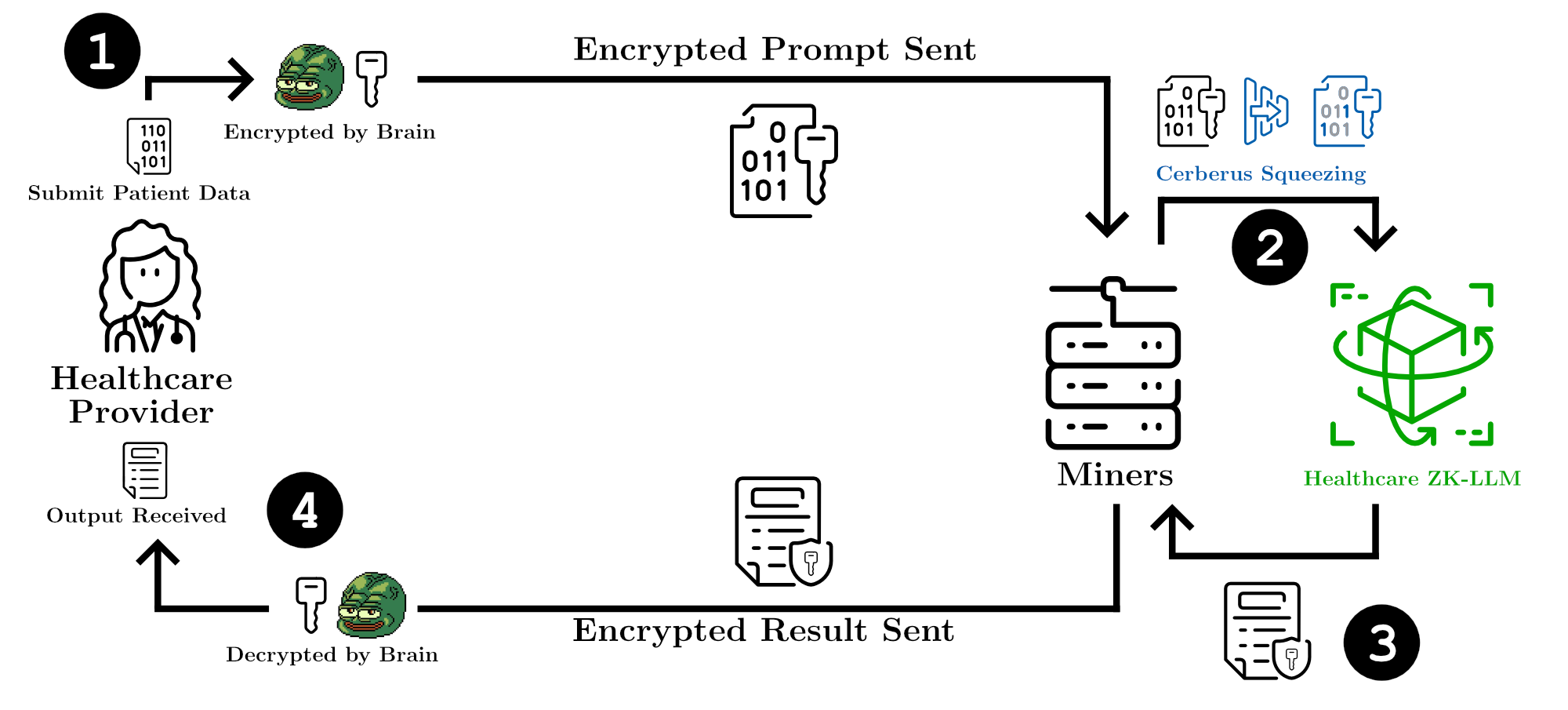
The patient's medical records are encrypted and submitted to the medical brain, which generates prompt words to ask for appropriate diagnostic opinions;
A suitable large language model in the BasedAI network, with the help of ZK and FHE, can generate answers without decrypting sensitive patient data. This step calls on the computing resources of miners and verifiers;
Healthcare providers receive encrypted output from the BasedAI network. Only submitting users can decrypt their results and obtain treatment recommendations, without data being exposed or leaked in the process.
Selling the permission to play the “brain” of Huahua benefits Pepecoin
So, how do you get a brain and get the "start license" permission for encrypted calculations of AI models?
BasedAI teamed up with Pepecoin to make the sale of this permission a waste, and gave Pepecoin the MEME token use value.
Since there are only 1,024 brains, the project team naturally utilized NFT's Mint--- for every brain sold, a corresponding ERC-721 token will be generated , which you can think of as a license.
To unlock the brain NFT Mint, two actions related to Pepecoin are required: burning or staking Pepecoin.
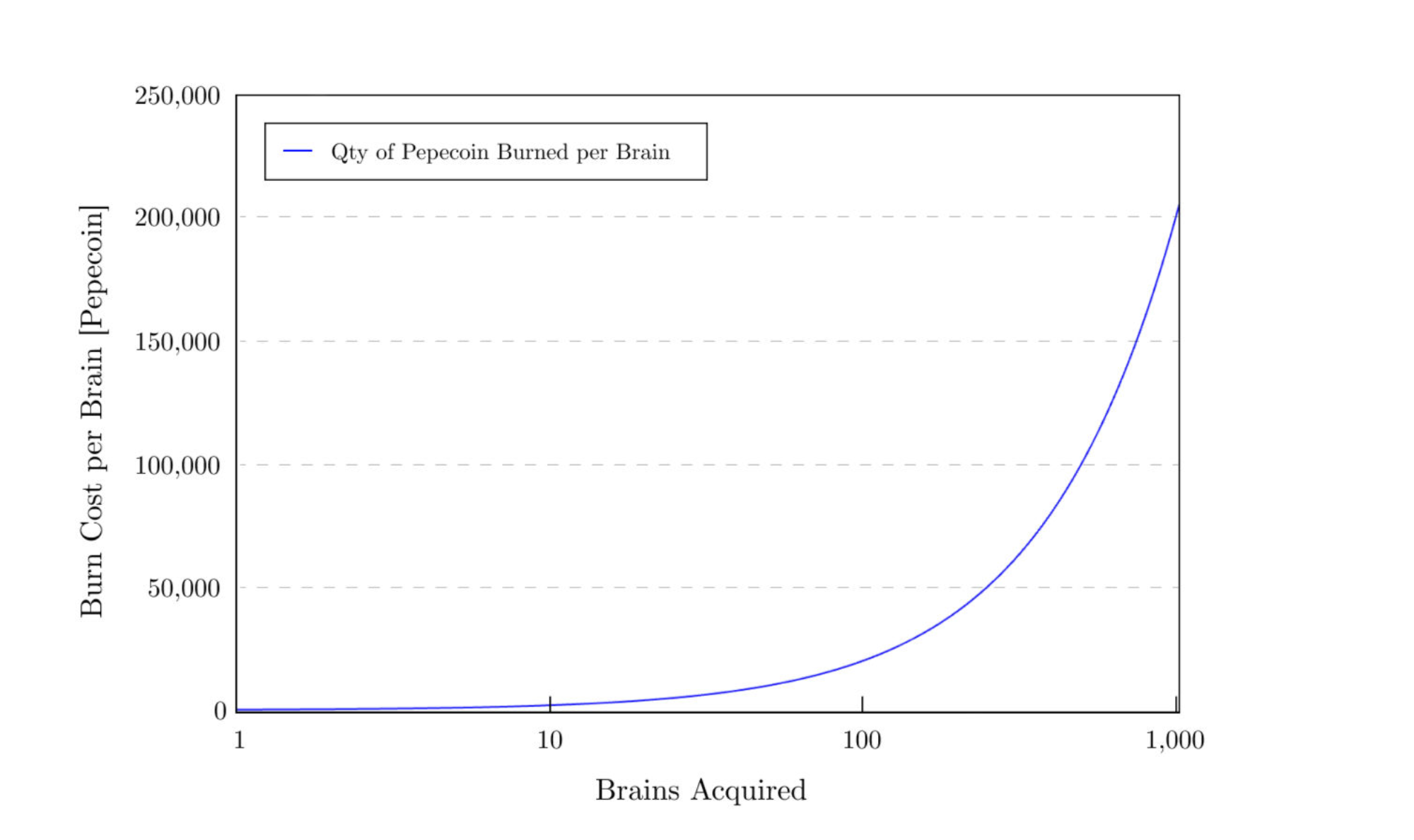
In terms of burning, the first brain requires the user to spend 1,000 Pepecoin to Mint;
For every Mint of a brain, the cost of the next Mint increases by 200 Pepecoin;
Brains generated in this way are transferable transactions;
If all Brains are obtained through the Burn burning method, 107,563,530 Pepecoin will be permanently destroyed. (CMC data shows that the current circulation is 133M. If this burning is fully realized, it will reduce the token supply by almost 80%)
And in terms of staking:
Users are required to pledge 100,000 Pepecoin for 90 days;
Brain’s ERC-721 NFT is issued immediately after staking;
Brains generated in this way are non-transferable, but will be gradually rewarded with $BASED project native tokens
The pledge can be released after 90 days
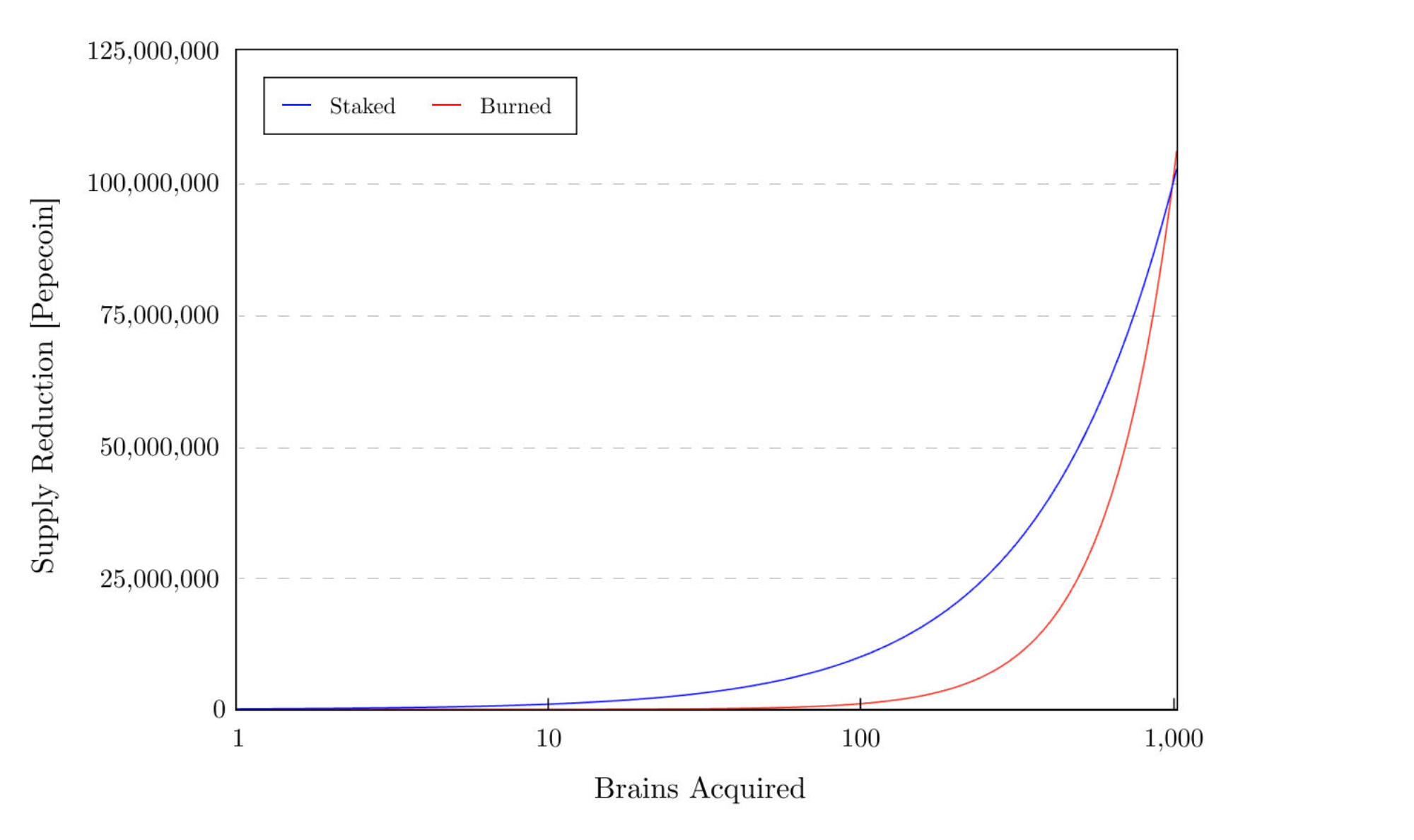
Either way, as more brains are created, a corresponding amount of Pepecoin is either burned or locked, depending on the participation ratio of the two methods.
Obviously, this is not so much the allocation of AI resources as it is the allocation of crypto assets.
Due to the scarcity of the brain and the token rewards brought by its operation, the demand for Pepecoin will increase significantly when generating the brain; whether it is pledged or burned, the supply of Pepecoin in circulation will be reduced , and the secondary market price of the token will be reduced. Of course it is a theoretical benefit.
At the same time, as long as the number of issued and active Brains in the ERC-721 contract is less than 1024, BasedAI Portal will continue to issue Brains.
If all 1024 Brains are issued, BasedAI Portal will not allow the creation of new Brains.
An Ethereum address can hold multiple Brain NFTs. The BasedAI portal will allow users to manage rewards earned from all owned Brains associated with connected ETH wallets. Active brain owners can expect to earn $30,000 to $80,000 per brain per year (official paper figures).
Under the guidance of this economic incentive, coupled with the narrative of AI and privacy, we can foresee how popular Brain will be after it is officially launched.
Summarize
In crypto projects, technology itself is not the end. The role of technology is to guide attention, and then guide asset allocation and flow.
It can be clearly seen from the brain design of BasedAI that the project has figured out "how to promote asset allocation": with the correct narrative of data privacy, the resources required for AI factor calculations are integrated into a kind of authority to create The scarcity of this permission, in turn, guides the flow of assets into the permission, pushing up the consumption of another MEME token.
Computing resources are correctly allocated and incentives can be obtained, the project's "brain" asset earns scarcity and popularity, and Meme coins reduce the circulating supply...
From the perspective of asset creation, BasedAI’s design is quite sophisticated and sophisticated.
But if you really want to answer those questions that are tacitly understood, avoided, and pretended to be confused:
How many people will use this privacy-preserving large language model for this reason? How many giant AI companies are willing to cooperate with such unselfish privacy protection technology?
The answer is probably still difficult to be optimistic about.
However, the narrative is riding the wave and the hype is at the right time.
Sometimes what we need is not to question whether there is really a way to go, but to go with the wind.
References :
X: https://twitter.com/getbasedai
Official website: https://www.getbased.ai/
Pepecoin: https://twitter.com/pepecoins