Author: Zuo Ye
Fashion is cyclical, and so is Web 3.
Near "re" became an AI public chain. As one of the founders of Transformer, he was able to attend the NVIDIA GTC conference and talk with leather-clad Lao Huang about the future of generative AI. Solana has successfully transformed as a gathering place for io.net, Bittensor and Render Network. For the AI concept chain, there are also emerging players involved in GPU computing such as Akash, GAIMIN, and Gensyn.
If we raise our sights, while the currency price is rising, we can find several interesting facts:
The battle for GPU computing power comes to the decentralized platform. The more computing power, the stronger the computing effect. CPU, storage and GPU are tied to each other;
The computing paradigm is transitioning from cloudization to decentralization. Behind it is the change in demand from AI training to reasoning. On-chain models are no longer empty talk;
The underlying software and hardware composition and operating logic of the Internet architecture have not fundamentally changed, and the decentralized computing power layer is more responsible for stimulating networking.
Let’s first make a conceptual distinction. Cloud computing power in the Web3 world was born in the era of cloud mining. It refers to packaging and selling the computing power of mining machines, eliminating the huge expenditure of users to purchase mining machines. However, computing power manufacturers often “oversell”, such as Mixing and selling the computing power of 100 mining machines to 105 people in order to obtain excess profits ultimately makes the term equivalent to a lie.
The cloud computing power in this article refers specifically to the computing resources of GPU-based cloud vendors. The question here is whether the decentralized computing power platform is the front-end puppet of the cloud vendor or the next version update.
The integration between traditional cloud vendors and blockchain is deeper than we imagined. For example, public chain nodes, development and daily storage will basically revolve around AWS, Alibaba Cloud and Huawei Cloud, eliminating the expensive investment of purchasing physical hardware. However, the problems caused cannot be ignored. In extreme cases, unplugging the network cable will cause the public chain to go down, which seriously violates the spirit of decentralization.
On the other hand, decentralized computing power platforms either directly build "computer rooms" to maintain network stability, or directly build incentive networks, such as IO.NET's airdrop strategy to increase the number of GPUs, and Filecoin's storage FIL tokens. The starting point is not to meet usage needs, but to empower tokens. One evidence is that major manufacturers, individuals, or academic institutions rarely actually use them for ML training, reasoning, or graphics rendering, resulting in a serious waste of resources.
However, in the face of rising currency prices and FOMO sentiment, all accusations that decentralized computing power is a cloud computing power scam have disappeared.
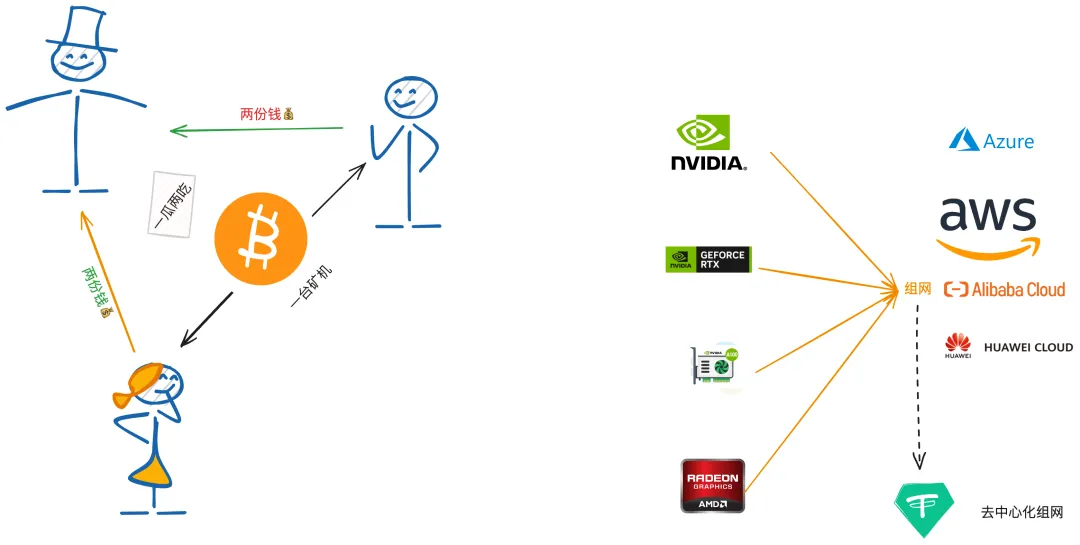
Do two types of computing power have the same name and luck?
Inference and FLOPS, quantifying GPU computing power
The computing power requirements of AI models are evolving from training to inference.
Let's take OpenAI's Sora as an example. Although it is also manufactured based on Transformer technology, its parameter size is compared to the trillions of GPT-4. Academic circles speculate that it is below the hundreds of billions. Yang Likun even said that it is only 3 billion, that is, training The cost is low, which is also very easy to understand. The computing resources required for a small number of parameters are also proportionally attenuated.
But in turn, Sora may need stronger "reasoning" capabilities. Reasoning can be understood as the ability to generate specific videos according to instructions. Videos have long been regarded as creative content, so they require stronger AI understanding capabilities, and training is relatively simple. It can be understood as summarizing the rules based on existing content, stacking computing power without brains, and working hard to create miracles.
In the past, AI computing power was mainly used for training, with a small amount used for reasoning capabilities, and was basically covered by various NVIDIA products. However, after the advent of Groq LPU (Language Processing Unit), things began to change, and better Reasoning capabilities, superimposed large models to slim down and improve accuracy, and having the brain to talk logic are slowly becoming mainstream.
In addition, I would like to add the classification of GPU. It is often seen that it is those who play games that save AI. What makes sense is that the strong demand for high-performance GPUs in the game market covers the research and development costs. For example, 4090 graphics cards, those who play games and AI alchemy can be used, but it should be noted that the game card and the computing card will gradually be decoupled. This process is similar to the development of Bitcoin mining machines from personal computers to dedicated mining machines, and the chips used also follow In order from CPU, GPU, FPGA and ASIC.
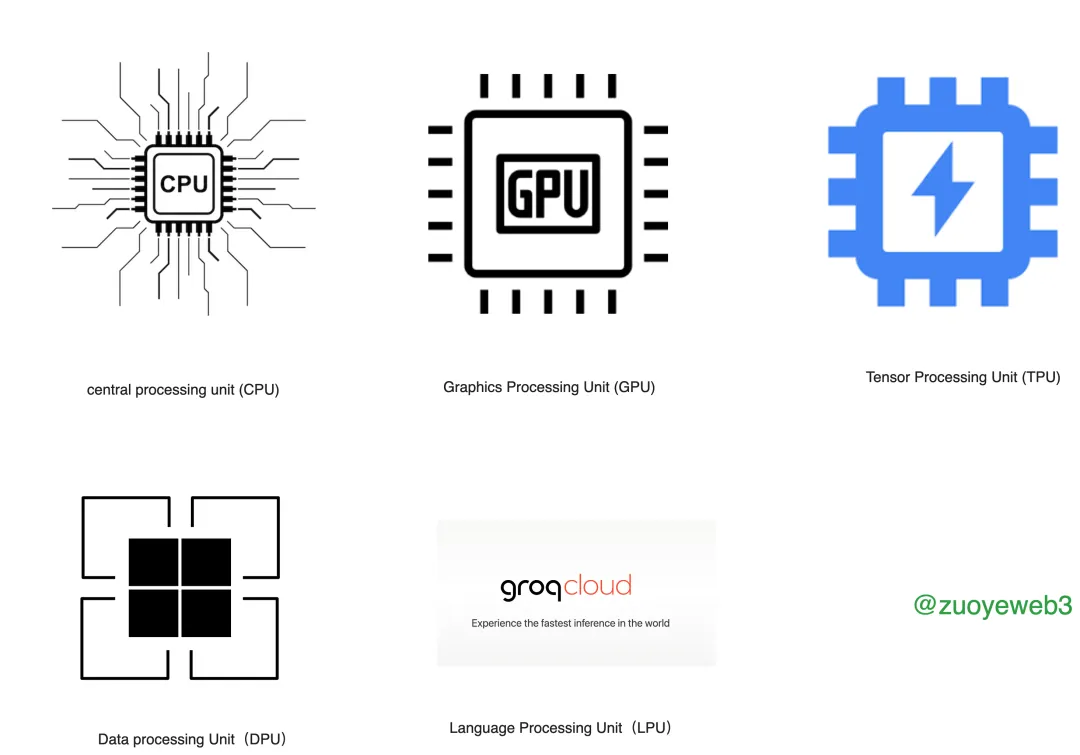
LLM special card is under development...
As AI technology, especially the LLM route, matures and advances, there will be more and more similar attempts at TPU, DPU and LPU. Of course, the current main product is NVIDIA's GPU. All the discussions below are also based on GPU and LPU. Waiting for more is a supplement to the GPU, and it will take some time to completely replace it.
The decentralized computing power competition does not compete for GPU acquisition channels, but attempts to establish new profit models.
At this point in writing, NVIDIA has almost become the protagonist. Basically, NVIDIA occupies 80% of the graphics card market. The dispute between N card and A card only exists in theory. In reality, everyone is talking about integrity.
The absolute monopoly has created a fierce competition for GPUs, from the consumer-level RTX 4090 to the enterprise-level A100/H100, and various cloud vendors are the main force in stocking up. However, AI-related companies such as Google, Meta, Tesla and OpenAI all have actions or plans to produce self-made chips, and domestic companies have turned to domestic manufacturers such as Huawei, and the GPU track is still extremely crowded.
For traditional cloud vendors, what they sell is actually computing power and storage space, so whether to use their own chips is not as urgent as AI companies. However, for decentralized computing power projects, they are currently in the first half, that is, compared with traditional cloud Manufacturers are competing for computing power business, focusing on cheap and easy-to-obtain computing power. However, like Bitcoin mining in the future, there is little chance of Web3 AI chips appearing.
An additional comment, since Ethereum switched to PoS, there have been fewer and fewer dedicated hardware in the crypto. The markets such as Saga mobile phones, ZK hardware acceleration and DePIN are too small. I hope that decentralized computing power can be explored for dedicated AI computing power cards. Create a unique path for Web3.
Decentralized computing power is the next step or complement to the cloud.
The computing power of GPU is usually compared in the industry with FLOPS (Floating Point Operations Per Second), which is the most commonly used indicator of computing speed. Regardless of the specifications of the GPU or optimization measures such as application parallelism, it is ultimately based on FLOPS on high and low.
It has taken about half a century from local computing to moving to the cloud, and the concept of distribution has existed since the birth of computers. Driven by LLM, the combination of decentralization and computing power is no longer as vague as before. I will Summarize as many existing decentralized computing power projects as possible, with only two dimensions:
The number of hardware such as GPUs is used to measure their computing speed. According to Moore's Law, the newer the GPU, the stronger the computing power. The greater the number of GPUs with the same specifications, the stronger the computing power;
The incentive layer organization method is an industry characteristic of Web3. Dual tokens, additional governance functions, airdrop incentives, etc. make it easier to understand the long-term value of each project, instead of overly focusing on short-term currency prices and only looking at how much you can own or dispatch in the long term. GPU.
From this perspective, decentralized computing power is still based on the DePIN route of "existing hardware + incentive network", or the Internet architecture is still the bottom layer, and the decentralized computing power layer is the monetization after "hardware virtualization" , focusing on access without permission. Real networking still requires the cooperation of hardware.
Computing power needs to be decentralized, and GPUs need to be centralized
With the help of the blockchain trilemma framework, the security of decentralized computing power does not need to be specially considered. The main issues are decentralization and scalability. The latter is the purpose of GPU networking, which is currently at the forefront of AI. state.
Starting from a paradox, if the decentralized computing power project is to be completed, the number of GPUs on the network must be as large as possible. There is no other reason. The parameters of large models such as GPT are exploding, and there is no GPU of a certain scale. Cannot have training or inference effects.
Of course, compared to the absolute control of cloud vendors, at the current stage, decentralized computing power projects can at least set up mechanisms such as no access and free migration of GPU resources. However, due to the improvement of capital efficiency, will there be a similar mining pool in the future? The product may not be the same.
In terms of scalability, GPU can not only be used for AI, but cloud computing and rendering are also feasible paths. For example, Render Network focuses on rendering work, while Bittensor and others focus on providing model training. From a more straightforward perspective, scalability is equivalent to Usage scenarios and purposes.
Therefore, two additional parameters can be added to the GPU and the incentive network, namely decentralization and scalability, to form a comparison indicator from four angles. Please note that this method is different from the technical comparison and is purely a picture.
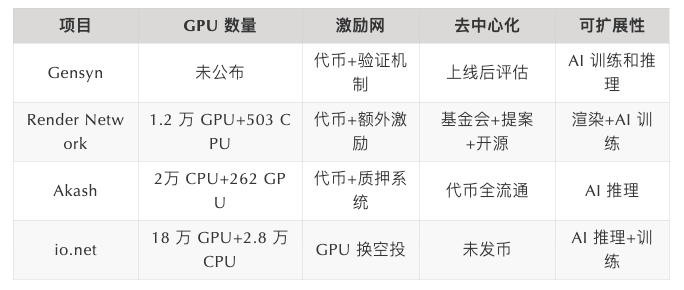
In the above-mentioned projects, Render Network is actually very special. It is essentially a distributed rendering network, and its relationship with AI is not direct. In AI training and reasoning, all links are interlocked, whether it is SGD (stochastic gradient descent, Algorithms such as Stochastic Gradient Descent) or backpropagation require consistency, but rendering and other tasks do not necessarily have to be so. Videos and pictures are often segmented to facilitate task distribution.
Its AI training capabilities are mainly integrated with io.net and exist as a plug-in of io.net. Anyway, the GPU is working, no matter how hard it is, what is more forward-looking is its defection to Solana at the moment of underestimation. , It was later proven that Solana was more suitable for the high-performance requirements of rendering and other networks.
The second is io.net’s scale development route of violent GPU replacement. Currently, the official website lists a full 180,000 GPUs. It is in the first level of the decentralized computing power project. There is an order of magnitude difference with other opponents, and in In terms of scalability, io.net focuses on AI reasoning, and AI training is a hands-on way of working.
Strictly speaking, AI training is not suitable for distributed deployment. Even for lightweight LLMs, the absolute number of parameters will not be much less. The centralized computing method is more cost-effective in terms of economic cost. Web 3 and The integration point of AI in training is more data privacy and encryption operations, such as ZK and FHE technologies, and AI inference Web 3 has great potential. On the one hand, it has relatively low requirements on GPU computing performance and can tolerate a certain degree of loss. , On the other hand, AI reasoning is closer to the application side, and incentives from the user's perspective are more substantial.
Another company that mines and exchanges tokens, Filecoin, has also reached a GPU utilization agreement with io.net. Filecoin will use its 1,000 GPUs in parallel with io.net. It can be regarded as a joint effort between the predecessors. I wish you both good luck. .
Next is Gensyn, which has not yet been launched. We also come to the cloud for evaluation. Because it is still in the early stages of network construction, the number of GPUs has not been announced. However, its main usage scenario is AI training. Personally, I feel that the number of high-performance GPUs is not small. , at least beyond the level of Render Network. Compared with AI inference, AI training has a direct competitive relationship with cloud vendors, and the specific mechanism design will be more complicated.
Specifically, Gensyn needs to ensure the effectiveness of model training. At the same time, in order to improve training efficiency, it uses off-chain computing paradigms on a large scale. Therefore, model verification and anti-cheating systems require multi-party role games:
Submitters: Task initiators, who ultimately pay for training costs.
Solvers: train the model and provide proof of effectiveness.
Verifiers: Verify model validity.
Whistleblowers: Check validator work.
Overall, the operation method is similar to PoW mining + optimistic proof mechanism. The architecture is very complex. Maybe transferring calculations to off-chain can save costs, but the complexity of the architecture will bring additional operating costs. At present, the main decentralized computing power Focusing on the juncture of AI reasoning, I also wish Gensyn good luck.
Finally, there is the old Akash, who basically started together with Render Network. Akash focused on the decentralization of CPU, and Render Network was the first to focus on the decentralization of GPU. Unexpectedly, after the outbreak of AI, both parties entered the field of GPU + AI computing. The difference Akash is more concerned with reasoning.
The key to Akash’s rejuvenation is to take a fancy to the mining problems after Ethereum’s upgrade. The idle GPU can not only be used as second-hand by female college students for personal use, but now they can also work on AI together. Anyway, they are all contributing to human civilization.
However, one good thing about Akash is that the tokens are basically fully circulated. After all, it is a very old project, and it also actively adopts the staking system commonly used in PoS. However, the team seems to be more Buddhist, and they are not as youthful as io.net. feel.
In addition, there are THETA for edge cloud computing, Phoenix for providing niche solutions for AI computing power, and old and new computing companies such as Bittensor and Ritual. Due to space limitations, we cannot list them all. Mainly because some of them are really hard to find. Less than the number of GPUs and other parameters.
Conclusion
Throughout the history of computer development, decentralized versions of various computing paradigms can be built. The only regret is that they have no impact on mainstream applications. The current Web3 computing project is mainly self-promotion within the industry. The founder of Near went to the GTC conference It's also because of Transformer's authorship, not Near's founder status.
What is even more pessimistic is that the current cloud computing market size and players are too powerful. Can io.net replace AWS? If there are enough GPUs, it is really possible. After all, AWS has long used open source Redis as the underlying component.
In a sense, the power of open source and decentralization are not equal. Decentralized projects are overly concentrated in financial fields such as DeFi, and AI may be a key path to enter the mainstream market.