
Written by @0xJohnsons
TL;DR
1. First of all, the Dencun upgrade corresponds to the "Surge" part of the Ethereum development plan, which aims to improve the scalability and modularity of Ethereum, enhance the security functions of the Ethereum network, and improve overall usability:
- The core of the upgrade is to introduce EIP-4844 , which significantly reduces the transaction fees of Ethereum Layer2 and improves transaction throughput, while preparing for the full implementation of Danksharding;
- A new data storage structure, Blob , is introduced, which is specifically used to store transaction data submitted by L2 to L1. This is also the core reason for the overall reduction of L2 Gas.
- The EIP-1153 transient storage opcode reduces storage costs and gas consumption, EIP-4788 achieves interoperability between the EVM and the beacon chain in a minimally trusted manner, the MCOPY instruction of EIP-5656 fills the missing gap in the current method of copying memory in the EVM, and EIP-6780 limits the function of the opcode SELFDESTRUCT, improving the development stability of Ethereum.
2. Secondly, compare the effects before and after the upgrade from a data perspective:
- In terms of gas fees, the L2 gas fee has dropped significantly , which is basically in line with the expectation that the Layer2 fee will drop by 90% before the upgrade. Ethereum gas fees have dropped, but not significantly, and users have not felt any change in actual use.
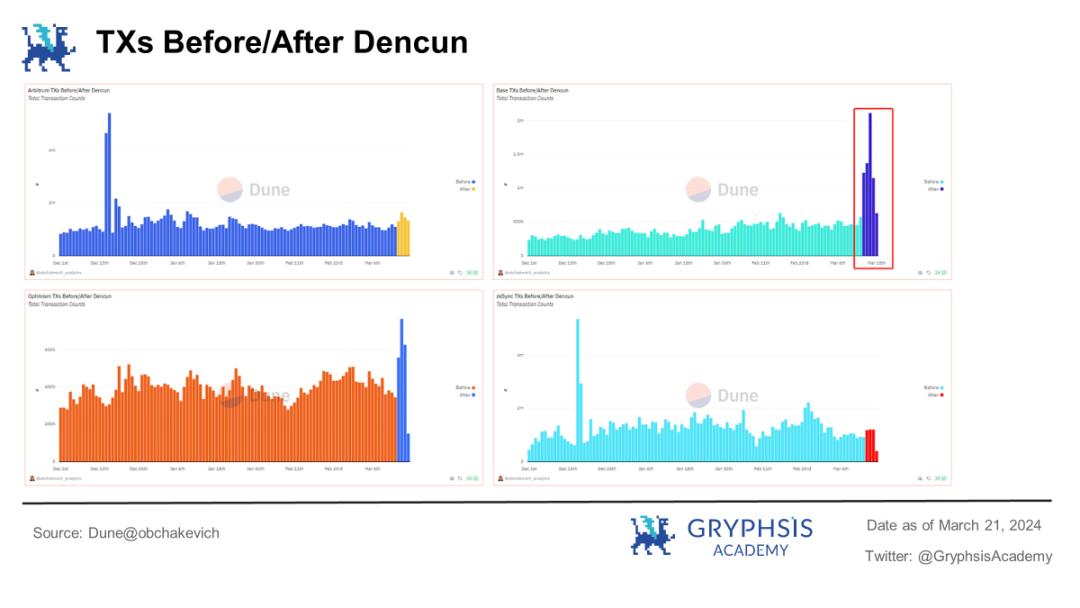
- In terms of transaction volume, the transaction volume of each L2 has increased after the upgrade, the most obvious of which is Base, which has increased from 500,000 to 2 million, and has benefited the most from the upgrade;
- In terms of TPS (throughput), the L2 TPS has increased after the upgrade, but it is not as obvious as the transaction volume. However, from the perspective of industry development, this upgrade is also laying the foundation for the future. At the same time, it also echoes the development expectations of Ethereum, reaching 100,000+ TPS;
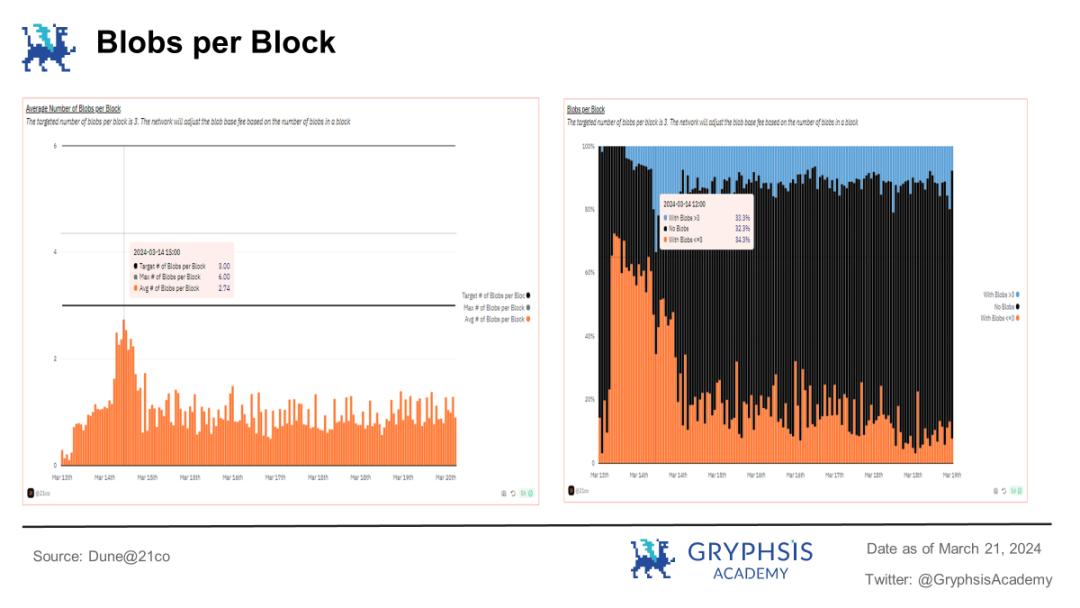
- In terms of Blob quantity usage, the Blob usage rate was average after the upgrade and did not reach the expected target value of 3, but it can be seen intuitively that the data cost of using L1 in the L2 average transaction fee was significantly reduced.
3. Finally, the impact of Dencun upgrade on Ethereum and L2 investment was explored:
- The author believes that this upgrade mainly lays the foundation for the future development of Ethereum, bringing it closer to becoming a fully scalable and accessible global trading platform. As for ETH, as the native token of the "platform", combined with the ETH-ETF narrative, it will exist more as a global asset allocation in the future, just like the current role change of BTC, which is more suitable for long-term investment;
- L2 leaders Arbitrum and Optimism are particularly noteworthy. Currently, both are developing well and have their own moats. At the same time, this upgrade is expected to increase their profit margins in the future, which will benefit users and form a positive cycle for their ecological construction.
- Another L2 that is more in favor is Base . Backed by Coinbase, it naturally has a large number of users and funds. Its recent data performance is very outstanding, and the market is also hot. It may have good Alpha opportunities after the upgrade.
- We should continue to pay attention to L2, which has not yet issued coins . The upgrade will cause a significant drop in interaction costs, and more users will be willing to participate in ecological interactions, such as ZKsync, Blast, etc.
Preface
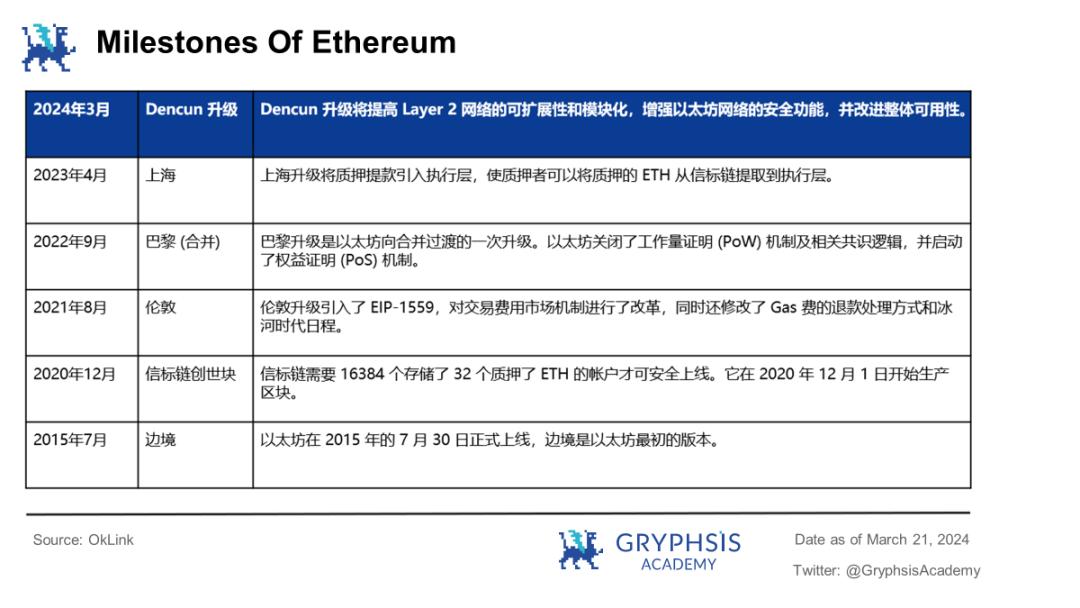
Since Ethereum introduced the concept of smart contracts, it has led to the subsequent prosperity of the blockchain ecosystem. Since its official launch on July 30, 2015, Ethereum has undergone 12 upgrades, and each upgrade has attracted much attention.
The main goal of the Ethereum Cancun-Deneb upgrade (Dencun upgrade) is to improve the scalability and modularity of the Layer 2 network, enhance the security features of the Ethereum network, and improve overall usability.
1. What is Dencun Upgrade?
1.1 Upgrade Introduction
1.1.1 Origin of the name
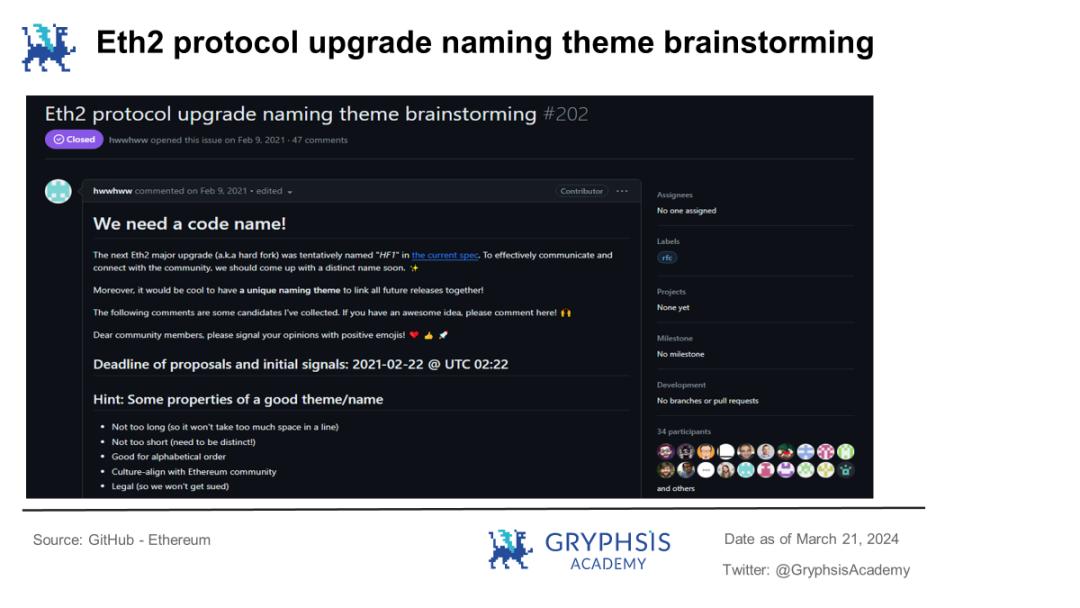
The underlying layer of Ethereum is composed of two parts: the execution layer and the consensus layer, and the two parts have different naming rules.
The naming rules for execution layer upgrades will be named after the city where Devcon (Ethereum Developer Conference) is held starting from 2021. For example, Berlin Upgrade, London Upgrade, Shanghai Upgrade, etc.
The naming convention for consensus layer upgrades is to name them after celestial bodies in alphabetical order since the launch of the beacon chain, such as Altair, Bellatrix, Capella, etc.
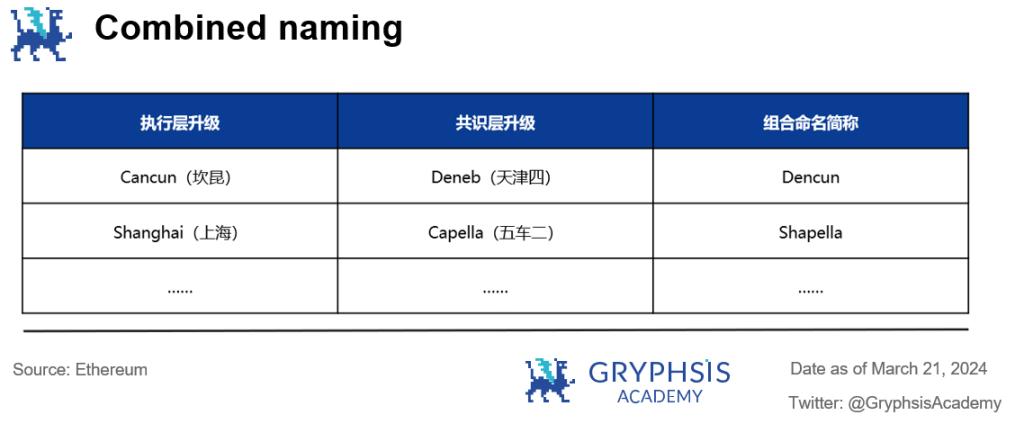
Each upgrade name of Ethereum is a combination of the two different upgrade names to form an overall upgrade name. Since the Devcon location is in Cancun, Mexico, and the consensus layer upgrade is Deneb, this Ethereum upgrade is referred to as the Dencun upgrade.
1.1.2 Upgrade Background
The background of Dencun upgrade is based on the long-term development plan of Ethereum, and the other core is to enhance the Ethereum experience and ultimately realize a permissionless, decentralized, censorship-resistant, open source ecosystem.
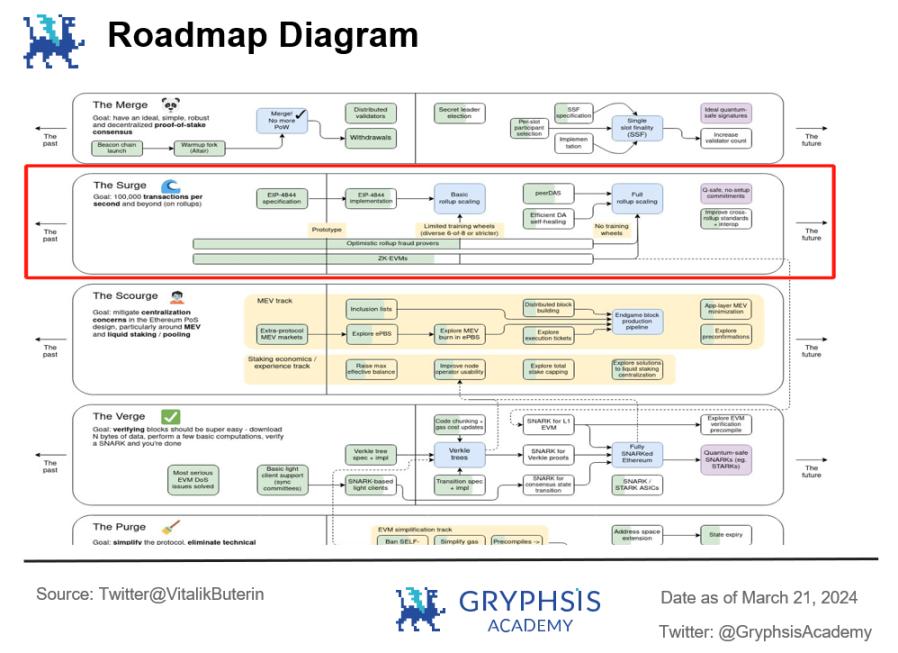
On the one hand, according to the roadmap released by Ethereum founder Vitalik Buterin on December 31, 2023, the Dencun upgrade corresponds to the part of The surge, which begins to put user experience first (such as increasing transaction speed and reducing Gas fee), with the aim of improving network efficiency, reducing transaction costs, and laying a solid foundation for future development.
On the other hand, from Vitalik Buterin’s article “ Make Ethereum Cypherpunk Again ” published on December 28, 2023, we can see that Vitalik believes that one of the core reasons why blockchain is increasingly limited to asset speculation is the increase in transaction fees , which makes Degen Gamblers become the mainstream group, which is not conducive to realizing the application value of blockchain, so transaction fees must be reduced.

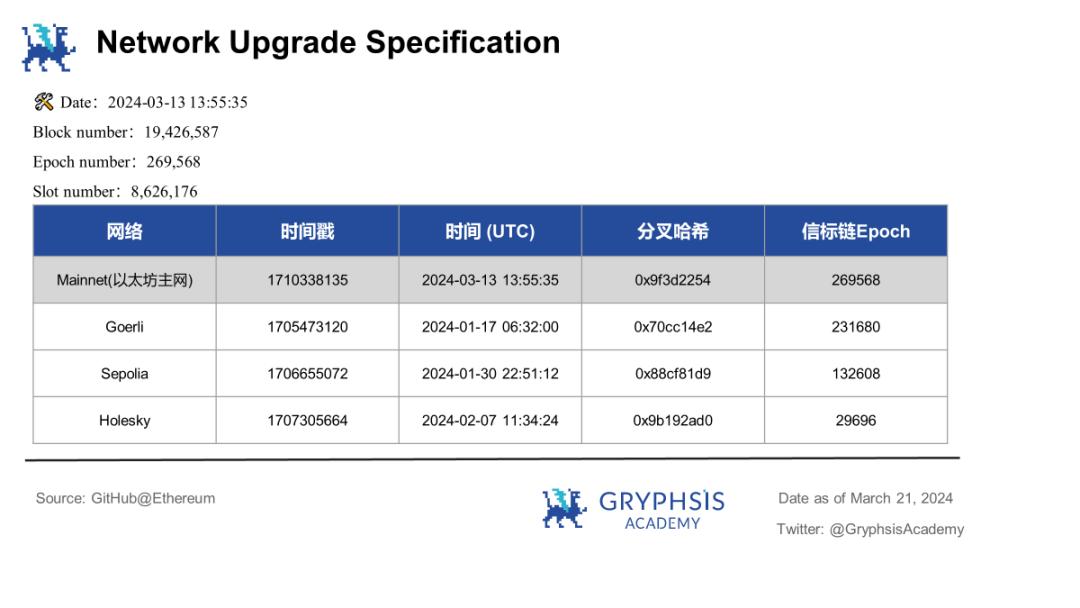
1.1.3 Upgrade Time
According to Ethereum's plan, the upgrade time and activation information are:
1.1.4 Contents
The Ethereum Cancun-Deneb upgrade has made a series of improvements to the execution layer and consensus layer respectively. Cancun improves the execution layer (EL), Deneb enhances the consensus layer (CL), and incorporates a series of EIPs (Ethereum Improvement Proposals) that are critical to the development of the Ethereum network. There are a total of 9 EIPs, and we will introduce the key EIPs later.

1.2 Dencun Upgrade Focus
Through the above understanding, we know that the Dencun upgrade is mainly to improve Ethereum, and the specific implementation plan is based on a series of EIPs. The following will analyze the core EIPs involved.
1.2.1 EIP-4844 Sharding Blob Transactions (Proto-Danksharding)
EIP-4844 is the biggest highlight of this upgrade, which aims to reduce handling fees, increase transaction throughput (TPS) and scalability. Its essence is a transitional upgrade to prepare for the future to achieve full Danksharding (the last part of Ethereum's "Tranquility" phase upgrade). Proto-Danksharding is laying the foundation for Danksharding.
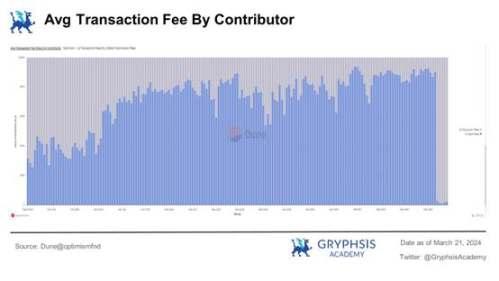
The data availability provided on the Ethereum main chain is Calldata (which can be understood as the data generated in the contract transaction call), and the data sent back from Layer 2 to Layer 1 is stored in Calldata. In addition, for security reasons, each step of Calldata execution requires Gas, which results in a high Gas cost. However, the transaction data in Calldata is not very useful after verification. Long-term data can also be downloaded for verification, and it does not even need to be transmitted to the execution layer. Taking the average transaction fee history of the Layer2-OP chain as an example, it can be seen that nearly 80% of the fees come from L1 data fees.

Therefore, EIP-4844 introduces a new data storage structure - Blob, which is specifically used to store transaction data submitted by L2 to L1. After the introduction, L2 transaction data is directly submitted to Blob for storage, which can be fully downloaded by consensus nodes and deleted after only a short delay, reducing unnecessary storage burden. This means that the introduction of Blob will greatly reduce the transaction fees of L2. At the same time, Blob is equivalent to expanding the block space for L2, and the transaction throughput of L2 will also be significantly improved.

1.2.2 EIP-1153 Transient Storage Opcodes
The main purpose of EIP-1153 is to save storage space and storage costs. Transient storage is discarded after each transaction, so temporary storage is cheaper because it does not require disk access.
EIP-1153 is friendly to Dapp developers. It introduces new opcodes TSTORE and TLOAD in EVM. The gas cost of calling these opcodes is about 100 Gas each, which is 95% cheaper than traditional storage calls (SLOAD and SSTORE). At the same time, once the complete transaction is executed, the storage will be cleared, thereby reducing storage costs and gas consumption. For example, in the future, new DeFi contracts may save more gas.

1.2.3 Beacon Block Root in EIP-4788 EVM
EIP-4788 will enable communication between EVM (Ethereum Virtual Machine) and Beacon Chain. This feature supports various use cases and can improve staking pools, restaking constructions, cross-chain bridges (smart contract bridges), MEV, etc.
Previously, EVM could not directly access Beacon data and status, and could only capture the status through external trusted oracles. Therefore, it is proposed to place a parent beacon block root (parent_beacon_block_root) in each EVM block, so that when Beacon is updated, EVM can immediately obtain accurate information.
The parent beacon block root will be stored in a ring buffer for only about 1 day. Once a new parent beacon block root enters and the buffer capacity reaches a critical value, the oldest parent beacon block root will be overwritten, thereby achieving efficient and limited consensus storage. In this way, communication is achieved in a trust-minimized manner, and external oracle failures and malicious risks are eliminated, increasing security.
1.2.4 EIP-5656 MCOPY - Memory Copy Instruction
EIP-5656 optimizes the cost of copying memory areas by introducing a new EVM instruction MCOPY, thereby improving the efficiency of moving data in the EVM.
Memory copying is a basic operation, but implementing it on the EVM comes with overhead. Taking copying 256 bytes of memory data as an example, developers can significantly reduce the cost from the previous 96 Gas (using MLOAD and MSTORE) to 27 Gas through the MCOPY opcode. It is expected that most developers will use MCOPY instead of MSTORE/MLOAD in the future, and more efficient Gas contracts will eventually benefit end users.
At the same time MCOPY fills a missing gap in the current methods of copying memory in the EVM.

1.2.5 EIP-6780 SELFDESTRUCT only in the same transaction
EIP-6780 limits the function of the opcode SELFDESTRUCT. The new function simply sends all funds in the account to the target, but does not affect the code, storage and other information. It is also a preparation for subsequent Verkle tree upgrades.
Before EIP-6780, if the SELFDESTRUCT opcode was referenced in the contract creation, funds could be sent to the target, but the code, storage, and other information would be deleted. However, this feature would have certain dangers and unexpected consequences. After EIP-6780, all this will not be affected, and developers can better manage projects, resulting in a more stable and predictable blockchain.
2. Impact on data level after upgrade
2.1 Impact of Gas Fees
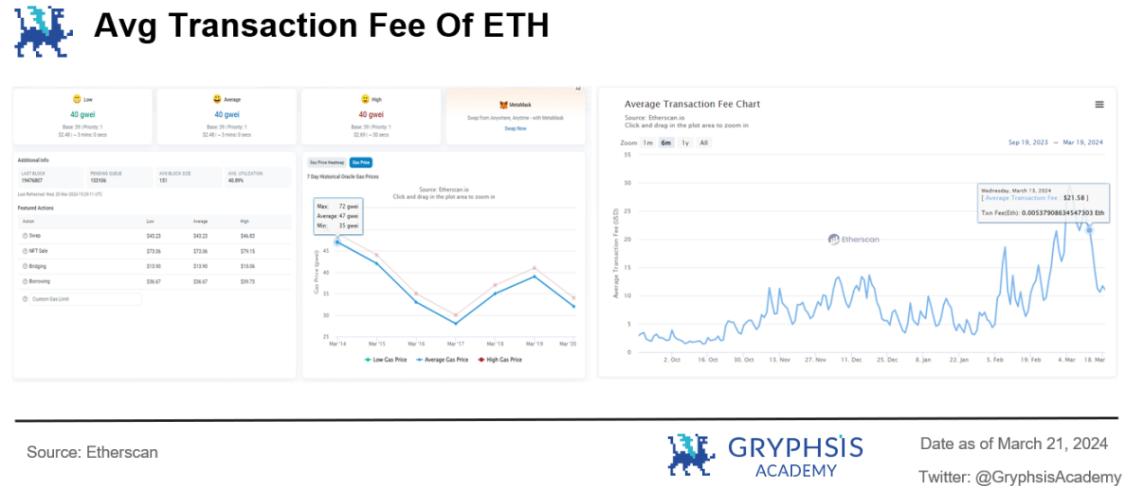
The core of this upgrade and what everyone is most concerned about is the change in gas fees. Due to the introduction of EIP-4844, the most significant benefit is the Layer 2 layer, the gas fee has dropped significantly, and the user experience has been improved. This is basically in line with the expectation that the Layer 2 fee will be reduced by 90% before the upgrade.

As for Layer 1 (Ethereum itself), the Gas fee has been reduced after the upgrade, but not significantly, and users do not actually feel any change in actual use.
2.2 Impact of trading volume
In addition to reducing Gas, the upgrade also aims to increase throughput, which is also a key point in Ethereum's expansion development plan.
After the upgrade was completed, Base's transaction volume surged first and broke through the original bottleneck, increasing from 500,000 to 2 million, which means that EIP-4844 had a direct impact on it and the benefits were the most obvious.
2.3 TPS Impact
The optimization of TPS (transactions per second) means that developers have greater flexibility in building and deploying dApps, which is expected to give rise to more complex, data-intensive applications that will appeal to a wider user base.
After the upgrade is completed, the TPS of each Layer2 has basically increased, but the maximum does not exceed 30 transactions/second.

Low TPS is a common phenomenon in the current Web3 industry, which is different from the high TPS characteristics of the traditional Web2 industry. The highest TPS of Layer2 does not exceed 500, but from the perspective of industry development, this upgrade is also laying the foundation for the future, and it also echoes Ethereum's development expectations - reaching 100,000+ TPS.
2.4 Blob Usage
The main reason for the overall decline in Layer2 transaction fees is the introduction of the Blob type. The more blobs are included in a transaction, the greater the overall throughput will be. This also lays the foundation for subsequent Ethereum upgrades.
Initially, it was estimated that if the average goal of 3 blobs per block is achieved, the throughput of L2 will be nearly 2 times higher. If the goal of 64 blobs per block is finally achieved, the throughput of L2 will be nearly 40 times higher. The maximum limit for this upgrade is 6 blobs.
As of now, Blobs have begun to be used in transactions, but the overall utilization rate is not high. The peak occurred just after the upgrade was completed, and then gradually declined, and has not yet reached the estimated average target of 3 Blobs.
However, the introduction of the Blob type has indeed significantly improved the data costs of Layer2 on Layer1. From the OP chain example mentioned above, we can intuitively feel that the data costs of using L1 in the average transaction costs of Layer2 have been significantly reduced, almost eliminated. This also infers from another aspect that the profit margin of Layer2 may be improved.
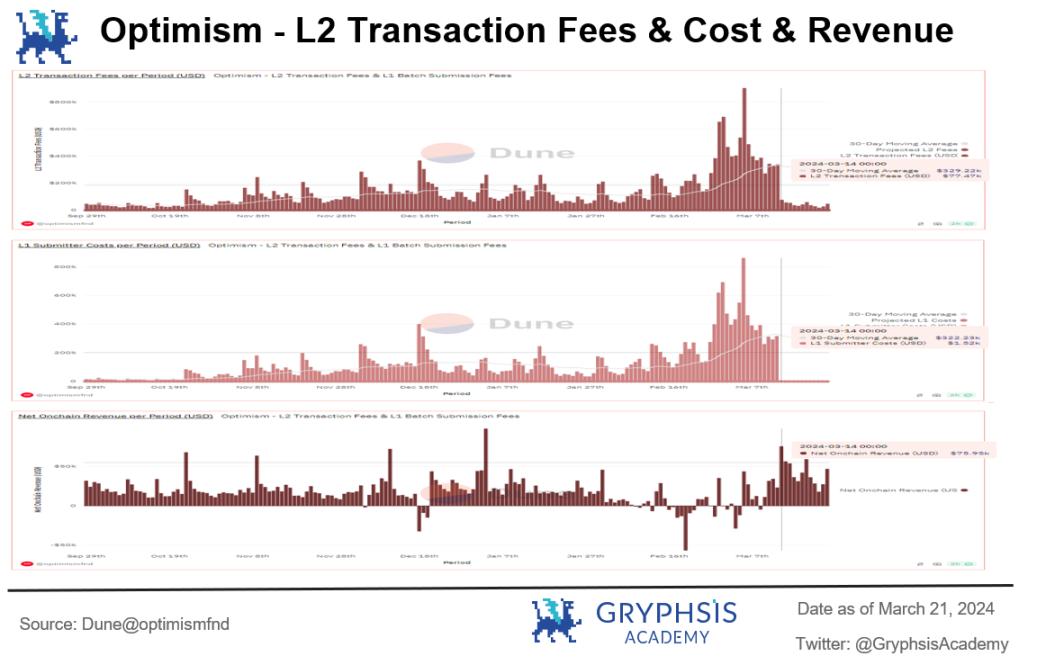
The profit model of L2 is relatively simple and clear, and can be basically summarized as: on-chain profit = L2 transaction fee - L1 payment cost; taking the OP chain as an example, although the upgrade reduced both L2 transaction fees and L1 payment costs, the reductions were not at the same order of magnitude due to the increase in transaction volume and user base. Transaction fees were reduced from hundreds of thousands to tens of thousands, while payment costs were reduced from hundreds of thousands to less than 1k, and on-chain profits also increased after the upgrade.
2.5 Price Impact
For this upgrade, in addition to whether the on-chain usage experience has improved, users are most concerned about the price of the native tokens of each L2. It can be seen that after the upgrade of the issued Layer2, the price of the tokens began to fall. This is also related to the characteristics of the industry, and the positive landing turned into negative. The actual market has been hyping the concept of Ethereum upgrade since 2023. Judging from the increase in the price of the token during this period, this upgrade can also be regarded as a positive realization.

3. Impact on investment value
Dencun upgrade has been the focus of attention in the past 23-24 years. The public is also making investment decisions based on a series of concepts related to Dencun upgrade. This upgrade is bound to have an impact on the subsequent investment value of Ethereum and L2.
3.1 Ethereum takes over the baton from L2
Ethereum's vision is to become more scalable and more secure while remaining decentralized.
In order to get rid of the trilemma (the "Blockchain Trilemma" proposed by Vitalik Buterin), in the previous upgrade, Ethereum switched from POW to POS to improve security. In terms of scalability, the L2 Rollup solution was also explicitly adopted, with the aim of increasing Ethereum's throughput while greatly reducing user fees.
Although Ethereum's TVL is still in the first place, other L1 public chains have also had a significant impact on it. For example, Solana's transaction volume has exceeded Ethereum. According to active addresses, Ethereum is only ranked 6th.

Another example is Sui's explosion and the recent hot BTC L2 concept, which will cause users to continue to flow out of Ethereum. When the user and developer base decreases, its value will usually decrease. But this does not mean that Ethereum will go downhill, but the development trajectory will change.
Ethereum was released in 2015 and ushered in the Web3 era. Since its development, it has created a prosperous industry. The most typical example is the emergence of L2. Many L2s provide solutions for Ethereum's expansion, and the focus of the Dencun upgrade is on L2. In the future Ethereum upgrades, many L2-related issues will also be involved. The two are becoming increasingly closely linked and complement each other.
The author believes that this upgrade mainly lays the foundation for the future development of Ethereum, making it closer to becoming a fully scalable and accessible global trading platform . As for ETH, as the native token of the "platform", combined with the ETH-ETF narrative, it will exist more as a global asset allocation in the future, just like the current role change of BTC, which is more suitable for long-term investment . Alpha opportunities will definitely appear in L2 in the future. Ethereum will gradually hand over the baton of expanding the territory to L2 and complete the role change, so more investment focus should be placed on L2 and other tracks.
3.2 L2 Ecosystem Explosion
Undoubtedly, the biggest and most direct impact of the Dencun upgrade is Layer 2. From the above data, we can see that the transaction fees of L2 have generally been greatly reduced, and the throughput has also been improved. This allows L2 to attract users into the ecosystem through lower prices and higher performance, and further compete with other L1s.
According to DeFiLlama statistics, 4 of the top 10 TVL are L2 (Polygon is strictly a side chain, but it also has a corresponding ZK Layer2 solution and is gradually embracing ETH L2), among which Arbitrum ranks fourth after BSC and Solana. There are also rising stars in L2, such as Blast, which is very popular for airdrops, and Base, which is backed by the strong resources of Coinbase. These L2s with huge development potential need to be paid special attention.
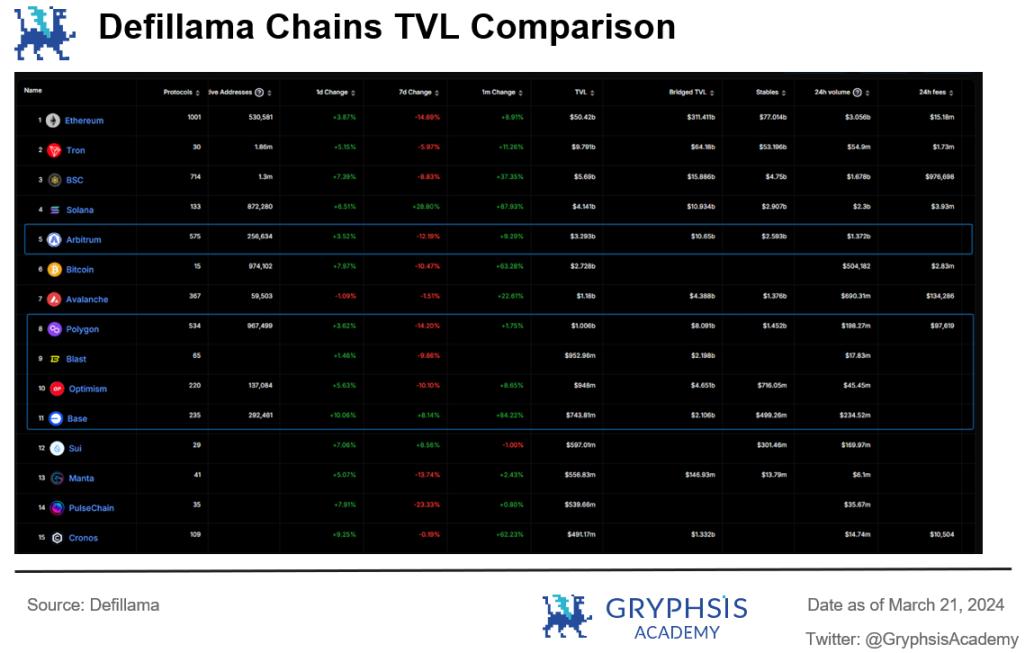
For Layer2, Dencun has actually reduced its own costs after the upgrade, so there is a chance to increase profit margins in the future. As the current L2 leaders, Arbitrum and Optimism are likely to use the profits brought by the upgrade to build their own ecosystems and increase activity, so users will also benefit from it. In other words, L2's own profitability will increase, and the value of its tokens will also rise accordingly, which is unanimously recognized by the market. Although the current upgrade expectations have been implemented, the prices of $arb and $op have fallen, but judging from their respective trading volumes and active users, the market still maintains expectations.

Regarding the ecological construction of Arbitrum and Optimism , we can understand it from their respective contract deployment situations. The growth of Arbitrum's contract deployment is lower than that of Optimism, but Arbitrum still has the richest variety of L2 protocols. According to DeFiLlama statistics, the current number of Arbitrum protocols is 575, which is far greater than the number of other L2 protocols, and TVL is also at the top of many L2s. Since the launch of Arbitrunm, various data have been relatively excellent.
Optimism proposed the Superchain strategy in 2023 and began to promote OP stack (an open source L2 technology stack), which means that other projects that want to run their own L2 can use it for free, and because of the consistency of technical architecture, they can achieve safe, efficient, atomic-level information and asset communication and interaction with each other. Coinbase first adopted it and launched the Base chain. Others include Binance's opBNB, NFT project ZORA, and the well-known on-chain data dashboard Debank.
Arbitrum and Optimism are L2s that are at the top in terms of TVL and user volume. Combined with the current prosperous ecosystem, they have formed their own moats. They are also the core L2s that are most directly affected by this upgrade. Both have natural first-mover advantages, and both themselves and the leading protocols in the ecosystem can be the focus of attention.

Another L2 worth noting is Base , whose TVL has increased by more than 80% in the past month. In terms of active addresses, Base has surpassed all L2s and is second only to Ethereum. In terms of the number of ecological protocols, it has surpassed OP and jumped to 7th place.

Similarly, Base is one of the L2s most directly affected by the upgrade. The transaction volume and users have increased significantly after the upgrade, and the market discussion has also increased. For example, the market discussion on SocialFi (friend.tech), DeFi (Perennial), memecoin, etc. on Base has always been hot;
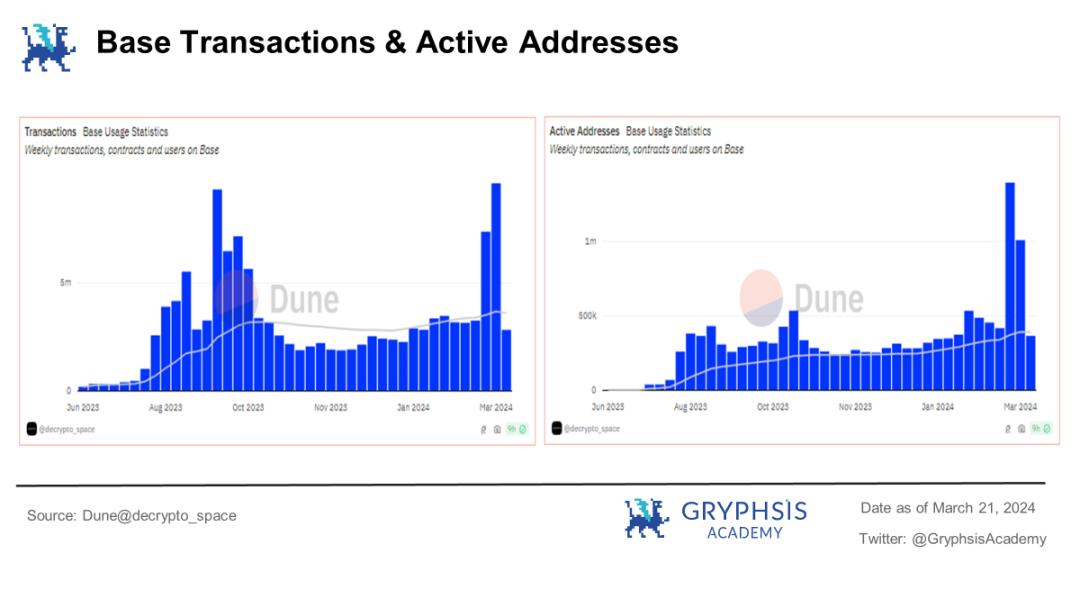
The strong binding relationship between Base and Coinbase means that Base naturally has a certain scale of users and capital. With the popularity of the friend.tech project, the market's attention has been drawn back to the SocialFi track. The core requirements of SocialFi itself are high interaction frequency, low interaction costs and a large number of users. Related applications have higher performance requirements, which coincides with the benefits brought by the Dencun upgrade. Perhaps in the future, there will be phenomenal related projects on Base.
In addition, there are more L2s like Blast and Zksync that have not yet issued coins and are still accumulating power. The Dencun upgrade can greatly reduce the cost of user interaction and may further promote the prosperity of such L2 chain activities.
On the other hand , although EIP-4844 has brought about a decrease in L2 transaction fees, it cannot always ensure that L2 fees are low. Take the Base chain as an example. During the period when the upgrade was completed, as the popularity of memecoin on Base increased, transaction fees also skyrocketed and remained at a high level.

Eric Wall, co-founder of Taproot Wizards, gave an example on Twitter about the emergence of this phenomenon. You can click the link to view the original text for details. In short, the L2-DA capacity space brought by EIP-4844 is not infinite. When a large number of centralized transactions appear (TPS increases), in order to achieve priority transactions, Blob Space fees will compete and increase, and L2 sorter fees will also increase, thus affecting the increase in transaction fees. The sorter can still only prioritize within a limited TPS. In other words, when a large number of concurrent transactions occur on the same chain, transaction fees will also increase.
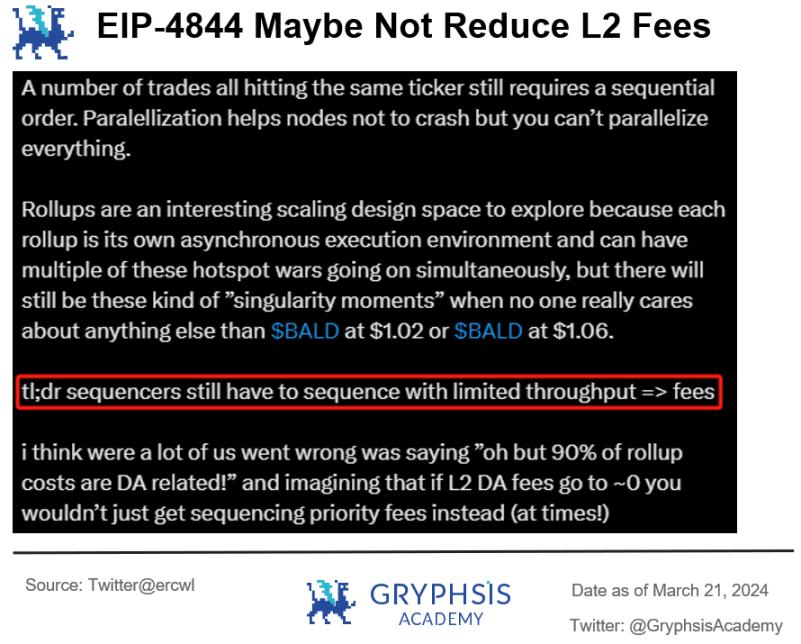
Source: https://twitter.com/ercwl/status/1771156029121663082
4. Conclusion and Outlook
- Dencun has a significant upgrade effect, significantly reducing the transaction cost of L2, and basically achieving the expected 90% reduction in L2 transaction fees. However, Ethereum's transaction fee reduction effect is not as good as L2 . At the same time, the throughput of L2 has been improved to varying degrees after the upgrade, among which the Base chain has the most outstanding performance. On the other hand, if a large number of concurrent transactions occur on the same chain, the transaction fee will still be high.
- This upgrade has made further progress in the scalability dimension of Ethereum, and the introduction of the new Blob data structure lays the foundation for future high concurrency situations;
- Dencun upgrade will further promote the prosperity of L2 ecology . Arbitrum and Optimism, the current leaders of L2, are particularly worthy of attention. Arbitrum has the most diverse protocols and has always performed well in data. Optimism 's Superchain strategy will form a network to become the "OP system". At the same time, this upgrade may increase the profit margins of the two in the future, and it is very likely to benefit the user level in the future, forming a positive cycle for its ecological construction.
- Base , a rising star in L2, also deserves attention. Backed by Coinbase, it naturally has a large number of users and funds . At the same time, its data performance is outstanding. In the past month, its TVL has increased by more than 80%, the number of active addresses ranks first in L2, and the number of protocols exceeds OP. The development of ecological projects on this chain deserves attention;
- The most obvious user experience after the upgrade is that the interaction costs of each L2 are greatly reduced, which makes users more willing to interact, bringing about a positive cycle in the ecosystem. In addition, you can continue to pay attention to some L2 projects that have not yet issued tokens, such as Blast, Zksync, etc. The reduction in interaction costs will allow more users to participate.