What is DePIN?
DePIN (Decentralized Physical Infrastructure Networks) is a term proposed by Messari, referring to networks that aggregate and provide services or resources to users, ultimately matching the supply and demand of specific resources. This concept covers a very broad range and can be divided into two categories: physical infrastructure networks and digital resource networks. Under these two categories, there are also many fields such as storage, computing, artificial intelligence, wireless networks, images and map making. The DePIN protocol rewards and incentivizes users to contribute and provide value to the entire network through a token reward mechanism.
The DePIN protocol has advantages in several aspects:
1. Resource efficiency: Providers with underutilized resources can “rent” these resources to other consumers, ensuring that idle resources are not wasted.
2. Lowering the barrier to entry: DePIN effectively lowers the barrier to entry for acquiring certain resources. For example, imagine if you need to use certain specific GPUs to perform tasks that are not readily available on the open market, users can easily “rent” computing power from the right provider without having to worry about purchasing the components.
3. Decentralization: Users of the service do not have to worry about the downtime faced by centralized entities.
According to data on CoinGecko, the market capitalization of the DePIN category has witnessed a 35% increase in the field, showing its strong performance and room for future growth.
Reasons for DePIN
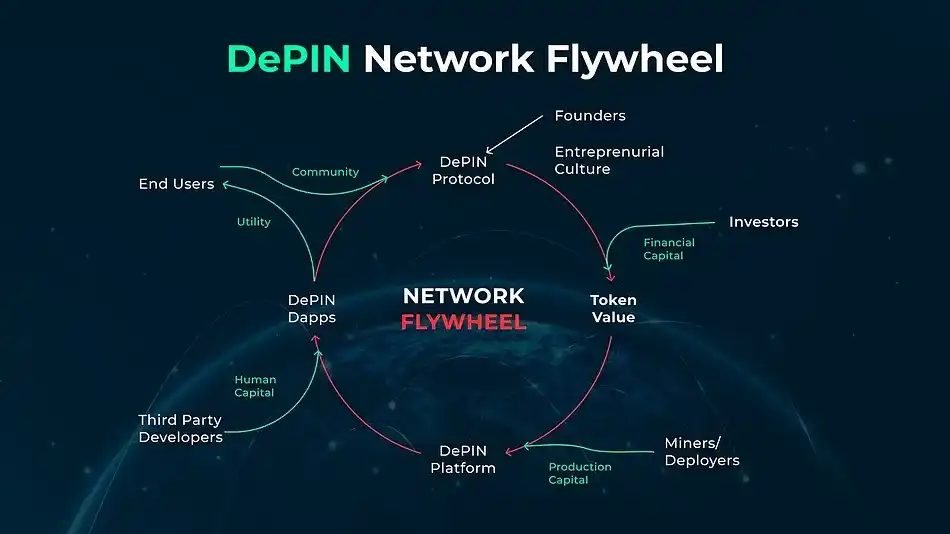
According to Coingecko, DePIN allows facilities to grow capacity in a more flexible way. Instead of increasing the capacity of each resource, the network can add resources. This provides good flexibility, and facilities built with this system can easily scale up or down based on demand. The blockchain can also control available resources and ration demand.
In low demand situations, some providers may experience lower workloads. In high demand situations, the network can reactivate dormant resources, add more instances, and increase capacity across the network without any changes. Depending on the available dormant resources and DePIN’s rationing system, a system like this can scale infinitely.
Like DeFi, DePIN is also decentralizing the infrastructure system, shifting from enterprises to individuals collectively investing resources to build facilities. The system distributes control of facilities to different providers, which is similar to miners in a PoW network.
DePIN is like a DAO in the industry, where everyone in the system contributes resources and has relative control based on their capabilities. In a system where every provider has equal capabilities, DePIN becomes a decentralized system or almost decentralized.
The pricing model of DePIN is different compared to traditional facilities. Factors that influence the pricing model include the cost of private providers operating their respective facilities and other network-related factors. The additional charges of the platform may be less because the platform itself does not need to spend any cost to provide these facilities.
Overall, DePIN’s pricing model is expected to be cheaper, and pricing is expected to be fair because it takes fundamentals into account without unfair price inflation, which is often associated with facilities operated by centralized institutions. For a system driven by people, DePIN is also more likely to factor in affordability in its pricing model, rather than like a business.
The DePIN network requires almost no cost to set up the network and providers have great flexibility in providing services. For example, providers can submit their facilities to multiple networks. Users also pay a fair price for the services they receive from the network. DePIN aims to provide the best possible service at the lowest possible cost, providing a cost-effective system.
Anyone can contribute their resources to DePIN. On the user side, anyone can also get the services provided by DePIN. There is no price haggling or user screening for these services. Once providers have the required infrastructure, they can run a provider-side account on DePIN, just as anyone can deploy a liquidity pool on a DEX or easily get a loan from a money market.
Incentives are an important tool for DePIN. For providers, they offer a passive or active income opportunity depending on how DePIN operates. Individuals can also build income streams primarily from DePIN. Projects like Nunet hope to reduce the amount of dormant computing resources through its AI-driven computing power marketplace. Providers can earn income from facilities that would otherwise sit idle.
DePIN Project
Filecoin ($FIL)

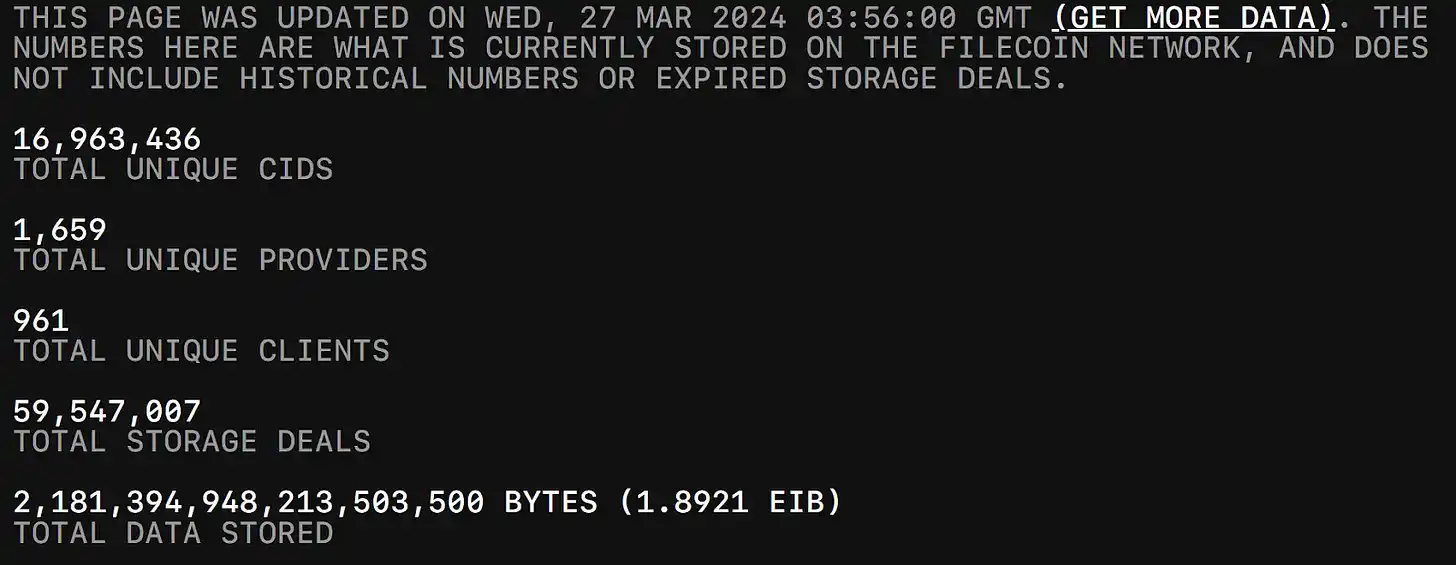
Filecoin is widely known as a decentralized storage layer that allows anyone to store data in a decentralized manner (also known as the "Dropbox" of Web3). It is built on a proprietary file system (IPFS) and incentivizes data storage providers to ensure that data is securely stored and retrievable. Filecoin provides an open market for anyone who wants to store files or get paid for storing other users' files. Filecoin is already actively used by users, and this is a snapshot of the data currently stored on Filecoin:
In addition, the Filecoin blockchain supports smart contracts through the Filecoin Virtual Machine (FVM), which was introduced on March 14, 2023. FVM allows smart contracts to be deployed on the Filecoin network, similar to smart contracts on Ethereum. With FVM, computational logic conditions can be combined with traditional Filecoin storage and retrieval, which opens up many potential use cases.
Filecoin is still the market leader in long-term data storage. Coupled with its innovation, Filecoin remains a strong player in the decentralized storage space.
Helium ($HNT)
Helium is a decentralized wireless infrastructure network powered by Solana. It started out as an Internet of Things (IoT) network, using the Low Range Wide Area Network (LoRaWAN) protocol to provide connectivity for IoT devices. It has subsequently expanded to 5G hotspots, where the Helium 5G network is powered by user-operated nodes. Node operators are compensated by providing resources to the network in exchange for tokens.
An interesting real-world use case for Helium is Helium Mobile, a network provider in the US that uses Helium nodes wherever they are available. Mobile networks will utilize Helium nodes wherever they are in range.

Shadow Token ($SHDW)
GenesysGo’s Shadow Token, often referred to as “Solana’s Filecoin,” is a cloud storage platform that aims to decentralize the traditional cloud storage stack. shdwDrive achieves this goal through DAGGER, the core of shdwDrive’s distributed ledger technology, allowing them to reduce the cost of enterprise-grade data center storage.
Combining DAGGER’s consensus mechanism and Solana’s execution environment, shdwDrive becomes a powerful cloud service platform, paving the way for a range of file storage applications.
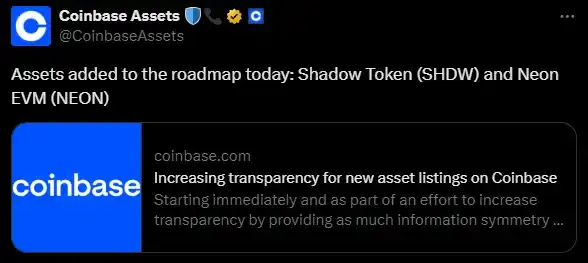
Shadow Token already has its own native token - $SHDW, with a current FDV of about $378.5 million. The catalyst for the token is the recently announced Coinbase listing. Currently, users can only buy this token on the Solana chain, but once this token is listed on a centralized exchange, more retail funds will flow into this token.
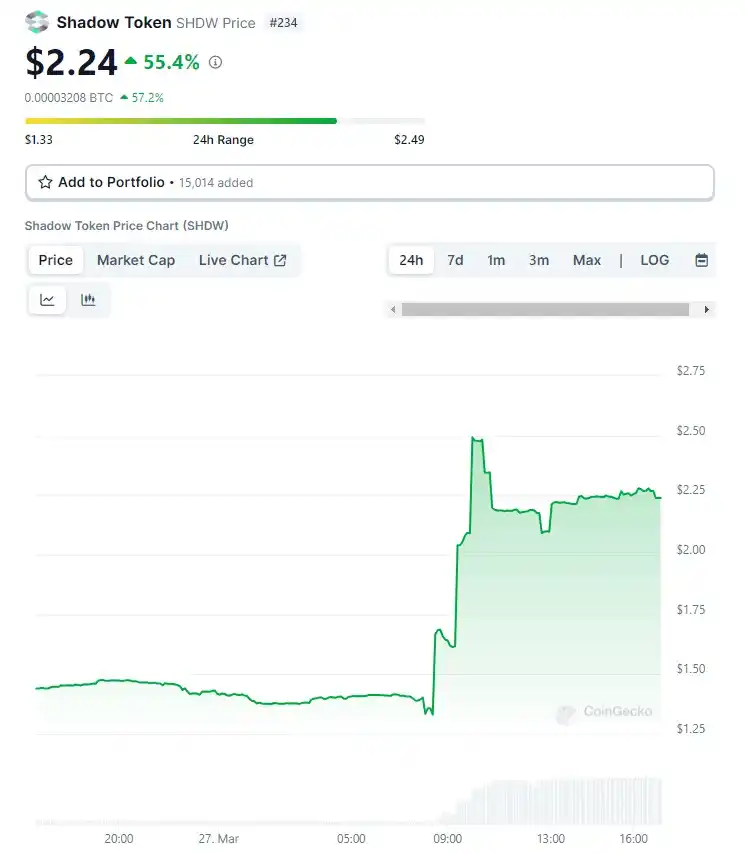
Following this news, the price of SHDW USD has increased by approximately 55% in the past 24 hours, from $1.35 to $2.49.
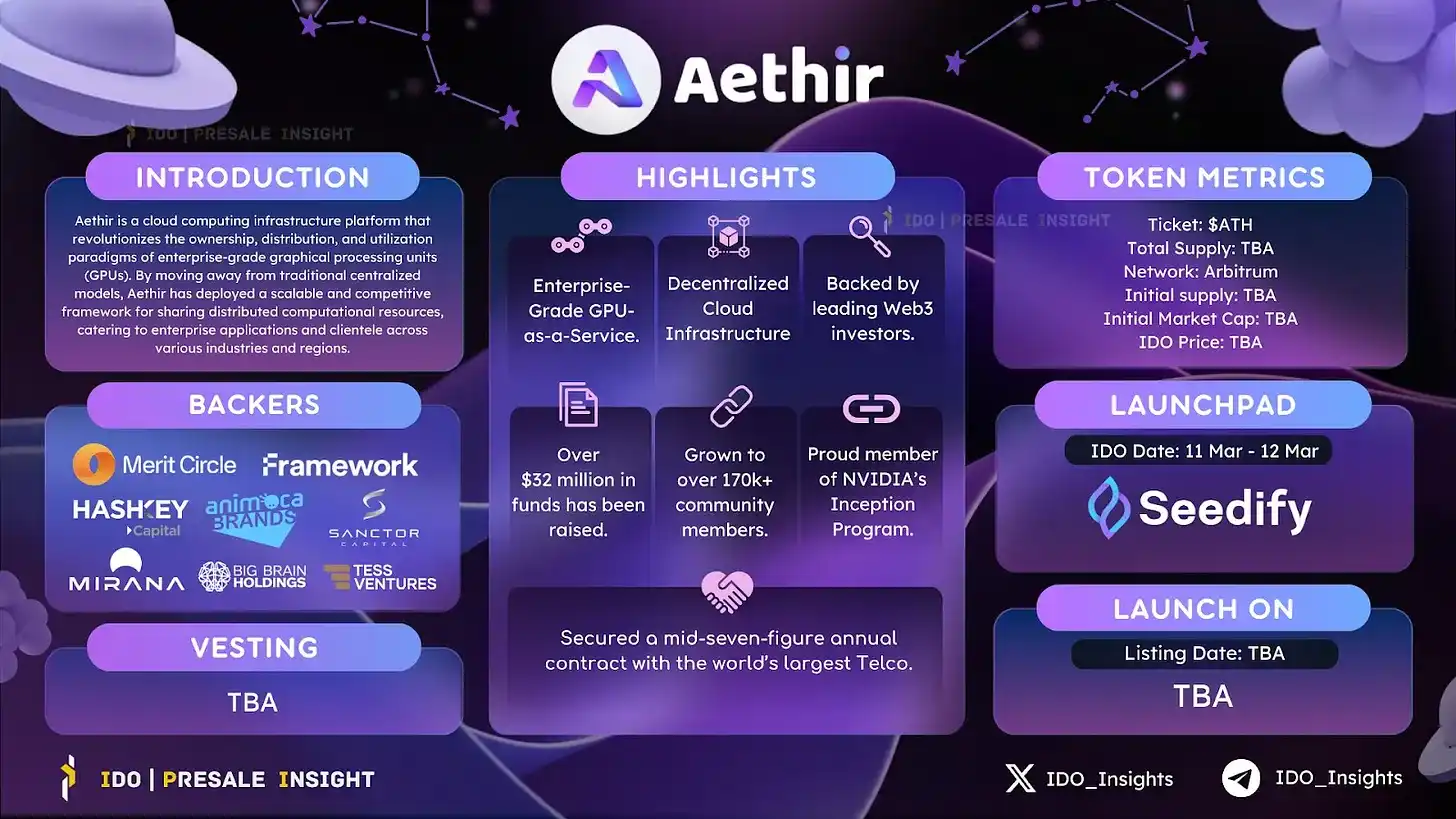
Aethir ($ATH)
Aethir Cloud is a new cloud computing protocol entering the market that will become a new competitor to the current decentralized computing giants such as Render and Akash. Aethir is a decentralized platform that is an aggregator of computing processing power. Aethir connects the providers of this computing power with users and consumers who need to use GPU hardware for different applications such as artificial intelligence, ML, and cloud gaming.
The Aethir network consists of three parts:
1. Containers
2. Checkers
3. Indexers
A brief description of these components follows:
1. Containers are virtual endpoints that execute and render actual work. The workload of the local device is transferred to the container, providing users with a "zero latency" experience
2. Checkers can be seen as "referees" who monitor containers to ensure the quality of service provided by the network
3. Indexes is a mechanism to match the appropriate Container according to the consumer's request, with the goal of delivering services in the shortest possible time.
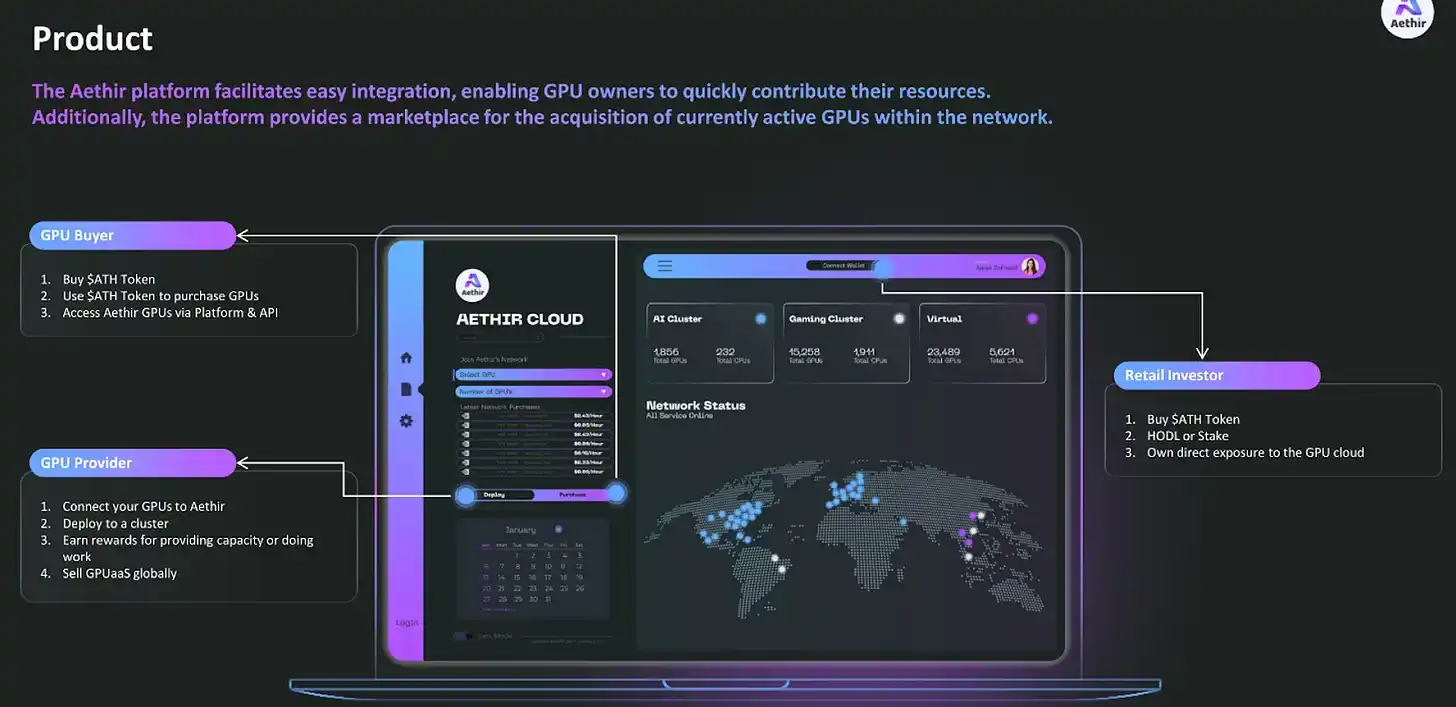
Aethir Cloud is backed by notable investors such as Maelstrom, Mirana Ventures, and Animoca Brands. They also raised a massive $9 million in their latest Pre-Series A round at a $150 million valuation. Additionally, Aethir held a node sale for its Checker nodes, raising over 26.8k ETH.
Grass
GRASS is a layer 2 dataset that utilizes web scraping nodes to fetch AI training data from different websites for builders to access. GRASS has gained a lot of attention recently as users are running GRASS applications and becoming GRASS nodes in anticipation of the airdrop.
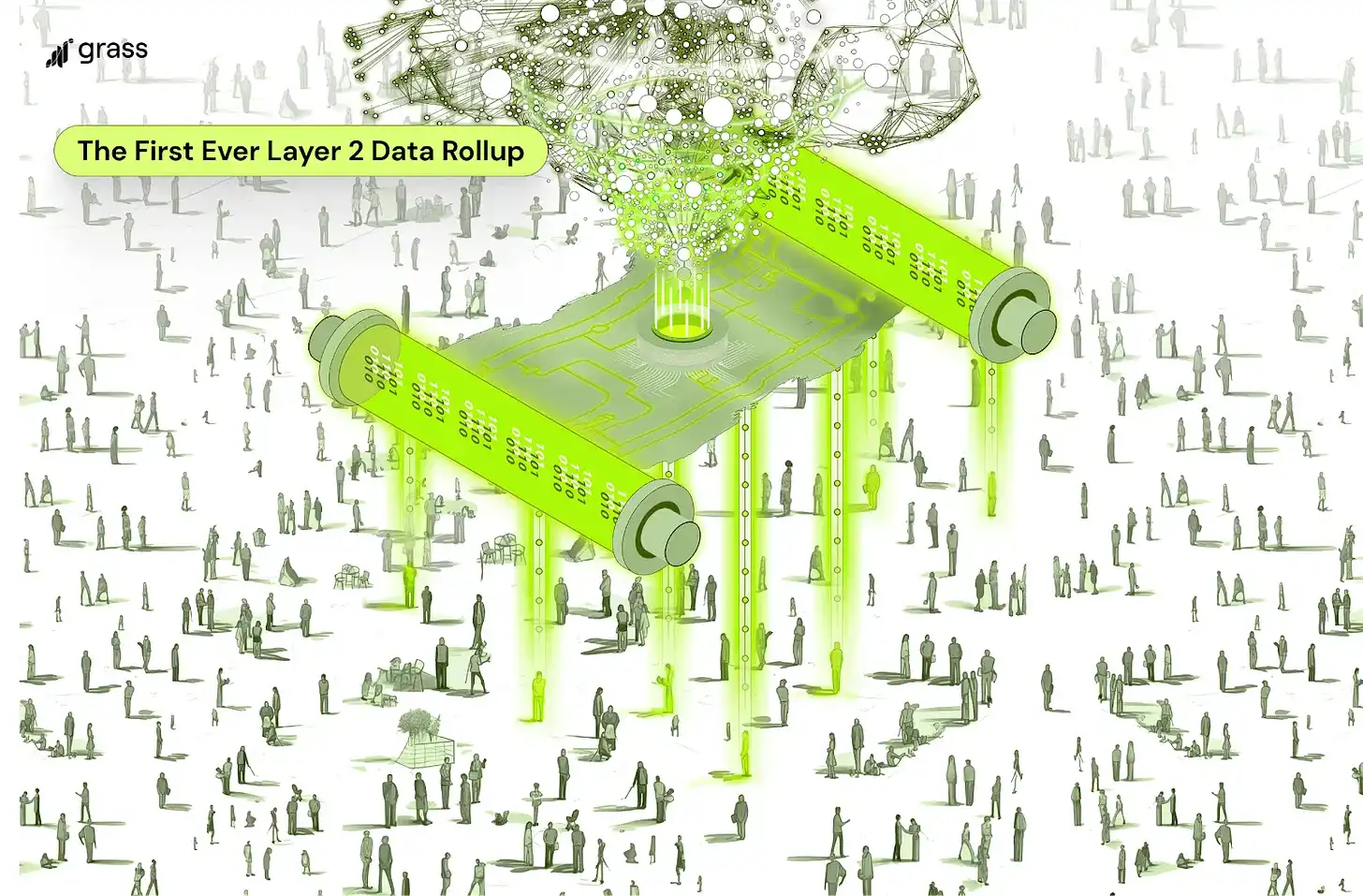
Grass works by forming a network of nodes around the world that specialize in capturing and processing network data. This data is then converted into structured data sets for use in AI training.
The data and algorithms behind AI applications are often opaque, making it difficult for users to understand how the AI model reaches its conclusions. This lack of data transparency can cause AI models to be accidentally or intentionally trained with incorrect or biased data, and Grass can solve this problem.
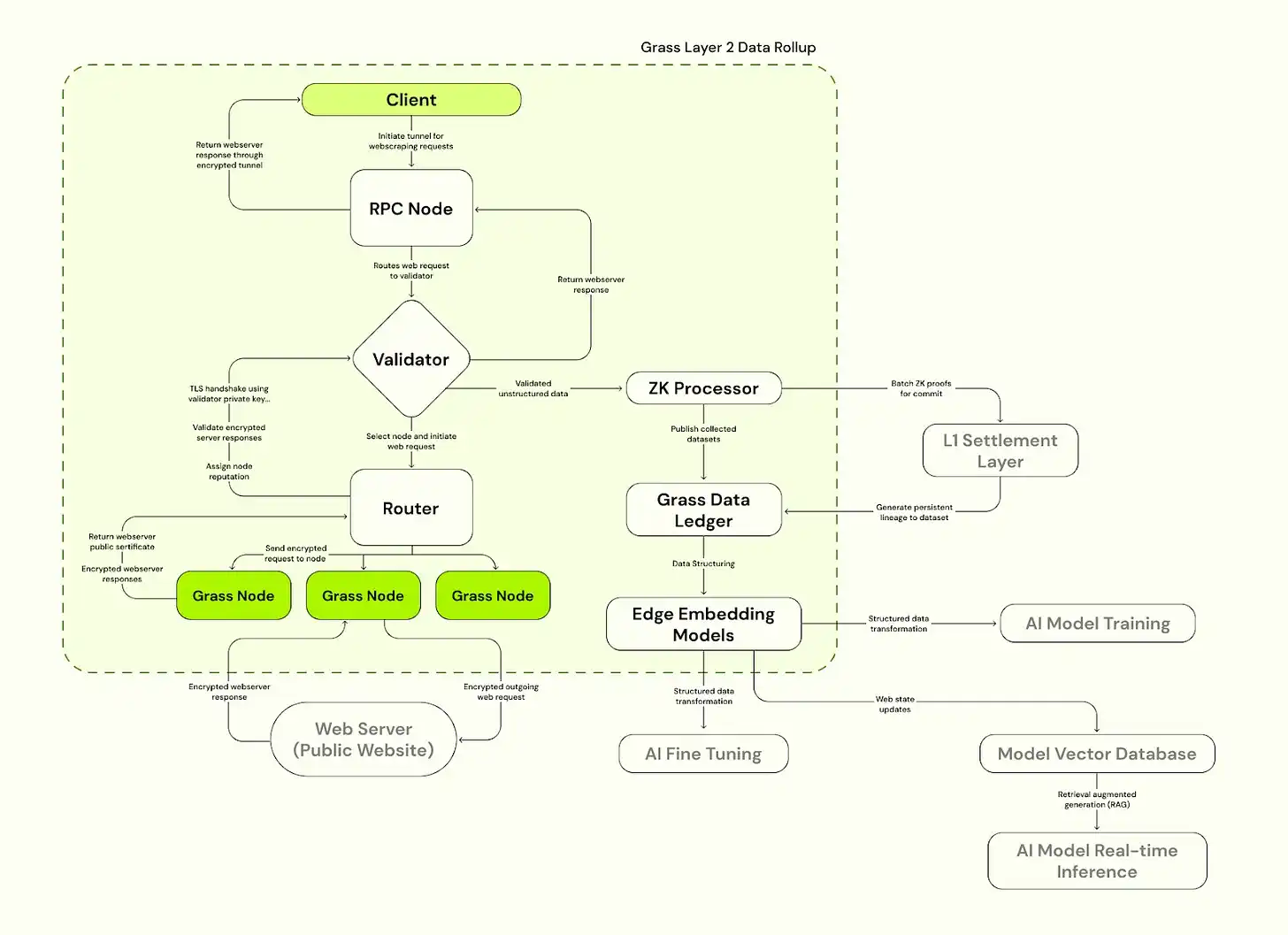
How does Grass solve these problems? This is where the second-layer data Rollup technology becomes particularly important. With this technology, all data captured by Grass nodes will be recorded and the source website of the data will be verified. These metadata will then be stored in the data set, thereby increasing the credibility of the data accuracy. Given the huge throughput required to process such a large amount of data, L2 uses ZK processors to perform batch verification of data.
The following is a detailed introduction to the Grass network architecture:
Grass is still running a points program for users who run nodes, as well as speculative airdrops. Grass's most recent funding was on December 20, when they raised $3.5 million in a seed round led by well-known investors such as Polychain Capital and Tribe Capital.