This article aims to answer the “why” question we are often asked regarding our investment thesis on Bitcoin. The topics discussed in the article should not be construed as financial advice.
Simply put: Bitcoin (BTC)’s identity as an institutional-grade asset, global remittance system, and soon to be a programmable blockchain network has become the focus of intense debate. Although BTC has always been viewed as a de facto store of value, there are a number of technical, institutional, and market factors that are pushing it in a more productive direction than mere “lazy” digital gold. In this article, we share our thoughts on the history and controversies of Bitcoin innovation, the latest initiatives, and Portal’s investment thesis, which aims to make Bitcoin more “capital efficient” rather than just “programmable.”

1. Bitcoin/Account
Digital gold is just a prelude. The most solid asset created by human civilization is extending its huge influence to the field of smart contracts.
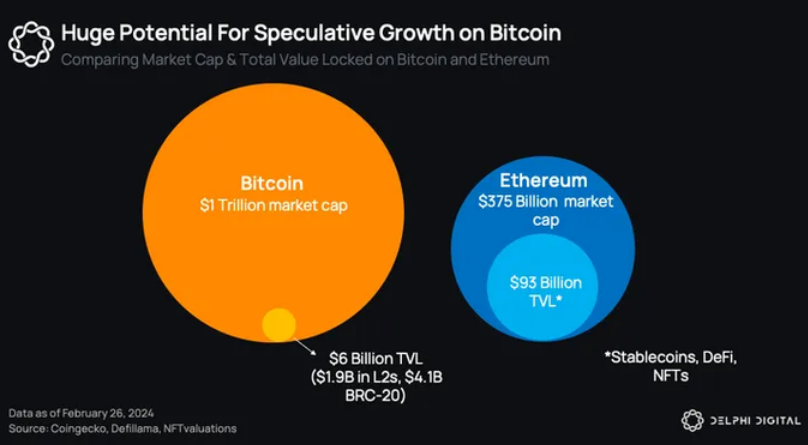
untapped potential
Bitcoin is mostly classified as a store of value because of its lack of programmability. Add to that low transaction throughput, slow speeds and high fees. Most of the Bitcoin held by 3 billion users lies dormant, unused.
This lack of programmability stems from its non-Turing complete scripting language and the fact that the core development team placed strict limits on the types of operations that could be performed. This inflexibility ensures security, but comes at the cost of slow innovation.
While stores of value like real estate, gold, stocks, etc. can be used as collateral/generate income, Bitcoin remains mostly unused.
Previous attempts to lend out Bitcoin left a sour taste among users, as they had to hand over custody of Bitcoin to overleveraged entities that eventually went bankrupt.
Attempting to send Bitcoin to the Ethereum VM chain to replicate DeFi borrowing was also not very successful, as the two are completely different environments and the bridge needs to provide a trust zone for this exchange.
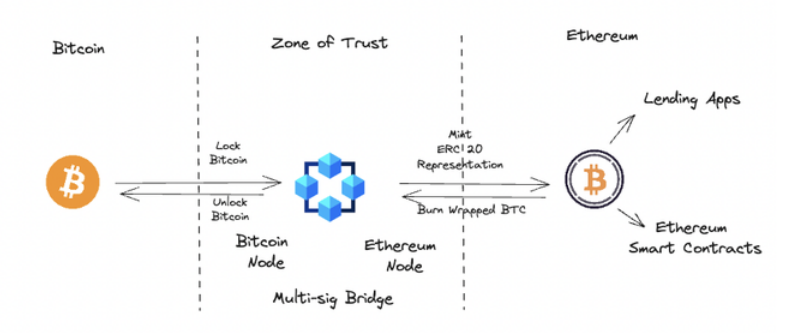
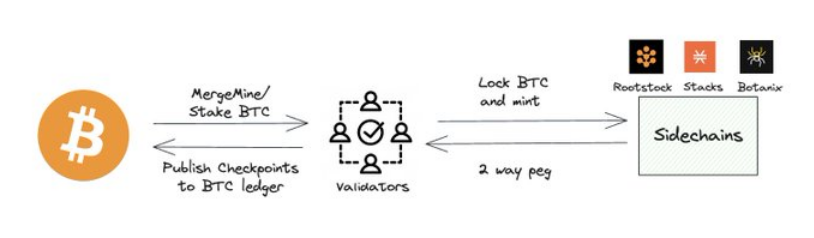
The bridge locks Bitcoin and mints a representation on the Ethereum Virtual Machine chain. This introduces reliance on a centralized entity or a set of multi-signature validators, which has lower security guarantees. The most popular bridge token, WBTC, has a market capitalization of only $10 billion, less than 1% of Bitcoin’s total market capitalization.
2. So, why is there renewed interest in programmable Bitcoin?
Three catalysts have attracted attention:
1)Ordinals
2) BitVM
3)Babylon
1)Ordinals
While ETF inflows have attracted attention from the financial world, Ordinals have attracted a large number of developers to the Bitcoin ecosystem. Ordinals and BRC-20 Tokens "burn" data onto the Bitcoin ledger, but require a social consensus layer to convert these specific data encodings.
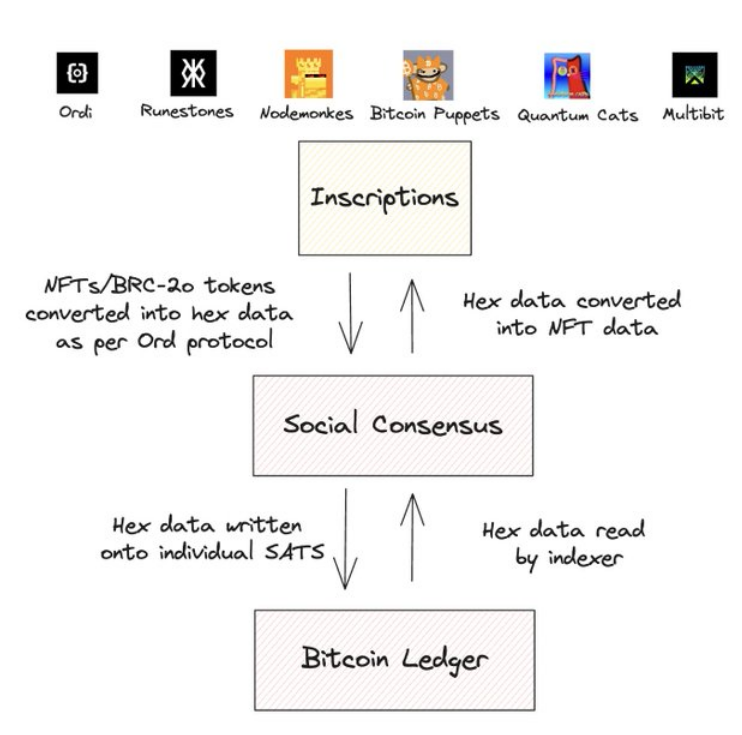
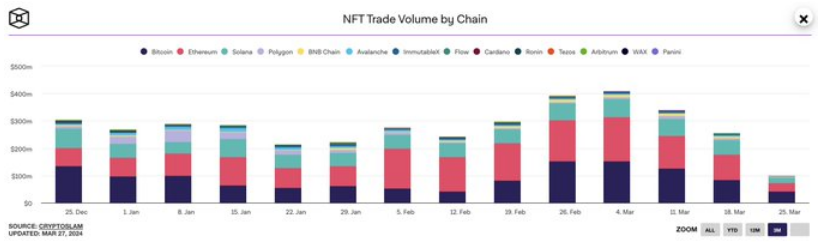
Ordinals has pushed Bitcoin NFTs to second place by volume, behind Ethereum. This success raises a key question: can we create a trustless EVM paradigm on Bitcoin that does not rely on the social layer for support, backed by Bitcoin L1 guarantees?
This seems impossible due to the limitations of the base layer. Sidechains have been the only alternative, utilizing Bitcoin miners to secure new chains embedded in the EVM environment. However, the security of this layer depends on an external group of coordinators.
2) Enter BitVM
Robin Linus of the ZeroSync team found a way to implement validator logic on Bitcoin Script without requiring protocol changes or soft forks.
BitVM adopts an OP's proof-verifier model to express Turing-complete smart contracts.

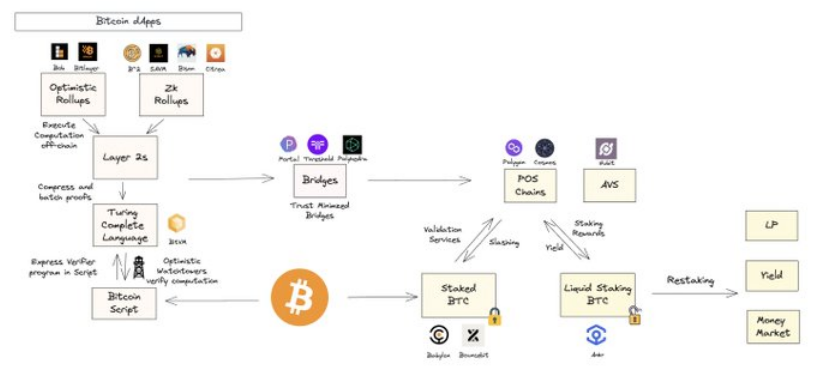
Computations are performed off-chain and results are settled on the Bitcoin chain, similar to the modular Rollup ecosystem. Any observer can verify the execution results and has the power to punish the prover by having his or her funds slashed if fraud is discovered.

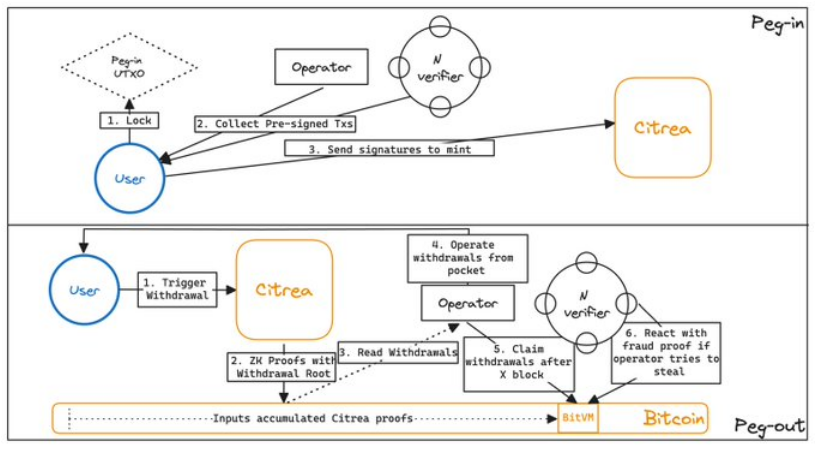
This became the catalyst for layer 2 scaling on Bitcoin to take off. Teams like BSquaredNetwork are using BitVM to build Rollups with diverse proof mechanisms and virtual machines. The citrea_xyz team designed a zero-knowledge validator circuit that runs natively on Bitcoin Script.
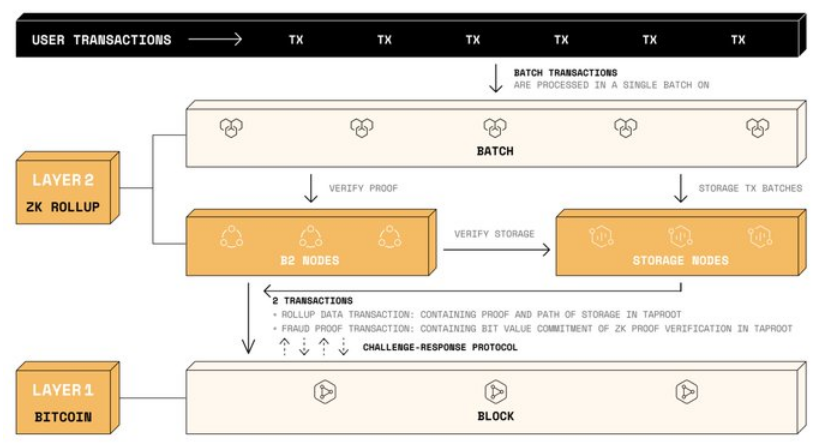
Rollup on Bitcoin leverages a modular technology stack that greatly improves scalability and efficiency. This advancement not only attracts talented developers who are proficient in EVM tools, but also attracts millions of users eager to interact with the same user experience.
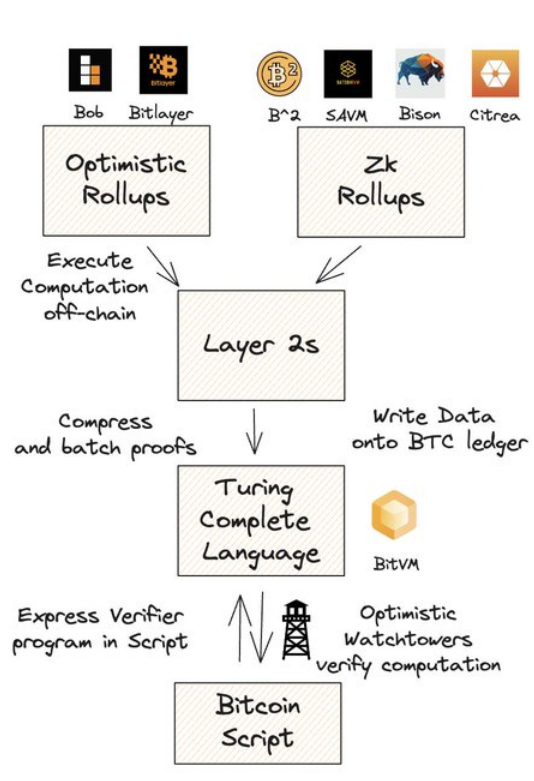
BitVM also introduces a trust-minimized bridge to transfer BTC to the POS chain. Citrea collects lightweight client-side proofs from other chains that can be verified natively on Bitcoin. This reduces the trust required, ensuring integrity as long as at least one validator remains honest.
3)Babylon
While second-layer scaling is busy scaling, Babylon has sparked a revolution in capital efficiency within the Bitcoin ecosystem. Simply put, Babylon is the EigenLayer of Bitcoin. @eigenlayer is a re-staking protocol that allows Ethereum stakers to provide verification services to POS chains, bridges, and sequencers, and earn profits.
It ensures integrity through an automatic reduction mechanism in the base chain smart contract - a feature not possible on Bitcoin. So the Babylon team came up with an ingenious solution. Bitcoins are locked in a multi-signature account, allowing holders to stake and retrieve their funds after a waiting period.
If any attack is observed, the protocol will leak the keys to this vault, thus enabling automatic penalties.
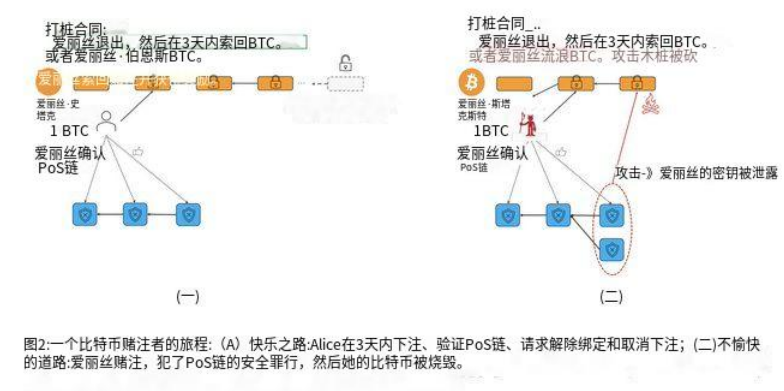
By staking their Bitcoin, users can provide verification services for PoS chains, DA layers, oracles, AVS, and more. This has sparked a new paradigm that allows Bitcoin to generate substantial returns without giving up self-custody.
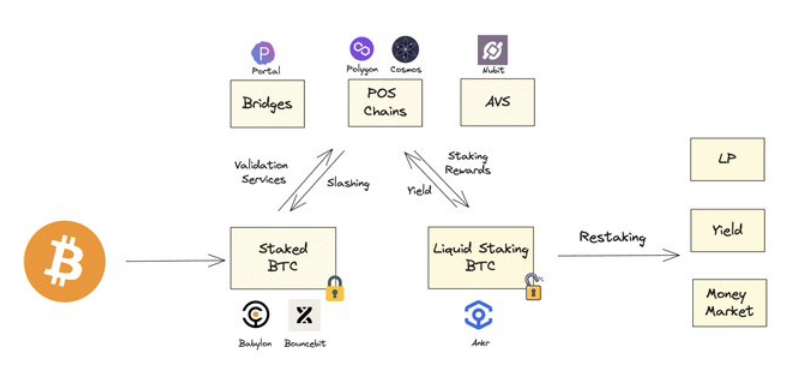
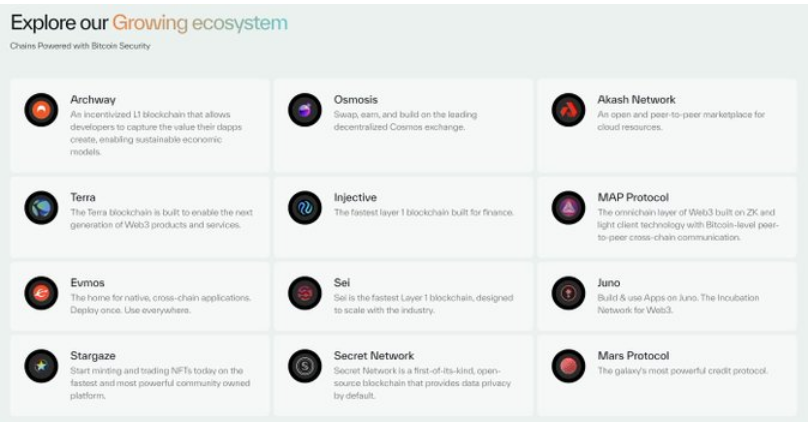
POS chains and other verification services can leverage Bitcoin’s economic security to bootstrap their protocols and build layers of security . Portal Finance is securing a Bitcoin bridge, Nubit is using Bitcoin as a DA layer, and the Avail Project plans to use quorum backed by Bitcoin.
LSTs increase liquidity by creating freely tradable locked-pledged tokens on the POS chain. Babylon partners with Ankr Staking to re-stake these tokens for higher yields, create stablecoins backed by Bitcoin, and more.
3. Summary
To summarize, Bitcoin is making important strides in two areas:
- Scale vertically to solve programmability issues with a layer 2 solution capable of handling millions of transactions.
- Improve capital efficiency by serving as reliable collateral across a wide range of applications.
BitVM is still in its early stages and has encountered some issues with multi-party contracts, high computational costs, and the need for regular server interaction. The ultimate goal may involve integrating zero-knowledge validator opcodes into Bitcoin’s scripting language to overcome these obstacles.
Echoing @sandeepnailwal’s sentiments, “Bitcoin is an isolated island with no connection to the broader web3 ecosystem.”
We are on the verge of seeing entirely new applications emerge on Bitcoin that will smoothly integrate with the EVM stack, opening up endless possibilities .