I. Introduction
Over the past 30 years, infrastructure projects of all sizes have injected a steady stream of water into the country's development. Money has been released through infrastructure. The funds for shantytown renovation alone have driven the bull market in real estate for more than a decade. When we look at DePIN in the crypto world today, there are many similarities.
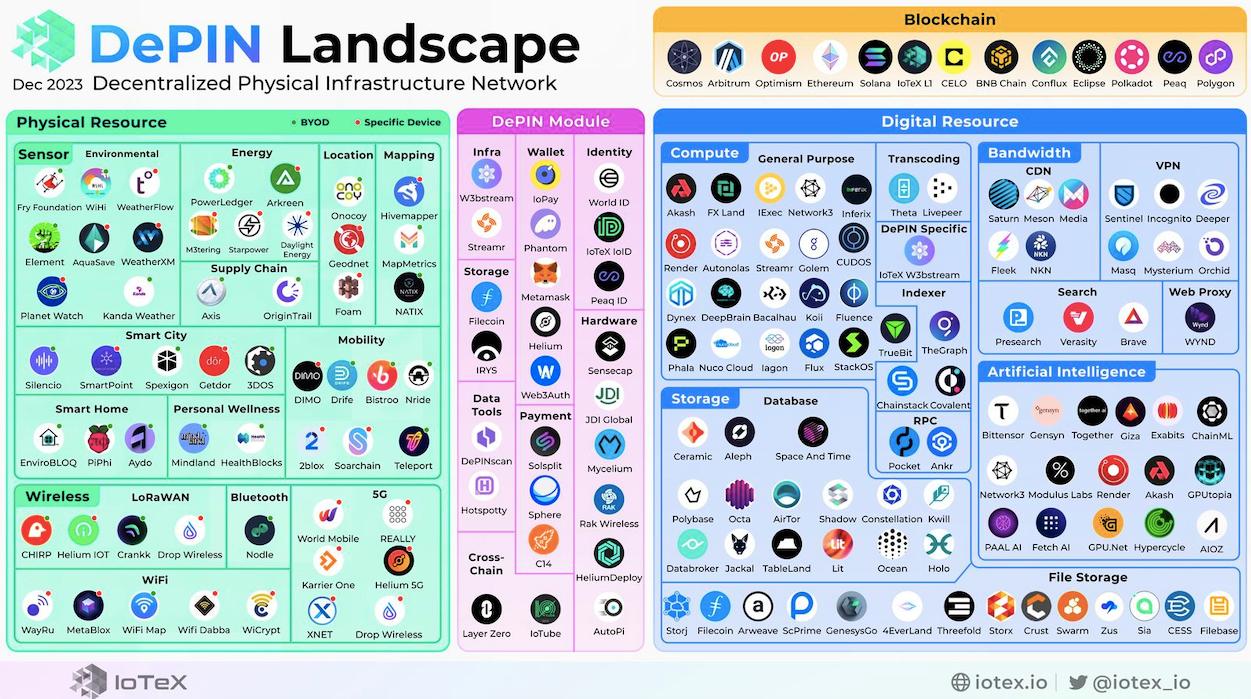
As an extension of RWA, DePIN is the industry that can best integrate with the real world and has received a lot of attention in the past period of time. Messari believes that DePIN is "one of the most important areas of crypto investment in the next decade."
DePIN’s core promise is to bring the principles of blockchain applications to the world of physical “things” and infrastructure, in short the “Internet of Things pro max” whether it’s WiFi, security cameras or computing servers.
2. DePIN Market Space
Traditional physical infrastructure construction is capital-intensive, has a long investment cycle, and has low returns. Using blockchain's token incentive mechanism to release the potential of decentralized hardware can effectively solve this pain point. The core of the DePIN model is to use token incentives and flywheel effects to connect decentralized demands and idle physical resources, and meet demands with lower costs and higher efficiency.
According to DePINscan, a public data platform created by IoTeX, there are currently 17 million devices connected to Web3, and the growth rate has fully demonstrated the flywheel effect of DePIN.

3. IoTex provides a full-stack solution for DePIN applications
IoTeX was founded in 2017 and has been committed to the combination of physical devices and their data with blockchain technology since its inception. It ensures that people can own and control their devices, data, and the value they generate, allowing builders and users to become owners and beneficiaries of the trillion-dollar IoT economy.
IoTeX has built an EVM-compatible Layer 1 blockchain designed for IoT data and DePIN applications. It also connects DePIN physical devices and data to Layer 1 by providing the DePIN middleware W 3 bstream. Any DePIN application can create its own dAPP in W 3 bstream with one click, including hardware components, off-chain logic programs, and on-chain logic/token economy. According to the application logic, it incentivizes the flow of real-world data and generates token rewards for users.
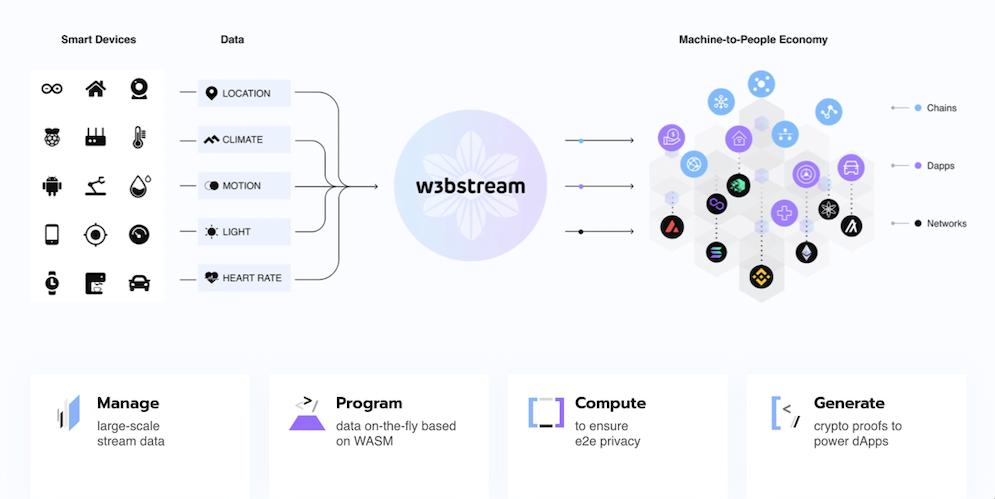
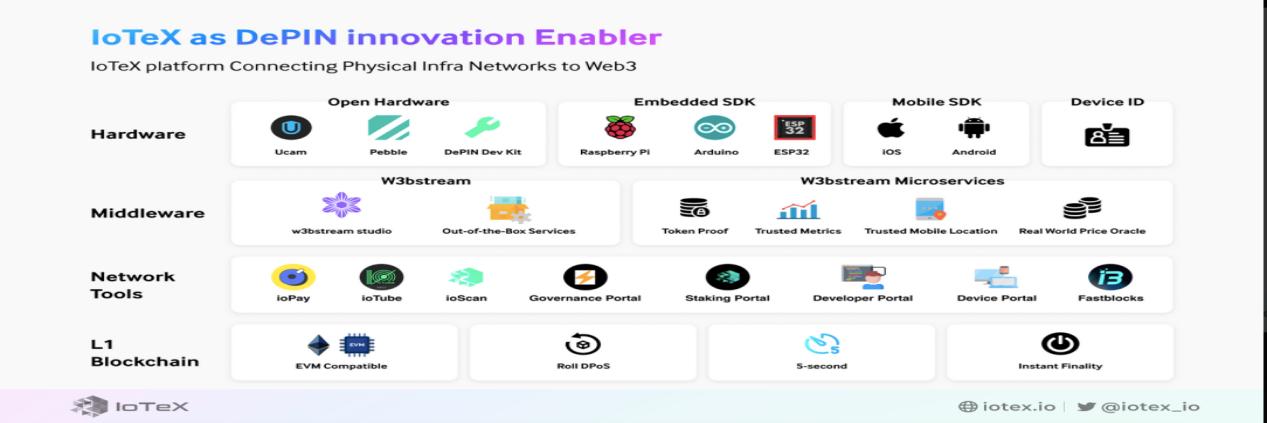
IoTeX's full-stack DePIN solution provides a full set of "plug-and-play" products and tools for blockchain-driven IoT applications. Building DePIN applications on the IoTeX platform only requires focusing on business logic. Its full-stack DePIN infrastructure is divided into four layers from top to bottom:
Hardware layer: MachineFi is a hardware portal platform where developers and users can register devices and obtain visual data.
Middleware: W 3 bstream It is a middleware between smart devices and blockchain, used to connect smart devices to smart contracts.
Tool layer: IoTeX provides a series of tools to help applications achieve data interaction and value transfer. For example, ioScan is a blockchain browser for querying blockchain data, and ioTube is a cross-chain bridge for facilitating two-way token exchanges between IoTeX, Ethereum, BNB chain and other top L1s.
Blockchain: IoTeX Blockchain is an EVM-compatible L1 designed specifically for IoT data.
In the fourth quarter of 2023, IoTeX's network transaction fees increased significantly, exceeding $212,000, with a quarterly growth rate of more than 3,000%.
IoTeX has developed W3bstream to serve the depin project, and its actual business has developed faster. Currently, Ethereum, IoTeX Chain, Solana, Polygon, Arbitrum, Optimism and Conflux all use IoTeX.
4. IoTeX Development Journey
IoTeX was founded in 2017 and raised approximately $30 million in funding from venture capital firms in 2018, launched a testnet, and was subsequently listed on Binance, Kucoin, and Gate.
In 2019, IoTeX developed a PoS-based EVM public chain and incubated many DeFi and NFT projects. The amount of ecological application data exceeded 100, and products included ioPay, staking portal, IoTeXScan, etc.
In 2020, the first IoT + blockchain vertical experiment was launched: Ucam, which won the CES Award and achieved more than 20,000 sales on Amazon.
In 2021, the second IoT+ blockchain vertical experiment was launched: Pebble, and within two weeks, 1,000+ units were sold. At the same time, through two social experiments, the concept of "MachineFi" was introduced and used as a direction. "MachineFi" is the current industry definition of DePIN.
In 2022, the W 3 bStream project was started, and the DePIN project was cooperated to provide infrastructure support. The team hopes that W 3 bStream can become the standard for the entire industry in the future. In May and June of that year, MachineFi Lab completed two financings totaling US$60 million.
In 2023, IoTeX clearly proposed the "DePIN First" strategic development plan, focusing on improving the imperfect infrastructure in the DePIN ecosystem, and launched the W3bStream project, actively participating in DePIN and cooperating with various projects in the ecosystem to promote the development of the entire ecosystem.
5. Application Cases
IoTeX built the entire blockchain and IoT middleware from scratch and launched a number of blockchain-driven IoT products.
6. What problems does IOTX solve?
Decentralized trust: IoTeX's blockchain provides a decentralized trust mechanism for devices to ensure the authenticity and integrity of data. Data privacy and security: With blockchain technology, users can control their own data and privacy, and only authorized people can access relevant information.
Efficient resource utilization: IoTeX can provide an efficient resource allocation mechanism, which makes it easier to process data generated by a large number of devices.
Value creation and transfer: IoTeX allows value transfer between devices, for example, using tokens to incentivize data sharing.
Smart Contracts and Automation: IoTeX’s smart contracts can automate tasks, such as automatically processing transactions when certain conditions are met.
Scalability: IoTeX has designed a scalable architecture to support the onboarding and operation of a large number of devices.
User empowerment: IoTeX gives users control over the platform through token economics and participation in governance. Incentive mechanism: Reward users and devices that contribute to the network and services through tokens.
7. Token Economic Model
IoTeX’s native currency, IOTX, not only manages the underlying blockchain protocol, but also serves as the fuel for the blockchain protocol, driving the entire ecosystem. Burndrop is a unique economic design that causes IOTX deflation as the number of devices coordinated by IoTeX increases, thereby maintaining economic stability.
When IoTeX supports the first 1 million devices, a total of 1 billion IOTX will be Burn-Dropped, of which 900 million will be directly destroyed and 100 million will be released (for example, to voters whose automatic subscription time is ≥ 91 days).
This process is generated by a smart contract, and every time the number of newly connected devices reaches a certain stage, a new "Burn-Drop" plan will be automatically executed.
After the Burn-Drop phase is completed, the Burn-to-Certify mechanism will be activated. Device manufacturers burn IOTX to obtain Powered by IoTeX (PBI) certificates, and PBI devices will receive token revenue every month, which comes from transaction fees paid by other devices.

8. Project Team and Financing
IoTeX is headquartered in Silicon Valley and its team consists of more than 30 top engineers and scientists from Uber, Google, Intel, Facebook, and other top technology companies.
Founding members:
Raullen Chai: Co-founder and CEO of IoTeX, PhD in Computer Science from the University of Waterloo. Former head of encryption R&D at Uber and technical director at Google.
Qevan Guo: Co-founder of IoTeX, PhD in Machine Learning and Computer Vision from the National University of Singapore. Former product director at Facebook.
Jing Sun: Co-founder of IoTeX, formerly managing partner of Silicon Valley venture capital firm Sparkland Capital.

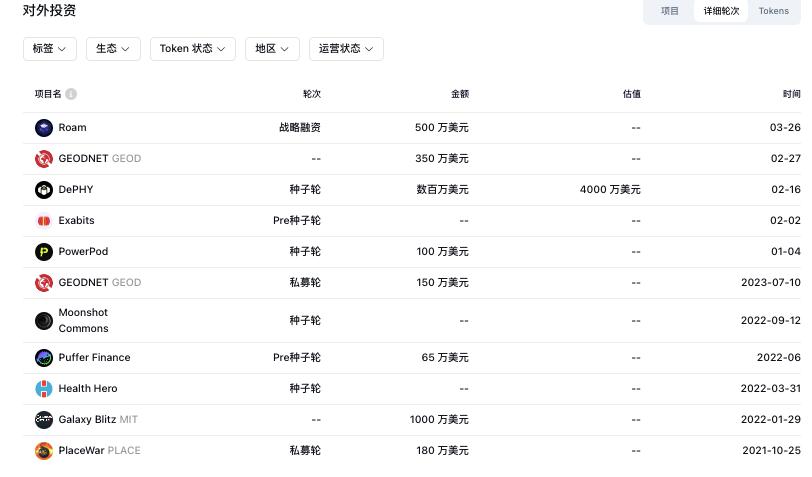
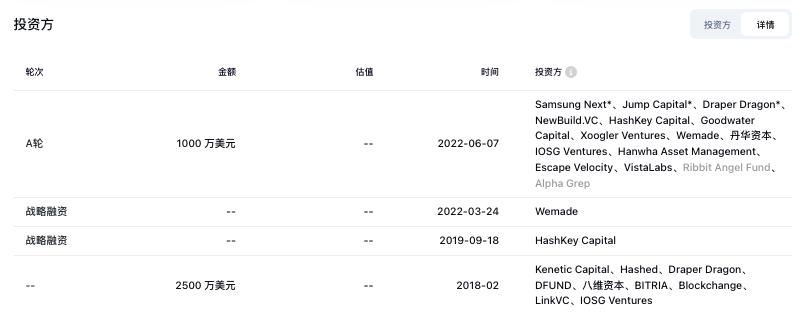
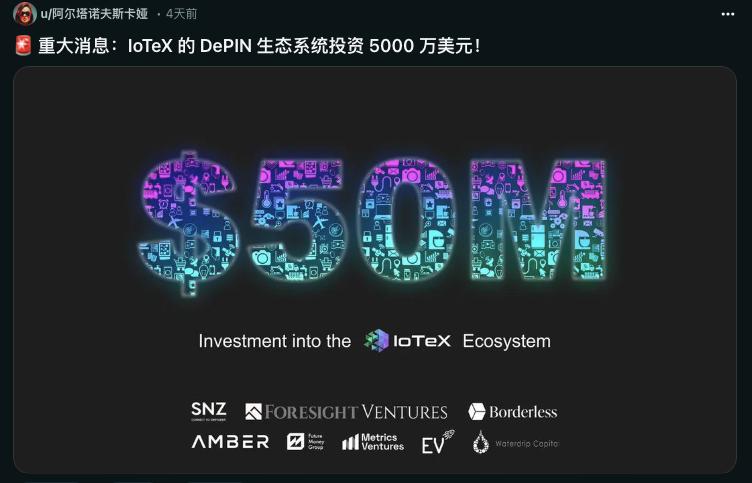
Regarding financing information, rootdata has not yet updated to the 50 million yuan raised on April 3. I will use two pictures.
IX. Conclusion
The distributed and immutable nature of blockchain technology and the connectivity and data exchange capabilities of the Internet of Things bring great potential for creating revolutionary IoT projects. Today, after years of development, blockchain technology, IoT devices, and data scale have all increased significantly. DePIN, as a bridge connecting physical world devices and Web3, has a more solid foundation today. IoTeX was founded in 2017 and has a top team and technology. After two cycles of dormancy, it has made great progress in both R&D and practical applications. We can see the project's determination and strength to deepen its roots in this field.
As a revolutionary blockchain network, it empowers machines and humans to interact seamlessly. It gives users full control over their data and guarantees privacy and security when conducting online transactions. IoTex's core goal is to ensure that consumers can own and manage the value and data they generate. With the network's ability to merge the digital world with the real world, users can now enjoy a variety of services.
References
1. https://machinefi.notion.site/IoTeX-DePIN-First-v2-64b8a285193f49cfa81240b3d3f12a33
2. https://www.rootdata.com/zh/Projects/detail/IoTeX?k=MTUx
4. https://depinscan.io/#mineable
6. https://app.gitbook.com/o/-MQ9LhchTp7_QJr-AYG0/c/-MQ9LuQRabCk_Dkn2xx1/introduction