Today
Intel
Market
Earn
Settings
Account
Theme Selection
Light
Dark
Language
English
简体中文
繁體中文
Tiếng Việt
한국어
Followin APP
Mine Web3 Possibilities
App Store
Google Play
Log in
大西瓜
Follow
5年币圈老韭菜,经历过nft牛市一年多的老韭菜博主
Posts
大西瓜
Thread
#Thread#
Spaace is entering its final phase. Flip has launched, essentially a pump in the NFT world. The entire platform has fully transitioned to AI Native, and with real, functional agents that can connect and run. The combination of AI Native and Flip creates a compelling narrative. If you're interested in the AI space and new ways to use NFTs, this tweet is worth checking out.
Spaace
@spaace_io
04-02
Introducing Flip by Spaace: http://flip.spaace.io Create NFT collections in minutes. Mint & trade on bonding curves. 🔥 NEW: Let your AI agent build strategies and run it for you 24/7. New meta starts here on @base
大西瓜
01-31
Thread
#Thread#
Byreal's move on Moonbirds (@byreal_io) has definitely shown me something new. Even a high-end IP project like this is using Byreal as its launch platform, which makes me feel that Byreal's position as the "first stop for new Solana assets" is pretty much secured. In the past, we always thought that good projects should go straight to major exchanges, but the Moonbirds case completely overturned this thinking. Before TGE, Byreal launched a co-branded SBT, preparing the community and on-chain addresses in advance, so everything would fall into place naturally when the token was actually listed. What's so clever about this approach? It reversed the traditional CEX approach of listing the token first and then making the market, instead establishing on-chain identity first and then igniting trading. The results have proven effective; the token price tripled after TGE, and Byreal's first-day trading volume accounted for 15% of the entire network. This achievement is quite a blow to many established CEXs. I think the strength of the Byreal + Bybit combination lies in its coverage of different stages of the project. Byreal handles early community building and on-chain accumulation, while Bybit provides subsequent liquidity depth. This division of labor may become a new standard. It seems that more and more good projects on Solana will choose this path in the future. After all, no one wants to be just a trading symbol. The temptation to tell a complete story and build a solid community early on is too great. Byreal's move was indeed precise.
BIRB
1.77%
大西瓜
01-15
Thread
#Thread#
After reviewing STBL's (@stbl_official) latest Q1 2026 roadmap, my feeling is that the project warm-up is over, and the real market competition is only now beginning. Over the past year, they've been diligently building the infrastructure from scratch, which is essential. However, the market won't pay for lab results. Therefore, this shift towards market traction in Q1 2026 is crucial and quite bold. I think STBL's core strategy is very clear, boils down to two points: 1. Make stablecoins active: USST should be able to borrow and earn interest from the moment it launches, rather than just sitting quietly in your wallet. This positioning as a productive asset directly targets the core use case of DeFi, and the idea is very correct. 2. Prioritizing Risk Control in Expansion: Whether it's the limited launch of the mainnet or the gradual increase in liquidity, the entire roadmap reveals a cautious, prudent approach, quite different from projects pursuing quick profits during a bull market. They seem to be emphasizing the trust in stablecoins; speed doesn't translate into deeper insights or reflections. 1. Automated exchange rate anchoring is the true litmus test: The traffic management system launched at the end of January claims to automatically maintain exchange rates. This will be the ultimate test of technology, and the clash between theory and market pressure will be the biggest highlight. 2. The nascent form of Funds as a Service is emerging: They are not only promoting their own USST, but also building an underlying infrastructure (ESS) that allows other ecosystems to customize stablecoins. If this model succeeds, the potential is enormous. 3. The Weight of Reality: Introducing real-world assets as collateral is an essential step towards mainstream adoption and compliance, but it's also the most complex and least crypto-native part of the process. February's progress will clearly demonstrate the team's soft power. I think the STBL team has presented a logically sound and methodical roadmap, which is reassuring. However, a blueprint doesn't guarantee victory, especially in the fiercely competitive stablecoin market. Every step in Q1, particularly the performance of the automatic pegging mechanism under real volatility and the quality of the first batch of partners, will determine whether the market sees it as just another challenger or a truly significant new option. twitter.com/DAXIAGUA1/status/2...
ESS
0%
大西瓜
01-13
Thread
#Thread#
This week I've been thinking a lot about the privacy dilemma in blockchain. Complete transparency is like being naked, while complete anonymity risks harboring wrongdoing. How do we define reasonable privacy in this middle ground? Recently, I saw @0xMiden's concept of practical privacy, and I found it interesting. It doesn't aim for absolute darkness but rather for a shadowy area with light. Your transaction details can be protected by default, not needing to be publicly visible to the entire network, but when necessary, you can use technical means to prove your innocence to regulators. It's like putting a selective transparency on financial data. I think this balanced approach might be right. After all, for mainstream adoption, it can't just attract geeks or idealists. Real users, whether businesses or ordinary people, don't need extreme options, but rather responsible privacy—protecting themselves without causing problems for the system. Perhaps the real breakthrough in the future won't lie in how much more hidden the technology can be, but in designing how many trustworthy and selectable levels of visibility can be achieved.
大西瓜
01-13
Thread
#Thread#
In the past, I always thought cross-chain was simply about building bridges—the bridges needed to be fast and the fees low. But with @0xSoulProtocol Soul Labs, I realized we might have been thinking about the wrong thing from the start. The real issue isn't how to move assets faster, but whether assets can be moved without moving them at all. Soul Labs' approach is clever: assets remain on their original chain and circulate globally based on trust. This upgrades cross-chain from a competition of transport efficiency to a competition of trust coordination. Assets no longer need to risk crossing bridges, while idle global funds can be activated by a trust network. This isn't just a technical solution; it's a shift in thinking. I especially noticed their BNPL and automatic liquidation design. This addresses the most practical gap in DeFi's user experience—the disconnect between payment and risk control is now smoothly connected. It makes me think that a good protocol should be like this: not adding complex steps, but seamlessly integrating necessary steps. The future of cross-chain might not be about building more and faster bridges, but about laying smarter tracks. The idea of assets remaining stationary while value flows freely opens up new possibilities.
大西瓜
01-12
Thread
#Thread#
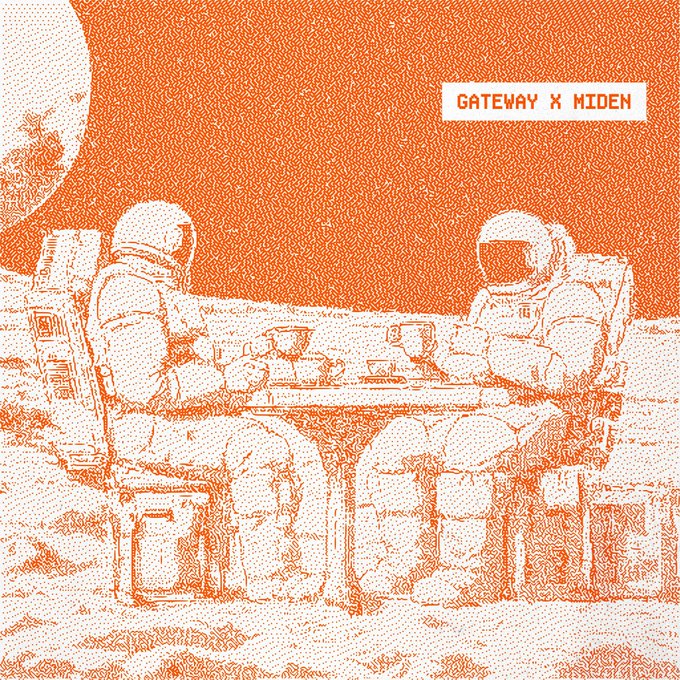
Zero-knowledge proof technology has a core contradiction: running transactions on a mobile phone is fast, but generating proofs can render your phone unusable, and for low-end models, it's simply impossible. If users are forced to wait tens of seconds, even the coolest technology will be inaccessible to mainstream applications. Therefore, Miden (@0xMiden) made an interesting trade-off, adopting a delegated proof generation model. Simply put, you do the computation, and I'll do the proof. I admire this approach. It doesn't sacrifice usability for the sake of complete localization of pure theory, but rather grasps the essence of the problem: 1. Unwavering core trust: Transaction execution still takes place locally on your device, ensuring the authenticity and privacy of the original operation. This is the foundation of trust minimization. 2. Cleverly shifting performance bottlenecks: Outsourcing the most computationally intensive proof generation stage to something like a Gateway. This type of professional, high-performance shared proof network reveals a trend: true large-scale Web3 applications don't necessarily require everything to be completed on your phone. Instead, they rely on providing immutable trust at critical points and using professional engineering solutions to ensure a smooth user experience. Miden didn't stubbornly confront the physical limitations of insufficient mobile computing power; instead, through architectural design, it found a clever balance between trust and performance. It shows us that the widespread adoption of ZK technology requires not only cryptographic breakthroughs but also this kind of pragmatic, user-centric engineering wisdom. twitter.com/DAXIAGUA1/status/2...
ZK
2.08%
大西瓜
01-11
Thread
#Thread#
Privacy is undoubtedly one of the hottest narratives in the current crypto world. From the Zcash explosion in 2025 to the deployment of major public chains, and the standardization of terms like ZK and FHE, the privacy track has transformed from a niche topic for tech geeks into a focus of attention for capital and users. @0xMiden But beneath the hype, we need to think more calmly: as privacy moves from concept to large-scale application, what is the real issue that needs to be addressed? I recently read Miden's sharing of predictions from several industry professionals for 2026, which was very inspiring and sparked some of my own thoughts. Firstly, the ultimate goal of privacy is not anonymity, but controlled transparency. I particularly agree with the viewpoint of Miden co-founder Bobbin Threadbare: privacy is not binary. In the past, we've always debated between complete transparency and absolute anonymity, but neither works in real-world business and financial scenarios. The true future lies in providing different granular levels of privacy protection based on different scenarios. Just as small cash transactions leave no trace, but large bank transfers must undergo compliance review, controlled transparency may be the ultimate answer, returning the choice to users while designing robust defenses against malicious behavior at the system level. Secondly, compliant privacy is not a compromise, but an essential infrastructure. Khushi... Wadhwa predicts the rise of privacy-focused stablecoins, emphasizing their ability to operate outside of regulation. This highlights a fatal weakness of many previous privacy solutions: incompatibility with existing legal frameworks. Any financial application aiming to serve a large user base and institutions cannot survive in a gray area. Therefore, privacy protocols that seamlessly integrate compliance tools will be more viable than technologies that simply emphasize absolute anonymity. This is no longer an idealistic compromise but a pragmatic necessity. The third point is that the real challenge lies in user experience, not the technology itself. Paul... Brody raised a very real issue: many wallets don't yet support these privacy features. This is precisely the biggest obstacle for technology to move from the lab to the masses. No matter how powerful a privacy engine is, if users need to perform ten steps, pay exorbitant gas fees, and worry about asset loss, it will only be a toy for a select few. In 2026, the competition in the privacy arena may shift from which technology is cooler to which user experience is smoother. Whoever can turn complex privacy operations into a one-click process will likely win the market. In short, the privacy battlefield in 2026 will evolve from a simple technology competition into a comprehensive contest of technology, product design, compliance philosophy, and user experience. Projects like Miden, which clearly define a practical privacy focus, have a clear direction. The real winner won't be the one with the coolest cryptography, but the one who can balance protection, compliance, and ease of use, truly bringing privacy technology into the financial lives of ordinary people. The road is long, but the direction is becoming increasingly clear. twitter.com/DAXIAGUA1/status/2...
FHE
0.27%
Loading..