Today
Intel
Market
Earn
Settings
Account
Theme Selection
Light
Dark
Language
English
简体中文
繁體中文
Tiếng Việt
한국어
Followin APP
Mine Web3 Possibilities
App Store
Google Play
Log in
Bitcoin Addict Thailand
55,021 Twitter followers
Follow
Thailand’s largest crypto media and community | บทความ ข่าวสาร และความรู้เกี่ยวกับ Blockchain และการลงทุน Cryptocurrency 💰📊
Posts
Bitcoin Addict Thailand
03-27
Thread
#Thread#
Bitcoin holders' profits plummeted to 60%, with statistics indicating a "reset point" before a potential 600% surge like in the past. Earlier this year, every week was filled with news of losses, discouragement, and people saying BTC was "dead" after falling nearly 45% from its all-time high (ATH). But on March 27, 2026, a number appeared in the on-chain data (directly on the Bitcoin blockchain) that many analysts in the industry recognized because it had previously appeared during the best accumulation periods. That number was 60.6%. This is the proportion of all Bitcoins in the market that owners still hold "in profit" relative to their purchase price, known as Supply in Profit. Why is this number important? We need to look back at the story: 1) March 2020 — The global market collapsed due to COVID. The price of BTC plummeted to around $6,500. Supply in Profit dropped below 50%, meaning more than half of all Bitcoins in the world were "below their cost price." Most holders were losing money. The resulting surge — BTC reached $69,000 in 2021, an increase of approximately 10 times. 2) January 2023 — The second surge of similar figures after FTX (the crypto exchange that went bankrupt at the end of 2022) flooded the market, with a Supply-in-Profit ratio of 51%. The price of BTC was at $16,682. Most people in the industry thought it was "over." The resulting surge — BTC reached a 655% increase, reaching $126,000 in 2025. 3) October 2025 — The peak of the cycle, and then everything started to change. After reaching an all-time high of $126,000, the market began to correct. Retail investors who entered late in the market exited first, causing BTC to gradually decline by approximately 45% from its peak. 4) February 5, 2026 — The day of peak selling pressure; Supply-in-Profit ratio plummeted to 50.8%, the lowest since early 2023. During the same period, BTC being sent to Binance (the world's largest exchange) by short-term investors surged to approximately 100,000 BTC per day. This was a signal of panic and selling. 5) March 18, 2026 — The US Federal Reserve announced it would keep interest rates at 3.5–3.75% and signaled it was not in a hurry to lower them. Because inflation remains at 2.7%, and pressure from oil prices soaring more than 60% since the beginning of the year due to tensions in the Middle East, the direction of risk assets like crypto remains difficult to predict. 6) March 25, 2026 — Selling pressure subsided, with BTC flowing from short-term investors into Binance dropping to only 25,000 BTC per day. Analyst Darkfost noted this as a new market low, down from 100,000 BTC during the February crisis. Simply put, most of those who panicked and wanted to sell have already done so, and what remains are the stronger hands. 7) March 27, 2026 — Today, the Supply-in-Profit ratio returned to 60.6%. This figure remains in the historical zone of interest for long-term collectors. But one thing that's different from all previous cycles is that LTH-NUPL (Long-Term Investor Profit/Loss Index) remains at 0.40. This means that long-term investors haven't really suffered yet, unlike in 2018 and 2022 when this number plummeted below zero before reaching a true bottom. 8) The game-changer this time is that financial institutions and spot ETFs (funds that actually hold Bitcoin, not just contracts) currently hold approximately 15.8% of the total circulating BTC, or about 3.3 million BTC. CoinShares reported that money has continued to flow into Bitcoin ETFs for three consecutive weeks, totaling over $340 million, even though the market is stable and directionless. This group isn't panicking like retail investors, so the panic selling that heavily pressured the market in previous cycles is significantly less. The Supply-in-Profit figure isn't an accurate indicator of the bottom, but in every past cycle, it has often shown that "selling pressure is dissipating" before the market truly starts accumulating. The remaining question isn't "Has this signal ever been correct?" because historically it has, but "How long will it take this time?" amidst the Fed's continued interest rate cuts. Oil prices remain high, and altcoins are still bleeding.
BTC
0.52%
Bitcoin Addict Thailand
03-26
Thread
#Thread#
Trust Bitkub, it's safe. How did the "Somchai Sae-Tang" saga unfold? Unraveling the mystery in one post! 1/ Free users without Premium started getting suspicious, leading to posts about the AI Deepfake "Somchai Sae-Tang" crisis. The chaos began when scammers used AI Deepfake technology to impersonate Mr. Somchai and his voice.
BTC
0.52%
Bitcoin Addict Thailand
03-23
Thread
#Thread#
Resolv insists its collateral assets are still safe after the coin issuance mechanism was attacked. At one point earlier this year, Resolv's TVL (Total Value of Assets in the protocol) stood at over $500 million. There had been 14 audits from 5 different companies, and a bug bounty of up to $500,000 was offered. The protocol seemed well-built. Then, in the 3-4 weeks leading up to the incident, money began to drain out – quietly and gradually, from $400 million to $100 million, before Sunday night changed everything. The Resolv Protocol is a DeFi (decentralized finance) protocol designed to allow users to deposit assets and receive returns. Its USR (Security Reward) is the protocol's stablecoin, designed for stability using ETH and Bitcoin as collateral, not cash. The bigger question than the $24 million figure is – why did 75% of the money disappear before the attack? And why did a system that had passed 14 audits still have such vulnerabilities? 1) April 2025 — Abu Dhabi-based Resolv Labs raised $10 million in a seed round led by Cyber.Fund and Maven11, with additional investors including Coinbase Ventures and Arrington Capital. TVL surged past $500 million at its peak. 2) Throughout 2024–2025 — Repeated Audits The Smart Contract was audited 14 times by five security firms. In July 2025, Pashov audited the Staking module and commented that the overall system design was "good." 3) February 2026 — Funds began to quietly flow out. TVL dropped from approximately $400 million to just $100 million in the 3-4 weeks prior to the event. Analysts from BeInCrypto noted that a 75% contraction in liquidity before the attack was unusual. And the question arises: did anyone know in advance? . 4) Sunday, March 22, 2026 — $200,000 enters the process . The hacker deposited approximately $200,000 (about 6.8 million baht) of USDC into the USR system via the requestSwap function, a standard procedure for issuing new USR coins. . 5) 17 minutes later, 500 times the expected amount was issued. . The Service Role system (an account with special privileges to mint coins) responded to the request by issuing 50 million USR coins, instead of the usual ~200,000 coins – 500 times what should have been received. An additional 30 million coins were later mined, totaling 80 million unbacked USR coins. . 6) DeFi sell-off causes price crash . USR coins were sold off across multiple liquidity pools. The price plummeted to $0.025 in the Curve Finance pool (97.5% below the $1 target) before recovering to around $0.14–$0.42, according to various reports. . 7) Convert everything to ETH - Onchain data from Arkham, confirmed by Cyvers, indicates that hackers converted approximately 11,400 ETH, worth around $23-25 million, into Ethereum. The remaining $36 million in USR continues to be sold off. . 8) PeckShield warns before Resolv speaks - Security company PeckShield posted a warning on X about an unusual amount of USR being mined before Resolv Labs issued an official statement. . 9) Resolv releases statement — "Collateral Pool Remains Valid" . Resolv Labs confirmed that the asset reserve "remains valid" and "no actual assets have been lost," while temporarily suspending all protocol functions. . However, Cyvers points out that this statement... "Technically correct, but doesn't reflect reality" because this type of attack is supply inflation — printing more coins until they become diluted, not stealing money from the treasury. The result for retail investors is heavy losses. 10) Pashov reveals the cause — it wasn't broken code. Pashov, the audit firm, stated that "the system design was good." However, the root cause appears to be a Private Key Compromise — meaning the private key of a Service Role account was stolen. That Service Role was just an EOA (Externally Owned Account — a regular account, not a multi-user system) and had no Mint limit or Oracle price verification requirements. 11) Other DeFi protocols issue statements refuting the claim. Lido, Morpho, and Aave all issued statements confirming their security, while Euler, Venus, Lista, and Fluid decided to temporarily halt trading or forgo Vault. Charles Guillemet, CTO of Ledger, commented that this incident "isn't like Terra Luna" because the size of the USR (Security Response) was small enough not to spread throughout the system. This isn't the first time this year — in January 2026, Truebit lost $26.6 million due to a vulnerability in a Smart Contract deployed five years prior, and Balancer recently lost $100 million. Immunefi reports that the current average cost of a hack is around $25 million, which is exactly the resolution figure. Some in the industry have compared this to some stocks whose prices start behaving erratically a week before bad news breaks — But in DeFi, it's onchain, visible to everyone, it's just that nobody notices in time.
RESOLV
7.74%
Bitcoin Addict Thailand
03-23
Thread
#Thread#
Bitcoin's "4-Year Cycle" Isn't Dead Yet! Attention long-term investors! Anthony Scaramucci, CEO of SkyBridge Capital, reassured us amidst the despair in his "Wolf of All Streets" podcast, confirming that Bitcoin's 4-year cycle is not yet broken and predicting a market recovery in Q4 2026. The question is... does he see something others don't, or is he simply overconfident? 1) 2024 — The Golden Age of Bitcoin ETFs Bitcoin Spot ETFs (traded funds holding actual BTC, not just derivatives) were approved in the US. Capital from large financial institutions began to flow in, significantly altering market dynamics. 2) Late 2024 — A Boost from the White House Trump won the election, clearly announcing pro-crypto policies. US regulatory agencies began to relax their stance. Analysts worldwide, including Scaramucci himself, predicted BTC would reach $150,000 in 2025. 3) October 2025 — An unexpected peak. Bitcoin hit an all-time high of approximately $126,000, but instead of continuing to reach $150,000, the market abruptly stalled. 4) After October 2025 — OG Whale begin selling. Scaramucci explains that this is the point where OG Whale (pioneering large-scale Bitcoin investors who held the stock since it was in the hundreds or thousands of dollars) began to sell off their holdings when the price broke through the crucial psychological level of $100,000. This is because they believed in the 4-year cycle — and this mechanism is what makes the cycle "real." "When people believe in something, it often happens — the 4-year cycle becomes a self-fulfilling prophecy." Self-fulfilling prophecy = a prediction that becomes reality. Because people believed and followed. 5) Late 2025 — The year after the Halving closed in the red for the first time in BTC history. It plummeted from a high of $126,000 to a low of around $60,000, closing 2025 in the red, something unprecedented in a post-Halving year. This raised new questions about whether the 4-year cycle had ended. 6) This week — The war further exacerbated an already wounded market. BTC prices plunged below $69,000 last Saturday. Following the prolonged conflict in Iran entering its third week, pressuring risky assets worldwide, the S&P 500 index (a representative index of the US economy) fell by about 1.3% and dropped below the 200-day Moving Average for the first time in 10 months. Some analysts warn that if BTC continues to move in line with the S&P 500, its price could fall another 50% this year. 7) Scaramucci Remains Steadfast — Pointing to Early 2023 as a Lesson After the FTX Exchange (a crypto trading platform that went bankrupt in November 2022 with massive debt) shut down, the market was in a state of stagnation and despair. But that's where the bull run started again in early 2023. Scaramucci isn't always right. He previously predicted $150,000 in 2025 and was wrong. But the reason he gives this time — the OG Whale behavior of cyclical selling and persistent institutional buying — isn't just hope.
BTC
0.52%
Bitcoin Addict Thailand
03-22
Thread
#Thread#
Mining Difficulty Drops Sharply - Worst in Months What happened to the mining operations? The Bitcoin mining difficulty recently dropped sharply by 7.7% to 133.79 trillion on March 20th, one of the most severe drops since the beginning of the year! Mining Difficulty is the level of computing power the Bitcoin system assigns to miners to mine a new block. The system automatically adjusts every 2,016 blocks (approximately 2 weeks) to ensure a consistent block release every 10 minutes. When Difficulty drops, it means the total computing power on the network is decreasing; miners have unplugged their devices. 1) April 2024 — The 4th Halving occurred. The mining reward per block was halved from 6.25 to 3.125 BTC, while the cost remained the same. 1) Revenue halved. 2) Early 2026 — BTC price was around $70,600, with research from Cambridge University estimating the average mining cost at around $87,000-$101,000 per coin. This means many miners were losing money on every BTC they mined. 3) February 2026 — Difficulty dropped for the first time, by 11.16%, the most severe drop of the year, partly due to storms in the US that disrupted large mining farms. But it rebounded 14.7% after the weather improved. . 4) Around the same time — the giants began moving out. Core Scientific signed a $10.2 billion contract with CoreWeave (an AI company) to convert its data center from Bitcoin mining to providing GPU services for AI; Hut 8 signed a $7 billion AI infrastructure contract; and Cipher Mining cut its mining power by 51% to focus entirely on AI. . 5) February 21, 2026 — Bitdeer (a Bitcoin mining company listed on Nasdaq) sold all of its reserve 943 BTC, leaving it with zero BTC. As of March 21, it confirmed that it still holds zero BTC — a Bitcoin mining company that doesn't hold Bitcoin. 6) March 20–21, 2026 — Difficulty dropped again by 7.76% to 133.79 trillion. The average block time stretched to 12 minutes and 36 seconds, from a target of 10 minutes. The system automatically adjusted the difficulty level. This is a sign that actual miners are abandoning their equipment, not just that it's a temporary shutdown. Ran Neuner, a trader and co-founder of Crypto Banter, posted on X that AI has become the most formidable competitor to Bitcoin mining because both industries are vying for the same thing: electricity. Bitcoin mining generates approximately $57–129 per megawatt, while AI data centers earn up to $200–500 per megawatt from the same infrastructure. Meanwhile, CoinShares (a digital asset research firm) predicts that revenue from Bitcoin mining by companies that sign contracts with AI will shrink from 85% of total revenue in early 2025 to less than 20% by the end of 2026. Willy Woo, a prominent on-chain analyst, argues that electricity prices don't directly affect the stability of the Bitcoin network because the Difficulty Adjustment system is designed to handle such situations — if miners can't tolerate the high prices, they leave, the remaining miners get a larger share, and the network continues to function. The Bitcoin network itself remains strong. Blocks are still being released every 10 minutes, but the people who used to manage it are changing hands — from miners who believed in Bitcoin to miners who pay the most. The next difficulty adjustment is expected in early April, and preliminary figures suggest a further decrease of approximately 0.7%. This isn't the end of the story — stay tuned 👀
BTC
0.52%
Bitcoin Addict Thailand
03-22
Thread
#Thread#
Bitcoin Options Send a Warning Signal! Traders Rush to Buy Bid Insurance Amid Energy Crisis . The crypto market is getting tense! After Bitcoin failed to stay above $75,000 and fell back to the $70,000 zone, Bitcoin Spot ETFs experienced continuous outflows for two consecutive days, totaling over $254 million. . 1) October 2025 — Bitcoin reached an all-time high of approximately $126,000 before steadily declining due to profit-taking by large investors. . 2) February 2026 — Over $3.8 billion flowed out of Bitcoin Spot ETFs (publicly traded funds holding actual Bitcoin) in a single month, the heaviest outflow since ETFs launched in 2024. . 3) February 28, 2026 — The US and Israel jointly attacked Iran's nuclear infrastructure and top leaders within an hour. The cryptocurrency market value dwindled by $128 billion. Bitcoin plummeted from $66 billion to $63 billion. 94,058 traders were liquidated (forced to close their positions due to insufficient margin) within 24 hours. 4) Early March 2026 — The Strait of Hormuz, a passageway for 20% of the world's oil, was threatened. Over 150 oil tankers were forced to wait outside the strait. WTI crude oil (the benchmark US crude oil) surged to nearly $120 per barrel. The direct consequence was that the Fed (US central bank) hesitated to cut interest rates because if energy prices continued to rise, inflation would be unstoppable. And with high interest rates, cash retained its value → risky assets like Bitcoin would continue to be under pressure. 5) March 9, 2026 — Trump announced on CBS that the operation... "It's over." Oil plummeted from $116 to $85 overnight. Bitcoin immediately jumped back above $70,000. The market breathed a sigh of relief. ETFs began receiving continuous inflows again. 6) Mid-March 2026 — The battle wasn't over as announced. WTI oil surged back above $94 per barrel since March 12th, up more than 50% compared to pre-war levels. The S&P 500 index plummeted to its lowest level in six months. Even gold, often seen as a safe haven during crises, fell more than 10% in just three days. The Fed revised its 2026 inflation forecast upwards to 2.7% and confirmed it would only cut interest rates once throughout the year. 7) Tuesday ~March 18th, 2026 — Bitcoin surged to $75,000, but there was no following buying interest in the options market. Bitcoin jumped to $75,000-$76,000. Inflows into ETFs have continued for 7 consecutive days, but in the Options market, there are no bullish buy signals. Institutional traders still don't believe in this support level. 8) Friday, March 21, 2026 — The Put/Call Ratio on Deribit (the world's largest crypto derivatives exchange) surged 2.5 times. Short explanation: A Put Option is a contract that gives the right to sell an asset at a predetermined price, used for profit or protection against a market downturn. A Call Option is a contract that gives the right to buy at a predetermined price, used for speculating on an upward trend. When a Put is significantly higher than a Call, it means people are "buying insurance against a downturn." This figure is similar to what happened on February 27th, the day Iran refused to negotiate on the nuclear issue, one day before war broke out. 9) Delta Skew reached +16% — Delta Skew is an indicator that shows where the Market Makers, or liquidity providers, are looking at the market. The worrying normal level started at +6%, today it's at +16%, reflecting that even institutional traders are uncertain whether the $69,000 support level will hold. 10) $254 million out of Bitcoin ETF in 2 days after the price stalled at $75,000. A net outflow of $254 million from Bitcoin Spot ETFs over two consecutive days. While this figure is still very small compared to the total assets in the fund, it's not yet clear that institutions have permanently reversed course. Oxford Economics indicates that higher energy prices will dampen consumer spending and may cause shortages of certain goods in the US. If this happens, fears of a recession will be the next wave the market will have to deal with. Currently, Bitcoin stands at an uncertain point: institutional selling pressure isn't strong enough to call it a crisis, but buying pressure hasn't returned consistently. The main variable the market is watching now is oil. If the war eases and oil falls below $80, the door for interest rate cuts will open again, and Bitcoin could reverse direction. #Bitcoin #BTC #OptionsTrading
BTC
0.52%
Bitcoin Addict Thailand
03-21
Thread
#Thread#
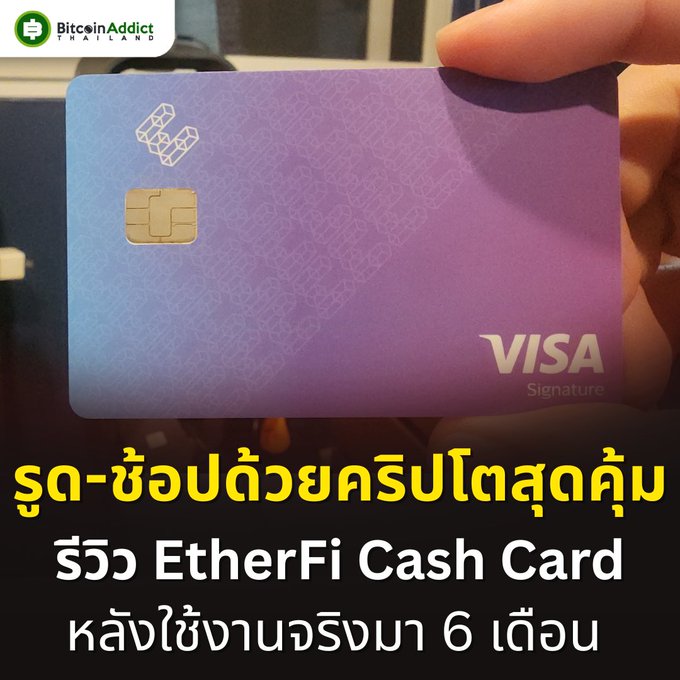
Save time selling crypto for Thai baht. Let's make better use of crypto. Today, we'll review the EtherFi Cash Card, another option for those who want to use crypto. 1/ Normally, when we want to use crypto for real-life spending, there are always the same steps: open an exchange → wait for a good price → sell → wait for the transfer to our account → then pay. And every time we do that, there are hidden costs, such as transfer fees and withdrawal fees. And if the price goes up after we sell, we regret it later. Using this card reduces the steps and risks mentioned above. 2/ But what is the EtherFi Cash Card? EtherFi was originally a staking protocol (locking ETH to receive interest from the Ethereum network) with over $5 billion in the system, making it one of the largest DeFi protocols in the world. But what's even more interesting is that they've expanded it into the EtherFi Cash Card, a VISA card that lets you directly use your ETH or USDC to buy things without having to sell them first. 3/ The amazing thing is that we have people using it for 6 months and they've told us how it is. First, you don't have to wait for a physical card. It's ready to use on the day you register. After completing KYC, request a virtual card and link it to Apple Pay or Google Pay. Tap to pay instantly at over 100 million locations worldwide. If you want a physical metal card, place a $40 deposit and wait 15 business days (the deposit will be refunded later). 4/ There are two payment methods to choose from, depending on your convenience: Method 1 — Direct Pay (recommended for those who want simplicity). The system deducts USDC (a stablecoin pegged to the dollar at a 1:1 ratio) directly from your wallet immediately after swiping. It's as easy as a regular debit card with no additional risk. Suitable for anyone who just wants to use crypto to buy things in their daily lives. Method 2 — Borrow Mode (for those familiar with DeFi). Deposit ETH as collateral. The system borrows USDC to pay instead, while the ETH remains in the vault and continues to earn interest. A key advantage is that it's a "borrowing," not a "sale," so there's no taxable event, meaning there's no need to calculate taxes on profits from selling crypto. However, if the ETH price plummets to the point where collateral is insufficient, it may be subject to liquidation, which is the system that automatically forces the sale of collateral assets. 5/ Actual costs compared to traditional cash-out methods: Traditional cash-out method: Thai exchange spread ~0.5-1%, withdrawal fee ~0.25%, waiting for funds to be transferred to the account, paying only after receiving Thai baht. EtherFi Cash Card method: FX fee (currency conversion fee) ~1%, instant 3% cashback. Net profit = +2% profit back every time you swipe. For example, our team calculated this in real-world terms by swiping at Makro for approximately 1,399 baht, receiving $2.20 cashback, saving around 55 baht compared to selling through an exchange and paying with Thai baht. 6/ This is the trump card: special cashback promotions are constantly being offered. In addition to the base 3% cashback, there are special campaigns that have offered up to 20% during specified periods. And there's a year-end campaign offering 10% off, but these promotions come and go quickly, so you have to keep an eye on EtherFi's Discord or social media. 7/ Considerations before using this as your primary card: While this card works well with Lazada, Makro, most Visa-accepting stores, and mobile contactless payments, it still struggles with Shopee, Steam, and some other online platforms. ATM withdrawals are possible, but the fees are higher than regular purchases (ATM ~2% vs. regular purchases ~1% FX). If you really need Thai baht, selling crypto through an exchange is still more worthwhile. Customer support isn't as good as bank cards. In case of refunds, the issue is usually sent to the merchant directly; there's no chargeback system like with regular credit cards. This is a review after 6 months of using the card. Has anyone used this card before? Comment and share your experience! #EtherFiCash #EtherFi #Crypto #BitcoinAddictThailand
ETH
0.09%
Bitcoin Addict Thailand
03-21
Thread
#Thread#
Analysts warn that Bitcoin is forming a bearish wedge pattern similar to that early this year. If it breaks below a key support level, it could plummet to $52,500! Throughout 2025, one pattern has recurred almost entirely—Bitcoin crashes after nearly every Fed meeting, regardless of whether the Fed cuts interest rates, keeps them unchanged, or signals anything else. In 7 out of 8 meetings in 2025, Bitcoin was in negative territory within 48 hours of the decision. And this week's events suggest that 2026 will be no different. Bitcoin surged for eight consecutive days ahead of the Fed meeting on March 18, 2026, before bouncing to $76,000 and then falling back below $70,000 in the following days. 1) January 19, 2026 — The First Signal Aksel Kibar, a technical analyst, founder of Tech Charts LLC, and former fund manager at the National Bank of Abu Dhabi, and holder of a CMT (Chartered Market Technician) certification—the highest international standard for chart analysts—posted on X that Bitcoin was forming a rising wedge near $97,000, stating that if the price broke, the next test zone would be $73,700–$76,500. 2) Early March 2026 — The Market Deceived Itself Bitcoin ran up for eight consecutive days, the market became excited. Expectations that the Fed would "cut interest rates four times" this year were still on most investors' minds. Prior to the meeting, a record 6,100 BTC were transferred into trading platforms per hour — the highest level since February 20th, which typically indicates a sell signal. 3) March 18, 2026 — The FOMC went quiet. The Fed announced it would keep interest rates at 3.5–3.75%, as expected, but Powell stated that "the surge in oil prices has clearly impacted our inflation forecasts," and revised its 2026 inflation forecast from 2.4% to 2.7%, primarily citing the US-Israel-Iran conflict. The surge in crude oil prices above $110 per barrel caused the Nasdaq to close at its day's low, down 1.5%. Bitcoin plummeted from $76,000 to $70,900 overnight. 4) March 19, 2026 — Kibar posted a second warning. After reviewing this week's charts, Kibar posted that "the same Bearish Wedge pattern is forming again," stating that a break below $66,000 would open the door for a correction down to $52,500, emphasizing that this was a "technical signal, not a prediction." 5) Spreading Impact — Grayscale Bitcoin Trust (the world's largest Bitcoin fund) experienced a $340 million outflow in a single day. MicroStrategy, a company holding more than 190,000 Bitcoins, plummeted 8% in the after-market. Only Coinbase saw a 40% above-normal trading volume surge — partly due to people rushing to cut their losses. Another perspective from those who rushed to buy on the dip: One of the most commented-on posts on X said, "$75K is a trap. Anyone who bought before the Fed meeting gets caught every time. It's no different." Another commented, "Kibar warned about this before the December crash last year. This time, people didn't listen." The $66,000 support level is a zone to watch — if it breaks below that, the bearish wedge will become much more significant. The Iran-Iran conflict is not over, oil prices are still high, and the Fed recently said inflation will last longer than expected. Stay tuned 👇
CMT
0%
Bitcoin Addict Thailand
03-20
Thread
#Thread#
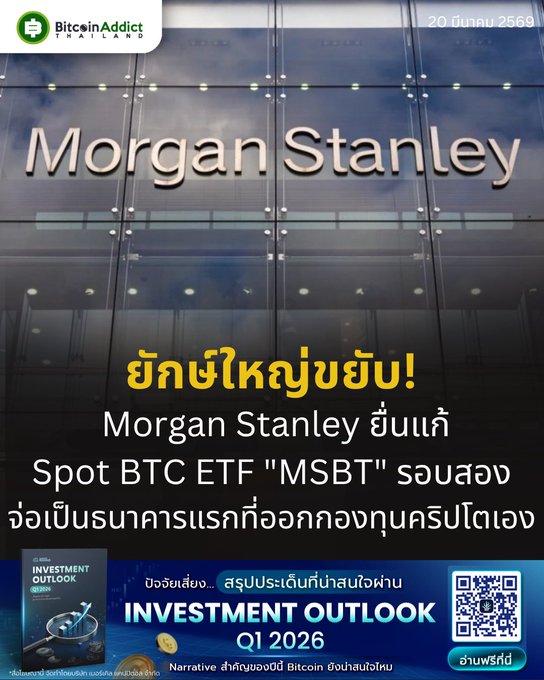
Morgan Stanley Files Second SEC Application to Launch Bitcoin ETF "MSBT" on US Stock Exchange The traditional financial world (TradFi) is about to enter a new era as Morgan Stanley, one of the world's most influential investment banks, is no longer just a "middleman" selling funds for others, but has decided to jump into the role of "fund owner" itself. This is being done through a second filing with the US SEC to amend its application for registration of the Morgan Stanley Bitcoin Trust (MSBT). If successful, they will become the first major bank to launch a Bitcoin Spot ETF under their own brand. 1) August 1, 2024: A cautious start — Morgan Stanley will allow financial advisors to recommend Bitcoin ETFs to clients for the first time, but limited to BlackRock and Fidelity funds only. Every dollar invested by clients will be subject to change. 1) Fund management fees go to competitors. 2) Late 2025 — Goldman Sachs proceeds with the acquisition of ETF issuing company Innovator for $2 billion to have its own crypto fund. Meanwhile, Merrill Lynch begins allowing advisors to proactively recommend Bitcoin ETFs to clients in January 2026, a clear signal that major US banks are moving from distributors to product owners. 3) January 2026 — Morgan Stanley files its first S-1 (Securities Registration Application with the SEC) for both the Bitcoin ETF and the Solana ETF simultaneously, but without specifying any key details. 4) Early 2026 — All 15,000 financial advisors are approved to proactively recommend Bitcoin ETFs to clients, whereas previously they had to wait for client requests. 5) March 18, 2026 — Second amendment filing reveals all cards. This time, the details are complete: 🔹Market Symbol: MSBT on the NYSE Arca 🔹Bitcoin Custodian: Coinbase Custody, stored in Cold Storage (an offline wallet disconnected from the internet) 🔹Cash and Fund Management Custodian: BNY Mellon and Fidelity 🔹Fund Management Fee: Approximately 0.20%–0.30% per year (compared to BlackRock's IBIT of 0.25%) 🔹Special: Fee waiver for the first $5 billion for 6 months 6) The real reason for crossing this line The numbers speak for themselves — for every $1 billion Morgan Stanley clients deposit into BlackRock's IBIT, a 0.25% annual fee flows into BlackRock's pockets, totaling $2.5 million annually. But with MSBT, that figure belongs to Morgan Stanley itself. With $1.8 trillion in assets, even if only 1% of clients invested in MSBT, that would immediately mean managing over $18 billion in funds. This is similar to what we've seen in the mutual fund market, where large banks realize they already have an established client base and only need to change the wallet receiving the funds. Amy Oldenburg, head of digital asset strategy at Morgan Stanley, stated that the bank intends to develop its own comprehensive custody and exchange system in the future because "clients trust the Morgan Stanley brand to be reliable." If the SEC approves, MSBT will become the first Bitcoin ETF in history issued directly by a major US commercial bank, not just an asset management company. #MorganStanley #BitcoinETF #MSBT
BTC
0.52%
Bitcoin Addict Thailand
03-20
Thread
#Thread#
Searching for the missing Pirate King. Initial information suggests he previously worked as an MD for a famous VC firm. Anyone with information, please report it immediately. The bounty is sky-high: 1 billion! Send information to the page's inbox. 🫡 #BillionDollarDeal #PirateKing #BitcoinAddict
BTC
0.52%
Loading..