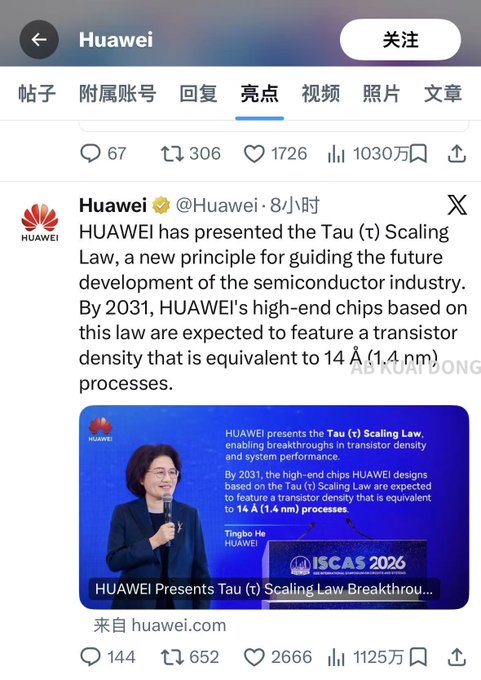
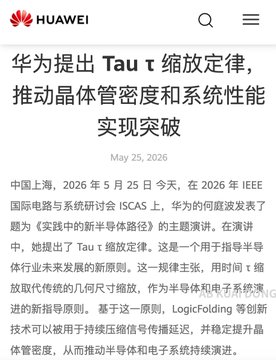
Huawei's official X account, after publishing "Tao's Law" today, has seen each post garner over 1 million views, with announcements consistently exceeding 10 million. It's impossible to say that international observers aren't paying close attention.
Huawei is discussing a new semiconductor approach called "Tao's Law." Its core isn't about relentlessly pushing for smaller transistors, but rather shifting the focus to improving the speed of data processing and computation within the entire system.
In other words, while Moore's Law focused on space—making chips smaller and smaller—Huawei now emphasizes time, meaning reducing latency and increasing efficiency through packaging, interconnects, and architectural optimization within the same manufacturing process.
One key technology is Logic Folding. Simply put, it involves changing the circuitry from a single planar surface to a multi-layered stack, shortening the signal path.
Shorter paths result in lower latency and better power consumption. The article states that the Kirin 2026 chip, using this technology, shows significant improvements in transistor density, energy efficiency, and frequency within a fixed manufacturing process.
Another key focus is AI data centers. Huawei believes that the bottleneck in the AI era is not just insufficient computing power, but also the slow, power-intensive, and expensive data transfer. The article mentions that in large AI clusters, much energy and cost is spent on data transmission, storage, and interconnection.
Therefore, Huawei has proposed solutions such as a unified bus, Hi-ONE optical interconnect, and 3D folding, aiming to enable a large number of chips to work collaboratively as a unified system.
In layman's terms, since the most advanced lithography is difficult to obtain, the focus shouldn't be solely on 2nm and 3nm processes; alternative approaches should be taken to improve performance. Huawei states that it has mass-produced 381 chips in the past six years and has summarized its experience into a methodology that optimizes not only individual transistors but the entire chain—transistors, circuits, chips, systems, and data centers—together.
Huawei believes that future chip competition may no longer be about who can produce even smaller nanometers like 2nm and 3nm among TSMC, Samsung, and Intel, but rather about who can excel in packaging, interconnection, system architecture, and hardware-software synergy.