The approval of the Bitcoin spot ETF by the United States has strengthened BTC's image as a store of value asset and consolidated its macro asset status. In contrast, Ethereum's fundamental positioning in the crypto space is still unclear. Competitive public chains like Solana have affected Ethereum's position as the preferred DApp deployment platform. The growth of Ethereum Layer2 and the reduction in ETH destruction also seem to have affected its value accumulation method.
However, we believe that Ethereum's long-term prospects remain optimistic. It has unique advantages among smart contract platforms, including Solidity's strong developer ecosystem, the widespread use of the EVM platform, the importance of ETH as DeFi collateral, and the decentralization and security of the mainnet. Moreover, with the acceleration of tokenization, the trend of converting real-world assets into digital assets on the blockchain, ETH may receive a more positive and active boost in the short term compared to other L1s.
Historical trading data shows that ETH embodies both the characteristics of storage value and technological innovation. It is highly linked to BTC, which meets the characteristics of storage value, but can also perform independently during the long-term rise of BTC, following the technology-oriented market laws like other crypto assets. It is expected that ETH will continue to integrate these two characteristics and may reverse its current poor performance in the second half of 2024 and achieve unexpected growth.
ETH’s Narrative
ETH has various roles. It is called Ultrasound money that controls supply through production reduction, and is also regarded as an Internet bond that provides non-inflationary staking income. With the rise of Layer2 expansion and re-staking technology, new concepts such as "settlement layer assets" and "universal labor proof assets" have also emerged.
Translator's note: Under the PoS mechanism, users can participate in network maintenance and receive rewards by staking ETH, which is similar to buying bonds to get interest, but more decentralized. Since staking rewards come from network transaction fees and newly issued ETH, and the total control strategy limits excessive issuance, this staking reward model of ETH is regarded as a more inflation-resistant Internet bond compared to traditional inflation.
But in the final analysis, we believe that none of these individual statements can fully reflect the vitality of ETH. In fact, the increase in ETH's uses makes the way to evaluate its value more complicated, and it is difficult to define a single metric. Moreover, the interweaving of these multiple concepts may sometimes cause confusion, and the contradictions between them may distract the attention of market participants and obscure the real driving force behind the rise in ETH's value.
Spot ETF
Spot ETFs are critical for Bitcoin, not only clarifying the regulatory framework, but also attracting new capital injections. This type of ETF fundamentally reshapes the industry landscape, and we believe it subverts the previous cyclical pattern of funds shifting from Bitcoin to Ethereum and then to higher-risk alternative assets.
There is a barrier between funds invested in ETFs and funds on centralized exchanges, which have access to a wider range of crypto assets. Once a spot Ethereum ETF is approved, this barrier will be removed and Ethereum will have access to capital sources that are currently only open to Bitcoin .
In fact, the logic for approving a Bitcoin spot ETF also applies to an Ethereum spot ETF, because the futures prices of the Chicago Mercantile Exchange (CME) are closely related to the spot prices, which can effectively monitor and prevent market misconduct.
The correlation study period for Bitcoin spot ETF approval reference started exactly one month after the launch of Ethereum futures on the Chicago Mercantile Exchange (CME), in March 2021. We speculate that this was intentional so that the same logic can be applied to the Ethereum market in the future. Previous data analysis by Coinbase and Grayscale also showed that the correlation between Ethereum spot and futures prices is similar to that of BTC.
Other Layer 1 Challenges
Some high-performance integrated chains, especially Solana, are gradually encroaching on Ethereum's market share. These chains provide high-speed and low-cost transactions, which has led to more and more trading activities being transferred away from the Ethereum mainnet. For example, in the past year alone, the share of DEX trading volume in the Solana ecosystem has soared from 2% to 21%.
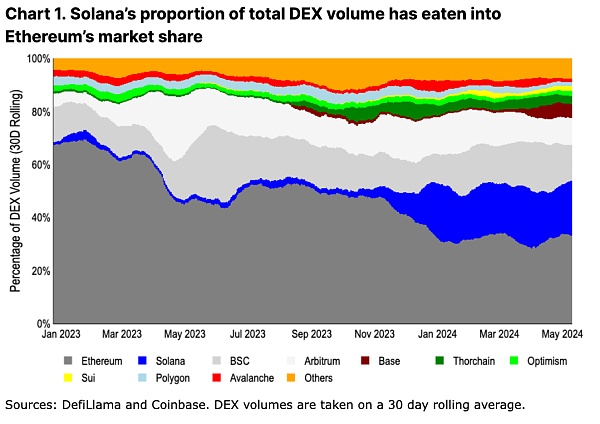
We have observed that these L1s are now more different from Ethereum than in the previous bull market cycle. They no longer rely on the Ethereum virtual machine, and DApps are designed from scratch to create their own unique user experience. In addition, the integrated/holistic strategy adopted by these chains enhances the synergy between different applications and solves problems such as poor user experience and dispersed liquidity during the bridging process.
While these unique value propositions are critical, we believe it is too early to judge success based solely on incentive-driven activity metrics. For example, some Ethereum Layer2 user transaction volumes decreased by more than 80% after the peak of the airdrop. At the same time, Solana's share of total DEX volume increased from 6% on November 16, 2023, when the Jupiter airdrop announcement was released, to 17% on the first claim day on January 31, 2024 (Jupiter is the main DEX aggregator on Solana).
As Jupiter still has three airdrops to complete, Solana’s DEX activity is expected to remain high. However, during this period, assumptions about the long-term activity retention ratio are still speculative.
On the other hand, the leading Ethereum Layer2s (Arbitrum, Optimism, and Base) currently account for 17% of total DEX volume, plus 33% for Ethereum itself. This is particularly important when comparing ETH’s demand growth to other Layer1 solutions, as ETH is the base fuel asset in all three Layer2s. In addition, additional demand drivers for ETH in these networks, such as MEV, have not yet been fully developed, leaving room for future demand growth. Therefore, from the perspective of DEX activity, this provides a more commensurate comparison of integrated vs. modular scaling approaches.
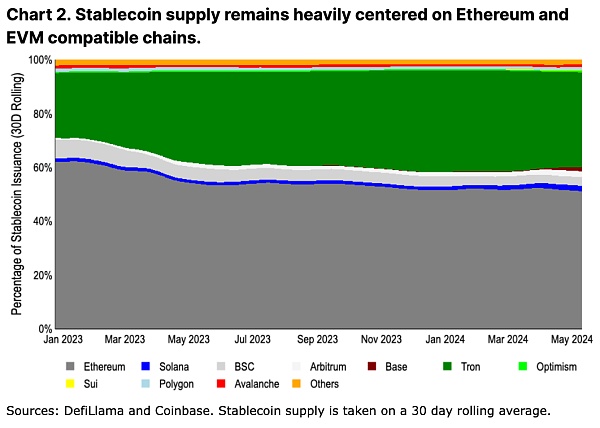
In addition, another more persistent indicator of network adoption is the supply of stablecoins. The circulation and issuance/redemption of stablecoins are subject to bridge restrictions, so their movement is slower.
Activity remains concentrated on Ethereum, as measured by stablecoin issuance. We believe that many emerging chains are not yet trustworthy and reliable enough to support large-scale capital, especially capital locked in smart contracts. Large capital holders tend to be less sensitive to Ethereum's higher transaction fees (relative to transaction size) and prefer to reduce risk by reducing liquidity outage time and minimizing bridge trust.
In fact, stablecoin supply is growing faster on Ethereum L2 than Solana. Arbitrum has surpassed Solana in stablecoin supply since the beginning of 2024 (currently $3.6 billion vs. $3.2 billion in stablecoins, respectively), while Base has grown its stablecoin supply from $160 million to $2.4 billion so far this year.
While the final verdict on the scaling debate is far from clear, early signs of stablecoin growth may actually be more beneficial to Ethereum Layer 2 rather than other Layer 1 chains.
The booming development of Layer2 technology has sparked discussion: Layer2 reduces the demand for Layer1 block space (thereby reducing the amount of ETH destroyed as transaction fees), and may also support non-ETH gas fees in its ecosystem (further reducing ETH destruction).
However, in-depth analysis shows that the impact of this situation on ETH is not negative.
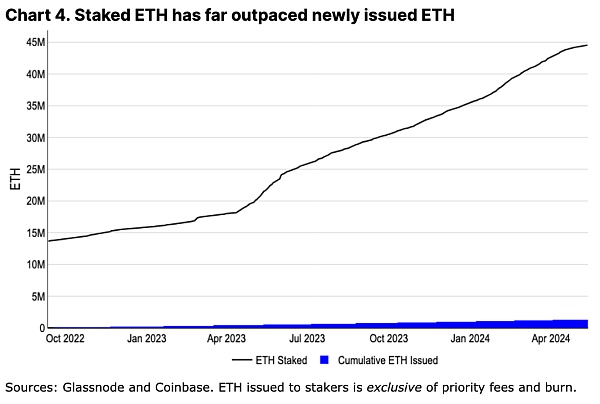
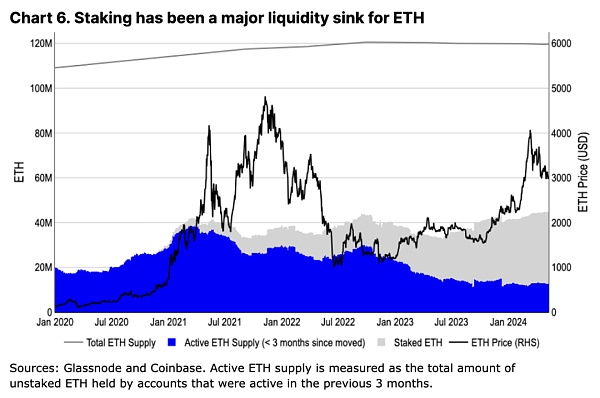
ETH has seen its highest annualized inflation rate since Ethereum switched to PoS in 2022. While inflation is often considered a structurally important component of BTC supply, we do not believe this is true for ETH. In essence, all newly issued ETH is allocated directly to stakers, and these stakers’ ETH holdings are growing at an alarming rate, far exceeding the rate of issuance. Unlike the Bitcoin mining economy, where miners need to frequently sell BTC to maintain operations, ETH’s low staking cost allows stakers to accumulate ETH over the long term without having to sell.
At the same time, staking has become a magnet for ETH liquidity, and the growth rate of staking ETH is more than 20 times the speed of ETH issuance.
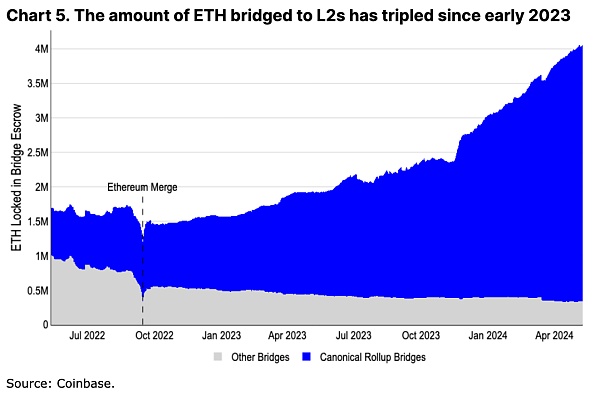
The rise of Layer2 has further exacerbated ETH's liquidity crunch. More than 3.5 million ETH have been migrated to Layer2, which not only directly transferred ETH, but also prompted users to prepare ETH as a reserve for Layer2 transactions, which is equivalent to locking up ETH in disguise.
Although the Layer2 ecosystem is growing, core financial services and governance activities such as EigenLayer re-staking, Aave, Maker, Uniswap, etc., still rely on Layer1, ensuring the fundamental demand for ETH. In particular, those large fund holders who value security the most are more inclined to stay in Layer1 before Layer2 fully realizes decentralization and permissionless fraud proof, which also supports the market demand for ETH.
In summary, the development of Layer2 has not weakened ETH, but has promoted the appreciation of ETH in a complex way. It is not only a driver of the growth of ETH demand, but also strengthens the core value of ETH by increasing the application scenarios of ETH and serving as the basic unit of Layer1 fees and Layer2 pricing.
Advantages of Ethereum
In addition to the common data-driven narratives, we believe Ethereum has other, harder to quantify but still very important advantages. These may not be short-term tradable narratives, but rather represent a set of core advantages that can sustain its dominance over the long term.
High-quality mortgage assets and pricing benchmarks
ETH plays a core role in the DeFi field. It is widely used in L1 and L2, serves as a low-risk collateral in lending platforms such as Maker and Aave, and is also a basic trading pair in many DEXs. With the expansion of DeFi applications on L1 and L2, the demand and liquidity of ETH have also increased.
Although BTC is recognized as the primary store of value asset, WBTC, which is used in a packaged form on Ethereum, involves additional trust bridging issues. At present, it seems unlikely that WBTC will replace ETH's position in Ethereum DeFi - the supply of WBTC has been stable for a long time, more than 40% lower than the previous peak. On the contrary, ETH's value and role are becoming increasingly prominent due to its wide applicability in a diverse secondary ecosystem.
Ethereum community continues to innovate and decentralize
Ethereum is unique in that it has maintained strong innovation capabilities while continuously advancing decentralization. Ethereum is sometimes criticized for delaying upgrade plans, but it does not fully recognize the difficulty of coordinating technical progress among many developers from different backgrounds.
It is important to understand that in order to ensure uninterrupted operation of the network, teams involving more than five execution clients and four consensus clients must work closely together to promote updates.
For example, since Bitcoin's major upgrade (Taproot) in November 2021, Ethereum has achieved a series of changes: including the introduction of dynamic transaction fee destruction (August 2021), the successful transition to PoS (September 2022), the opening of the deposit withdrawal function (March 2023), and the addition of Blob storage to L2 (March 2024), and many other technical improvement proposals (EIPs) have been introduced. In contrast, some other rapidly developing blockchain platforms, although they iterate quickly, are more centralized and fragile due to their reliance on a single client.
Although decentralization will make the decision-making process more cumbersome and even rigid to a certain extent, it is also a necessary price to pay to ensure security and fairness. For other ecosystems that may embark on a similar path of decentralization in the future, whether they can establish a development model that is both efficient and inclusive of opinions from all parties remains a challenge to be solved.
Rapid advancement of L2 innovation
This is not to say that innovation on Ethereum is slower than other ecosystems. On the contrary, we believe that innovation around execution environments and developer tooling is actually outpacing the competition. Ethereum benefits from rapid centralized development of L2s, all of which pay settlement fees to L1s in ETH. The ability to create diverse platforms with different execution environments (such as WebAssembly, Move, or the Solana virtual machine) or other features such as privacy protection or enhanced staking rewards means that the slower development timeline for L1 does not hinder ETH's adoption for more technically comprehensive use cases.
At the same time, the Ethereum community has enhanced the transparency of the industry by clarifying various trust premises and definitions when defining concepts such as sidechains, Validium, and Rollup. In contrast, similar efforts (such as the L2 Beat project) in the Bitcoin L2 ecosystem are not significant, and the trust models that L2 relies on are diverse and often not clearly understood or fully communicated to the outside world.
EVM’s widespread adoption
Innovation around new execution environments does not mean that the Solidity language and EVM will become obsolete in the short term. On the contrary, the EVM has been widely spread to other blockchains. For example, the research results of Ethereum L2 are being adopted by many Bitcoin L2. Some shortcomings of Solidity (such as its susceptibility to reentrancy vulnerabilities) now have static tool checkers to prevent basic attacks. In addition, the popularity of the language has spawned a mature auditing industry, a large number of open source code examples, and detailed best practice guides, which are essential for cultivating a large developer talent pool.
While direct use of the EVM does not necessarily increase demand for ETH, improvements to the EVM are a result of Ethereum's development process, and other chains will follow suit to maintain compatibility with the EVM. We believe that fundamental innovations in the EVM will continue to be Ethereum-centric or will soon be absorbed by an L2, thereby consolidating the Ethereum ecosystem's position in the minds of developers.
Tokenization Trend and Cumulative Advantages
We believe that the promotion of tokenization projects and increasingly clear global regulatory policies will first benefit Ethereum (among public chains). Financial products are usually more concerned with technical security rather than extreme optimization, and Ethereum has a natural advantage as the most mature smart contract platform. For many large tokenization projects, relatively high transaction costs (several dollars instead of a few cents) and long confirmation times (several seconds instead of milliseconds) are not major obstacles.
For traditional enterprises that want to enter the blockchain field, it is crucial to have a sufficient number of skilled developers. At this time, Solidity, as the most widely used smart contract language, has become the first choice, which further strengthens the popularity of EVM. Blackstone's Ethereum BUIDL Fund and JPMorgan Chase's proposed ODA-FACT standard compatible with ERC-20 are early signals of attention to this developer group.
Ethereum supply dynamics are very different from Bitcoin
The changes in ETH's circulating supply are fundamentally different from BTC. Even with the sharp price increase since Q4 2023, ETH's three-month liquid supply has not expanded significantly, while BTC's active supply has increased by about 75% during the same period. Unlike the previous Ethereum mining period (2021/2022) when long-term holders increased market supply, more and more ETH is now being used for staking, indicating that staking is an important way for ETH to reduce selling pressure.
Evolution of the trading landscape
Historical data shows that ETH is more closely related to BTC than any other crypto asset. However, during bull market peaks or specific Ethereum ecosystem events, ETH will briefly decouple from BTC, a pattern that is also reflected in other crypto assets, but to a lesser extent. This reflects the market's relative evaluation of ETH based on its store of value attributes and technological innovation utility value.
In 2023, a special phenomenon appeared in the correlation between ETH and BTC: when the price of BTC rose, the correlation between the trends of ETH and BTC weakened; when the price of BTC fell, the correlation between the two strengthened.
This suggests that BTC price fluctuations are like a leading signal, foreshadowing the subsequent changes in ETH's market correlation. The market's enthusiasm for the high price of BTC seems to drive the independent trend of other crypto assets (including ETH), especially during market ups, when various asset types perform differently; while when the market is down, they tend to perform in line with BTC.
But this pattern has changed after the United States approved the Bitcoin spot ETF. The newly approved ETF attracted different types of investor groups, such as investment advisors, wealth management institutions, etc., who handle BTC differently from traditional investors in the crypto space.
In pure crypto asset portfolios, BTC is valued because of its low volatility, but in traditional investment portfolios, it is more of a small part of the diversified configuration. The changes in capital flows and market structure caused by the change in BTC's role have affected the trading interaction between BTC and ETH. In the future, if the Ethereum spot ETF is approved for listing, it is expected that ETH will also face similar market structure changes, and its trading model may be adjusted again.
Summarize
We believe that ETH still has potential upside surprises in the coming months. ETH does not appear to have significant sources of supply-side excess such as asset unlocking or miner selling pressure. On the contrary, staking and L2 growth have proven to be meaningful and sustained growth points of ETH liquidity. Given the widespread use of EVM and its L2 innovation, ETH's position as the center of DeFi is unlikely to be replaced. At the same time, the importance of US spot ETH ETFs cannot be underestimated.
We believe that structural demand drivers for ETH, along with technological innovation within its ecosystem, will enable ETH to continue to maintain its unique position across multiple narratives.