The author has worked in relevant overseas institutions, mainly doing risk management at the transaction level. I have also had many direct or indirect contacts with large market makers, project developers, and institutional users.
Recently, there have been a lot of pull-ups for small-market value contracts. I will use my own experience to decipher and discuss with you how project parties, market makers, and large institutional investors jointly make markets in spot and contracts, and why it is unfair competition for retail investors. .
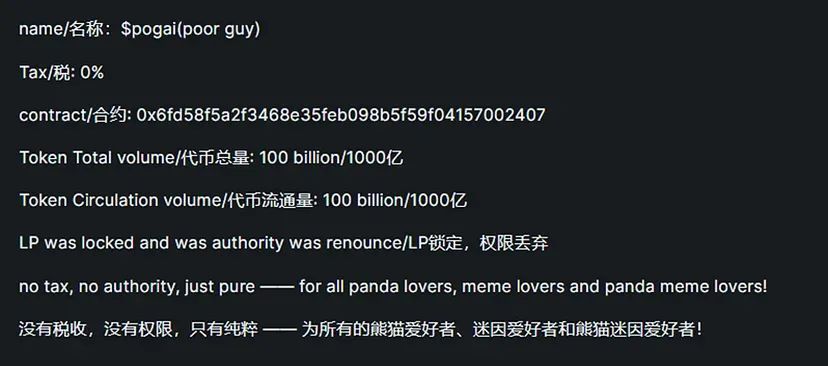
This article is not aimed at $P****. I just randomly picked a project with obviously abnormal data related to the secondary market, so that it is easier to demonstrate.
This article discusses a common strategy for manipulating spot and contract currency prices. It may be the project owner's own market value management team, it may be a professional market maker, or it may be a large hot money investor with a large amount of funds. Therefore, in the following text, we will use the word that everyone prefers to use and collectively refer to it as "Zhuang".
1. Let’s write the simple process first
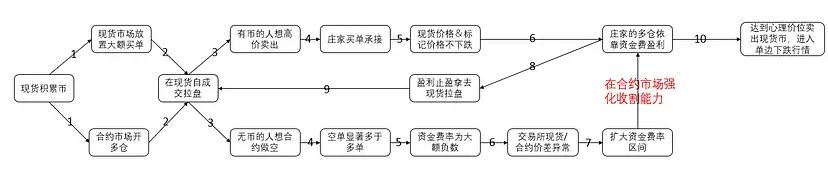
2. Phenomenon
Do you often see the following unreasonable situations on the exchange?
Phenomenon 1: On-chain and spot trading volume is low, but contract trading volume is high
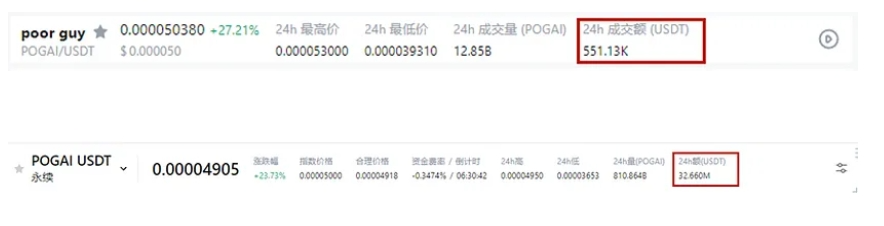
Taking Gate Exchange as an example, the contract trading volume is about 60 times that of the spot trading volume.
Phenomenon 2: Prices are rising but trading volume is gradually declining?
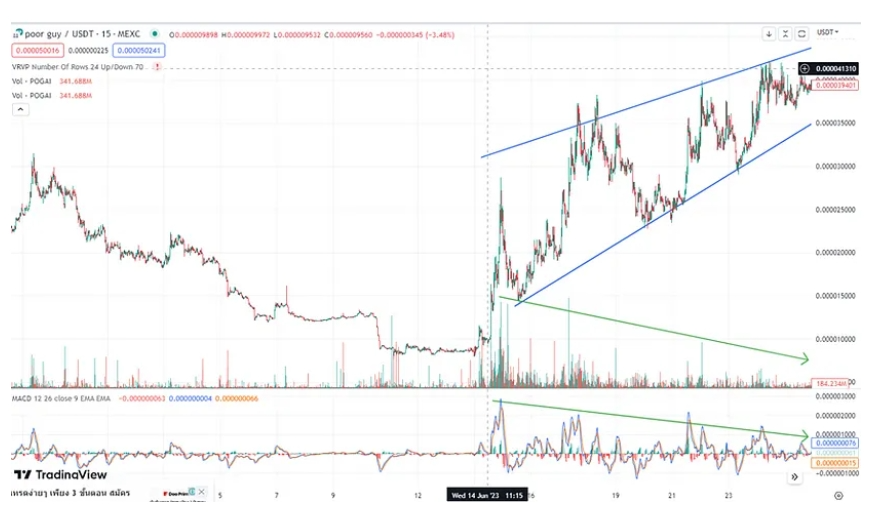
The price keeps rising but the trading volume is getting smaller and the MACD is clearly diverging.
Phenomenon 3: The long-short ratio of spot and contract trading orders is completely opposite, resulting in a negative funding rate
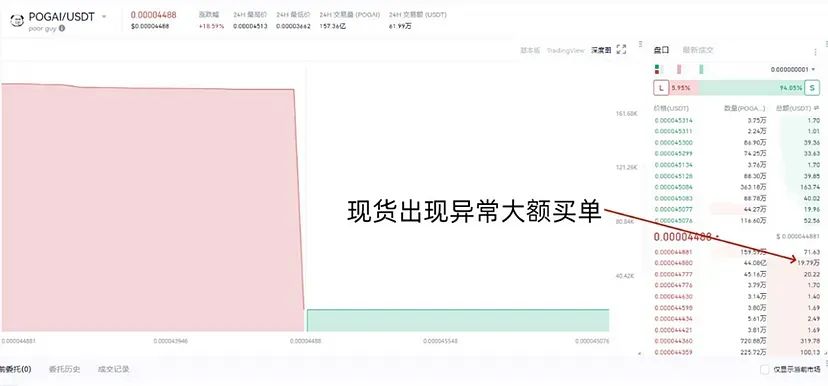
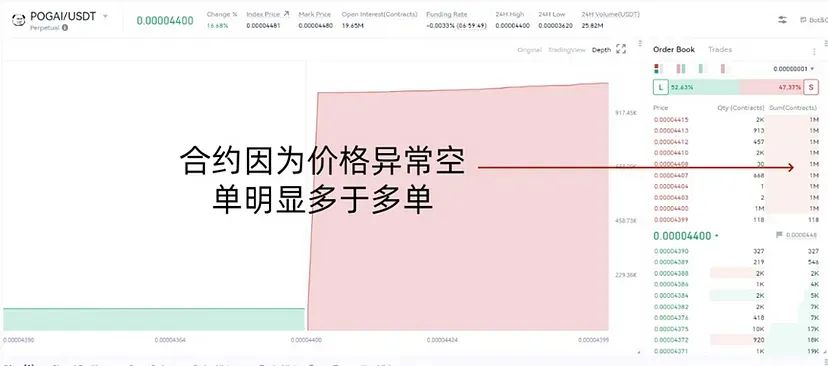
The rising price has caused users to be collectively bearish, but they do not have the coins in hand, so they can only open short orders on contracts. Therefore, the spot and contract markets have completely opposite market sentiments.
Completely opposite market sentiment leads to the funding rate reaching -0.66%, with settlement every 8 hours, so it is -1.98% in 24 hours.

The market is controlled by bookmakers
For example, trading derivatives (contracts) is like buying and selling a house. I am a real estate developer, and my house mainly serves wealthy person A. A bought all my properties at once. Pricing power only exists between me and A. We are the supply and demand parties that will affect housing prices.
Although B is not the homeowner, he believes that the price of this property will fall. Therefore, B spent 1 million to make a bet with A, believing that A will definitely lose money on this investment. Then it is difficult for B to succeed, because the circulation price of the house is controlled by me and A. Only the transaction between me and A will really affect the circulation price. It is enough for me and A to negotiate the transaction price. Then B It is bound to be a loss. The bet between B and A is similar to derivatives trading and will not affect the spot circulation price.
Even if B believes that the inflated house price is actually only worth 1 yuan/square meter, it is impossible to realize because his transaction is not a spot transaction, but a derivatives transaction. Derivatives trading bets on spot prices, so those who control the spot price (Me and A) can determine derivatives trading to a large extent.
In the above example, the real estate developer is the project party, A is the "banker" who controls the spot circulation (may control the spot price), and B is the contract user.
This is why it is often said that naked short selling in the derivatives market is a very dangerous behavior.
3. Some basic contract knowledge that you must know
Knowledge point 1: What are the mark price and latest transaction price of a contract?
A contract has two prices: the latest transaction price and the mark price. When users trade, the latest transaction price is generally used by default. The liquidation uses the mark price. In order to objectively reflect the price situation, the mark price is calculated through an algorithm using the latest spot transaction price of foreign exchanges.
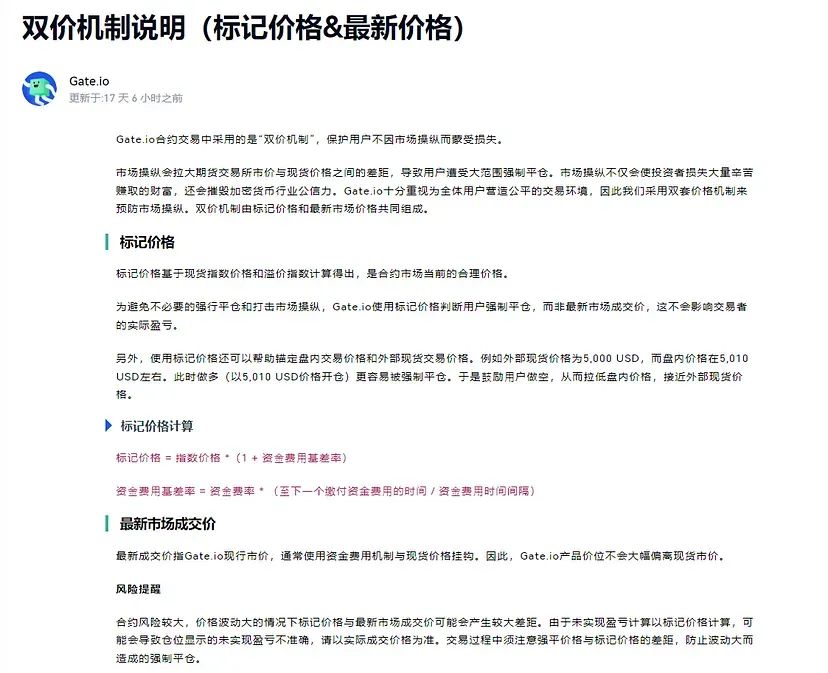
Gate’s contract mark price description:
In other words, as long as the spot price is controlled, the mark price can be controlled, and thus whether the contract market is liquidated.
Knowledge point 2: What is the funding rate of the contract?
In order to prevent the latest transaction price of the contract from being detached from the latest transaction price of the spot, the long position user will hand it over to the short position user in the form of capital fee every 8 hours, or the short position user will hand it over to the long position user, and the latest spot price will be transferred to the long position user. The gap between the transaction price and the latest transaction price of the contract narrows.
Knowledge point 3: What is the circulating market value of a project?
The economic mechanism of a project depends on the white paper. Generally, they are divided into project parties, early investors, community airdrops, project treasury, etc. If the white paper of a project is not transparent enough, it is more likely to be manipulated.
For example, although the white paper gives enough freedom to the community, it also gives enough freedom to market makers/large institutional investors - they can freely obtain low-price chips at low prices, and once obtained, they cannot be diluted because there is no additional issuance. Or a linear unlocking mechanism.
4. Small market value contract control process
Step 1: Find a project with a relatively small circulating market value and open a contract on CEX
Generally, small projects with a circulating market value of 1~10M USDT are selected, and the contract leverage is generally 20~30 times.
Step 2: Prepare funds, funds > external circulation market value
Million-level hot money investors prefer to be the banker in small-market value contracts. Take $P**** as an example, with a circulating market value of 5M. During the long decline, if the dealer obtains 60% of the circulating quantity at a low price, then it only needs to prepare 2M USDT and 3M coins in hand to fully control the spot and contract prices of this coin.
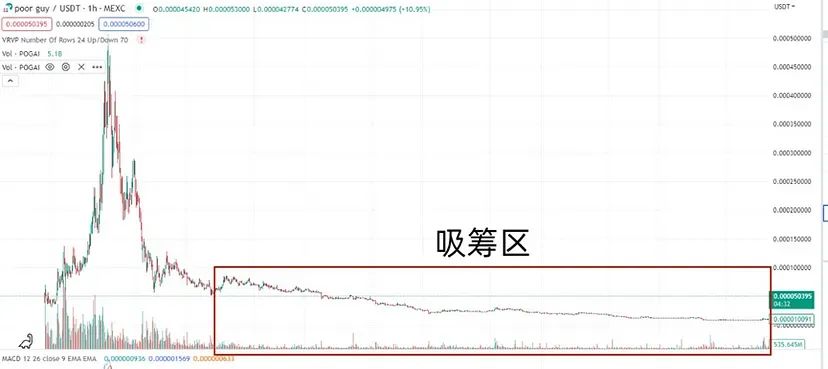
Step 3: Control the spot price
As long as 3M coins are not sold, a maximum sell order of 2M will appear in the spot market. So as a "bookmaker" who wants to manipulate currency prices, you will need to prepare 2M USDT first as funds to maintain the spot price.
Obviously, even if all $P**** except in the hands of the "banker" are sold at the same time, the price will not fall.
Step 4: Control the contract mark price
As mentioned earlier, the marked price of the contract is the spot price of each exchange, which means that the marked price of the contract does not move.
Step 5: Open a long position on the contract
After ensuring that the mark price is under control, use your own funds to open any leveraged position in the contract. If you are prudent, you can open a little lower, if you are aggressive, you can open a little higher - it doesn't matter, anyway, the mark price has been controlled, and the dealer's long position will never be liquidated.
Step 6: Use funds to pull the market or use small counterparties to trade
For coins with poor depth and small market capitalization, it doesn’t take much capital to pull 100% of the spot price in one day. If you can't pull it up, then open a small account yourself and place a high sell order at a price of +100%. After the transaction is completed, it will naturally be displayed as the currency's recent 24 H increase or decrease of +100%.
After seeing this news, retail investors will pour in and start to generate a large amount of short demand.
Step 7: Use funding rates to make money stably
There are very few sell orders in the spot order book at this time, but there are many short in the contract. This causes the spot price to be higher than the contract price, resulting in a negative funding rate. The larger the gap, the more negative the funding rate is, which means that even if the mark price remains unchanged, the short side will have to pay a high funding rate to the long side every 8 hours just for holding a position.
Under this game mechanism, the dealer continues to make money by relying on the funding rate. To give a more extreme example, SRM can earn 16% every 24 hours by just holding the position.
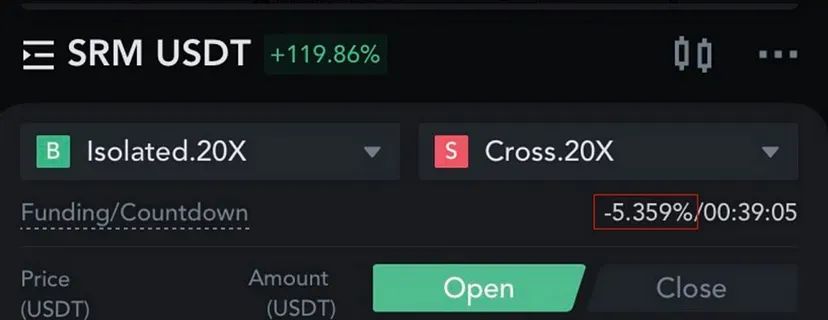
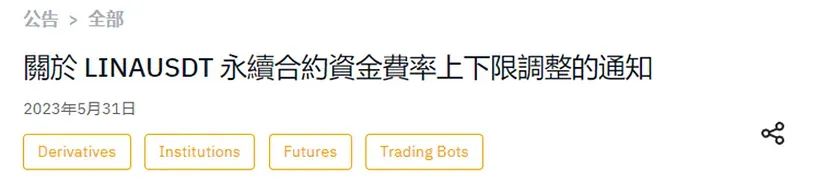
Coincidentally, exchanges have recently frequently revised funding rates to help narrow the price gap between the spot market and the contract market. However, they have not found the root cause of the abnormal funding rate. Expanding the rate range will not solve this problem. Instead, it will help project developers/market makers/large institutional investors use funding rates to harvest retail investors.
Adjust LINA funding rate
Adjust MTL funding rate
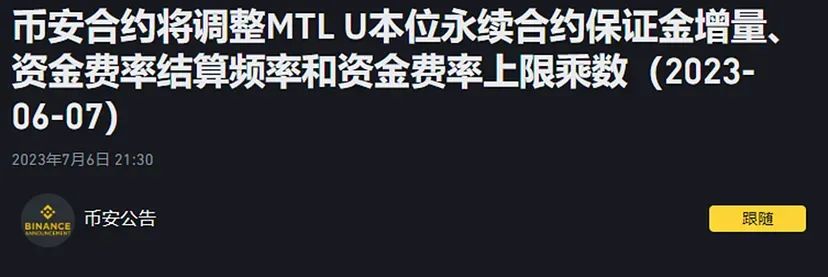
You will also find that LINA and MTL were the demon coins that pulled the market some time ago, and the contract funding rate showed a large negative number.
5. How do bookmakers make profits?
The first profit point : buy low and sell high on spot.
Please remember that being a banker is not a charity. The currency you buy is not gold or BTC. In the end, you must sell it to make a profit. The so-called pump is for subsequent dump.
The second profit point : contract funding rate.
The third profit point : Take the coins you don’t want to sell and directly lend them to the leveraged lending market. For example, Gate can be placed in Yubibao to obtain an annualized rate of return of 499%+.

After reading the process, everyone can also find that the prerequisite is to control the circulation of current currency. If it is a coin with a large number of linear unlocking mechanisms, it cannot be manipulated for a long time. Each unlock changes the amount in circulation.
6. What’s the problem?
Question 1: Can the contract Open Interest (open position) exceed the spot circulation market value?
The contract only requires USDT to open a position, while the spot requires coins to sell. The difficulty of obtaining coins to form selling pressure in the spot market is different from that of short in the contract market.
Returning to the third step of the third part, the user who is the banker has already withdrawn the coins into his own hands. Even if some users believe that the currency is seriously overvalued, they will not be able to form selling pressure on the spot market. At this time, the user will switch to short the contract. In other words, the user's trading tendency cannot be released in the spot market due to the problem of low circulation, but can only be short in the contract market.
Back to the marked price in part two. The marked price of the contract is the latest spot transaction price, which has been controlled by the project developer/market maker/large institutional investors. Therefore, how the contract liquidates its position has also been controlled.
Therefore, when contract OI > spot circulation market value, it means that users’ transaction needs cannot be reflected in the spot price due to the scarcity of the currency. The extra contract OI will aggravate the phenomenon of spot price deviation.
Question 2: When the funding rate is abnormal, can expanding the upper and lower limits of the funding rate really promote fairness?
The current solution for exchanges is to expand funding rates, which ostensibly solves the problem of price differences between spot and contract markets, but actually expands the ability of project developers/market makers/large institutional investors to harvest retail investors. Generally, the current funding rate range of exchanges is [-2%, +2%]. Further expansion will actually increase the profits of the "bookmaker".
Therefore, although the existing funding rate mechanism helps the derivatives market price anchor the spot market price, it does not help the trading market become fair. On the contrary, it may make the trading market become more unfair.
7. How to avoid risks as a retail investor
Note 1: Be wary of projects with small market capitalization but high-leverage contracts. Giving large investors a very unequal competitive advantage over retail investors
When the user chooses to follow the spot buying and open long contract, enough buyers have been accumulated for the project developer/market maker/large institutional investors, and they can ship the goods in batches and start harvesting retail investors again.
Note 2: Projects with higher absolute value of funding rate
Note 3: The banker does not do charity, and the final cost of pulling the market is to make a profit by selling the market.
Escape early and be careful to become the dealer's taker. When the idea of "this currency is a value currency and I want to hold it for a long time until the next bull market" appears, it is not far from the banker's decision to sell it. His purpose in pulling the market is to cultivate this user mentality and take over the market for himself.
Playing against the dealer in the small-capitalization contract market is like playing Texas hold'em poker with him. He is both a player and a dealer.