The S&P 500 has been on a tear in recent months. Tech stocks have been soaring, pushing the index to new highs time and again. Especially this past Tuesday, with a strong push from AI and big tech earnings, the S&P 500 index spiked to 5,796.80, setting a new record high. The market is filled with optimism, and investors' joy is almost spilling off the screen.
VX: TTZS6308
In stark contrast to the stock market's revelry, Bitcoin has been languishing. As the "king" of the crypto world, Bitcoin's performance has been lackluster. Prices have been oscillating between $50,000 and $65,000, far from the dizzying heights of the bull market peak.

Especially after the release of the CPI data by the Federal Reserve last night, Bitcoin experienced significant volatility. The data showed that the unadjusted CPI in the US for September was 2.4%, the sixth consecutive month of decline, reaching a new low since February 2021. After this data release, the S&P 500 dipped slightly during the session but then quickly rebounded, largely unfazed. However, Bitcoin prices briefly dipped below $59,000.
Macro market liquidity remains ample, and economic data is bright, boosting investor confidence, but Bitcoin prices have failed to rebound in sync. There was a time when Bitcoin and the S&P 500 were virtually in sync, rising and falling in tandem. But now, the S&P 500 has soared, while Bitcoin remains stagnant, trapped in a wide range. Why isn't Bitcoin rising with the US stock market?
AI and Tech Stocks Steal the Spotlight: A Chill in the Crypto Realm
In 2023 and 2024, AI has become the "new darling" of the capital markets. Generative AI has exploded, with tech giants continuously rolling out new AI technologies, products, and applications. Market expectations for future technology are at an all-time high, and capital is pouring into the tech sector. Against this backdrop, the S&P 500 has once again entered an upward trend, setting new highs.
On the Bitcoin side, while there have been developments in technologies like Layer 2 and the Lightning Network, it has failed to capture the market's attention like the AI sector. Investors are more willing to allocate funds to tech companies that can deliver faster commercial returns, rather than the relatively mature but lacking in explosive growth opportunities like Bitcoin.
Bitcoin ETF Approved, Whales and Institutions Dominate the Market, but Altcoins Left in the Cold
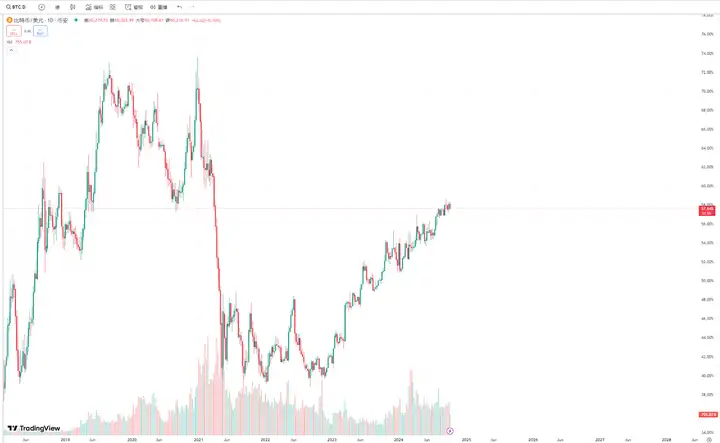
The Bitcoin market dominance (BTC Dominance) has risen to over 57%, while the total market cap of Altcoins has declined significantly. In comparison, at the peak of the 2021 bull market, Altcoins accounted for nearly 70% of the market share.
In January 2024, the Bitcoin ETF was finally approved by the US regulatory authorities, undoubtedly injecting new life into the market. The launch of the ETF has opened the door for traditional financial institutions to enter the Bitcoin market, with whales and institutions becoming the main drivers of market fluctuations.
However, the investment preferences of institutions are very clear: they favor Bitcoin, which has a larger market cap and better liquidity, over the riskier and less liquid Altcoins in the market. This has directly led to a significant increase in Bitcoin's market dominance, while the liquidity of Altcoins has plummeted. Market interest in Altcoins has gradually waned, and the daily trading volume of many small-cap coins has fallen into a slump.
The rise in Bitcoin's dominance, while seemingly positive for Bitcoin, has actually limited the diversified development of the entire cryptocurrency market. The once-thriving crypto realm, where many contenders vied for supremacy, has now been reduced to Bitcoin as the sole "giant," with the fate of other Altcoins significantly diminished. The decline in liquidity has further darkened the market prospects for Altcoins, and Bitcoin's solitary strength has been unable to lift the entire market out of the doldrums.
At the slightest market disturbance, Bitcoin's price tends to experience violent fluctuations. This volatility is at odds with the stable upward trend of the S&P 500. As a result, we have seen the performance of Bitcoin and the S&P 500 become increasingly divergent in market fluctuations.
Will Bitcoin and the S&P 500 Reconnect in the Future?
The financial market is like an endless game of chess, and the rules of the past may not apply to the future. The changing correlation between Bitcoin and the S&P 500 reflects the shifts in capital flows, regulatory environments, and market preferences. The revelry in the S&P 500 is driven by tech giants leading the AI wave; while Bitcoin, despite the dawn of ETFs, faces the loneliness of forging its own path.
In the future, Bitcoin may once again be seen as a "digital gold" haven in turbulent times, becoming a safe harbor for capital; or it may continue to oscillate between high volatility and regulatory challenges. Whether it can once again march in step with the traditional market or continue on an independent path depends on the attitudes of capital, the pace of innovation, and the choices we make in the ever-changing market.