1. What does Stripe's largest acquisition of Bridge mean for the crypto industry?
Stripe is one of the world's largest online payment service providers and processors, helping businesses accept online and in-person payments through its developer-friendly APIs. In 2023 alone, Stripe processed over $1 trillion in transactions, with adoption second only to ApplePay.
Last month, Stripe made a major acquisition, purchasing the stablecoin platform Bridge for $1.1 billion, the largest crypto acquisition in history.
Recent crypto M&A activity, such as Robinhood's $200 million acquisition of Bitstamp, is starting to reflect the growing demand from tech/fintech giants for compliant 2B and 2C crypto businesses with established user bases. Bridge is no exception.
You may have noticed that the adoption of stablecoins has been skyrocketing globally. According to a report by a16z, stablecoin transaction volume reached $85 trillion in Q2 2024, more than double Visa's $39 trillion during the same period.
Stripe sees the potential in stablecoins as the perfect medium to facilitate smooth and efficient asset conversion. While Bridge only generates $10-15 million in annual revenue, Stripe paid nearly 100x the premium to acquire the company. This highlights that Stripe's motivations are not just about Bridge's current revenue, but also the compliance, partnerships, and technology that Bridge can bring to Stripe's ecosystem.

2. What is Bridge?
Bridge is a stablecoin platform that allows businesses or users to transfer tokenized US dollars using blockchain. Users can purchase crypto with fiat by wire/ACH transfers to whitelisted banks, or sell crypto for fiat by sending assets to designated wallets. It also provides custodial wallets to help businesses accept, hold, or transfer stablecoins through a set of simple APIs.
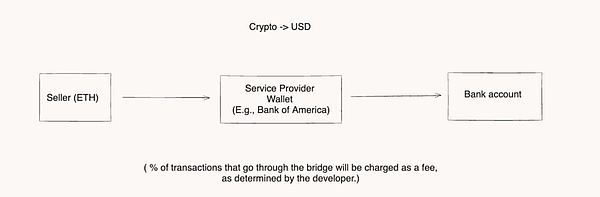
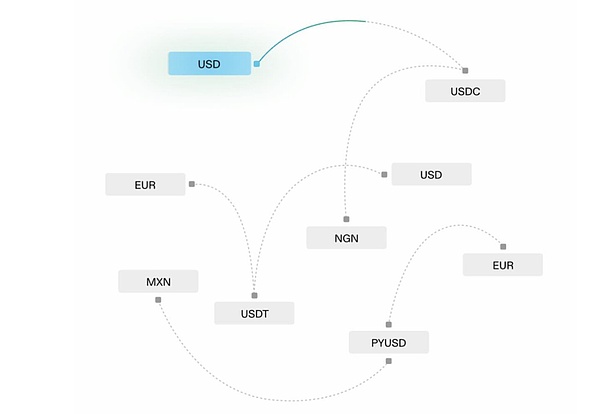
Behind the scenes, Bridge handles KYC, regulatory compliance, etc., enabling businesses to easily integrate and start accepting crypto as a payment method. Currently, Bridge supports USD/EUR as fiat payment options and accepts 5 different stablecoins across 9 different chains.
On the team, Bridge's founders Zach Abrams and Sean Yu previously worked at Coinbase as the head of consumer products and a senior engineer, respectively. Prior to the acquisition, Bridge had raised a total of $58 million from various venture firms, with around $40 million coming from Sequoia Capital, indicating investors' confidence in the product even before the acquisition.
2.1 Bridge's Advantages and Moat:
Bridge is not the first product to solve the cross-border transaction service problem. In fact, Ripple (XRP) has been providing cross-border remittance and payment services for the past 3 years, but it relies on its own currency as the medium, requiring users to bear the downside risk of the currency. However, in an era of more regulated stablecoins like USDC providing greater protection and resilience, such solutions are now outdated. Bridge solves this problem in a more efficient and compliant way.
2.2 Compliance and Partnerships
Bridge's strength lies in its achieved compliance and partnerships. First, according to Sequoia's report, Bridge complies with all US and European financial regulations and anti-money laundering laws, holds money transmitter licenses in 22 states, and collaborates with the US State Department and Treasury for asset transfers. Before integrating with Bridge, businesses need to provide ownership and incorporation documents to prove their credibility. For more details, please refer to the following documents: Bridge
As SY Lee, the founder of Story Protocol, points out, content businesses often lack network effects, forcing them to rely on massive content production and marketing budgets to sustain themselves. This overwhelming bargaining power makes it difficult for smaller IPs to be profitable, often leading to their failure even before launch. Even large IP studios are hesitant to develop new IPs, instead choosing to focus on expanding existing IPs.
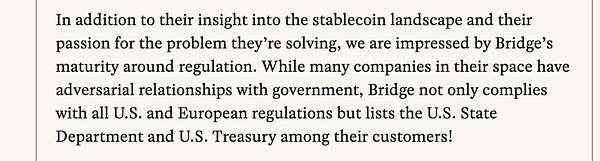
The credibility and reputation that Bridge gains from its compliance will significantly improve and expand its business channels, as evidenced by their recent collaboration with SpaceX, where Bridge will be used for stablecoin management in their global financial operations (source: Ledger).
In addition to compliance, Bridge also allows businesses to customize and issue stablecoins using Bridge's orchestration APIs, with the underlying USD invested in US Treasuries to earn a 5% yield or kept idle. This provides possibilities for enterprises and even CBDCs to create and customize their tokenized USD, with all reserves held in cash and Treasuries within Bridge, while still adhering to compliance.
2.3 Use Cases of Bridge:
2.4 In Today's Payment Solutions:
The global demand for electronic payment solutions is rising, with the e-payments industry expected to grow at 9.9% annually, reaching a market size of $90 billion.
Today's digital payment solutions, especially in the US, charge transaction fees as high as 1.5-3.5% (Visa charges 1.5-3.5%, Stripe charges 3.4%, Europe caps at ~0.3%, global payments like PayPal cap at ~2%).
Bridge's fees are expected to be much lower, as they are primarily composed of blockchain transaction fees and developer or issuer fees.
In October, Stripe launched a feature called "Pay with Stablecoins" in its customer checkout product, charging a 1.5% transaction fee. While it is not yet confirmed if this feature was co-created with Bridge, or if the fee was designed by Stripe, it indicates that Bridge as an alternative payment solution could potentially provide a more cost-effective choice for digital payments.
Additionally, data breaches have been a long-standing issue in the traditional e-payments industry. The tamper-proof nature and security of smart contracts can effectively solve these problems. Besides cost savings, Bridge also unlocks access to the $180 billion stablecoin liquidity in the crypto ecosystem, allowing Stripe to extend its influence into the crypto market.
In Underbanked Regions:
Bridge can provide solutions for underserved businesses to hold USD or EUR in custodial wallets, enabling them to establish better systems for remittances, payments, or investment in tokenized dollars based on their needs.
Additionally, financial institutions can start offering more sophisticated structured products, accepting stablecoins as deposits to create more business opportunities by leveraging on-chain funds.
Since these transactions are conducted on the blockchain, the selected chain can also benefit from the associated transaction fees. Therefore, Bridge can enhance on-chain transaction activity and potentially increase the earnings of validators and stakers.
In DeFi:
Businesses can also participate in DeFi to earn additional yields. For example, they can borrow or lend tokenized USD on platforms like Aave to earn interest, or potentially gain returns from crypto investments.
Alternatively, users can provide liquidity for stablecoin pairs on Uniswap V2/V3 to earn trading fees. While DeFi investments come with significant risks, they provide opportunities to maximize the capital efficiency of idle assets.
Given the dominant market positions of USDC and USDT, I believe Bridge's integration can further solidify their role in the evolving crypto landscape.

3.Market Outlook
Until recently, the use cases of cryptocurrencies have been largely hindered by their adoption as payment solutions. However, Stripe's acquisition of Bridge has the potential to change the trend, making crypto payments as seamless and indistinguishable from traditional fiat transactions, and potentially becoming a pillar of the future PayFi.
The largest crypto acquisition in history highlights the clear product-market fit and undeniable utility of stablecoins and the regulated payments industry. Value transfer remains the most prominent use case of cryptocurrencies, with regulated stablecoins emerging as the primary medium for payments.

4. Key Takeaways
Bridge is a stablecoin platform that enables businesses and users to transfer, hold, and pay with tokenized US dollars using blockchain technology. Bridge manages all compliance and regulatory matters behind the scenes.
The advantage of Bridge lies in its compliance and established partnerships. It complies with all U.S. and European financial regulations and anti-money laundering laws, and collaborates with reputable partners such as the U.S. Department of State and the Treasury Department.
Due to the economic security provided by the U.S. dollar, regions that cannot directly access the financial system can greatly benefit from Bridge.
Enterprises can now participate in DeFi and maximize the capital efficiency of their idle assets. Bridge serves as a conduit to inject more capital into stablecoins, which is expected to promote the overall DeFi economy.
Compared to today's electronic payment solutions, lower fees, faster settlement, and data security are some of the main advantages of blockchain. Bridge has the potential to replace or become a better alternative to the current payment systems.