Tokyo is definitely one of the most favorite cities for Web3 industry practitioners, as the city can satisfy your 360-degree desires. When we go on a business trip to a city, if the city can also provide you with the enjoyment outside of work, it would be great. And Tokyo is definitely such a city.
The main reason why TEAMZ Summit chooses to be held in April every year is that April is the best time of the year in Japan in terms of climate. Not only is the climate pleasant, but you can also appreciate the very romantic cherry blossoms and feel the pink Tokyo in April. Whether you come with your colleagues to do some work, or bring your family and friends to attend the conference and travel, it is a good plan.
From a business perspective, April is actually the first month after the personnel changes of the Japanese government and domestic companies, so April is the real Q1 (first quarter) of Japan's business activities. The government's decisions and the company's annual development plans are all introduced after April. TEAMZ Summit 2025 will also share and analyze the latest information on the Japanese Web3 industry for the audience, including the national Web3 strategic planning, the regulatory policies of the Financial Services Agency, the tax and support policies of the government, and the latest developments of major companies and communities in Web3.
In addition, it is worth mentioning that the 2025 World Expo (EXPO 2025) will open in Japan on April 13, 2025. This World Expo is themed "Designing Future Society for Our Lives", aiming to explore the future of global sustainable development through innovation and cooperation. Everyone can experience the first wave of Expo 2025 before and after the TEAMZ Summit, which is a great opportunity.
If these are not enough to motivate you to come to Tokyo for TEAMZ Summit 2025, let's take a closer look at the current state of the Japanese Web3 market and the highlights of the TEAMZ Summit 2025.
Current State of the Japanese Web3 Market
National Level
Web3 is seen as an important part of the national strategy and is positioned as a key task in promoting economic development. At the same time, in order to achieve the healthy development of the crypto asset industry, institutions such as the Financial Services Agency and the Digital Agency of Japan are actively promoting the regulation of cryptocurrencies and the reform of the tax system.
Cryptocurrency Tax Policy Reform:
1. Unrealized Profit Exemption: From April 2024, Japan will no longer tax the unrealized profits of cryptocurrencies held by companies. Previously, companies needed to pay taxes on the unrealized gains of their crypto assets at the end of the fiscal year based on the market value. The new policy stipulates that companies only need to pay taxes on the actual profits from the sale of cryptocurrencies.
2. Tax Rate Adjustment: Currently, cryptocurrency trading income is classified as "miscellaneous income" and is subject to a progressive tax rate of up to 55%. There are suggestions to unify the tax rate for crypto assets to 20% to enhance the industry's competitiveness.
Cryptocurrency Compliance Policy:
1. Registration Requirement: According to the "Fund Settlement Act", companies engaged in cryptocurrency exchange services must register with the Financial Services Agency of Japan as cryptocurrency exchange service providers. The service content includes the purchase, sale, or exchange of different types of cryptocurrencies.
2. Self-Regulatory Organizations: Japan has established self-regulatory organizations such as the Japan Virtual and Crypto Assets Exchange Association (JVCEA) and the Japan Security Token Offering Association (JSTOA). Among them, JVCEA is recognized by the Financial Services Agency and is responsible for formulating and managing the operational rules and internal control systems of traders or exchanges, ensuring the compliance of cryptocurrency exchanges.
3. Anti-Money Laundering Measures: Cryptocurrency exchange service providers must comply with the "Act on Prevention of Transfer of Criminal Proceeds", take due diligence measures, and prevent money laundering and terrorist financing risks.
4. Web3 VC License: The Japanese government approved a proposal on February 16, 2024, to allow venture capital (VC) companies to directly invest in cryptocurrencies and Web3 projects. This proposal will include cryptocurrencies in the list of assets that local investment limited partnerships (LPS) can acquire or hold. If this legal amendment is realized, Japanese VCs will be able to invest in projects that only issue virtual currencies, lowering the threshold for Japanese Web3 companies to raise funds and conduct business.
Through the reform and improvement of the above tax and compliance policies, Japan is striving to create a more favorable development environment for the crypto asset industry and promote innovation and growth in the Web3 field.
Large Enterprise and Institution Level
Based on their existing business foundations, many large companies have begun to introduce blockchain technology and use Tokens to provide new user experiences. Typical representatives include SBI, NTT Docomo, Toppan Printing, and NEC.
SBI Holdings Group: Collaborated with TradeFinex to develop a blockchain-based trade finance tool. Collaborated with UBS and DBS Bank to complete the first cross-border repo transaction of a digital bond.
NTT Docomo: Established NTT Digital to promote the application of Web3 technology in individuals and enterprises. Collaborated with Amazon to develop a tokenized asset solution.
Toppan Printing: Developed a blockchain-based supply chain management tool. Collaborated with the National Institute of Information and Communications Technology (NICT) of Japan to research quantum-safe communication technology.
NEC (Nippon Electric Company): Conducted quantum token experiments, exploring the integration of quantum technology and blockchain. Utilized blockchain technology to improve the KYC service quality of financial institutions.
Web3 Startups and Project Level
The number of startups is steadily growing. Japan is known as an "IP powerhouse", with rich cultural assets and world-renowned intellectual property. This advantage provides unique competitiveness for Japanese Web3 startups. Based on their IP advantages, they have launched games, Non-Fungible Tokens (NFTs), and other projects that have attracted global attention. Currently, the market has hundreds of active Web3 projects from Japanese domestic companies, and the number is gradually increasing.
Licensed Cryptocurrency Exchanges in Japan
Overview of Licensed Exchanges:
Since the implementation of the "Fund Settlement Act" in 2017, the Japanese government has required all companies providing cryptocurrency trading services to register with the Financial Services Agency (FSA) to ensure the transparency and compliance of the exchanges. As of now, the number of licensed exchanges has reached 32.
Major Licensed Exchanges:
bitFlyer: Japan's largest cryptocurrency trading platform, supporting spot trading, margin trading, and payment services. Coincheck: Provides a variety of cryptocurrency trading and Non-Fungible Token (NFT) market services, which are popular with users.
SBI VC Trade: Operated by the SBI Group, focusing on serving institutional investors.
Bitbank: Well-known for its high liquidity and support for various trading pairs, providing stable fiat currency exchange services.
Japan's licensing system not only ensures the compliance of the exchanges but also enhances the trust of users in the trading platforms. This environment has attracted more individual and institutional investors to participate, further driving the growth of the market.
Market Trading Volume
The total monthly trading volume of the Japanese cryptocurrency spot market is around 900 billion yen (about $6 billion), occupying an important position in the global market.
Trading Characteristics:
Fiat-to-Crypto Trading Dominates: The trading volume of JPY against BTC and ETH accounts for the majority of the market share.
Mainstream Cryptocurrencies Dominate: The trading volume of Bitcoin (BTC) and Ethereum (ETH) accounts for more than 70%, followed by XRP and other tokens.
Retail Investors are Active: The Japanese market is mainly composed of retail investors, who tend to consider cryptocurrencies as an important part of their asset allocation. At the same time, more and more institutional investors (such as the SBI Group) are trading through compliant exchanges, injecting more capital into the market and significantly increasing the trading volume.
As the scale of the Japanese cryptocurrency market expands, the market demand and development trends are also gradually changing. Cryptocurrencies are no longer just investment tools, and more and more companies are accepting cryptocurrencies as a means of payment, further increasing market demand. In addition, young investors tend to include cryptocurrencies in their asset portfolios, driving the activity of market transactions. With the Japanese Financial Services Agency's plan to simplify the listing process for new tokens, this will bring more trading options to the market and promote the growth of trading volume. More and more exchanges are also trying to integrate Web3 services and the Non-Fungible Token (NFT) market, providing users with more investment choices. Some Japanese exchanges are also planning to connect with overseas markets, and through cross-border cooperation, increase their global market share.User Level
The awareness of cryptocurrencies is constantly increasing. Especially since February 2024, when the US SEC approved BTC and ETH spot ETFs, a large amount of funds (billions of dollars) have flowed into the cryptocurrency asset industry. At the same time, due to media reports, the awareness of cryptocurrencies in Japan has increased significantly. According to data from the Japan Virtual Currency Exchange Association (JVCEA), as of 2024, the number of cryptocurrency asset accounts in Japan has exceeded 10 million, accounting for about 8% of the total Japanese population. This figure indicates that cryptocurrencies have gradually become integrated into the investment portfolios of the Japanese public.Investor Structure:
Young investors dominate: The young generation aged 18 to 35 are the main investors in cryptocurrencies, as they are familiar with digital technology and have a higher acceptance of virtual assets. This generation tends to view cryptocurrencies as part of their asset allocation, seeking investment options different from traditional assets (such as stocks and bonds).
Increase in institutional investors: With the legalization of cryptocurrency assets and the launch of ETFs, institutional investors (such as banks and funds) have also begun to participate in cryptocurrency investment.
The breakthrough of 10 million cryptocurrency accounts in Japan indicates that the Japanese cryptocurrency asset market has entered a mature stage, and its potential market size has further expanded. The compliance and transparency of the market have increased investor confidence, laying the foundation for more capital inflows. User participation is not limited to cryptocurrency trading, but has also driven the development of the Non-Fungible Token (NFT) market, blockchain games, and metaverse-related projects. With the emergence of more compliant exchanges and deeper market education, the number of Japanese cryptocurrency asset accounts is expected to continue to grow, reaching more than 15% of the total population.
Highlights of TEAMZ Summit 2025
As the oldest Web3 conference brand in Japan, TEAMZ Summit will celebrate its 7th edition in 2025. This event is an important platform for connecting Web3 industry resources, sharing market insights, and showcasing innovative achievements. To date, TEAMZ Summit has attracted over 30,000 offline participants, and is expected to attract 10,000 participants in 2025.
Top Speakers and Industry Insights
130 top global speakers: Including industry leaders such as Masato Hiramatsu, the Japanese Minister of Digital, will explore key issues in the Web3 industry in 2025 through keynote speeches and panel discussions. The core topics covered include: the Bitcoin ecosystem, Layer1 and Layer2 protocols, Real-World Assets (RWA), stablecoins, investment environment, compliance, centralized and decentralized exchanges (CEX and DEX), decentralized physical infrastructure networks (DePin), Non-Fungible Tokens (NFTs), blockchain games, and Web3 Dapps. The keynote speeches and discussions will provide attendees with unique insights and practical information on the future development of Web3, making it an unmissable learning opportunity for corporate decision-makers, developers, and investors.
High-Quality Showcase Projects
100 high-quality exhibiting projects: Covering multiple areas, including Layer1, Layer2, RWA, stablecoins, wallets, CEX and DEX, DePin, NFTs, blockchain games, Web3 Dapps, and Web3 service organizations. Providing a platform for participants to gain in-depth understanding of the latest technologies, solutions, and investment opportunities. The exhibiting projects not only showcase cutting-edge industry technologies, but also provide case studies of actual applications, making them an ideal opportunity for technology promotion and collaboration.
Powerful Support
100 top VC firms: Top venture capital firms from around the world will participate in the summit, providing financing and resource support for Web3 startups and innovative projects.
100 community partners: Community support covers multiple areas, providing broad ecosystem support and promotion for Web3 projects.
100 media partners: The conference has received widespread media support, ensuring maximum brand exposure for participating companies and projects.
500 top KOLs (Key Opinion Leaders): Industry experts and opinion leaders from around the world will leverage social media and on-site activities to expand the summit's influence.
100 side events: Including closed-door meetings, salons, and dinners, these diverse activities will further enrich the attendee experience and create more social and learning opportunities.
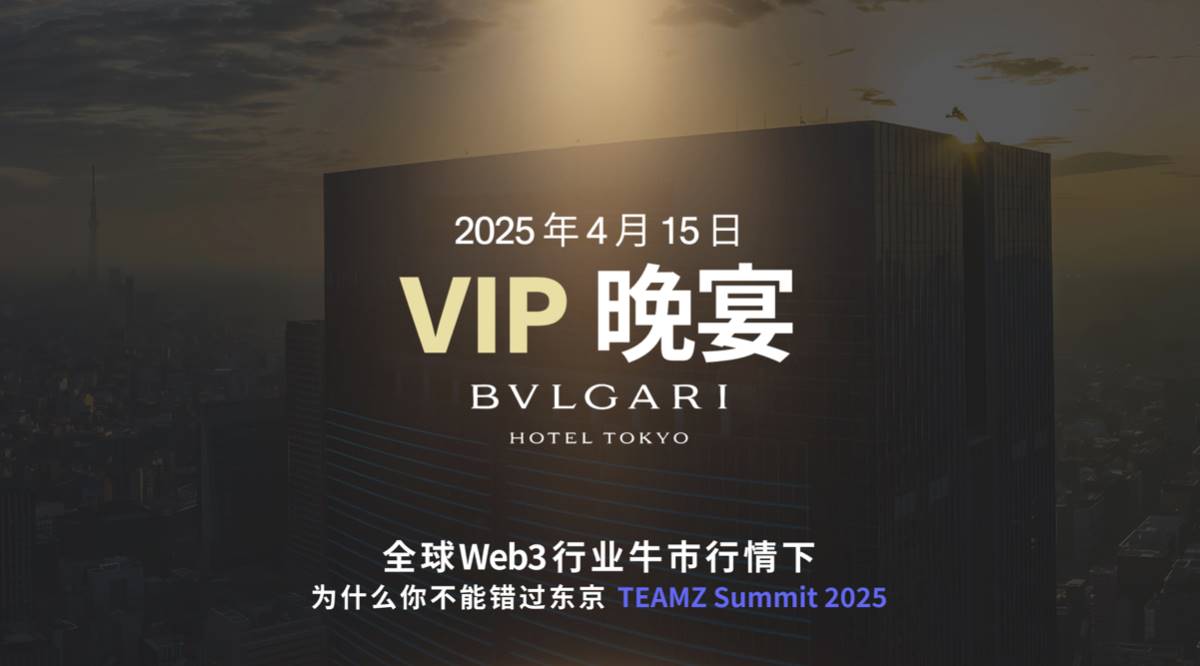
Additionally, TEAMZ Summit 2025 will host a VIP welcome dinner at the Bulgari Tokyo on the evening of April 15, 2025. The summit's speakers, invited guests, sponsor representatives, VCs, community members, and media representatives will connect and network before the start of the conference.
For more information about the summit:
TEAMZ Summit 2025 website: https://web3.teamz.co.jp/en
TEAMZ Summit 2025 sponsorship information: https://www.dropbox.com/scl/fi/iizvfuieg8hjdnwudf00m/TEAMZ-Summit-2025.pdf?rlkey=3h25dvh3bpe4hha1tola7svl1&dl=0
TEAMZ official X: https://x.com/teamz_inc
TEAMZ Summit 2025 ticket purchase link: https://web3.teamz.co.jp/en/tickets-list-2025
TEAMZ Summit 2025 official email: summit@teamz.co.jp