The payment sector today is dominated by gatekeepers who charge high fees, undermining the profitability of every business they touch, and defend these fees in the name of universality and convenience - while stifling competition and limiting the creativity of builders.
Stablecoins can do better.
Stablecoins have lower fees, more competition among payment providers, and broader accessibility. By reducing transaction costs to nearly zero, they can free businesses from the friction of existing alternatives. The adoption of stablecoins will start with the businesses most impacted by the current payment methods, a process that will disrupt the payment industry.
Stablecoins have already become the cheapest way to transfer US dollars. Last month, 28.5 million unique stablecoin users sent over 600 million transactions. Stablecoin users are found in almost every country, using them because they provide a secure, inexpensive, and inflation-resistant way to save and spend. Besides cash and gold, stablecoins are the only widely adopted payment method that can operate without gatekeepers like banks, payment networks, or central banks. Stablecoins are also permissionless, programmable, and scalable - anyone can help build stablecoin payment platforms.
This disruption may take time, but it may happen faster than many expect. Restaurants, retailers, businesses, and payment processors will benefit the most from stablecoin platforms, with significantly higher profit margins. This demand will drive adoption, and as stablecoin adoption increases, their other benefits - permissionless composability and improved programmability - will bring more advantages to on-chain users, businesses, and products. I'll share more reasons and ways in the following, first introducing some background on the payment industry.
The Payment Landscape
• Payment Rails: The technology, rules, and networks that process transactions
• Payment Processors: Operators on the payment rails that facilitate transactions
• Payment Service Providers: Entities that provide access to payment systems for end-users or other systems
• Payment Solutions: Products offered by payment service providers
• Payment Platforms: A suite of related payment solutions covering providers, processors, and rails
Background on the Payment Industry
The payment industry is massive in scale. In 2023, the global payment industry will process 34 trillion transactions worth $18 trillion, generating $2.4 trillion in revenue. Credit card payments in the US alone amount to $5.6 trillion, and debit card payments $4.4 trillion.
Despite its ubiquity and scale, payment solutions remain expensive and complex, and payment applications often obscure the consumer experience. For example, while the front-end of the peer-to-peer payment app Venmo looks simple, the backend hides intricate bank integrations, debit card vulnerabilities, and countless compliance obligations. Payment solutions are often interdependent, increasing complexity, and people still use a variety of payment methods: cash, debit cards, credit cards, peer-to-peer apps, ACH, checks, etc.
The four main metrics for payment products are timeliness, cost, reliability, and convenience.
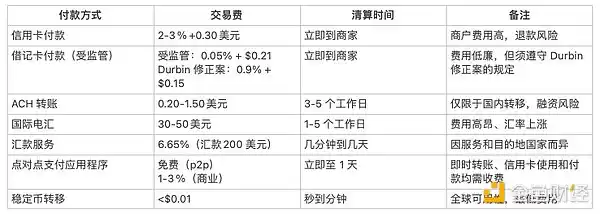
Consumer concerns include "How much will I pay?" and merchant concerns "Will I get paid?", but in reality, all four metrics are essential for both sides.
Since businesses had to scour physical ledgers for fraudulent credit cards, waves of innovation have improved the payment experience. Each wave has brought faster, more reliable, more convenient, and cheaper payment methods, which in turn have driven increases in transaction volumes and spending.
But many customers still don't enjoy modern service or are underserved. For merchants, credit card prices are expensive, directly eroding their profits. While real-time payments (RTP) adoption is growing, bank transfers in the US are still too slow, taking days. And peer-to-peer apps are region and network-specific, making cross-ecosystem transfers slow, costly, and complex.
While businesses and consumers have started to expect payment platforms to provide more sophisticated features, not all users benefit from existing solutions. In fact, most users pay too much for payments and don't use all the bundled payment products. But they have accepted the status quo.
Stablecoins Enter the Fray
The key to stablecoins disrupting the industry is the failure of existing payment solutions (high cost, low availability, or high friction) and the unnecessary bundling of payment solutions (including identity, lending, compliance, fraud protection, and bank integration).
Remittances, for example, were born out of desperation. Many remittance users are underbanked, using highly fragmented banking services. As a result, these users see little value in the native integration between traditional payments and banking services. Stablecoin payments offer instant finality, low cost, and no intermediaries, which are structural advantages for any payment user or builder. After all, with stablecoins, the cost to send $200 from the US to Colombia is less than $0.01, compared to $12.13 through traditional channels. (Remittance users need to send money home regardless of the transaction cost, but the lower fees will greatly benefit them.)
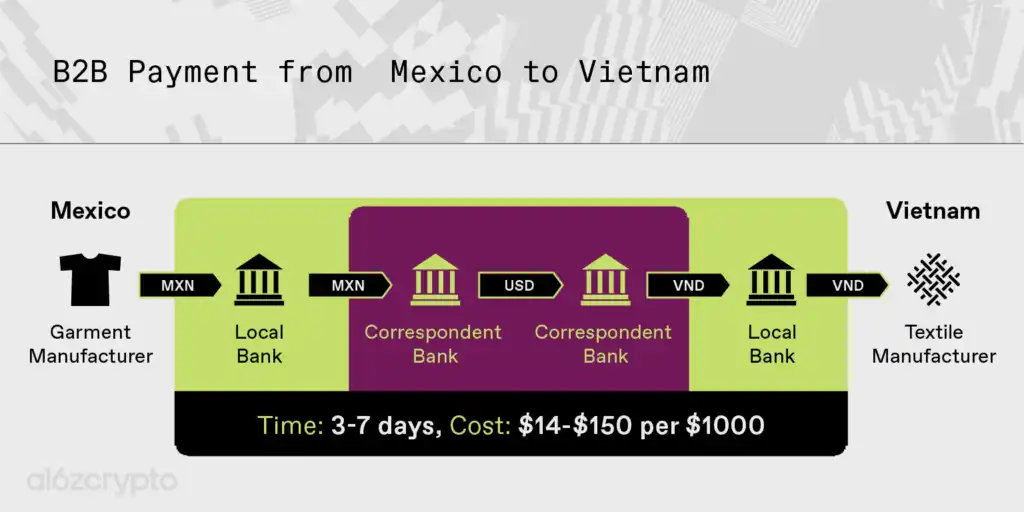
International business payments, especially for small businesses in emerging markets, also face high fees, slow processing times, and low bank support rates. For example, a payment from a Mexican garment manufacturer to a Vietnamese textile producer would involve four or more intermediaries - local bank, forex, correspondent bank, correspondent bank, forex, local bank. Each intermediary takes a cut, and there is a risk of intermediary insolvency.
Fortunately, these transactions occur between cooperating partners. With stablecoins, the Mexican payer and Vietnamese recipient can experiment and eliminate the slow, bureaucratic, and expensive intermediaries. They may need to work to find local channels and workflows, but ultimately they can enjoy faster, cheaper transactions and more control over the payment process.
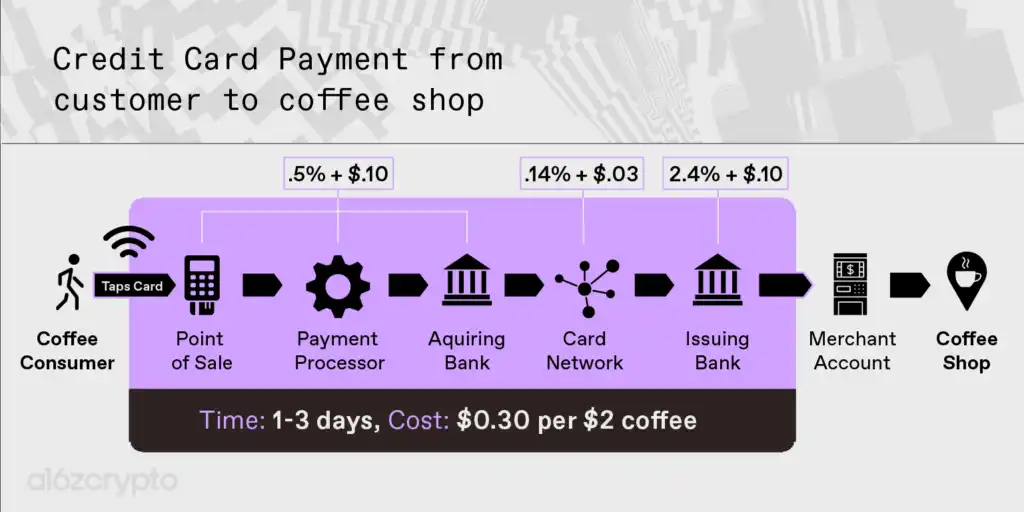
Micro-transactions (especially low-fraud, in-person transactions like those in restaurants, coffee shops, or street-corner stores) are also a promising opportunity. Due to low profit margins, these businesses are cost-sensitive, so a 15-cent transaction fee from a payment solution has a significant impact on their profitability.
If a customer spends $2 on a coffee, only $1.70 to $1.80 goes to the coffee shop, with the remaining nearly 15% going to the credit card company - just to facilitate the transaction. But credit cards are only for convenience: neither the consumer nor the store needs additional features to justify the charges. Consumers don't need fraud protection (they're just getting a cup of coffee) or lending (coffee costs $2). And the compliance and bank integration needs of the coffee shop are limited (they typically use an all-in-one restaurant management software or none at all). So if there's a cheap, reliable alternative, these businesses will use it.
Cheaper Payments Can Boost Profitability
The current payment system's transaction fees directly harm the profits of many businesses. Reducing these fees will bring massive profitability. The first shoe has dropped: Stripe announced they will charge a 1.5% fee for stablecoin payments, 30% lower than their credit card payment fees. To support this effort, Stripe announced the acquisition of Bridge.xyz for around $100 million.
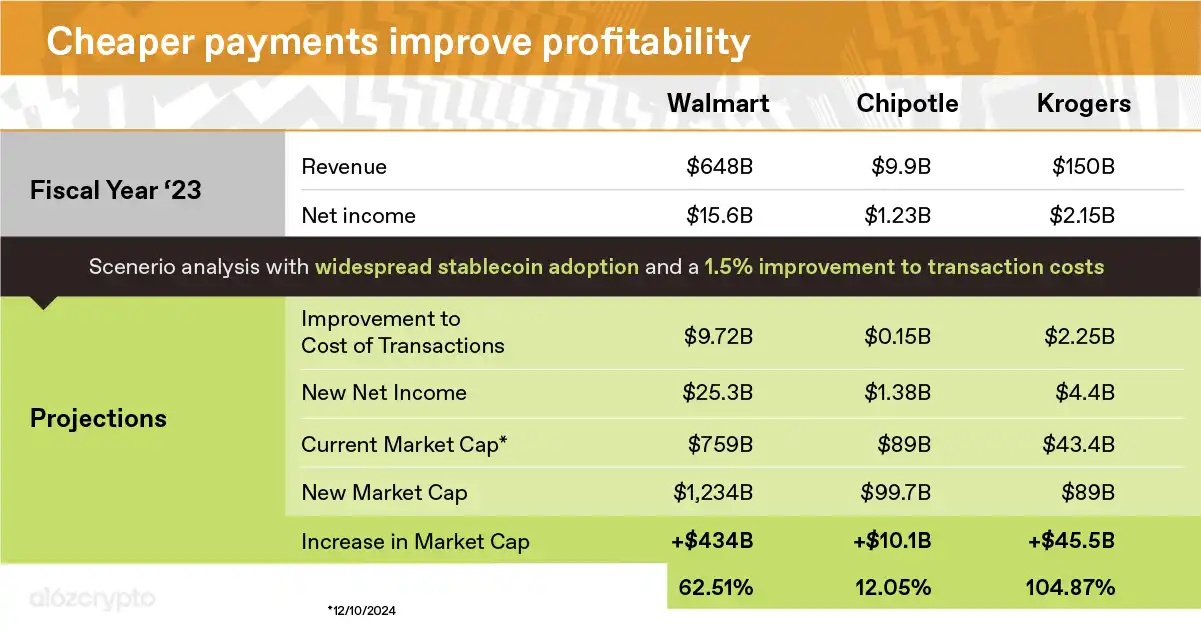
The widespread adoption of stablecoins will significantly improve the profitability of many businesses, not just small businesses like coffee shops or restaurants. Let's look at the financial performance of three publicly traded companies in the 2024 fiscal year to get a rough idea of the impact of reducing payment processing fees to 0.1%. (For convenience, this assessment assumes that the companies pay a 1.6% blended payment processor cost and that the cost of deposits and withdrawals is very low. For more information on this, please see below.)
· Walmart, with an annual revenue of $648 billion, may pay $10 billion in credit card fees, with a profit of $15.5 billion. Let's do the math: Considering the elimination of payment fees and Walmart's profitability, its valuation (controlling for all other factors) could increase by more than 60% through a cheaper payment solution alone.
· Chipotle, a fast-growing fast-food chain, has an annual revenue of $9.8 billion. Its annual profit is $1.2 billion, of which $148 million is paid in credit card fees. Just by reducing costs, Chipotle's profitability could increase by 12% - an astounding figure that cannot be obtained elsewhere in its income statement.
· Krogers, a national grocery store, has the lowest profit margins and therefore the highest profits. Surprisingly, Krogers' net income and payment costs are likely to be almost equal. Like many grocery stores, its profit margin is less than 2%, lower than the cost of processing credit card payments. With stablecoin payments, Krogers' profits could potentially double.
How will Walmart, Chipotle, and Krogers reduce transaction fees through stablecoins? First, consider an idealized scenario: consumers will not immediately accept stablecoins, and there will still be significant fees until stablecoins gain sufficient acceptance, especially at the start and end of use. Second, both retailers and payment processors oppose high-cost payment solutions. Payment processors are also low-margin businesses, passing most of their profits to credit card networks and issuing banks. When payment processors process transactions, most of their fees are passed on to the payment networks. So when Stripe processes an online retail checkout flow, they extract a 2.9% fee and a $0.30 fee from the total transaction, but they pay over 70% of the fees to Visa and the issuing banks. As more payment processors (such as Block - formerly Square, Fiserv, Stripe, and Toast) adopt stablecoins to improve their profit margins, they will make it easier for more businesses to access stablecoins.
Stablecoins have very low fees and do not require payment network gatekeeper fees. This means that payment processors can earn much higher profit margins on stablecoin transactions. Higher profit margins may encourage payment processors to support and encourage more businesses and use cases to adopt stablecoins. But as payment processors start adopting stablecoins, stablecoin payment fees are expected to compress over time: Stripe's 1.5% fee may decrease.
Next Step: Widespread Consumer Adoption
Today, stablecoins are a permissionless new way to send and store money. Entrepreneurs are building solutions to turn the stablecoin rails into stablecoin platforms. As with previous innovations, adoption will happen gradually, starting from the fringes of consumer demand, then forward-looking businesses, until the platform matures enough to meet the needs of everyday users and cautious enterprises. Three trends will drive more mainstream business adoption of stablecoins.
1. Increased Backend Integration Through Stablecoin Aggregation
Stablecoin aggregation (the ability to monitor, guide, and integrate stablecoins) will soon be integrated into payment processors like Stripe. These aggregation products allow businesses to process payments at a fraction of the current cost, without major process or engineering changes. Consumers may unknowingly end up with cheaper products, as invoices, paychecks, and subscriptions have lower structural costs by default.
Many such stablecoin aggregation businesses have already started onboarding customers who want instant settlement, low-cost, and widely available business-to-business or business-to-consumer payments. By integrating stablecoins into the backend, businesses will benefit from the advantages of stablecoins without disrupting or diminishing the service quality that users expect from their payment providers, while also increasing stablecoin adoption.
2. Improved Onboarding Experiences and Increased Shared Incentive Mechanisms
Stablecoin businesses are becoming more sophisticated in onboarding end-users to the chain through shared incentive mechanisms and improved onboarding solutions.
Onboarding is becoming cheaper, faster, and more ubiquitous, allowing users to more easily start using cryptocurrencies. At the same time, more consumer apps are supporting cryptocurrencies, allowing users to benefit from the expanded stablecoin ecosystem without adopting new apps or user behaviors. Popular apps like Venmo, ApplePay, Paypal, CashApp, Nubank, and Revolut all allow their customers to use stablecoins.
Additionally, companies have more incentive to integrate stablecoins and hold stablecoin balances, just as Visa shares profits with United and Chase for signing up credit card users. These partnerships and integrations benefit stablecoin issuers, as they can create larger asset pools to earn yields. But they can also benefit the businesses that successfully convert users from credit cards to stablecoins. These businesses can now earn a share of the revenue generated from their products, a business model typically only available to banks, fintechs, and gift card issuers that make money from user float.
3. Increased Regulatory Transparency and Availability of Compliance Solutions
Businesses are more likely to adopt stablecoins when they are confident in the regulatory environment. While we have not yet seen comprehensive global regulation of stablecoins, many jurisdictions have issued rules and guidance on stablecoins, allowing entrepreneurs to begin the arduous work of building compliant, user-friendly businesses.
For example, the European Union's Markets in Crypto-Assets (MiCA) regulation has set rules for stablecoin issuers, including prudential and behavioral requirements. Since the stablecoin provisions came into effect earlier this year, the regulation has significantly transformed the European stablecoin market.
Although the US currently lacks a stablecoin framework, policymakers from both parties are increasingly recognizing the need to enact effective stablecoin legislation. Such regulation will need to ensure that issuers fully back their tokens with high-quality assets, have their reserves audited by third parties, and take comprehensive measures to combat illicit financial activity. At the same time, legislation needs to preserve the ability of creators to build decentralized stablecoins, reducing user risk by eliminating intermediaries and leveraging the advantages of decentralization.
These policy efforts will make companies across industries consider transitioning from traditional payment methods to stablecoin infrastructure. While compliance solutions may not be appealing, each adoption of stablecoins helps demonstrate to existing businesses that stablecoins are a reliable, secure, regulated, and improved solution to traditional payment problems.
As stablecoins become more widespread, the network effects of the platform will grow stronger. While stablecoins may still take a few years to be used at the point of sale or as an alternative to bank accounts, as the number of stablecoin users grows, stablecoin-centric solutions will become more mainstream and more attractive to consumers, businesses, and entrepreneurs.
Trend: Why Stablecoins Will Continue to Improve
The product itself will continue to improve during the adoption process. The web3 community is celebrating the adoption of stablecoins for good reason: thanks to years of investment in infrastructure and on-chain applications, stablecoins are climbing the value innovation S-curve. As infrastructure improves, on-chain applications become richer, and on-chain networks grow, stablecoins will become more attractive to users. This will happen in two ways.
First, the arduous engineering of the crypto infrastructure has made sub-1-cent stablecoin payments possible. Future investments will continue to make transactions cheaper and faster. At the same time, it is only through better wallets, bridges, on/off ramps, developer experiences, and AMMs that stablecoin aggregation and improved onboarding experiences can be realized.
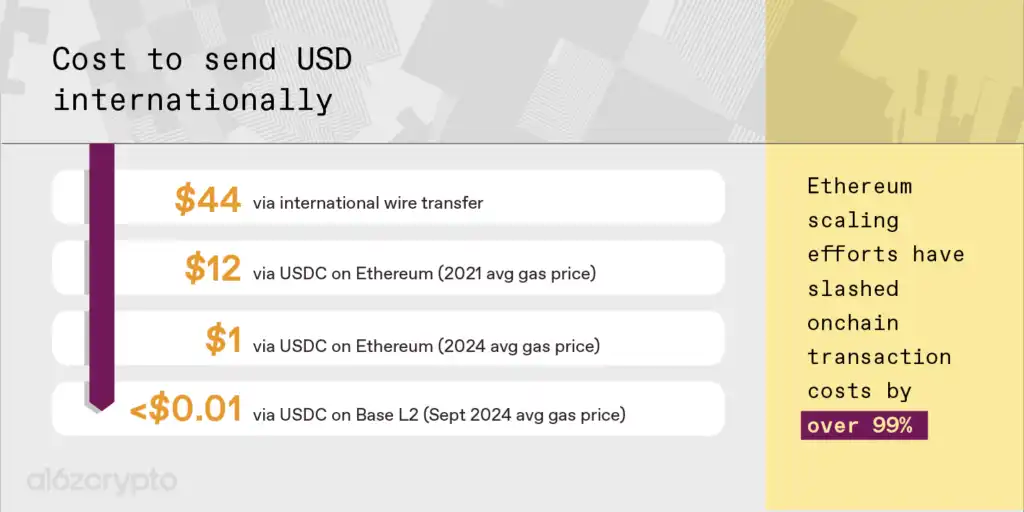
This technical foundation provides more and more incentives for entrepreneurs to build stablecoins, offering better developer experiences, rich ecosystems, widespread applications, and the permissionless composability of on-chain money.
Secondly, stablecoins unlock new user scenarios through the permissionless composability of on-chain money. Other payment platforms have gatekeepers, forcing entrepreneurs to cooperate with extraction networks, such as the high-cost intermediaries in credit card transactions or international payments. But stablecoins have self-custody and programmability, lowering the barriers to creating new payment experiences and integrating value-added services. Stablecoins are also composable, allowing users to benefit from the increasingly powerful on-chain applications and the increasingly fierce competition. For example, stablecoin users have already benefited from DeFi, on-chain subscriptions, and social applications.
Conclusion
Stablecoins can lead us into a world of free, scalable, instant payments. As Stripe CEO Patrick Collison said, stablecoins are the "room-temperature superconductor of financial services." They will enable businesses to pursue new opportunities that were previously untenable under the burden of existing payment channels or the friction of traditional gatekeepers.
In the short term, as payments become free and open, stablecoins will drive structural changes in financial products. Existing payment companies will seek new ways to monetize, either by taking a percentage of the yield, or by selling complementary services to this new commoditized platform. As these traditional businesses recognize the changing landscape, entrepreneurs will create new solutions to help them leverage stablecoins.
In the long run, as stablecoins become more widespread and the technology advances, startups will seize the opportunities of a world of free, frictionless, and instant payments. These startups will be founded today, unlocking new and unexpected scenarios, and further democratizing the opportunities provided by the global financial system.
Acknowledgments: Special thanks to Tim Sullivan, Aiden Slavin, Eddy Lazzarin, Robert Hackett, Jay Drain, Liz Harkavy, Miles Jennings, and Scott Kominers for their thoughtful feedback and suggestions that helped complete this piece.
Welcome to join the official BlockBeats community:
Telegram subscription group: https://t.me/theblockbeats
Telegram discussion group: https://t.me/BlockBeats_App
Twitter official account: https://twitter.com/BlockBeatsAsia