Staking and mining are the cornerstones of the cryptocurrency ecosystem, playing a crucial role in network security and investor participation. By participating in staking, individuals can contribute to the resilience of the blockchain network and unlock opportunities for passive income. Staking has several benefits:
Promoting Crypto-Economic Security
At its core, staking involves locking up a certain amount of cryptocurrency to support the operation of the blockchain network. This process is an indispensable part of Proof-of-Stake (PoS) blockchains, where validators confirm transactions based on the amount of cryptocurrency they have staked. This mechanism ensures network security and aligns the participants' interests with the health and stability of the blockchain.
Earning Passive Income
In addition to enhancing network security, staking also provides highly attractive economic incentives: the opportunity to earn passive income. By staking their assets, investors can receive rewards, typically in the form of additional cryptocurrency tokens. This income stream is appealing to both novice and experienced investors seeking to maximize returns without active trading.
Bootstrapping New Projects through Restaking
A recent innovation in the staking space is "Restaking," which allows staked assets to be used across multiple protocols. This approach enables new projects to leverage the security and capital of existing networks, effectively guiding their development. Platforms like EigenLayer, for example, facilitate restaking by allowing users to stake their ETH or liquid staking tokens, extending the crypto-economic security to other applications on the network.
While restaking presents opportunities to increase yields and network support, it also introduces complexities and risks that investors should carefully consider.
As 2025 approaches, DeFi staking will continue to evolve, offering investors many choices. This article aims to guide readers through the top DeFi staking platforms.
What is DeFi Staking?
DeFi staking involves locking up cryptocurrency assets into smart contracts to support the operation of blockchain networks, particularly those that use the Proof-of-Stake (PoS) consensus mechanism. In PoS networks, validators confirm transactions and create new blocks based on the amount of cryptocurrency they have staked. Traditional staking typically requires setting up a full node and meeting the network's minimum staking requirements, enabling participants to validate transactions and participate in the network consensus to earn rewards.
Key Concepts in DeFi Staking
- Smart Contracts and Staking Contracts: Smart contracts are self-executing protocols encoded on the blockchain, ensuring the staking process is automated, transparent, and secure. When you stake tokens, you effectively become a validator (or delegator) in the network, contributing to the security and stability of the network. In return, you receive rewards in the form of new tokens or transaction fee sharing.
- Staking Rewards: Staking rewards typically include newly minted tokens and transaction fee sharing, incentivizing participants to contribute to the network's security and operations.
- Slashing Mechanism: To maintain network integrity, PoS networks implement a "slashing" penalty mechanism, where a validator's staked funds are reduced if they engage in malicious activities or fail to fulfill their duties. This mechanism aims to deter misbehavior.
DeFi Staking vs. Centralized Staking
When comparing DeFi staking with centralized staking services, the following key factors are more prominent:
- Ownership: DeFi staking allows users to retain actual ownership of their assets, as they can control their own private keys. In contrast, centralized staking requires users to delegate their assets to a third party, relinquishing direct control.
- Transparency: DeFi platforms operate based on open-source smart contracts, providing a transparent staking process and reward distribution. Centralized platforms may lack this transparency, making it difficult for users to verify how rewards are calculated and allocated.
- Security and Control: DeFi staking enables users to have better control over their assets, reducing reliance on intermediaries and lowering counterparty risk. Centralized staking involves entrusting assets to a platform, which could pose security risks if the platform is compromised.
- Mechanics: In DeFi staking, users delegate their stake to a permissionless validator network, directly participating in the network's consensus mechanism. Centralized staking platforms pool user funds and use their selected validators for staking, often without disclosing the details of this process.
- Learning Curve: DeFi staking can be complex, requiring users to navigate various platforms and manage private keys, which may be challenging for beginners. Centralized platforms offer a more user-friendly, Web2-like experience, simplifying the staking process at the cost of decentralization.
Conclusion
The choice between DeFi and centralized staking platforms depends on personal preferences, particularly in terms of control, transparency, and ease of use. In the next section, we will explore emerging DeFi staking protocols that are poised to make an impact by 2025, providing insights to help you make informed decisions in the evolving landscape.
Top DeFi Staking Platforms
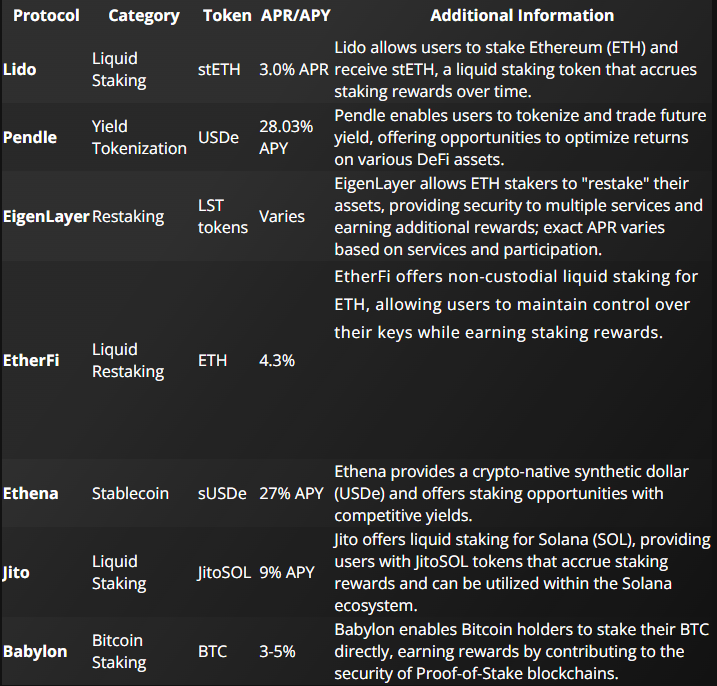
Here is a comprehensive overview of the DeFi staking protocols we will discuss, highlighting their key features, associated tokens, and current Annual Percentage Rates (APR) or Annual Percentage Yields (APY).
Lido Finance
Lido Finance is a DeFi protocol focused on liquid staking services. It enables users to stake their digital assets across multiple blockchain networks while maintaining liquidity, effectively solving the limitations of traditional staking, such as asset lockup and high entry barriers. By issuing liquid staking tokens (LSTs) like stETH for Ethereum, Lido allows users to earn staking rewards while utilizing their assets in the broader DeFi ecosystem.
Key Features
- Liquid Staking: Lido's core service allows users to stake assets without locking them up. It provides staking token derivatives (e.g., stETH) that can be freely transferred, traded, or used in other DeFi protocols.
- Decentralized Governance: Managed by the Lido decentralized autonomous organization (DAO), Lido ensures decisions regarding protocol parameters, node operator selection, and fee structure are made collectively by LDO token holders.
- Security Measures: Lido employs experienced node operators and conducts regular audits to maintain the integrity and security of the staking process, minimizing risks such as slashing penalties.
- DeFi Integration: Lido's liquid staking tokens are widely accepted across various DeFi platforms, enabling users to earn staking rewards while participating in activities like lending and yield farming.
Supported Staking Tokens
Lido supports staking of various cryptocurrencies across different networks, including:
- Ethereum (ETH): Stake ETH and receive stETH.
- Polygon (MATIC): Stake MATIC and receive stMATIC.
- Solana (SOL): Stake SOL and receive stSOL.
- Polkadot (DOT): Stake DOT and receive stDOT.
- Kusama (KSM): Stake KSM and receive stKSM.
LDO Token and Its Utilities
Lido's native token, LDO, plays several key roles in the ecosystem:
- Governance: LDO holders participate in the Lido DAO, voting on critical decisions such as protocol upgrades, fee structures, and node operator selection.
- Incentives: LDO tokens can be used to incentivize liquidity providers and users who contribute to the growth and stability of the Lido protocol.
Summary
Lido Finance has solidified its leading position in the DeFi space. As of December 2024, its Total Value Locked (TVL) has reached a historic high of nearly $40 billion.
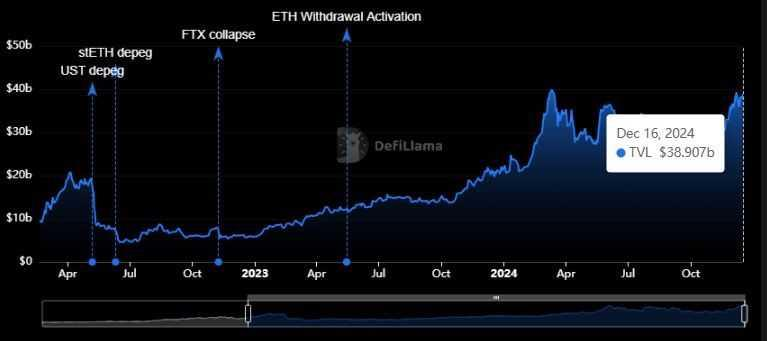
Lido's dominance as the leading LST platform is growing | Chart from defillama
This growth reflects increased confidence in Lido's liquid staking solutions and their integration into the DeFi ecosystem. Additionally, the recently launched community staking module, which allows permissionless node operators to participate, has enhanced decentralization, further strengthening the network's security and resilience.
Lido's flagship staking strategy involves providing users with liquid staking tokens that can be used across various DeFi platforms. This strategy offers flexibility and the potential for compounded returns. As the DeFi landscape continues to evolve, Lido remains at the forefront, providing innovative solutions to meet the diverse needs of cryptocurrency investors.
Pendle Finance
Pendle Finance is a DeFi protocol that allows users to tokenize and trade the future yield of yield-bearing assets. By separating the principal and yield components of an asset, Pendle employs more advanced yield management strategies, including fixed-income, speculation on future yield changes, and unlocking liquidity from staked assets. This innovative approach brings traditional financial concepts (such as interest rate derivatives) into the DeFi space, providing users with greater control and flexibility over their investments.
Key Features
- Yield Tokenization: Pendle allows users to wrap yield-bearing tokens into standardized yield (SY) tokens, which can then be split into principal tokens (PT) and yield tokens (YT). This separation enables the principal and future yield components to be traded independently, facilitating strategies such as locking in fixed yields or speculating on yield fluctuations.
- Pendle Automated Market Maker (AMM): Pendle's AMM is designed for time-decaying assets like YT, providing optimized pricing and minimal slippage. It supports concentrated liquidity and a dynamic fee structure, which can improve capital efficiency and reduce impermanent loss for liquidity providers.
- vePENDLE Governance: Pendle employs a vote-escrowed token model, where users can lock PENDLE tokens to receive vePENDLE. This mechanism grants governance rights, allowing holders to participate in protocol decisions, provide direct incentives to specific liquidity pools, and earn a share of the protocol's revenue.
Supported Staking Assets
Pendle supports a variety of yield-bearing assets across multiple blockchain networks, including:
- Ethereum (ETH): Pendle allows the tokenization and trading of assets like stETH (Lido's liquid staking token).
- Stablecoins: Tokens from lending protocols like Aave or Compound (e.g., USDC and DAI) can be utilized within Pendle's ecosystem.
- Other Yield Tokens: Assets generated by various DeFi protocols can also be integrated into Pendle's platform.
PENDLE Token and its Utility
The PENDLE token is the native utility and governance token of the Pendle ecosystem. Its main functions include:
- Governance: PENDLE holders can lock their tokens to receive vePENDLE, granting them voting rights to participate in protocol governance decisions, such as proposing and voting on upgrades, fee structures, and other key parameters.
- Incentives: PENDLE tokens incentivize liquidity providers and users, promoting the growth and stability of the platform. Additionally, vePENDLE holders can direct incentives to specific liquidity pools, increasing their rewards.
- Revenue Sharing: vePENDLE holders are entitled to a share of the protocol's revenue, aligning the community's interests with the platform's success.
Conclusion
Pendle Finance is emerging as a significant force in the DeFi space by introducing yield tokenization and a specialized AMM for yield trading. As of December 2024, Pendle's Total Value Locked (TVL) has exceeded $5 billion (data from defillama).
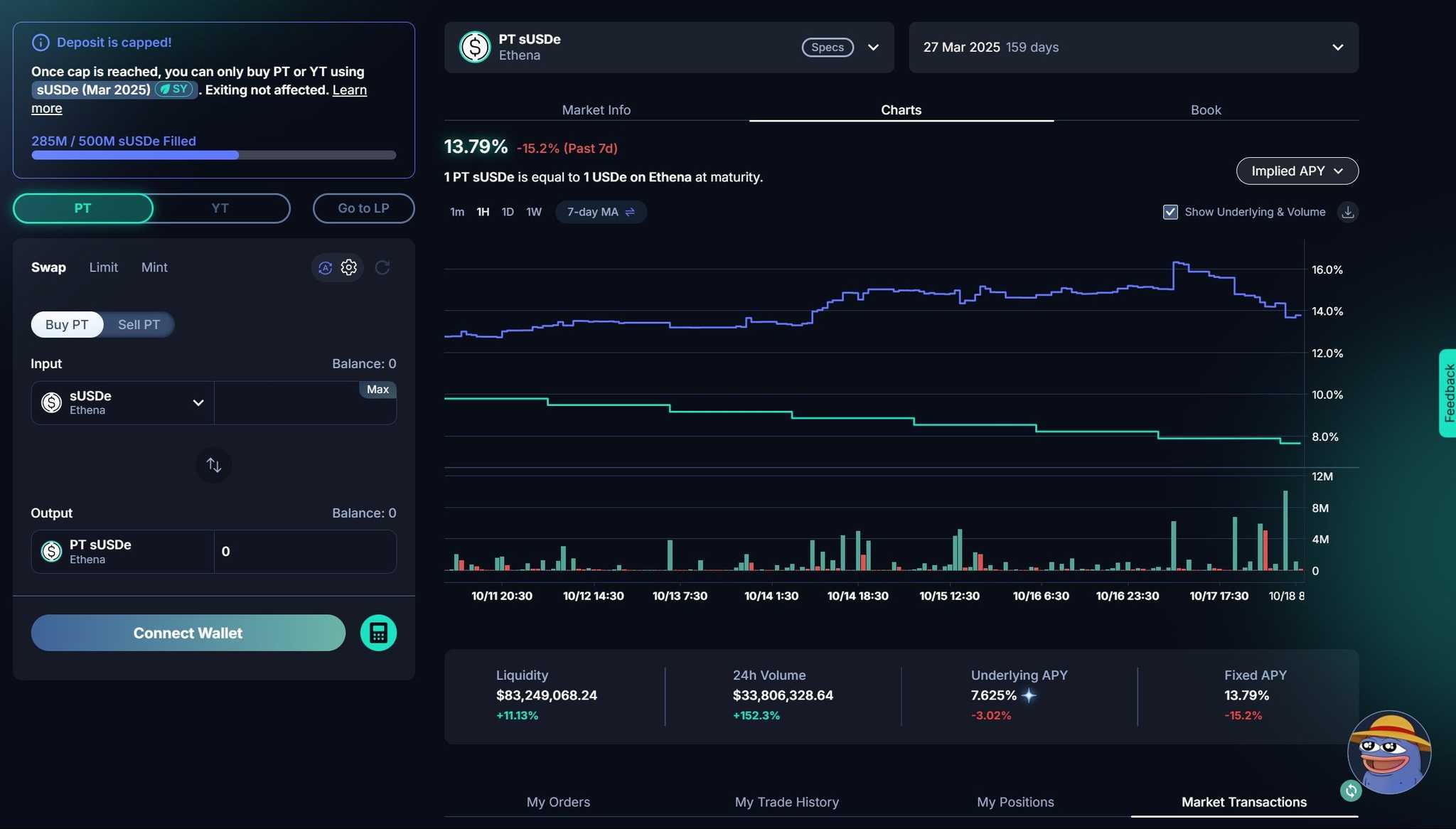
Pendle displaying variable yields for the USDe token | Image from Pendle DApp
Pendle's integrations with various DeFi protocols and its expansion across multiple blockchain networks, including Ethereum and Arbitrum, further solidify its position as a versatile and valuable tool for yield management within the DeFi ecosystem.
EigenLayer
EigenLayer is an innovative protocol built on Ethereum that introduces the concept of "restaking," allowing users to re-delegate their staked Ethereum (ETH) or liquid staking tokens (LSTs) to enhance the security and functionality of other services built on the Ethereum network. By enabling the reuse of staked assets, EigenLayer promotes a shared security model and the development of application chains and Rollup technologies without the need for independent validator sets.

Key Features
- Restaking Mechanism: EigenLayer allows ETH stakers and LST holders to choose to verify new software modules, called Active Verification Services (AVSs), by restaking their assets. This process extends Ethereum's security to a broader range of applications, including data availability layers, oracle networks, and consensus protocols.
- Permissionless Token Support: EigenLayer introduces permissionless token support, allowing any ERC-20 token to be added as a re-stakable asset. This expansion enables a variety of tokens to contribute to the security of decentralized networks, promoting cross-ecosystem collaboration while enhancing the utility of various tokens.
- EigenDA (Data Availability Layer): EigenLayer provides EigenDA, a low-cost data availability solution for Rollups and other Layer 2 solutions. By ensuring data is easily accessible and secure, EigenDA improves the scalability and efficiency of Ethereum-based applications.
- Governance and Flexibility: EigenLayer's architecture allows AVSs to customize their security parameters, including the choice of specific tokens for restaking and the definition of slashing conditions. This flexibility enables services to tailor their security measures to their unique needs, fostering a more resilient and adaptable ecosystem.
Supported Restaking Assets
EigenLayer supports a variety of assets for restaking, including:
- Ethereum (ETH): Users can re-stake their native staked ETH to participate in securing other services.
- Liquid Staking Tokens (LSTs): Tokens like stETH and rETH can be restaked through EigenLayer, allowing holders to earn additional rewards.
- ERC-20 Tokens: Through permissionless token support, any ERC-20 token can now be added as a re-stakable asset.
EIGEN Token and its Utility
EigenLayer has introduced the EIGEN token, a universal interoperability work token designed to enhance the security of the forked protocols supported by EigenLayer's AVS. In extreme situations, such as active attacks or security vulnerabilities, the EIGEN token can protect these protocols, ensuring the integrity of the blockchain modular stack is not compromised. By combining the EIGEN token with restaked ETH, EigenLayer provides users with an additional layer of cryptoeconomic security.
Conclusion and Recent Events
EigenLayer has quickly gained attention in the DeFi space, with its Total Value Locked (TVL) reaching approximately $20.1 billion as of December 2024 (through defillama). This growth highlights the appeal of the protocol, which allows users to maximize the utility of their staked assets through restaking.
As EigenLayer continues to evolve, it remains at the forefront of enhancing Ethereum's security and scalability through its pioneering restaking protocol, providing new opportunities for users and developers to participate in and build on the Ethereum network.
Ether.fi
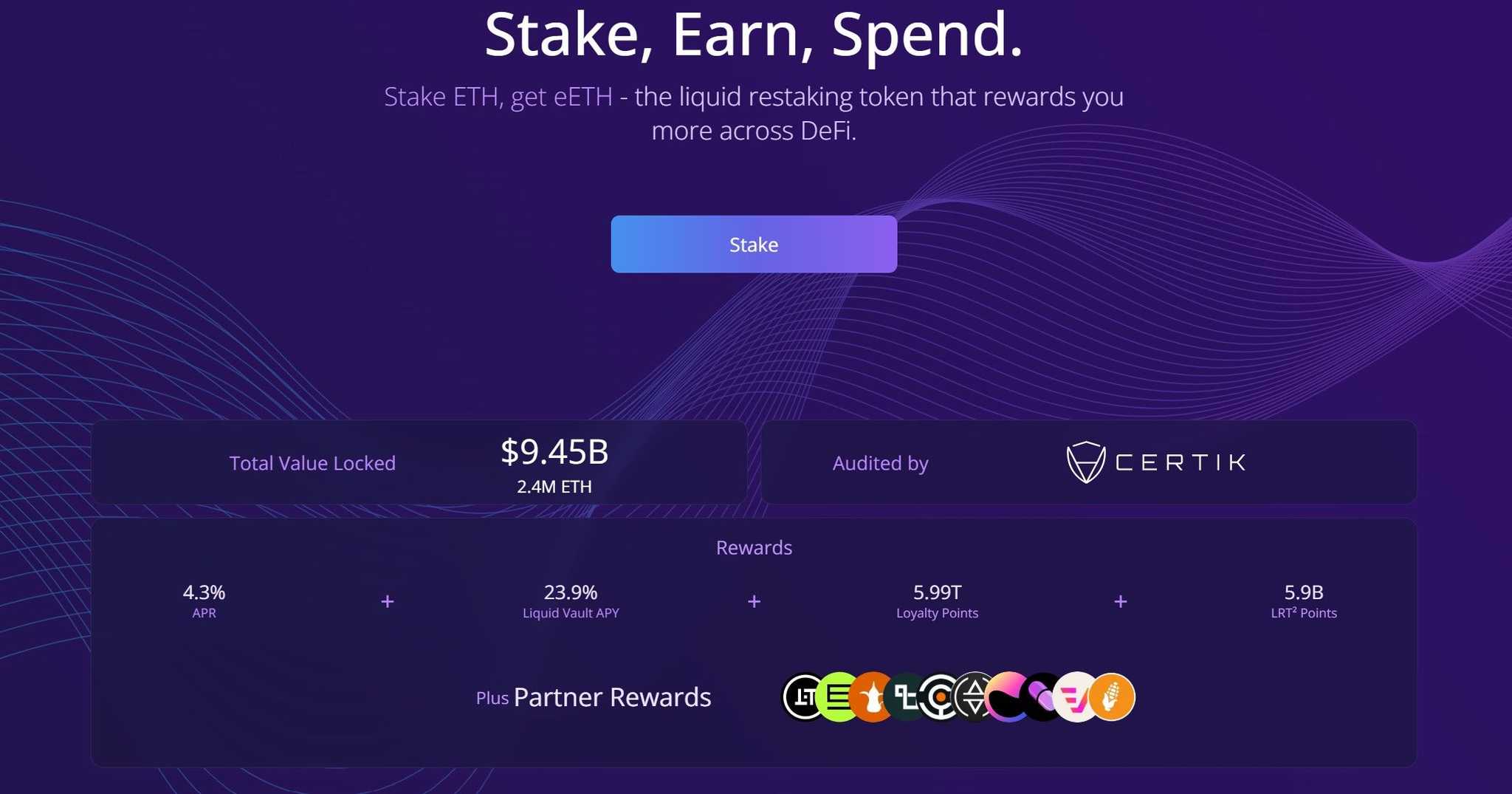
Ether.fi is a decentralized, non-custodial liquid staking protocol that empowers Ethereum holders by allowing them to stake their assets while retaining control over their private keys. Ether.fi issues the liquid staking token eETH, which enables users to earn staking rewards and participate in the broader DeFi ecosystem without the constraints of traditional staking. This approach enhances the security, decentralization, and user autonomy of the Ethereum network.
Key Features
- Non-custodial Staking: Unlike many staking services, Ether.fi ensures users maintain control of their private keys throughout the staking process, significantly reducing custodial risk.
- Use eETH for Liquid Staking: When users stake ETH, they receive eETH, a liquid token representing their staked assets. This token can be used for borrowing and yield farming on various DeFi platforms, while also accruing staking rewards.
- Integration with EigenLayer: Ether.fi collaborates with EigenLayer to provide reStaking functionality, allowing users to earn additional rewards by protecting multiple decentralized applications (DApps) simultaneously.
- Operation Solo Staker: Ether.fi's Operation Solo Staker program enables individuals to operate their own validator nodes, promoting decentralization.
ETHFI Token and Its Utilities
Ether.fi's native token, ETHFI, has multiple functions within the platform:
- Governance: ETHFI holders have the right to participate in the protocol's governance, influencing decisions related to treasury management, token utility, and ecosystem development.
- Revenue Sharing: A portion of the protocol's monthly revenue is used to buy back ETHFI tokens, which may increase their value and benefit token holders.
- Staking Incentives: Users can stake their ETHFI tokens to earn additional rewards, further incentivizing participation and alignment with the platform's growth.
Summary and Recent Events
Ether.fi has become a significant player in the DeFi space, with a TVL exceeding $9.54 billion as of December 2024, making it one of the leading reStaking protocols in the Ethereum ecosystem.
Ethena Finance
Ethena Finance is an Ethereum-based DeFi protocol that provides a crypto-native synthetic US dollar called "USDe". Unlike traditional stablecoins that rely on fiat reserves, USDe is maintained through a delta-hedging strategy and crypto-asset collateral (primarily Ethereum), providing a censorship-resistant and scalable solution.
Key Features of Ethena Finance
- Synthetic US Dollar (USDe): USDe is a fully-backed synthetic US dollar collateralized by crypto assets and managed through delta-hedging. This approach ensures stability without relying on the traditional banking system, providing a resilient alternative for the DeFi ecosystem.
- Internet Bonds (sUSDe): By staking USDe, users can earn sUSDe, a yield-bearing asset that accumulates the protocol's generated income over time. This mechanism allows users to earn passive income while maintaining exposure to a stable asset.
- Delta-Hedging Mechanism: Ethena employs delta-hedging, utilizing short positions in the derivatives market to offset the price volatility of the collateral assets. This strategy maintains the peg of USDe to the US dollar, ensuring stability even in market fluctuations.
- Non-Custodial and Decentralized: Ethena operates without reliance on traditional financial infrastructure, providing users with full control over their assets.
Supported Collateral Assets
Ethena primarily supports Ethereum as the collateral for minting USDe. Users can deposit ETH into the protocol to generate USDe, and then stake to receive sUSDe, participating in the protocol's yield-generating mechanism.
ENA Token and Its Utilities
Ethena's native governance token, ENA, plays several key roles in the ecosystem:
- Governance: ENA holders can participate in the protocol's governance, influencing decisions related to system upgrades, parameter adjustments, and overall strategic direction through voting.
- Staking Rewards: By staking ENA, users can earn sENA, which may accrue additional rewards within the protocol's incentive mechanisms and provide higher reward multipliers.
Summary
Ethena Finance has quickly gained attention in the DeFi space. As of December 2024, its Total Value Locked (TVL) exceeded $5.9 billion (via defillama.com), reflecting growing confidence in Ethena's synthetic US dollar solution and innovative decentralized finance approach.
A flagship feature of Ethena is its Internet Bonds (sUSDe), which allow users to earn yield by staking USDe. This tool combines the yield of liquid staking Ethereum and derivative financing arbitrage, providing DeFi participants with a stable and rewarding asset.
Ethena's unique approach to creating a synthetic US dollar breaks away from traditional financial dependence, making it a significant player in the evolving DeFi ecosystem, providing users with innovative tools for stability and yield generation.
Jito
Jito is a liquid staking protocol running on the Solana blockchain, focused on maximizing Maximal Extractable Value (MEV) strategies. By allowing users to stake their SOL tokens in exchange for JitoSOL, a liquid staking token, Jito enables participants to earn staking rewards enhanced by MEV revenue.

Key Features of Jito
- MEV-Driven Staking Rewards: Jito integrates MEV strategies to boost staking rewards. By capturing and redistributing MEV profits, JitoSOL holders can earn higher yields compared to traditional staking methods.
- Use JitoSOL for Liquid Staking: After staking SOL, users receive JitoSOL tokens representing their staked assets. These tokens maintain liquidity, allowing users to participate in various DeFi activities while still earning staking rewards.
- Non-Custodial Platform: Jito operates as a non-custodial platform, ensuring users retain control over their assets.
- Enhanced Network Performance: Jito contributes to improved network performance and reduced spam on the Solana blockchain by specifically staking with validators running optimized software.
Supported Collateral Assets
Jito primarily supports the staking of the Solana token, SOL. Users can stake any amount of SOL and receive JitoSOL in return.
JTO Token and Its Utilities
Jito has introduced its native token, JTO, which serves multiple functions in the ecosystem:
- Governance: JTO holders can participate in the protocol's governance.
- Staking Rewards: By staking JTO, users can earn additional rewards.
Summary
Jito has experienced significant growth within the Solana ecosystem. According to its website, as of December 2024, over 14.5 million SOL tokens have been staked through Jito, with approximately 204 Solana validators participating. The platform offers staking APYs exceeding 8%, reflecting its competitive advantage in the liquid staking market.
A flagship feature of Jito is its integration of MEV strategies to enhance staking rewards. By capturing and redistributing MEV profits, Jito increases user yields while also promoting the overall health and efficiency of the Solana network.
Jito's commitment to open-source development is exemplified by the release of Jito-Solana, the first third-party MEV-enhancing validator client for Solana. This initiative highlights Jito's dedication to improving blockchain performance transparency and community collaboration.
Babylon
Babylon is a pioneering protocol that brings Bitcoin staking into the DeFi ecosystem. By allowing Bitcoin holders to directly stake their assets, Babylon enables users to earn yield while also contributing to the security of proof-of-stake blockchains. This innovative approach eliminates the need to bridge, wrap, or transfer BTC to third-party custodians, maintaining Bitcoin's inherent security and decentralization.
Key Features of Babylon
- Self-Custodial Staking: Babylon's protocol allows BTC holders to stake their assets without transferring control to an external entity. Users lock their bitcoins in a self-custodial manner, ensuring full ownership and security throughout the staking process.
- Integration with PoS Chains: By staking BTC, users can participate in securing various PoS blockchains, including application chains and decentralized applications (DApps). This integration enhances the security of these networks and rewards stakers in return.
- Rapid Unstaking: Babylon adopts the Bitcoin timestamp protocol, enabling the staked BTC to be unstaked quickly. This feature ensures users can withdraw their assets rapidly without relying on social consensus, maintaining liquidity and flexibility.
- Scalable reStaking: The modular design of the protocol supports scalable reStaking, allowing a single BTC stake to simultaneously protect multiple PoS chains. This feature maximizes the potential for yield generation.
Supported Staking Assets
Babylon is focused on utilizing Bitcoin for staking purposes.
Summary
Babylon has achieved significant milestones, including the successful launch of its mainnet and the initiation of multiple staking caps. Notably, the protocol's total value locked (TVL) exceeded $5.7 billion in December 2024, reflecting strong community adoption and confidence.
A key feature of Babylon is its self-custodial Bitcoin staking mechanism, which allows users to earn yields without compromising the security of their assets. This approach represents a significant advancement in integrating Bitcoin into the DeFi ecosystem, providing BTC holders with new opportunities to participate in and benefit from the growth of decentralized finance.
In summary, Babylon's innovative protocol unlocks the potential of Bitcoin within the DeFi ecosystem, enabling secure self-custodial staking, enhancing the security of PoS blockchains, and offering attractive yields for BTC holders.
Pros and Cons of DeFi Staking
Advantages of DeFi Staking
- 1. Potential for high returns through yield farming: DeFi staking often provides substantial rewards, especially when combined with yield farming strategies.
- 2. Increased control over funds: Users retain full ownership of their funds through decentralized wallets, without relying on third-party custodians.
- 3. Participation in governance: Staking governance tokens allows users to vote on protocol decisions and influence the platform's future development.
- 4. Contribution to network security and operation: By staking, users can help protect blockchain networks and maintain decentralized operations.
- 5. Liquid staking tokens: Liquid staking tokens enable users to access their staked capital while continuing to earn rewards.
- 6. Flexibility in yield strategies: DeFi staking offers opportunities for innovative strategies, such as compounding through reStaking or leveraging staked tokens to participate in other DeFi activities.
- 7. Access to emerging ecosystems: Staking can help drive the adoption of new protocols and ecosystems by supporting innovation.
Risks of DeFi Staking
- 1. Smart contract vulnerabilities: Malicious attacks or vulnerabilities in smart contracts can lead to the loss of staked assets.
- 2. Impermanent loss in liquidity pools: Changes in token prices can reduce the value of assets in liquidity pools, affecting overall returns.
- 3. Volatility of token prices: The volatility of cryptocurrencies can impact the value of staking rewards.
- 4. Slashing penalties: In some networks, improper validator behavior can result in penalties that reduce the amount of staked funds.
- 5. Protocol-specific risks: Emerging platforms may lack sufficient auditing or experience, increasing the risk of operational failures.
- 6. Lack of liquidity: Staked assets may be locked for a period, limiting the immediate availability of funds.
Strategies to Mitigate DeFi Staking Risks
- 1. Diversify staking across multiple platforms: Spread your staked assets across different protocols to reduce the impact of a single platform failure.
- 2. Research platform audits and security history: Choose platforms with a good security track record and regular third-party audits to ensure the safety of your funds.
- 3. Monitor token economics and protocol changes: Closely track changes in token supply, reward mechanisms, and governance decisions that may impact your staking strategy.
- 4. Utilize liquid staking options: Use protocols that offer liquid staking tokens, allowing you to earn rewards while maintaining liquidity and flexibility.
- 5. Set risk limits: Determine the maximum percentage of your investment portfolio allocated to staking and strictly adhere to it to manage your risk exposure.
- 6. Use reputable wallets and hardware security devices: Store your staked assets in secure wallets to prevent potential hacking or phishing attacks.
How to Start DeFi Staking: Step-by-Step Guide
DeFi staking allows you to earn rewards by supporting blockchain networks. While the specific steps may vary by protocol, the following provides a general guide:
Step 1: Choose a Staking Protocol
- Research different staking platforms and select one that aligns with your goals, such as liquid staking (e.g., Lido Finance or Jito) or yield tokenization (e.g., Pendle Finance).
- Consider factors like supported assets, security measures, and potential returns.
Step 2: Set Up a Wallet
- Choose a non-custodial wallet compatible with the protocol you plan to use, such as MetaMask for Ethereum-based platforms or Phantom for Solana.
- Secure your wallet by backing up your seed phrase and enabling two-factor authentication.
Step 3: Acquire Tokens
- Purchase the tokens required for staking (e.g., Lido's ETH, Jito's SOL) through a cryptocurrency exchange.
- Transfer the tokens to your wallet.
Step 4: Connect to the Staking Protocol
- Visit the official website of the protocol.
- Follow the prompts to authorize the connection and link your wallet to the platform.
Step 5: Stake Your Assets
- Select the tokens you want to stake and specify the amount.
- Confirm the staking transaction and ensure you have sufficient funds to cover the transaction fees.
- In liquid staking protocols, you will receive a derivative token (e.g., stETH or JitoSOL) that you can use within the DeFi ecosystem.
Step 6: Monitor and Manage Your Stake
- Regularly track your staking rewards and portfolio performance through the dashboard or the protocol's interface.
- Consider utilizing yield tokenization features, like those offered by Pendle, to develop additional strategies.
How to Maximize DeFi Staking Yields
1. Diversify your staking portfolio: Spread your investments across multiple protocols to minimize risk and optimize returns.
2. Reinvest your rewards: Compound your staking rewards by restaking or participating in yield farming opportunities.
3. Stay informed: Keep up with updates on protocol governance, token economics, and network upgrades that may impact your staking rewards or security.
4. Optimize gas fees: Schedule your transactions during periods of lower network activity to reduce transaction costs.
5. Explore advanced strategies: Consider using protocols like Pendle Finance to lock in fixed yields or speculate on future earnings using tokenized assets.
7. Utilize DeFi liquidity staking tokens: To accumulate additional returns on top of your staking rewards, deploy derivative tokens (e.g., stETH, JitoSOL) in lending or yield farming activities.
Conclusion
DeFi staking has evolved into the bedrock of the cryptocurrency ecosystem, contributing to network security and decentralization while offering opportunities to earn rewards. This guide has explored some of the top platforms for 2025, including Lido Finance, Pendle Finance, EigenLayer, Ether.fi, Ethena, Jito, and Babylon. Each protocol offers basic staking services, but they all have unique features such as liquid staking, yield tokenization, reStaking, or Bitcoin staking.
The key to unlocking actual profits is understanding and effectively leveraging these standout functionalities. Whether it's maximizing returns through Jito staking supported by MEV, reStaking on EigenLayer, or exploring innovative strategies with Pendle, success in DeFi staking requires informed decision-making and strategic planning.
As the cryptocurrency market enters another bull market phase, the prospects for decentralized finance in 2025 are promising. With continued innovation and increasing adoption, DeFi staking is poised to offer bountiful opportunities for those prepared to navigate its dynamic landscape.