Author: Encrypted Wei Tuo
TL;DR
Whether you are willing to admit it or not, a large part of the progress of human civilization comes from unfounded but optimistic assumptions, and money is the best example of this assumption - a blindness to the ability of other entities to "equivalent returns" Optimistic assumptions.
Our ancestors unquestioningly accepted money as a substitute for food in exchange for the value they created. The fact is, however, that money is simply an accounting symbol that records social relationships between creditors and debtors and never needs to have any intrinsic value.
But now, we have given this phenomenon a more appropriate name - "Ponzi". Next, I will explain my theory on how to identify, understand, design, and ultimately control Ponzi mechanisms in cryptocurrency and other fields to maximize profits-this is what I call the "Three Traps Theory" (The Three Ponzi Problems).
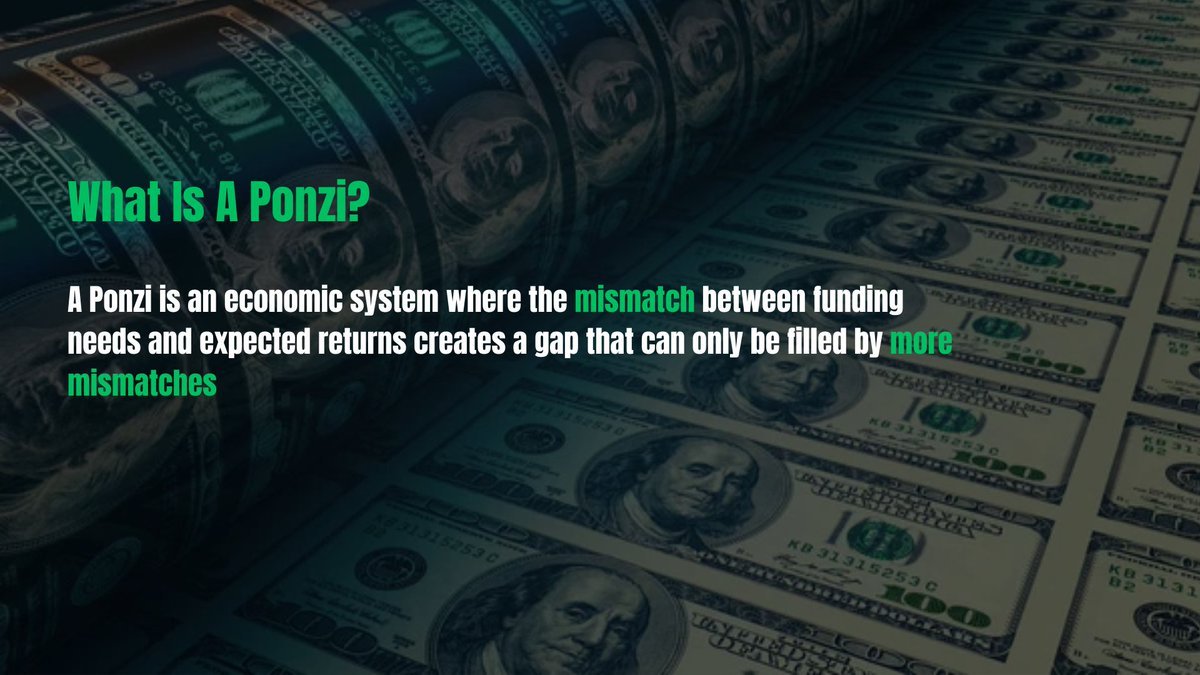
What is Ponzi?
In short, Ponzi is an economic system in which a mismatch between the demand for funds and expected returns creates a "gap" that can only be filled by further mismatches. (This definition is my own original creation, and I hereby declare it.)
Is every Ponzi an "artificially" designed system? Yes. But it's not necessarily a scam. It depends on whether this "gap" is considered reasonable and acceptable by the audience. Historically, these "gaps" have often been beautified and packaged into other terms, such as "sovereign credit", "legitimacy" or "market consensus." Ponzi is not an absolute concept. Its true nature often needs to be examined from a macro perspective, as many Ponzi do not exhibit typical characteristics at the micro level.
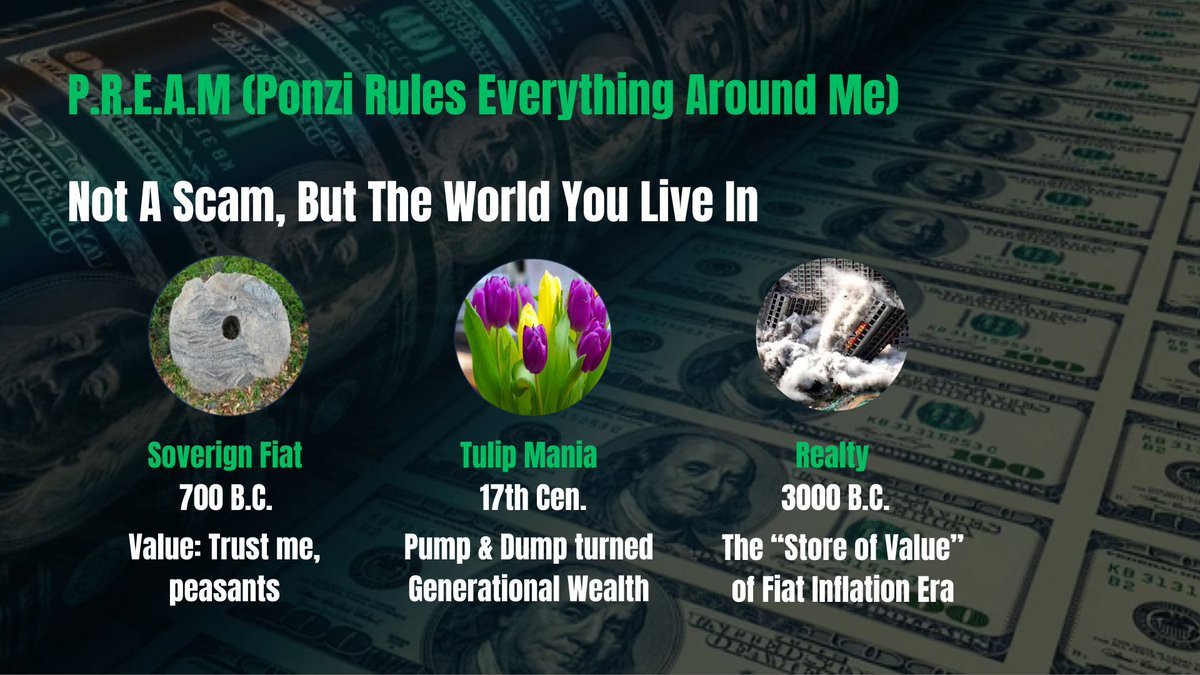
In fact, Ponzi's are more common in everyday life than you might think, and they often seem reasonable. Take the residential real estate market, which has existed since 3000 BC and is considered a “productive” store of value. However, in fact, if it were not for the rapid and continuously growing inflation caused by modern fiat money printing, this value logic would simply not be sustainable.
What is the three-game theory?
Every Ponzi is necessarily built on one or more of the following three basic forms: Mining, Pooling, and Splitting.
It may sound absurd, but the three-pan theory can serve as a guiding framework for designing and operating almost any Ponzi system—whether at a macro or micro level.
Three plates - dividend plate
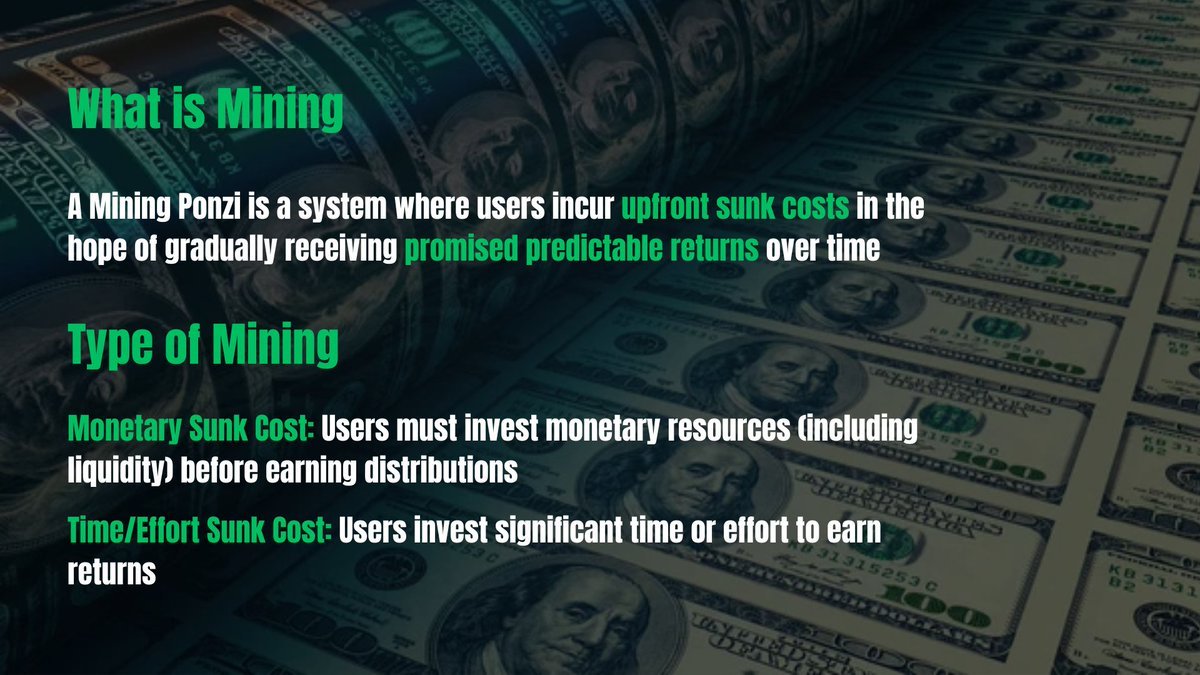
Bonus trading is a system where users bear upfront sunk costs in the expectation of gradually receiving a promised fixed return over a period of time.
Types of dividend plates
A. Fund-type sunk costs Users need to invest funds (including liquidity opportunity costs) to start earning benefits. Examples include the Bitcoin/KASPA/FIL mining ecosystem (excluding Bitcoin itself), PoS staking/re-staking on L1, DePIN, and dividend disks like Plustoken.
B. Time/Energy Sunk Cost Users invest a lot of time or energy in the hope of obtaining benefits. Examples include Pi Network, Galxe badge events, pointless Discord role battles, and Telegram mini-programs like DOGS.
Key indicators for evaluating dividend disks
Fixed sunk cost: A one-time non-recoverable investment (such as Bitcoin mining equipment).
Incremental sunk costs: Periodic non-recoverable costs (such as electricity and maintenance) incurred to obtain each incremental unit of revenue.
Withdrawable Return: Earnings that can be freely withdrawn and liquidated.
Reinvestment cycle: The period in which reinvestment is required after the expiration of sunk costs.
External Liquidity: The liquidity available for this dividend token on external trading venues.
crash model
Conditions for the collapse of the dividend disk: Actual incremental sunk cost + external liquidity < withdrawable returns At this time, the system creator should make a profit by stopping dividends and "running away".
How to delay the collapse (taking BTC mining as an example)
Activate the flywheel effect: high currency prices → higher mining machine demand → higher mining machine prices → manufacturers get more cash → manufacturers further push up the currency price.
Increase total sunk cost: Continue to increase the minimum total sunk cost to obtain additional tokens, driving a higher "shutdown price".
Pricing sunk costs in fiat currency: Avoid using token pricing as this gives early entrants an unfair advantage and defeats the purpose of driving higher shutdown prices by raising sunk costs.
Control early-stage liquidity: Minimize external liquidity in the early stages to prevent premature selling and maintain control over token holdings.
Case Study: Bitcoin Mining Ecosystem
Let’s review the Bitcoin mining ecosystem – one of the most classic and well-run crypto Ponzi systems – as well as Bitcoin ($BTC) itself. Many historical mysteries can be explained.
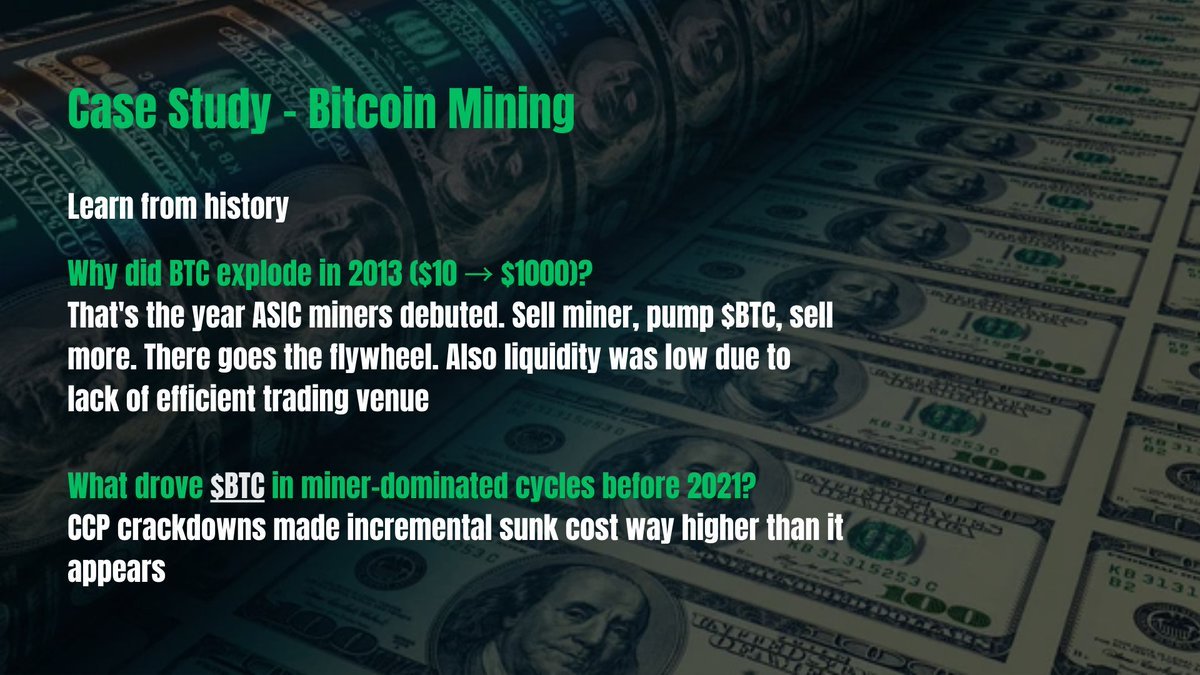
Why did BTC skyrocket in 2013 ($10 → $1000)?
2013 was the year that ASIC miners were introduced, giving miner manufacturers a dominant position in revenue and sales, making them the first “market makers” in Bitcoin. At the same time, there were no highly efficient and liquid trading venues and liquidity models, and low external liquidity also made price manipulation easier, thus initiating the flywheel effect.
How did Bitcoin rise in a miner-led cycle before 2021?
Miner costs (power and facilities) are denominated in fiat currency.
The incremental costs are much higher than electricity, especially in China, where policy crackdowns from 2019 have left many miners at risk of total losses as they pursue lower electricity prices.
Due to these policies, the total sunk costs and "shutdown price" are much higher than they appear on paper, objectively and unintentionally pushing up the price of Bitcoin.
Three sets - Mutual aid set
Mutual aid is a system where users provide liquidity in exchange for the promise of a fixed return per unit of contribution. Unlike the bonus plate, the mutual aid plate does not need to lock assets, but relies on high transaction volume to operate, just like a casino does not directly rely on individual wins and losses to make profits, but takes a certain percentage from the total transaction volume.
Types of mutual aid disks
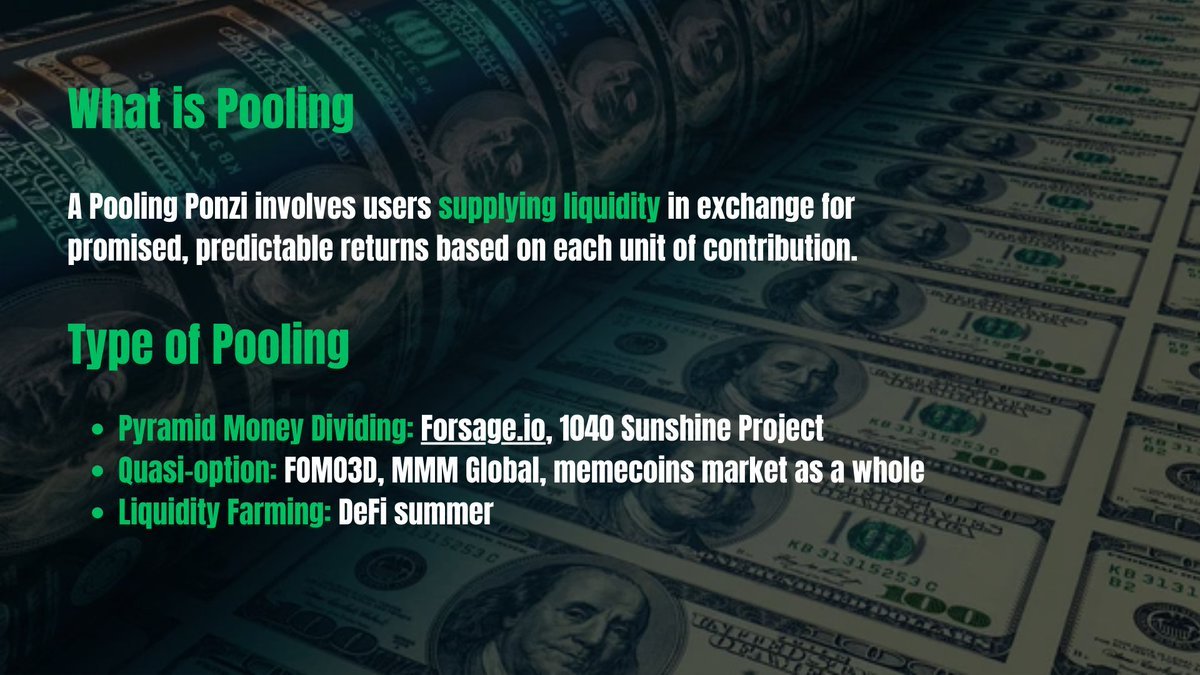
Pure MLM money-sharing users obtain dividends by attracting more participants and rely only on capital inflow (for example: Forsage.io, 1040 Sunshine Project).
Quasi-option funds are circulated among participants, and new funds are used to pay old participant returns (for example, A transfers money to → B transfers → C transfers → A), usually including liquidation or restart clauses to cope with funding targets What is not being achieved (eg: FOMO3D, 3M, the memecoin market in general).
Liquidity mining users earn income by providing liquidity, usually sacrificing exit opportunities in exchange for higher returns.
DeFi users are no stranger to mutual aid disks, because most DeFi instruments are essentially part of the "macro L1 mutual aid disk", such as lending protocols, etc. The speculative token dynamics in these systems are the core source of mismatch.
crash model
Conditions for mutual aid collapse: Systemic debt > liquidable assets + external liquidity.
Ponzi architects usually make their money through fees or front-running profits.
How to delay a crash
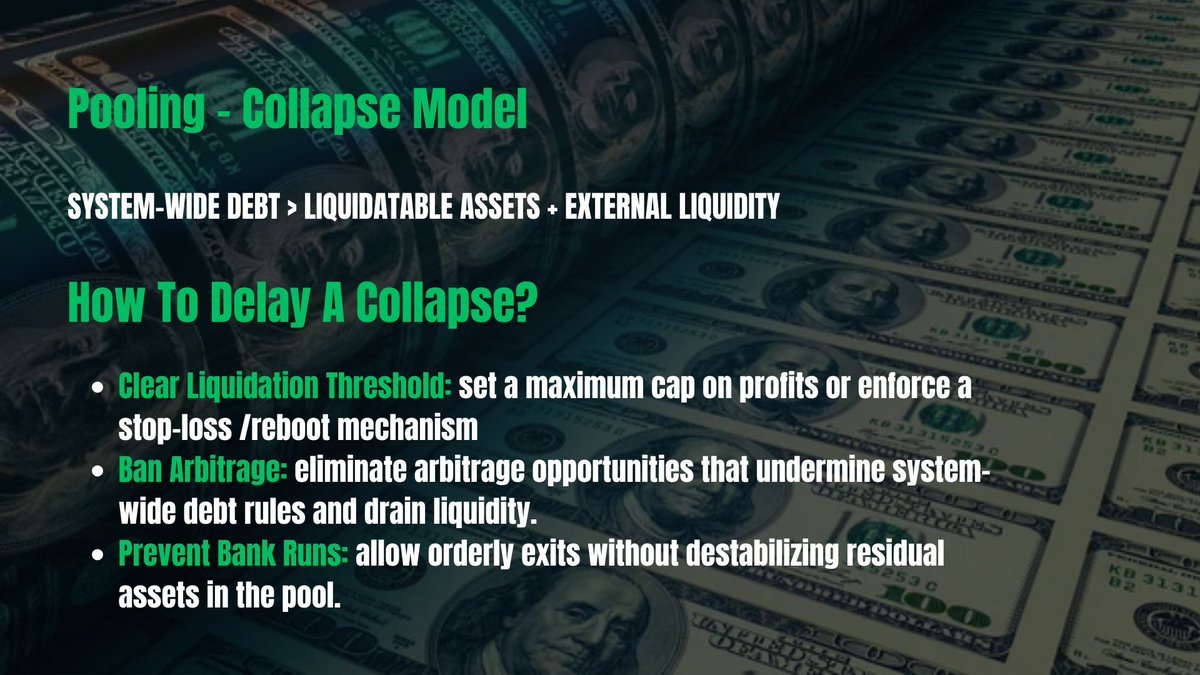
Clear liquidation thresholds, set maximum profit caps or enforce stop-loss/restart mechanisms;
Prohibiting arbitrage eliminates arbitrage opportunities that could undermine systemic debt rules and drain liquidity;
Preventing runs allows for an orderly exit that avoids damaging effects on the remaining assets in the pool;
Case study: The evolution of AMMs and mutual aid disks
AMMs (automated market makers) have achieved a major breakthrough in mutual financing infrastructure, comparable to the emergence of commercial banks.
Why did LP liquidity mining collapse after DeFi Summer?
Why do new profit mutual aid disks tend to be Uni V3 type models, such as @MeteoraAG ’s LP Army?
Uni V2 Liquidity Mining:
In Uni V2, users can provide liquidity indefinitely and be rewarded with high annualized yields (APY) in the same token.
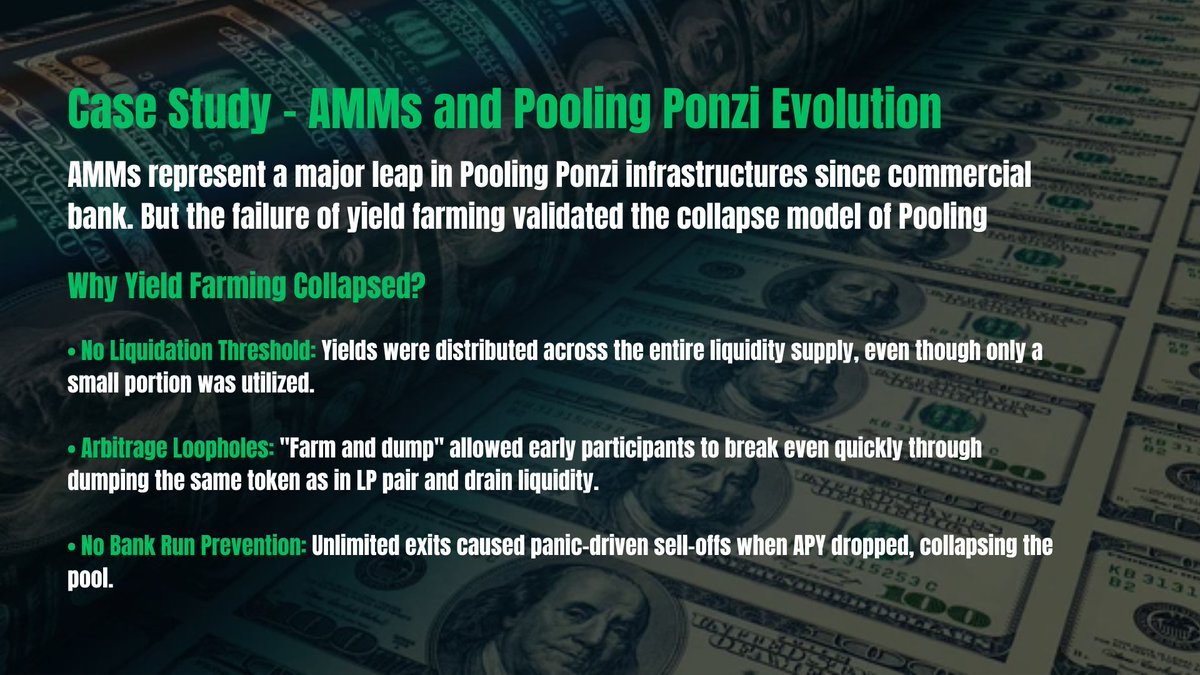
Why it crashes:
No liquidation threshold proceeds are distributed to the entire liquidity pool, even if only a small portion is actually used. But as long as the liquidity provided is in the pool, you can obtain unlimited local currency output;
The arbitrage loophole "dig, sell and withdraw" strategy allows early participants to quickly recover their capital, which is then equivalent to risk-free arbitrage and exhausts the liquidity of the remaining LPs by selling their own currencies;
No run prevention measures and no exit restrictions lead to panic selling when APY drops, eventually bringing down the entire pool;
How Uni V3 fixes the problem:
Liquidation Threshold Only liquidity within a specific price range is eligible for yield rewards.
Run prevention Liquidity exits in one price range will not affect rewards or liquidity in other ranges.
Repair arbitrage loopholes Most projects have removed instant token rewards and replaced them with a points mechanism (Post-DeFi Summer), although this mechanism has caused new problems in the split disk design.
Three Disks - Split Discs
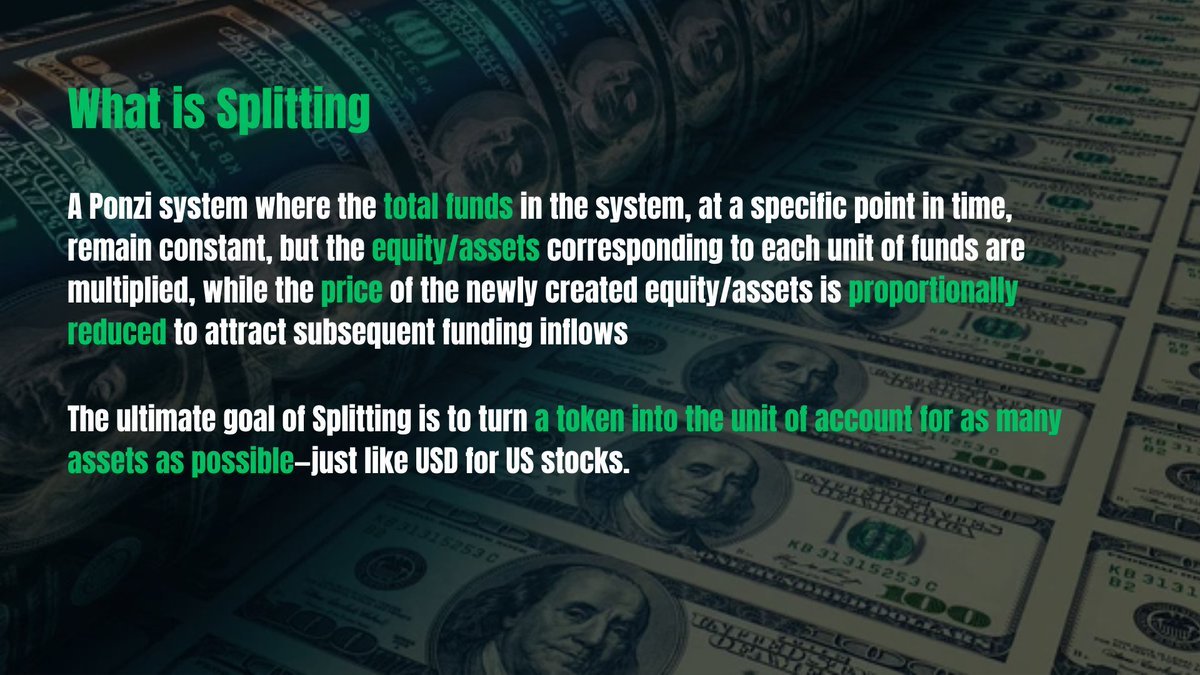
A split is a Ponzi system in which the total capital remains constant at a specific point in time, but the number of equity or assets corresponding to each unit of capital is multiplied, while the price of the newly generated equity or assets is reduced proportionally. to attract subsequent capital inflows. This is very similar to a stock split in traditional finance.
In my opinion, split trading is the most complex and difficult to control Ponzi system. It usually does not exist on its own, but rather serves as a "de-foaming" mechanism nested within one or two other Ponzi forms.
Crypto Split Disk
In Crypto, all L1/L2 are essentially dividend disks, and as long as they need to build an "ecosystem", they are also split disks. For example:
BTC inscription/rune/L2 is to BTC;
PumpdotFun to Solana;
aixbt/Luna/Game to Virtual;
The ultimate goal of a split is to convert a token into a unit of account for as many assets as possible, much like the U.S. dollar is for U.S. stocks.
Why?
Because both US dollars and L1 tokens are essentially created out of thin air. Alchemy, "fake money for real money" is achieved by providing a higher nominal ROI.
crash model
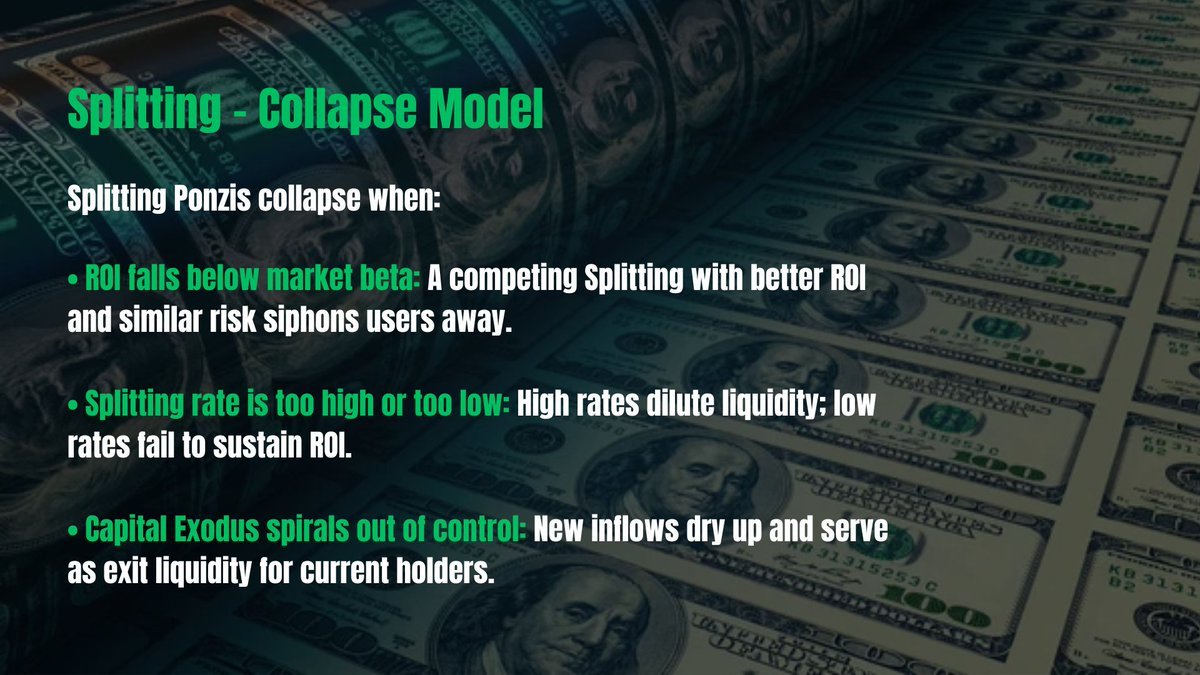
Conditions for split plate crash:
ROI Below Market Benchmark Beta Competing split systems with higher ROI and similar risks will attract churn.
The split ratio is too high or too low. A high split ratio will dilute liquidity, while a low split ratio cannot maintain ROI.
Capital Hemorrhage New inflows dry up and existing holders quickly exit using them as exit liquidity.
The main profit point for Ponzi architects is front-running.
Case Study: Ethereum, ICOs and Solana
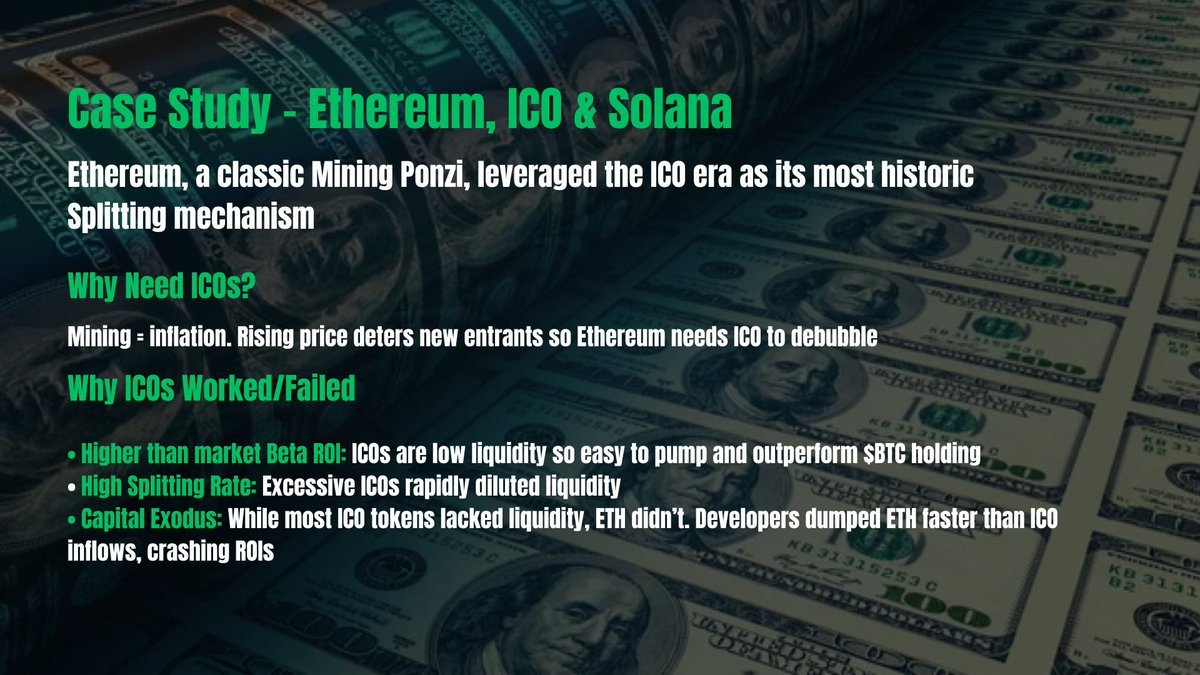
Ethereum is a classic dividend spinner, but it became the most important splitting mechanism in history through the ICO era.
Why does Ethereum need an ICO?
Mining is inflation: a rising “shutdown price” that is too high will naturally prevent new participants from entering.
- Splitting mechanism attracts funds: ICO attracts participants to hold $ETH, and these participants need to purchase ICO tokens to convert $ETH into units of account and achieve defoaming.
Why do ICOs succeed/fail?
- High ROI: The rate of return from ICO is much higher than holding $BTC or other outdated tokens. Many ICOs have close to 100% circulating supply and low FDV, creating explosive ROI in a low-liquidity environment.
High split rate: Too many ICOs too quickly dilute overall liquidity.
- Capital Leakage: At the time, most ICO tokens were illiquid and participants were unable to recover their funds. This was not the case with $ETH . Developers were selling ETH faster than funds were flowing in, turning ICO participants into pushing out liquidity. Eventually the ROI collapses.
As a result, $ETH experienced a “Davis Double Click” at that time.
Ethereum’s Dilemma in 2024
Capital loss: Locking funds through LSD, re-pledge (Restaking) and PointFi reduces the effective circulation (the trading volume that can participate in speculation).
The split rate is too slow: New projects are mainly led by the inner circle, in the name of "alignment and legitimacy with the Ethereum Foundation and Vitalik", to V entrepreneurship.
Low ROI: Compared with Solana, which has restored the ICO model of the ETH era (such as Pump.fun ), Ethereum's ROI is less competitive.
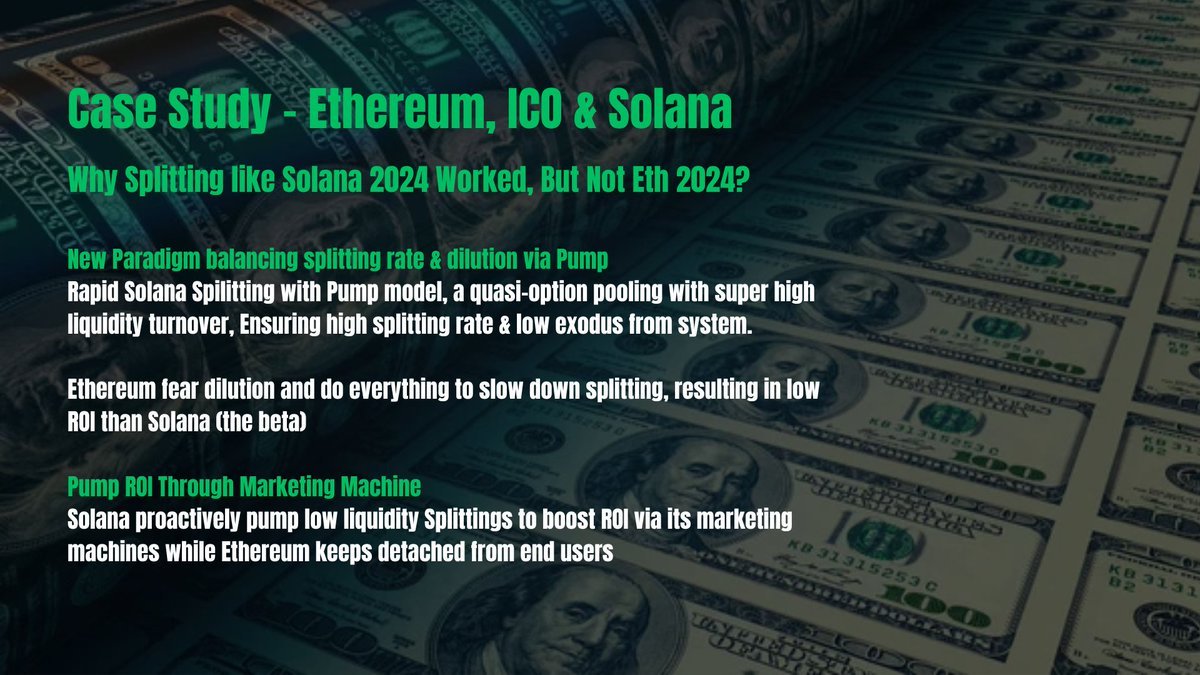
Why is a 2024 spin-off like Solana successful?
Balance resolution and dilution with Pump
Meme Coin is a split asset of Solana, with $SOL as the denomination unit, and is accelerated through the Pump mechanism. Pump itself operates as a mutual fund, with liquidity turnover so fast that it almost simulates a quasi-options cycle. This effectively alleviates the liquidity dilution problem caused by high split rates, allowing funds to remain on the market to continue to participate in speculation, while maintaining low-threshold entry opportunities for new users.
Increase ROI through marketing machine
Solana is the only L1 with its own "marketing machine", from the Colosseum/Superteam community to large vloggers and KOL networks (such as Jakey, Nick O'Neil, Banger, Threadguy, etc.).
Combined with core influencers such as Toly, Mert, and Raj, Solana deliberately brings liquidity to emerging low-liquidity meme coins and projects, provides super-exponential multiple ROI (exceeding market benchmarks), and drives the $SOL -meme coin flywheel effect.
Similar strategies are also imitated by Sui and Virtual (such as Luna and aiXBT).
Three-pan design mentality and three-pan combination
Each Ponzi operates under the assumption of a closed system, subject to the inherent limitations of its collapse model. These limitations can be alleviated by integrating the features of Mining, Pooling and Splitting, each of which has its own unique role:
Dividend plate: Lock assets to maximize assets under management (AUM).
Mutual aid market: Rake money through high trading volume.
Split plate: Use the price fluctuations of sub-plates to remove bubbles from the main plate.
When designing a Ponzi system, start with the following basic questions:
How does the dealer make money in this design?
How can Zhuang accept its collapse?
Then you will know which plate type to choose.
Choose your cabal and know your target audience.
Ponzi is a zero-sum game, where profits and losses come from the same source. The key question is: who are your allies and who are your “prey”?
First, understand the scope of your cabal's capabilities:
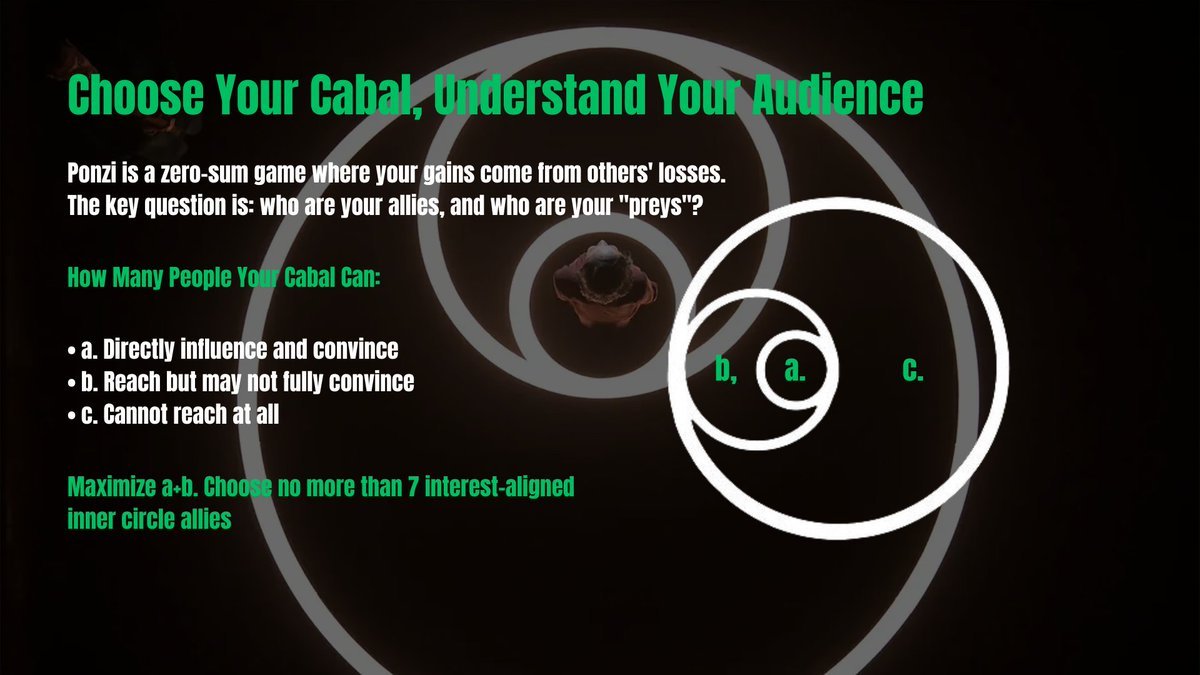
a. People who directly influence and persuade
b. People who can be reached but may not be completely convinced
c. People who are completely unreachable
An effective cabal should:
Maximize coverage of a + b
Highly aligned in interests
Assign clear roles to each member
No more than 7 members to ensure smooth collaboration
This also explains why some “particularly popular” advisors appear on multiple teams, or why certain VCs are replaced by exchange VCs in early funding rounds.
Secondly, understand your audience and their characteristics. Key indicators include:
Age group: Is it 80s, 90s or 00s? How liberal was their upbringing?
Source of information: Are you using Twitter, Telegram, TikTok, or WeChat?
Financial concepts: What is their attitude towards freelancing, financial freedom and time autonomy?
Knowledge level: Can they grasp the basics of cryptocurrency?
Risk preference: Do they prefer passive returns (interest) or active returns (trading)?
Typical portrait of "destined to join the cryptocurrency industry and become a family member":
At least after 80/90/00
Use Twitter, TikTok or Telegram
Tends to be self-employed and refuses to be institutionalized
Prefer active financial activities and value transactions
TikTok users are slightly different - they tend to prefer the PVP model. After all, most of them grew up in the era of stock games that lacked macro growth.
These are the “new humans” (as Gaudali calls them) who have embraced a hyper-financial worldview. Sell them the narrative of “fair start,” “anti-establishment,” and “anti-political correctness.”
If the above persona doesn’t fit your audience:
Borrow or forge the authoritative endorsement of their blind faith. They are more like docile people under authoritarian rules.
The first principle of three-pan design: never violate human nature
History proves one thing: Developers’ beliefs don’t matter. As with any cryptocurrency project (not just Ponzi), sustainability usually gives way to popularity (you need to survive first), and popularity relies on being consistent with human nature:
Nothing lasts forever: don't expect your project to be the exception.
Perception trumps reality: at its core, Ponzi is the art of manipulating people's minds. Your project doesn’t need to be what you claim it is, it just needs to match your audience’s perception and convince them that it is.
Let them gamble: Don’t make the decision for your users and sacrifice gambling opportunities for safety. Your audience loves risk, otherwise they wouldn’t get involved in crypto.
Say "thank you for participating" calmly: face it rationally. Your priority is profit, not emotional investment in the project. When the trend stops, retreat decisively.
opportunity
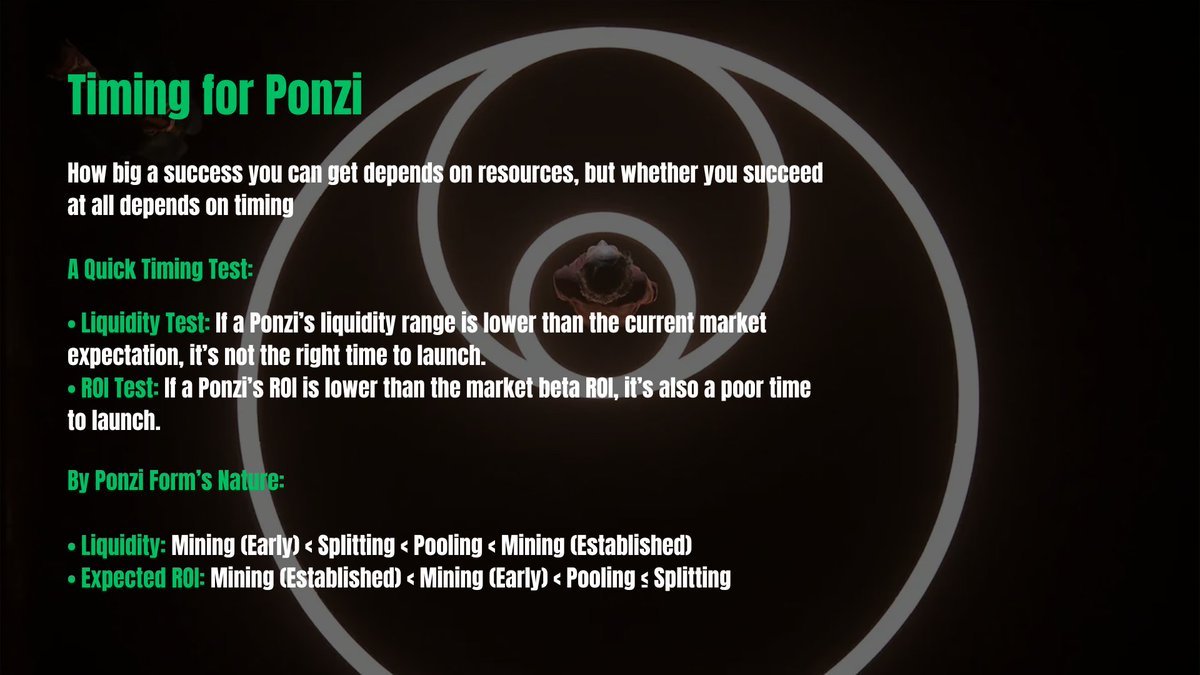
"Every time comes, heaven and earth are all united, and heroes are not free." How successful you can be depends on resources, but whether you can succeed or not depends entirely on timing. Many Ponzi's take off simply by launching at the right time, while others with comprehensive products struggle to break even.
How to evaluate timing?
For crypto users, the primary consideration is the risk-benefit ratio—the balance between perceived risk and expected return.
Two expectations to consider:
Liquidity relative to the market Users are expected to be affected by the average daily trading volume they are accustomed to. For example, in a bull market, $SOL may have a daily trading volume of $1 billion, while in a bear market, most coins only have a daily trading volume of $500,000 on Binance. - Why it matters: Liquidity determines how easy it is for users to convert book value into cash, which is a key factor in decision-making. - How to measure: Analyzing 30 days of DEX and CEX trading volumes can provide clear indicators.
Expected market Beta ROI under similar risk conditions In a bull market, even 100% APY may struggle to attract $1 million in TVL, while in a bear market, everyone may be more inclined to chase the safer 10% mining income. - Why it matters: Users will compare returns based on market conditions and adjust their risk appetite accordingly.
Specific to the plate type:
Liquidity: Mining type (early stage) < Split type < Capital pool type < Mining type (mature stage)
Expected rate of return: Mining type (mature stage) < Mining type (early stage) < Capital pool type ≤ Split type
Quick test:
Liquidity Test: If Ponzi’s liquidity is lower than current market expectations, it is not a good time to launch.
Return test: If Ponzi returns are lower than market beta returns, it is not a good time to launch.
Don't be overconfident, the opportunity is fleeting
Timing is like water, constantly changing. If your resources are insufficient to change the tide, focus on speed: fast delivery and speed to market. In this case, leveraging an industrial, replicable, and cost-effective product framework may become key.
Can Ponzi finally be rationalized?
Honey, isn’t that what we’ve been doing for thousands of years – rationalizing and integrating predatory systems into social normalcy. This process is so efficient that people no longer pursue predictable gains, but instead pursue "give a chance" and blame losses on their own "technical problems." So what is the outcome of the three Ponzi types?
Mining type: evolved into a similar form of mutual funds (by locking TVL dividends, such as mining pools, JITO model)
Fund pool type: evolved into casino (such as PumpdotFun, Crash Games, JLP/GLP pool)
Split type: Evolving into alternative asset markets (such as Bubble Mart, BTC Inscription, NFT, ICO)
before the end
Thank you for taking the time to read this long article. I tried to be concise but comprehensive. The three-pan theory was first released last year as part of my banker teaching project Open Rug (Open Source Sickle) in the Chinese currency circle. This series of articles is derived from the experience I have accumulated over the past eight years. Regardless of victory or failure, the peak capital volume of Ponzi projects exceeded $1 billion, and tens of millions were withdrawn.
Today, the three-pan theory has become one of the most cited analytical frameworks among degens and developers in Asia. From a relatively mild perspective, the three-disk theory is a set of extremely lethal growth hacking methodologies.
The real purpose of the three-pan theory is mainly to disenchant and deconstruct the overly complex and hypocritical narratives woven by the Western currency circle, and to refocus developers' attention on what really matters: through the ubiquitous Ponzi economics, Build a hyper-financial world where everything can be priced, traded, and frictionless.
Of course, the main thing is to make a lot of money.
Hope this helps you, in any way.