The inherent characteristics of the blockchain are causing the liquidity in the on-chain world to be too dispersed, fragmented and severely imbalanced. According to statistics, currently about 80% to 90% of the liquidity is locked in EVM applications, which poses challenges to the establishment and development of emerging ecosystems and inhibits the innovation of Web3. Many emerging ecosystems have to get caught in a continuous battle for liquidity due to the lack of a good multi-chain interoperability solution.
An obvious example is that every time the expected airdrop and wealth creation effect of emerging Layer2 and its related ecosystem applications can attract the attention of users within the circle, but the high cost and threshold of entering a new public chain make most users hesitate. These users mostly come from mature ecosystems such as Ethereum and BNB Chain, but the high cost and high threshold of traditional cross-chain bridges hinder most users from participating. In the post-DeFi era, the industry has always been exploring how to achieve efficient, secure and low-cost flow of assets across multiple chains, while providing users with a seamless user experience.
PicWe project is one of the many explorers, the project is based on a series of technical solutions such as the Omni-Chain Permissionless Bidding Orchestration Protocol (OPBOP), Dynamic Liquidity Matrix (DLM), and Programmable Token Transfer, and has launched the industry's first cross-chain trading model with no-bridge and no-trust transaction mode (CATM) on Movement, in order to build the next-generation cross-chain liquidity infrastructure.
As an innovator in the cross-chain field, PicWe's solutions have been widely recognized by the market. It is reported that the project stood out from 2,100 participating projects and won the first prize in the DeFi track at the "Battle of Olympus" hackathon event held by Movement Labs. At the same time, PicWe has shown impressive growth momentum in the past three months. Since its launch, the project has attracted 727,000 users, processed 221,000 interactions from 163,000 unique addresses, and achieved a total trading volume of $326 million.

As an outstanding representative of cross-chain solutions in the Movement ecosystem, PicWe has not only consolidated its leading position in the Movement ecosystem, but is also rapidly emerging as one of the best cross-chain liquidity infrastructures.
How does PicWe achieve cross-chain interaction without bridges?
In traditional cross-chain transactions, cross-chain bridges usually play an important role as an intermediary, often using a series of methods such as locking and wrapping to help traders transfer assets across different chains. Although traditional cross-chain bridges have made a huge contribution to the early liquidity interaction in the on-chain world, their drawbacks are also very obvious.
In fact, for a cross-chain transaction based on a cross-chain bridge, it usually involves a series of operations such as locking, minting and redeeming, and each step usually requires the user to pay a Gas fee, so a cross-chain transaction not only brings a relatively high friction cost to the user, but also invisibly increases many cumbersome transaction steps and higher transaction latency. Of course, traditional cross-chain bridges even exacerbate the fragmentation of liquidity, with some cross-chain solutions choosing to exist in the form of independent wrapped tokens on different chains, such as WBTC, which reduces the overall liquidity and availability of the assets.
An even more noteworthy issue is security, as many cross-chain bridges rely on centralized or semi-centralized custodians to ensure the security of the locked assets on the source chain, which leads to an extremely high single point of failure. Even if some PoS validators are introduced, as the liquidity of a single chain decreases, the attack cost will be greatly reduced, thereby increasing the risk of being attacked by malicious actors. In fact, the security incidents caused by the early exploration of interoperability are countless, which not only sparked controversy, but many people have also lost confidence in it.
Previously, Connext founder Arjun Bhuptani proposed the concept of the "interoperability trilemma", pointing out that it is difficult to simultaneously satisfy the following three characteristics when achieving interoperability between blockchains: universality (the ability to transfer any data between two chains), scalability (the ability to quickly deploy on heterogeneous chains), and trustlessness (minimizing trust assumptions).
It can be seen that cross-chain bridges have indeed played a very important role in the development of the industry, but they are just a temporary solution, and are definitely not the final state of cross-chain solutions.
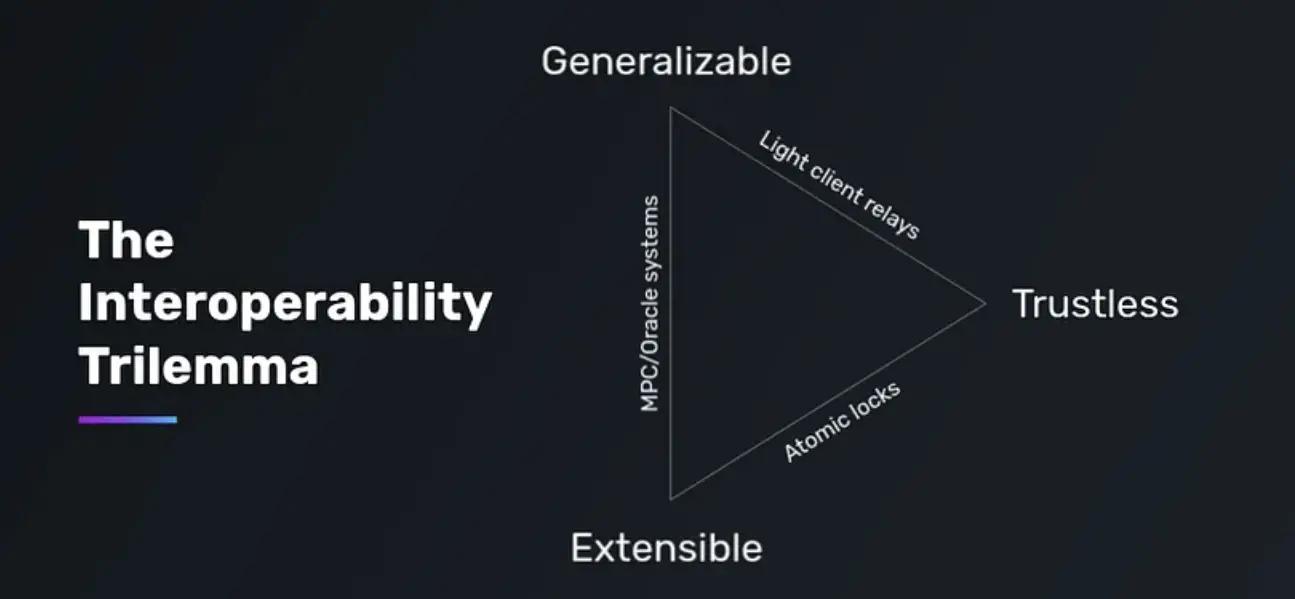
Figure: The Blockchain Trilemma
For PicWe, it did not choose to continue innovating on the basis of the existing cross-chain bridge approach, but rather built a decentralized cross-chain interaction system without the need for intermediaries by introducing a series of solutions such as state channels and liquidity incentives. Users only need to perform verification on the source chain to realize cross-chain asset transactions across multiple chains.
Chain Abstraction Transaction Model (CATM)
PicWe's cross-chain transaction system is mainly driven by the Chain Abstraction Transaction Model (CATM), in which contracts deployed on multiple chains are responsible for updating and coordinating transaction states, and a unique Omni-Chain Permissionless Bidding Orchestration Protocol is built to serve different chain pairs at any time.
In fact, the cross-chain liquidity of traditional cross-chain bridges mainly relies on locking sufficient assets on both the source chain and the target chain to ensure the parity on both sides of the chain. When the target chain's asset reserves are insufficient, cross-chain will become inefficient or even impossible to achieve. However, the CATM model of PicWe does not rely on locking or minting assets to guarantee liquidity, but rather builds a set of LP systems with incentives to "seek outward".
Specifically, the contracts deployed by PicWe, whether on the source chain or the target chain, can be understood as a cross-chain liquidity pool, which is provided by the LP role and has incentives attached.
When a user with cross-chain transaction needs, deposits assets into the source chain contract, it is similar to injecting assets into the liquidity pool of the source chain, and selects the corresponding target chain and fills in the address, and completes the multi-chain payment request to the Omni-Chain Permissionless Bidding Orchestration Protocol after single-chain signing to generate an order. After the contract records the user's assets, the distributed relayers will be responsible for safely transmitting the user's transaction status on the source chain to the target chain, including transaction date, ledger, order details, etc., to realize the transfer of status and data.
As for the target chain contract, after verifying that the signature of the source chain contract is valid and checking that the source chain transaction meets the required number of block confirmations (delayed confirmation to prevent double-spending, oracle manipulation, flash loans, etc.), the target chain contract pool will finally release the assets to the user's specified address.
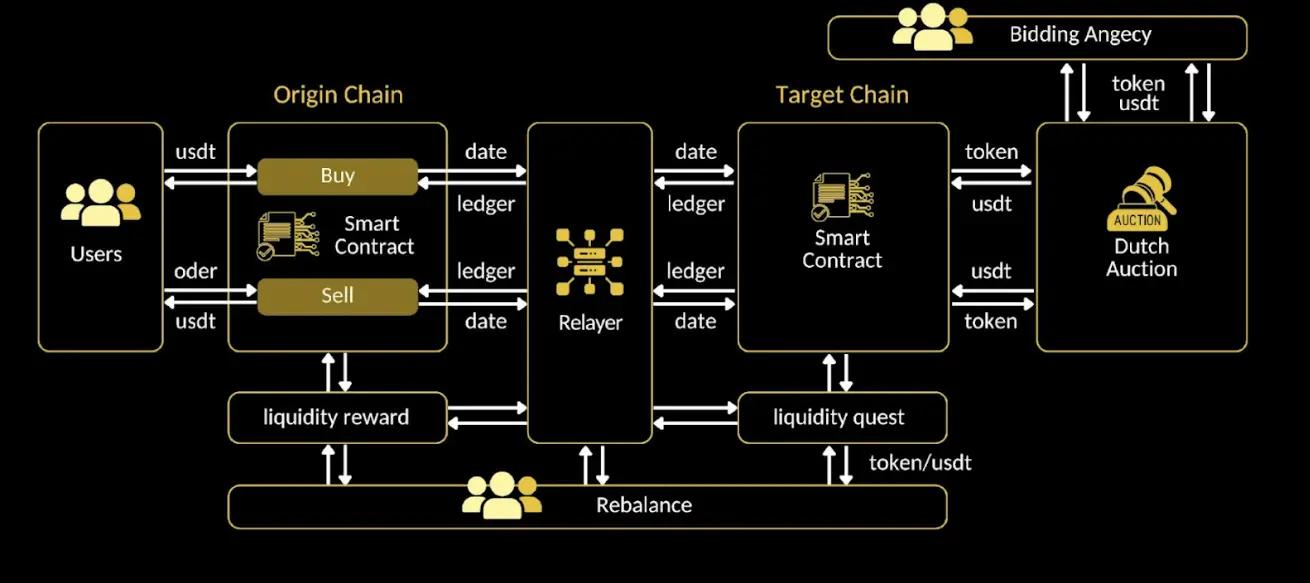
Most importantly, the CATM system has the ability to continuously rebalance liquidity.
In the past, LP users could obtain Farming incentives by providing liquidity to the contract pools on different chains, in order to ensure that the contract pools or fund pools on different chains have sufficient liquidity and maintain dynamism.
When the liquidity on the target chain is insufficient, PicWe seeks more assets from LPs or other liquidity providers through a Dutch auction, the feature of which is that an initial price is set for a certain asset, and the token price continues to decrease as the liquidity becomes more abundant (the incentive effect continues to decrease). For LPs, the liquidity difference represents an arbitrage opportunity, and the higher the difference, the greater the arbitrage opportunity, so at the beginning of a Dutch auction transaction, a large number of LP arbitrageurs will be instantly attracted to participate, ensuring that the target chain contract pool recovers liquidity as quickly as possible, while also ensuring that the cost of liquidity replenishment is optimal.
Based on this system, if the liquidity of a certain chain is insufficient, PicWe will also transfer assets from other chains to the chain lacking liquidity through the above Rebalance mechanism to ensure the sufficiency and balance of liquidity across different chains.
Benefiting from PicWe's cross-chain liquidity capabilities and the liquidity differentials between different chains, liquidity providers can earn yields simultaneously on multiple chains, breaking the constraints of single-chain liquidity pools, and investors can also optimize their returns by aggregating the liquidity yields across all supported chains.
Therefore, we can see that in the above process, PicWe's solution does not involve the minting and redemption of native tokens, nor does it require the custody of user assets, and PicWe itself directly transmits the native asset information from the source chain to the target chain based on the programmable token transmission technology,maintaining the native state and liquidity integrity of the assets on the source and target chains, and maximizing the cross-chain efficiency of the assets, while maintaining the complete decentralization of the entire process.
"Multi, Fast, Good, Cheap" Bridgeless Solution
Based on the above technical features, PicWe's bridgeless solution is presenting the advantages of "multi, fast, good, and cheap".
Multi
Traditional cross-chain solutions are limited by the token types provided by the liquidity pools, and cannot support the cross-chain purchase of mid-to-long-tail assets, such as it is difficult for us to directly use the USDT on the Base chain to buy the PNUT asset on the Solana chain.
This is like shopping in a supermarket or warehouse, where users can only buy the specified commodities (Tokens) provided by the suppliers (LPs). Due to the cost of inventory, the categories of commodities that supermarkets and warehouses can buy are limited. To buy any commodity, you can only do so through online P2P.
PicWe's Omni-Chain Permissionless Bidding Orchestration Protocol (OPBOP) is creating a decentralized "online mall" where users can buy any Token on any chain, allowing users to use the USDT of any chain to purchase any asset on any chain through PicWe.
Fast
Traditional cross-chain solutions require users to first exchange the assets on the source chain (such as USDT) into the assets accepted by the cross-chain bridge (such as ETH) before they can be cross-chained. After the cross-chain is completed, the assets still need to be exchanged into the assets they want to buy (such as exchanging ETH for PEPE). The entire transaction process has too many steps and a long chain, resulting in a poor user experience.
When purchasing assets across all chains through PicWe, the process can be completed in one step on the chain, without the need for cross-chain or Swap. Whether it is an EVM chain or a heterogeneous chain, the transaction can be completed within 1 minute.
Good
PicWe's bridgeless solution breaks the shackles of the Blockchain Trilemma. It realizes the on-chain interaction of assets across all chains in a completely decentralized way, avoiding the risks of past cross-chain protocols being able to use and transfer user assets. This bridgeless solution never "touches" user assets from start to finish, avoiding both project misconduct and hacker attacks.
Cheap
The bridgeless solution can save cross-chain bridge fees, Swap fees, and Gas fees. The currently popular intent trading and chain abstraction solutions only replace the user's complex cross-chain operations, but the multiple Swap, cross-chain, Gas, and other fees generated still need to be borne by the user. Through PicWe, users essentially pay USDT to directly purchase the Token on the target chain, and can save all intermediate fees, with the cost of each transaction controlled within 1 USDT.
Currently, PicWe has taken the lead in practicing this solution on the Movement stack, and based on the Movement network, PicWe supports users to seamlessly trade assets on any blockchain, such as traders can use USDT on the Movement network to purchase any tokens on other chains, including BTC on the Bitcoin blockchain.
PicWe's Capital Efficiency
Through the unique Dynamic Liquidity Matrix (DLM) technology,in terms of cross-chain capital efficiency, PicWe has obvious advantages over traditional cross-chain solutions. The LP pools provided by PicWe are no longer the traditional single trading pair pools, and their USDT pools are providing liquidity for different trading pairs at all times. And it is provided on demand, the USDT in the pool will only provide liquidity for the corresponding Token when the user submits a transaction demand for a certain Token, which greatly improves the profitability of the LP pool.
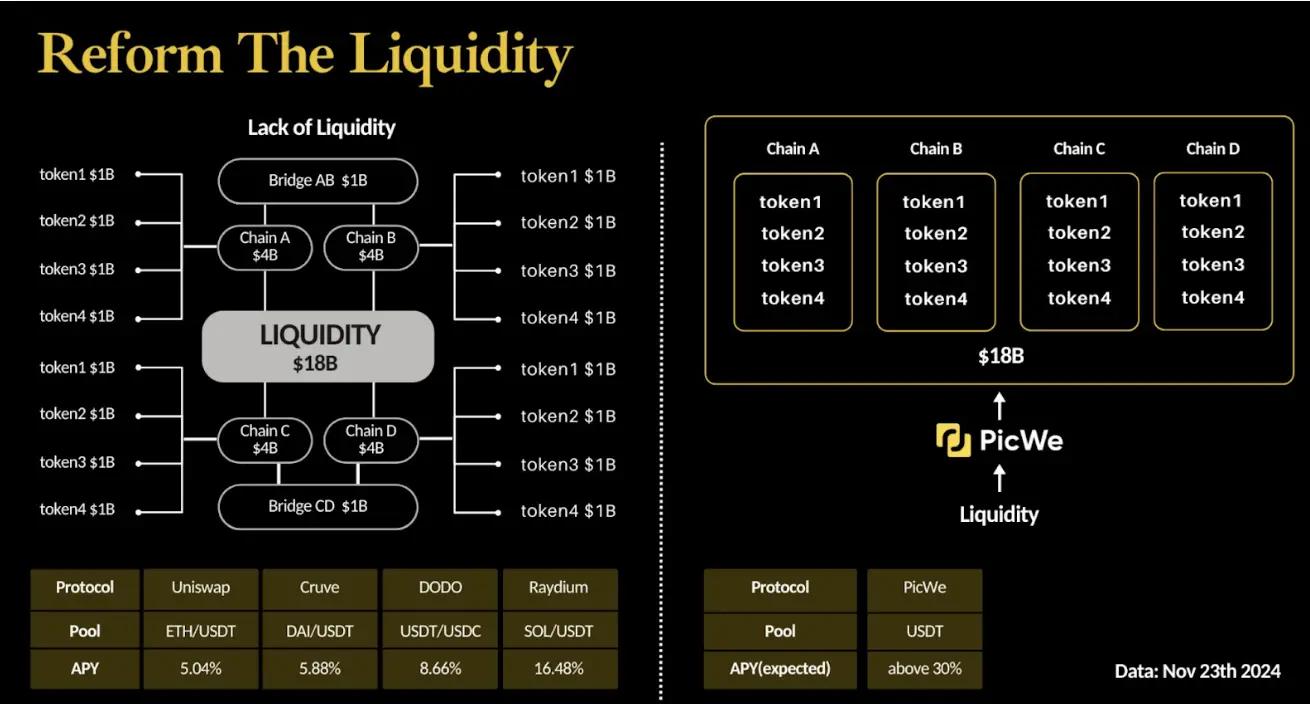
We can see that in the figure on the left is the traditional liquidity solution, and on the right is the PicWe solution.
In the example of the traditional liquidity solution, the total liquidity is $18B, but this liquidity is scattered across different chains and bridges:
- Each chain (such as Chain A, Chain B, Chain C, Chain D) has $4B in liquidity, and the bridges (such as Bridge AB and Bridge CD) each hold $1B in liquidity.
- There are multiple assets (Token1, Token2, Token3, Token4) on each chain, and the liquidity for each asset is $1B.
We can see intuitively that the liquidity in traditional cross-chain bridge solutions is highly fragmented, and the liquidity between different chains and bridges cannot be interconnected, resulting in low capital utilization. When the liquidity on a single chain or bridge is insufficient to meet large transaction demands, it is easy to cause price slippage, and the assets on each chain are independent of each other, making it difficult to integrate and utilize.
In PicWe's solution, the dynamic liquidity matrix abstracts the chains and integrates the scattered $18B liquidity into a unified pool that can be called across chains, and the assets (Token1, Token2, Token3, Token4) on each chain are interconnected through the PicWe system. After the liquidity is unified, users on each chain can share the overall liquidity, avoiding transaction failures or high slippage due to insufficient on-chain assets.
At the same time, based on the CATM trading system and dynamic liquidity matrix, PicWe does not need to inject ineffective liquidity into each chain separately, significantly optimizing capital allocation, and can also provide liquidity providers with up to 30% APY through PicWe's protocol. From the current stage, the LP returns provided by mainstream DEXs are usually not more than 10%, and due to the long-term sufficient liquidity, their considerable LP arbitrage opportunities are not many.
The income of PicWe comes from liquidity differentials, and the liquidity differentials between different assets and different chains must be long-term, which means that PicWe will be able to provide considerable arbitrage income for LP users all year round, and thus ensure the efficiency of the cross-chain system, while meeting the needs of multiple roles.
B2B2C
From the perspective of end-user (C-end) users, PicWe can be a good tool for cross-chain asset trading and yield generation, but PicWe is not just To C, but aims to take the B2B2C route.
In fact, PicWe is not just defined as a tool, but more as a underlying cross-chain liquidity infrastructure, which opens up SDKs to allow all on-chain applications to integrate with it and obtain the ability to expand across all chains through its technical solutions.
For example, for a DEX, it can integrate with PicWe based on its SDK, and the DEX will be able to further provide users with cross-chain trading capabilities, and even based on this, provide some innovative trading products and derivatives product lines, enhancing the platform's functionality and capturing users through better potential returns. For PicWe, by becoming the underlying infrastructure and serving B-end applications, it can indirectly bring the users of these partners into its ecosystem and accelerate the scalable adoption of its solutions.
Summary
PicWe is reshaping the cross-chain interoperability system, creating a new solution through the CATM-driven cross-chain architecture. Its bridgeless architecture not only minimizes liquidity fragmentation and enhances security, but also significantly reduces the cost of cross-chain interoperability. At the same time, with the OLBC model, PicWe provides a robust mechanism to maintain network stability and incentivize liquidity contributors.
As a new cross-chain interoperability system, PicWe not only breaks through the "interoperability trilemma", but also provides a scalable alternative to traditional cross-chain bridges. Meanwhile, through new expansion and combination methods, it redefines the paradigm of cross-chain interoperability, providing a new foundation for the transition from decentralization to unification in the on-chain world.
About PicWe
Relying on a series of technical solutions, including the Omni-Chain Permissionless Bidding Orchestration Protocol (OPBOP), Dynamic Liquidity Matrix (DLM), and Programmable Token Transfer, PicWe has launched the industry's first cross-chain trading model with a bridge-free, trustless transaction mode (CATM) on the Movement platform. This initiative aims to build the next-generation cross-chain liquidity infrastructure.
By building this cross-chain liquidity infrastructure, PicWe hopes to drive innovation in decentralized finance and bring endless possibilities to the B2B2C market.