Jessy, Jinse Finance
After reaching a new high of $543 on November 21, 2024, the stock of MicroStrategy has been declining and is currently down 44% from its peak, trading at $300. In comparison, the price of BTC has only dropped around 10% from its all-time high of $107,000.
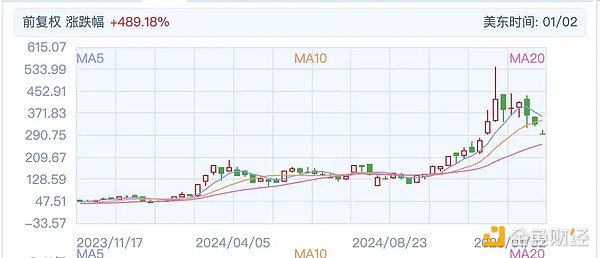
MicroStrategy stock price movement
Prior to the decline, MicroStrategy's stock price had surged nearly 30-fold from $20 in 2020 due to its aggressive purchase of BTC.
MicroStrategy's stock price has risen along with the price of BTC, being dubbed a "shadow BTC," and its price increase has far exceeded the rise in BTC.
Now, this leveraged BTC has also declined ahead of BTC, with a much larger pullback than BTC.
Why has MicroStrategy's stock price declined? Is there further downside risk?
Why did it rise?
To understand the sharp decline in MicroStrategy's stock price, we need to first understand why it had surged previously and what was supporting its valuation.
In 2020, MicroStrategy began purchasing BTC, becoming the first U.S. publicly-traded company to integrate BTC as a reserve asset. MicroStrategy announced its first BTC purchase of around 21,000 BTC, worth over $250 million, when BTC was trading below $10,000.
Initially, MicroStrategy used cash to purchase BTC, but later shifted to raising funds through the issuance and sale of stocks and convertible bonds.
Currently, MicroStrategy holds a total of 446,400 BTC, with a market value of around $45 billion and a total purchase cost of $27.9 billion.
Originally a software company, MicroStrategy's image has transformed into a "shadow BTC" company after its BTC purchases. From October 2000 to September 2020, MicroStrategy's stock price remained below $20 per share. However, as it continued to accumulate BTC, its stock price began to decouple from its core business and became more of a BTC-related concept stock.
Thanks to its strategy of actively buying BTC over the years, MicroStrategy's stock price has surged nearly 30-fold from $20 in 2020 to a peak of $543.
During the bull market, MicroStrategy's stock price has become a leveraged play on BTC, with its recent gains far exceeding the rise in BTC.
The main reasons for the stock price increase are:
1. MicroStrategy holds a large amount of BTC, and as BTC prices rise, the company's asset value increases, driving its stock price higher.
2. The market has a generally optimistic outlook on the continued rise of BTC, and the enthusiasm in the cryptocurrency market and investor optimism have increased the demand for MicroStrategy's stock, pushing the price higher.
3. The company has raised funds through the issuance of stocks and convertible bonds to purchase BTC, forming a "financing - purchasing BTC - increasing market value - re-financing" cycle, which has attracted investors and driven the stock price up.
From the above analysis, we can see that MicroStrategy's stock price is highly dependent on BTC. Its stock price appreciation has been supported by investors' confidence and expectations of continued BTC price increases.
Why did it decline?
As MicroStrategy's stock price continued to rise, the short-seller Hindenburg Research stated on social media platform X that they were shorting MicroStrategy, arguing that the company's trading volume had completely decoupled from BTC's fundamentals, and its market capitalization greatly exceeded the actual value of its BTC holdings.
As Hindenburg pointed out, MicroStrategy currently holds 446,400 BTC, with a market value of around $45 billion, accounting for over 2% of the global BTC supply. At the peak of MicroStrategy's stock price, its market capitalization exceeded $100 billion, more than double the value of its BTC holdings. However, MicroStrategy's core business is in intelligent software, which has not been very profitable, as evidenced by its financial reports showing increased net losses and lower-than-expected revenue in the third quarter of 2024.
MicroStrategy's stock price began to decline after reaching a peak of $543 on November 21, for the following reasons:
1. Doubts about MicroStrategy's BTC investment strategy
Currently, MicroStrategy is using the issuance of convertible bonds to purchase BTC. Statistics show that MicroStrategy has issued around $13 billion in stocks and $3 billion in convertible bonds, all of which have been used to buy BTC. Since October 31, MicroStrategy has been continuously purchasing BTC for eight consecutive weeks, accumulating an additional 19,418 BTC.
MicroStrategy's most recent BTC purchases have been made at an average price of around $97,000, and after these purchases, BTC has experienced declines. Although MicroStrategy continues to issue debt to purchase BTC, the current purchase prices are already quite high, which has caused investors to be concerned about the company's investment decisions and financial condition, affecting the stock price.
Moreover, MicroStrategy has almost completely shifted its business model to BTC, relying heavily on BTC price fluctuations and market performance. The company's business concentration has brought higher risks. When the BTC market experiences volatility or investor interest in BTC weakens, MicroStrategy's stock price will be significantly impacted.
2. MicroStrategy's leveraged ETFs have exacerbated stock price volatility
MicroStrategy is a leveraged play on BTC, and the related ETFs are leveraged plays on MicroStrategy's stock price. In other words, MicroStrategy itself is a leveraged bet on BTC, while the current MicroStrategy leveraged ETFs are designed for investors who want to take more aggressive positions on MicroStrategy's stock.
Funds like those from Tuttle Capital and Defiance ETFs, which focus on MicroStrategy's stock to amplify its BTC-related returns, use swaps and options to achieve leverage. However, they have faced liquidity issues, leading to underperformance compared to expectations. Disappointed by the funds' divergent performance, analysts believe the launch of leveraged MicroStrategy ETFs has accelerated the volatility of the stock.
3. Changes in market expectations
MicroStrategy has now been included in the Nasdaq-100 Index (which tracks the 100 largest non-financial companies listed on the Nasdaq), representing it becoming one of the 100 largest companies by market value on the Nasdaq. Companies included in the Nasdaq-100 are typically subject to stricter financial scrutiny and market oversight, which raises the bar for how MicroStrategy manages its BTC assets. While inclusion in the Nasdaq-100 was initially seen as a positive for MicroStrategy's stock price.
However, concerns about the high prices at which MicroStrategy has been purchasing BTC, as well as the stock's sharp rise in the short term, have led the market to worry about the potential for a bubble. When market concerns about a bubble intensify, investors often choose to sell stocks to avoid risks, leading to a significant stock price decline.
4. Macroeconomic factors
Similar to the recent correction in BTC, MicroStrategy's stock price is also susceptible to the influence of macroeconomic conditions. With U.S. bond yields remaining elevated and the U.S. dollar index repeatedly rising, there are even concerns that the U.S. may restart interest rate hikes if inflation rebounds in 2025. The current uncertainty in the global economy, rising interest rates, and inflationary pressures may lead to a decrease in investor risk appetite, reducing investment in high-risk assets like MicroStrategy's stock.
5. More followers of micro-strategies, coupled with the launch of Bitcoin spot ETFs, have greatly reduced the scarcity of their stocks
Seeing the profitability of micro-strategies issuing bonds to buy Bitcoin and thus inflating their own stock prices, many listed companies have followed suit, such as mining company Marathon Digital and Japanese investment company Metaplanet.
With a large number of companies entering this track, the scarcity of micro-strategy stocks has been greatly reduced. In the traditional financial market, if people want to invest in "leveraged Bitcoin", they also have other company stocks to choose from, and they can also choose Bitcoin spot ETFs.
Can Microstrategy stocks still be bought?
To put it bluntly - not recommended.
Currently, the biggest uncertainty factor in the investment market is macroeconomic factors. After Trump's return to the White House, his announced policy of across-the-board tariff hikes has a lot of uncertainty. If a tariff policy of up to 60% on China and 25% on other countries is implemented, it may trigger an escalation of global trade frictions, which not only will reshape the global trade pattern, but may also impact US inflation, GDP, currency value and various investment channels, and thus have a major impact on the US stock market.
The Federal Reserve's interest rate policy currently has extremely high uncertainty. The market originally expected the Federal Reserve to continue to cut interest rates in 2025, but Federal Reserve Chairman Powell's statement in December 2024 was more cautious. If the Federal Reserve's interest rate decision is inconsistent with market expectations, such as less-than-expected rate cuts or sudden rate hikes, this will trigger a major adjustment in the US stock market.
Currently, as a leveraged Bitcoin, Microstrategy's stock price has already been relatively high, although it has fallen 44% from its peak, but it still maintains a more than tenfold increase from the time the company first bought Bitcoin. This is far higher than the increase in Bitcoin. On the other hand, the company's current market value is also far higher than the market value of its Bitcoin reserves. This all indicates that the company's stock has a relatively large bubble.
Bitcoin's price may continue to rise in the future, and Microstrategy's continued bond issuance and Bitcoin buying behavior may also push up its stock price again, but it can be foreseen that as a stock that has been discovered in value, the only thing supporting its stock price is the price of Bitcoin and the leverage it adds to Bitcoin. Bitcoin will not be replaced, but Microstrategy's narrative will become outdated and be replaced.
In summary, the current risk of getting on board Microstrategy stocks is greater than the return.