The new US President Trump had promised to establish a Bit reserve in the US even before winning the election last November, which has raised great expectations in the entire cryptocurrency community.
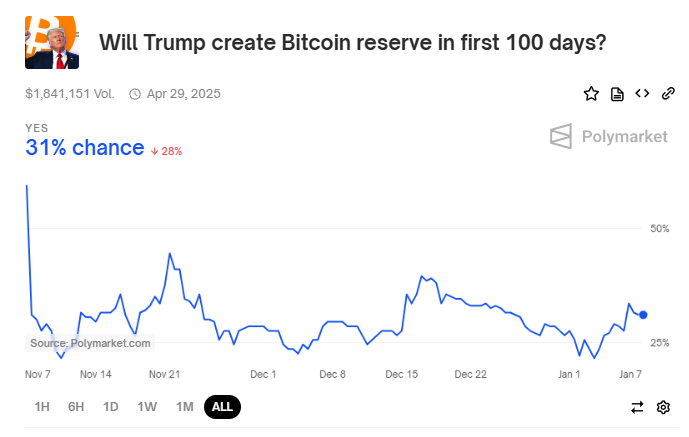
However, just before Trump's formal inauguration on the 20th of this month, data from the decentralized prediction platform Polymarket shows that people believe the probability of Trump establishing a Bit reserve in his first 100 days in office is only 31%, far lower than the 60% at the beginning of November last year when Trump won the election.
Netizen: The priority is to ensure that Bit is not sold
Regarding this, a netizen commented under this prediction that this is actually easy to do, because the US government already holds a large amount of Bit, and Trump only needs to sign an executive order after taking office to transfer the Bit in the US Department of Justice's wallet to a new wallet and guarantee that it will not be sold, which does not require the US government to immediately spend money to purchase Bit, but this represents Trump's determination to establish a Bit reserve.
In addition, Anthony Scaramucci, the founder of Skybridge Capital and former White House communications director, also said in a recent interview with the Bankless Podcast that the US government plans to purchase a large amount of Bit, possibly up to 500,000 Bit, and it will be reviewed by the Senate.
Scaramucci's core argument in support of establishing a strategic Bit reserve is to compare it with gold. The US currently has about $600 billion in gold reserves, and he believes that even if a small portion of it is converted to Bit, or even selling part of the gold reserves, it can strengthen the US economy in the digital transformation era.
However, some experts believe it's not that simple. From the perspective of the US executive order or legislative process, if Trump wants to implement the Bit strategic reserve plan, he needs to have the Crypto Currency Committee conduct policy research and feasibility assessment immediately after taking office, and then formally propose a plan, which can then be carried out through two paths:
Path 1: Presidential Executive Order (as early as the second half of 2025)
Trump issuing an executive order after taking office is the fastest path, as it can bypass the resistance from conservative and opposing forces such as the Federal Reserve and Congress, and it can refer to the draft provided by the "Bit Policy Institute" to instruct the US Treasury Department to directly allocate Bit using the Exchange Stabilization Fund (ESF).
However, although this method is fast and convenient, it also has side effects. Although the Treasury Department's Exchange Stabilization Fund can be allocated without Congressional approval, it can be investigated by Congress and legislatively restricted. Executive orders can also be overturned and modified by the next president, so their sustainability and stability are not as good as legislation.
Path 2: Congressional Legislation (as early as the second half of 2026)
If a more stable legislative path is taken, a longer process is required. After the Crypto Currency Committee conducts policy research and feasibility assessment, the bill needs to be submitted to Congress and reviewed by the Senate Banking Committee, then passed by the Senate, House of Representatives, and signed by the President before it can be officially enacted into law.
This process may experience various back-and-forth struggles and is relatively complex, as many conservative lawmakers will certainly raise objections and obstruct it. Therefore, although this path can obtain a lasting and stable law, it will take a long time, and it is unlikely to be implemented until the second half of 2026 or 2027.
Recently, the crypto industry is pushing Trump's team to issue an executive order on the first day of his next month's inauguration, to kick off the crypto policy reform he has promised, and help promote the mainstream adoption of crypto, so if an executive order is issued, the Bit strategic reserve may be implemented as early as the middle of 2025.
Czech Republic Considers Establishing Bit Reserve
With Trump's proposal to establish a Bit reserve, current officials in Japan, Russia, and Europe have also begun discussing this possibility. The well-known business magazine Forbes even boldly predicted that by 2025, the G7 group or the BRICS countries may all establish Bit reserves, triggering a global Bit reserve race, making Bit's status on par with gold, foreign exchange reserves, and sovereign bonds.
Just yesterday (7th), the Governor of the Czech National Bank, Aleš Michl, stated in an interview with CNN that they are currently considering including Bit in the diversification of the country's foreign exchange reserves, and the government's interest in cryptocurrencies is also increasing.
However, the Czech National Bank currently has no plans to immediately purchase crypto assets, and whether the plan will be approved and implemented in the future remains to be decided by a vote of the board members.