Author: E2M Research
Network Data Comparison
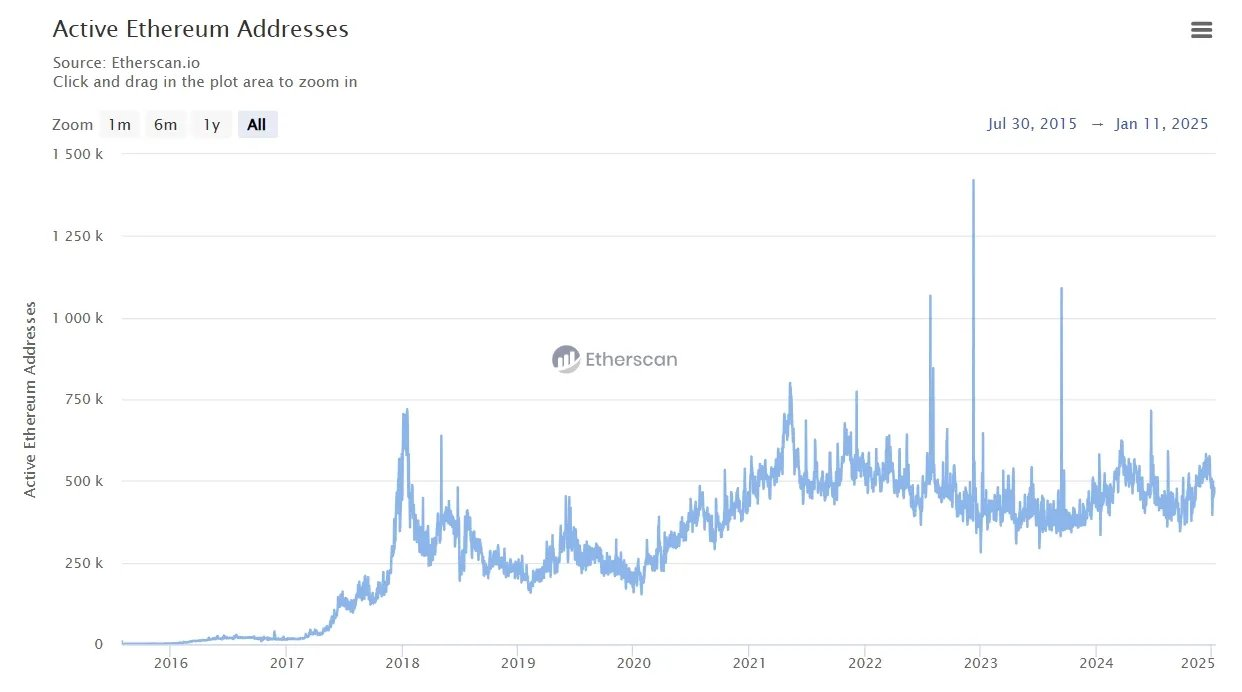
Looking at active user data, the daily active users of the Ethereum ecosystem, the mainnet, are basically maintained at 400,000-500,000.
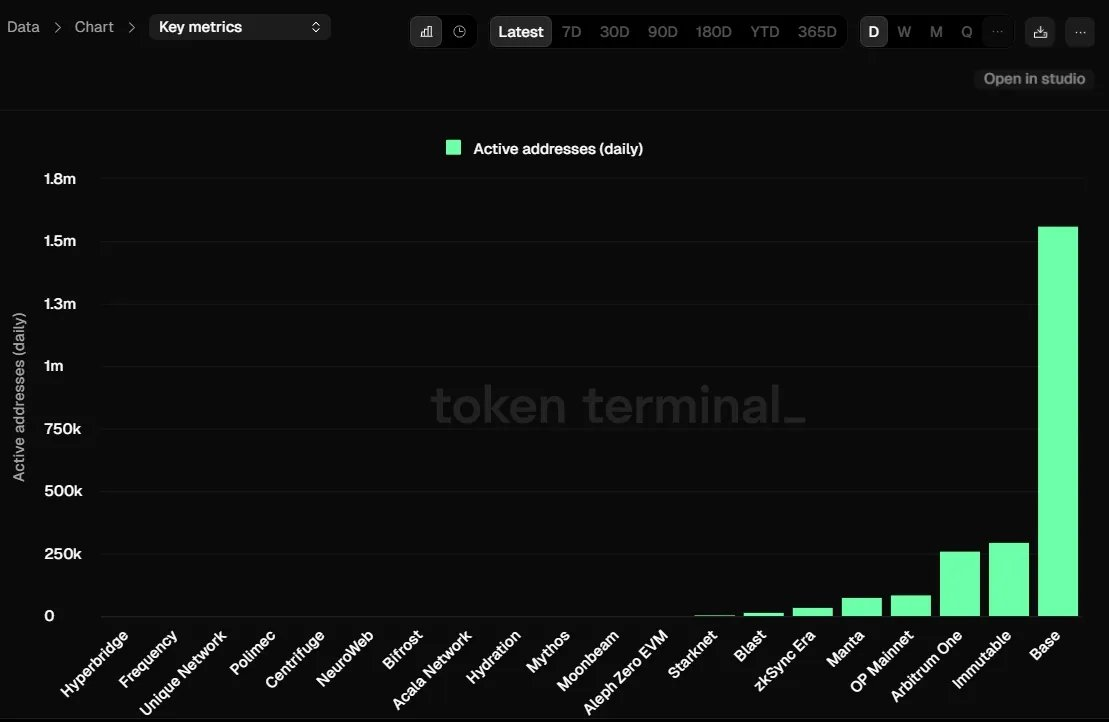
In terms of Layer2, Base occupies the vast majority, with about 1.5 million daily active users. Immutable is about 300,000, Arbitrum is about 260,000, and OP is about 90,000. All data added to the mainnet is less than 3 million daily active users.
Solana's data has seen a significant increase since 2024, showing a typical "bowling alley" S-shaped growth. It now maintains around 5 million daily active users.
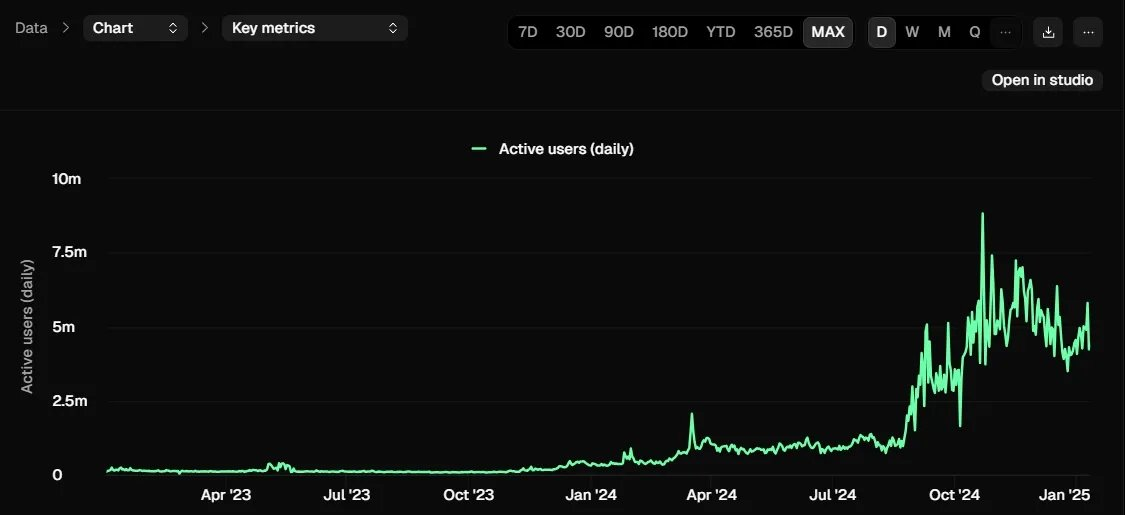
From the daily active user data, Solana's data has already surpassed the Ethereum ecosystem, at 5 million vs. 3 million.
This is different from the previous data boom of BSC, as the BSC data boom was still using the Ethereum EVM architecture, which was essentially influenced by the Ethereum architecture and could not have a huge impact on Ethereum's position. But Solana uses a completely different architecture, similar to the Chimp company, hoping to establish its own standard. If a large number of users enter the Solana ecosystem, it will drive project parties to migrate to the Solana ecosystem.
Recently, projects like PENGU have issued tokens on Solana, and projects like DePin and AI Agent are more inclined to issue assets on Solana, and the issuance of assets will also drive the increase in DEX trading volume. This can be referenced by comparing the data of mainstream DEXs:
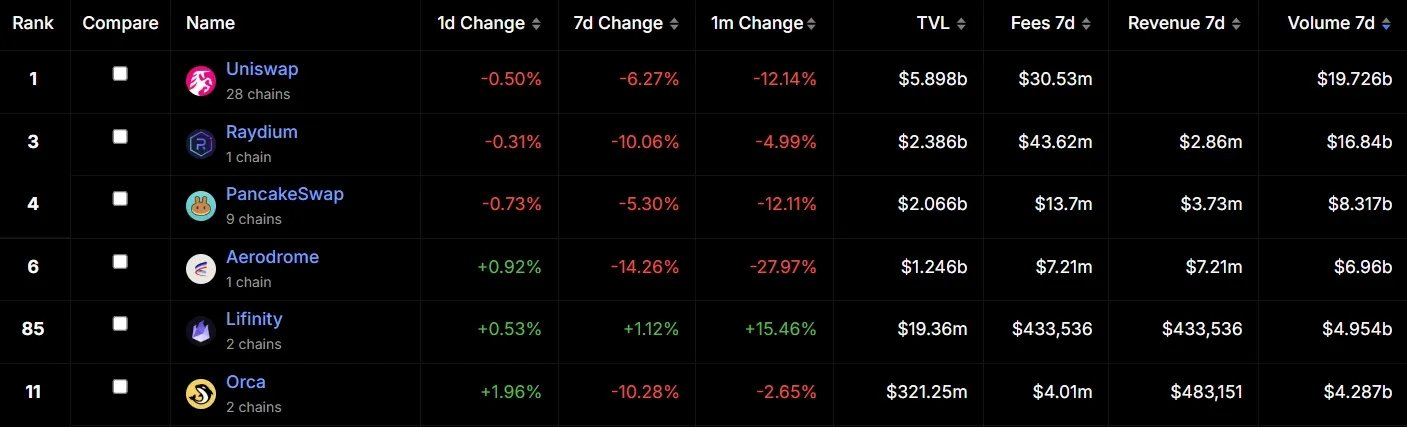
There are some differences in the statistics among different platforms, but this does not affect the analysis. Taking defillama as an example, the trading volume of the Ethereum ecosystem and the Solana ecosystem is basically at the same level.
In terms of fees, Solana has an advantage, mainly because meme transaction users are less sensitive to high transaction fees.
Project Revenue Data
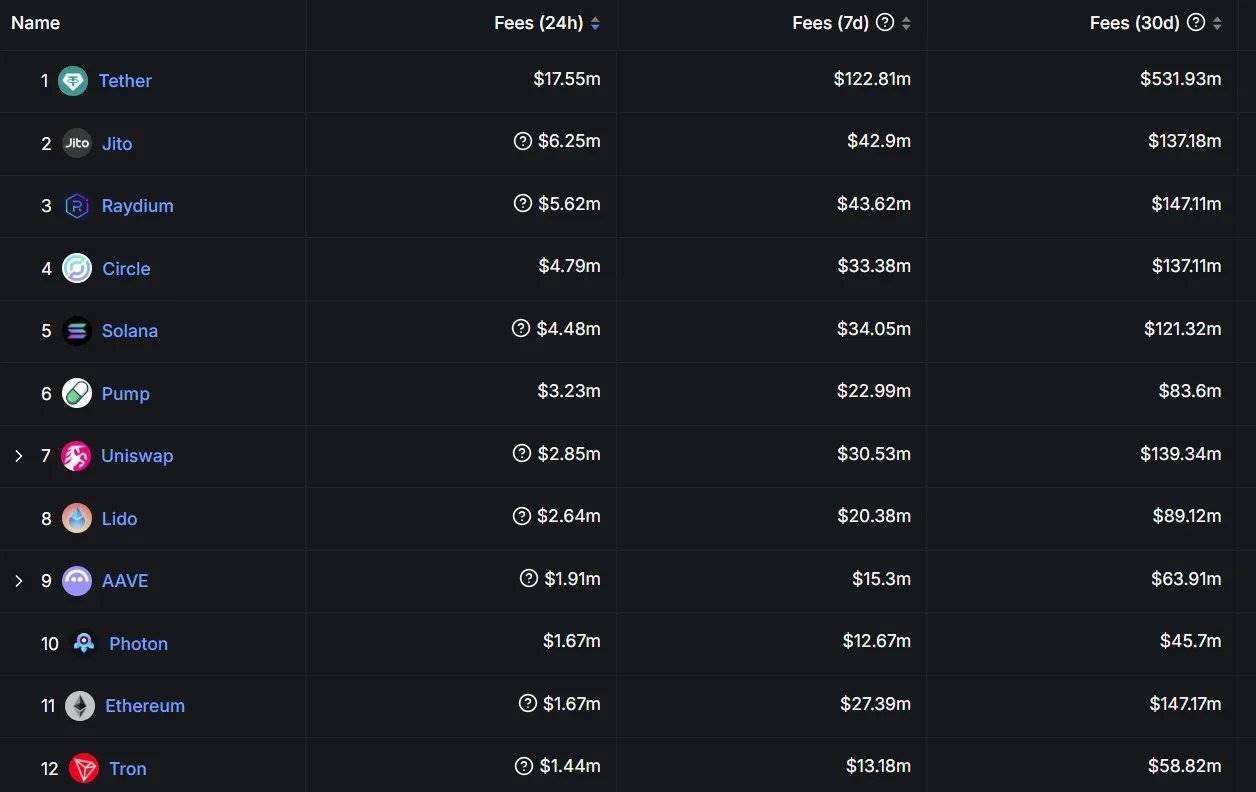
The following is the ranking of 24-hour revenue data of projects, and it can be seen that except for the stablecoins Tether and Circle, the rest are mainly from the Solana ecosystem. This data can be seen as an expensive signal, representing the willingness of users to pay for products. It can be seen that projects in the Solana ecosystem are clearly more popular.
Another point worth noting is that the revenue of the public chains themselves is not the highest, for example, Solana, Ethereum and TRON are lower than the mainstream applications on the chain. This is a debate about whether the "fat protocol" or the "fat application" captures more value, but currently, it seems that applications capture more value.
The reason may be that the applications on each chain are currently monopolized by a few applications. If the ecosystem develops to a larger scale, this phenomenon should weaken.
Fidelity's Report
The Fidelity Digital Assets 2025 Outlook Report also made a comparison between Ethereum and Solana.
The article points out: The Rollup-Centric roadmap aims to scale Ethereum while maintaining the usability of the Layer 1 blockchain. Although the fees on Layer 1 have decreased significantly after the Deneb-Cancun upgrade, the team still believes that although the revenue from the Blob market may not be able to offset the revenue decline caused by the upgrade in the short term, in the long run, this change will bring positive network effects.
The relationship between Layer 2 and Ethereum is a mutually beneficial symbiosis, where Layer 2 benefits from Ethereum by providing low-cost transaction execution and further expanding ETH.
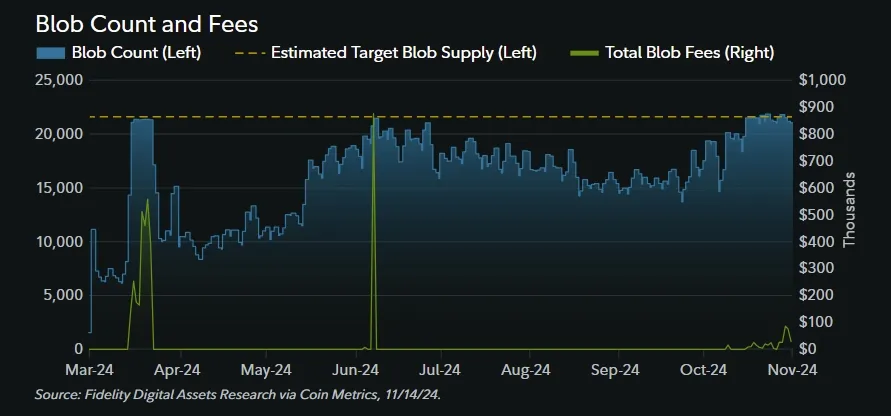
The following figure shows the trend of Blob quantity and Blob fee changes.
Blob fees are seen as a long-term positive driver of the Ethereum network effect, especially helping Layer 2 attract more users to interact with ETH. This does not mean that Ethereum is completely abandoning future cash flow. Developers say the most likely ultimate goal is for cash flow to naturally form as the network effect grows significantly.
Ethereum core developers point out that low fees are a key factor in driving Layer 2 user growth. It is expected that by 2025, there will be more Layer 2 solutions focused on specific use cases. Although Solana seems to have an advantage in the short term, in the long run, the fundamental strength of Ethereum may be more stable.
Ethereum tokens are expected to remain stable after the Deneb-Cancun upgrade, with an estimated annual inflation rate of 0.22% in 2024. Ethereum's expansion plan aims to gradually increase the number of blobs, and more blobs combined with Layer 2 user demand may cause Ethereum's total fees to exceed the annual ETH issuance.
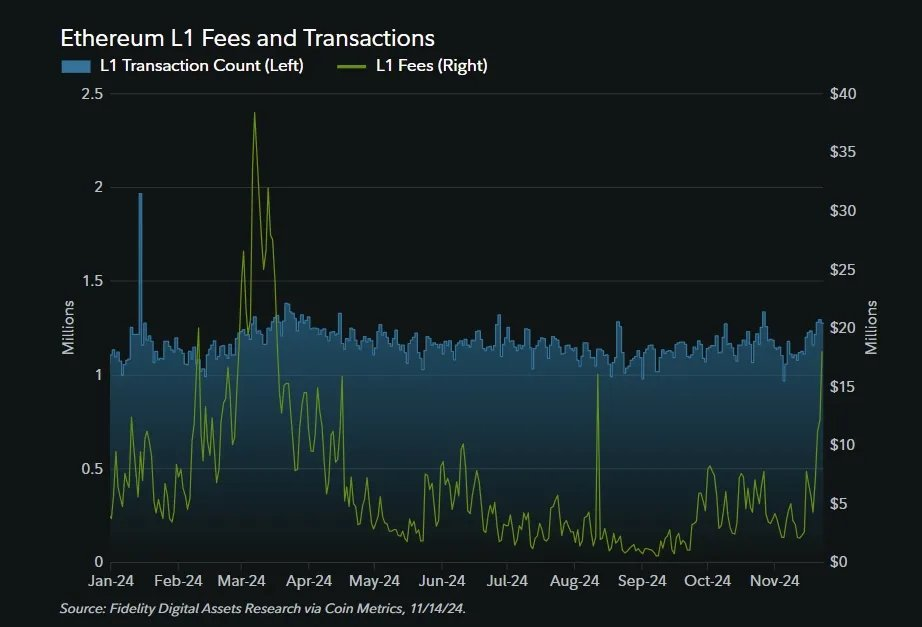
The following figure shows the fees and transaction volume of L1. The data shows that although more transactions are taking place on Layer 2, the transaction volume of Layer 1 has not decreased compared to before the upgrade, even though the Layer 1 transaction fees have decreased significantly. This indicates that even if Ethereum prioritizes Layer 2 improvements, there are still a large number of users choosing to use Layer 1 for transactions.
Thoughts
The above considers the situation when the daily active users are 5 million. The question to consider is, who has a better chance when the daily active users reach 50 million or 500 million?
Given the different characteristics of the two, at a scale of 500 million daily active users, the two ecosystems may present a "division of labor" situation:
Solana is more likely to become the main carrier layer for consumer-level applications, especially in scenarios such as games, social networking, and payments with high-frequency and low-value transactions.
Ethereum (and its Layer 2 ecosystem) may dominate institutional-level services and complex financial applications with high-value transactions.
In summary, Solana may have a greater advantage in pure consumer-level scenarios, which is due to its Web2-like user experience and high-performance characteristics.
But in terms of long-term ecosystem health and security, Ethereum ecosystem, with its modular architecture and mature infrastructure, has stronger sustainability in supporting large-scale adoption. The ideal development path may be for the two ecosystems to develop in their respective advantageous fields, jointly promoting the large-scale adoption of Web3. Of course, if the market grows 100 times, the value captured by ETH should be less than 100 times, with a large portion of the value being captured by Layer2 and upper-layer applications.
Solana Founder's Perspective

Although Ethereum does not have as many users as Solana, just like Apple phones, with a lower market share, they capture the most profit. Is Ethereum in a similar situation?
This is not currently the case. The previous analysis shows that Ethereum actually captures very little value on Layer2, while the applications on the chain capture a large amount of value. If we look at it from a long-term perspective, i.e., a market of 500 million users, Ethereum may dominate institutional-level services and complex financial applications with high-value transactions, a situation similar to Apple's business model, where a small number of high-value transactions can generate greater economic value. As the Layer 2 ecosystem matures, Ethereum will further expand its competitiveness at various value levels. The revenue of public chains is more like paying by space or bytes, rather than by asset value. This leads to their low profitability. Upper-layer applications, on the other hand, have more flexible pricing models and capture higher value. But through Ethereum's expansion approach, if there is a thriving Layer2 ecosystem in the future, the problem of low value capture may be reversed.
Referring to the Chimp game, Solana is more like the Chimp company, which needs to find its own niche market. Now it seems to be the meme issuance and trading market, and then hopes that the Chimp makes mistakes or opens up new markets in the eye of the storm, such as AI Agent. Only when the Chimp company has the prospect of becoming the Chimp company in the new storm, should one consider investing in it. (Even if Solana succeeds, the value may not be captured by SOL.) The meme coin market is not a high-migration-cost proprietary architecture market.
With the development of wallets, support for multi-chain has led to the meme market not being strongly dependent on the underlying public chain architecture. Ethereum has firmly established its foothold in the DeFi industry, which is Ethereum's bowling alley, and the migration cost of the DeFi industry is high, in which Ethereum has an advantage. The stablecoin industry has high switching costs, but its architecture is not related to specific public chains. Bitcoin is a non-proprietary architecture with high switching costs. This represents that the standards of the blockchain industry cannot be copied from the ape game. Consensus seems to be a more important factor, with strong network effects.
Solana has already become an indispensable part of the blockchain, with almost mainstream cross-chain bridges, and multi-chain wallets will prioritize the EVM and Solana chains. The blockchain is an open system, and may not be like the closed ecosystem of each application on the Internet, and the value network can be interchangeable.
It is not necessary to be limited to one ecosystem, users can speculate on memes on Solana and do DeFi on Ethereum. The all-chain wallet or chain abstraction may become a new battleground, because the all-chain wallet is the application closest to the user, and the user's private key management solution, user data identity system, and the derived social network may become the moat of the wallet.
cm: This round of SOL is a worthwhile target, very much like the previous round of Ethereum, and SOL needs to participate in this round of the meme market. Solana has not considered the importance of decentralization, and without decentralization, Solana has an advantage in the Blockchain Trilemma. In the long run, both have their own advantageous markets, but Ethereum's irreplaceability is stronger, and the next Solana may appear, but the next Ethereum is hard to come by.
dz: Bitcoin has no competitors as a value reserve market, Ethereum is permissionless for the global financial market and as a Layer 2 underlying support, and Solana is currently just a meme casino with low irreplaceability.