Author of the original article: Noam Segal, Crypto KOL
Original article compiled by: Felix, PANews
Crypto KOL Noam Segal has published a report on the use of technical tools (with over 6,500 participants). The survey covered 13 categories, from AI assistants to project management to CRM (customer relationship management). In addition to asking "what tools are you using", it also asked people what their favorite tools are, what tools disappoint them, and what they would switch to if possible.
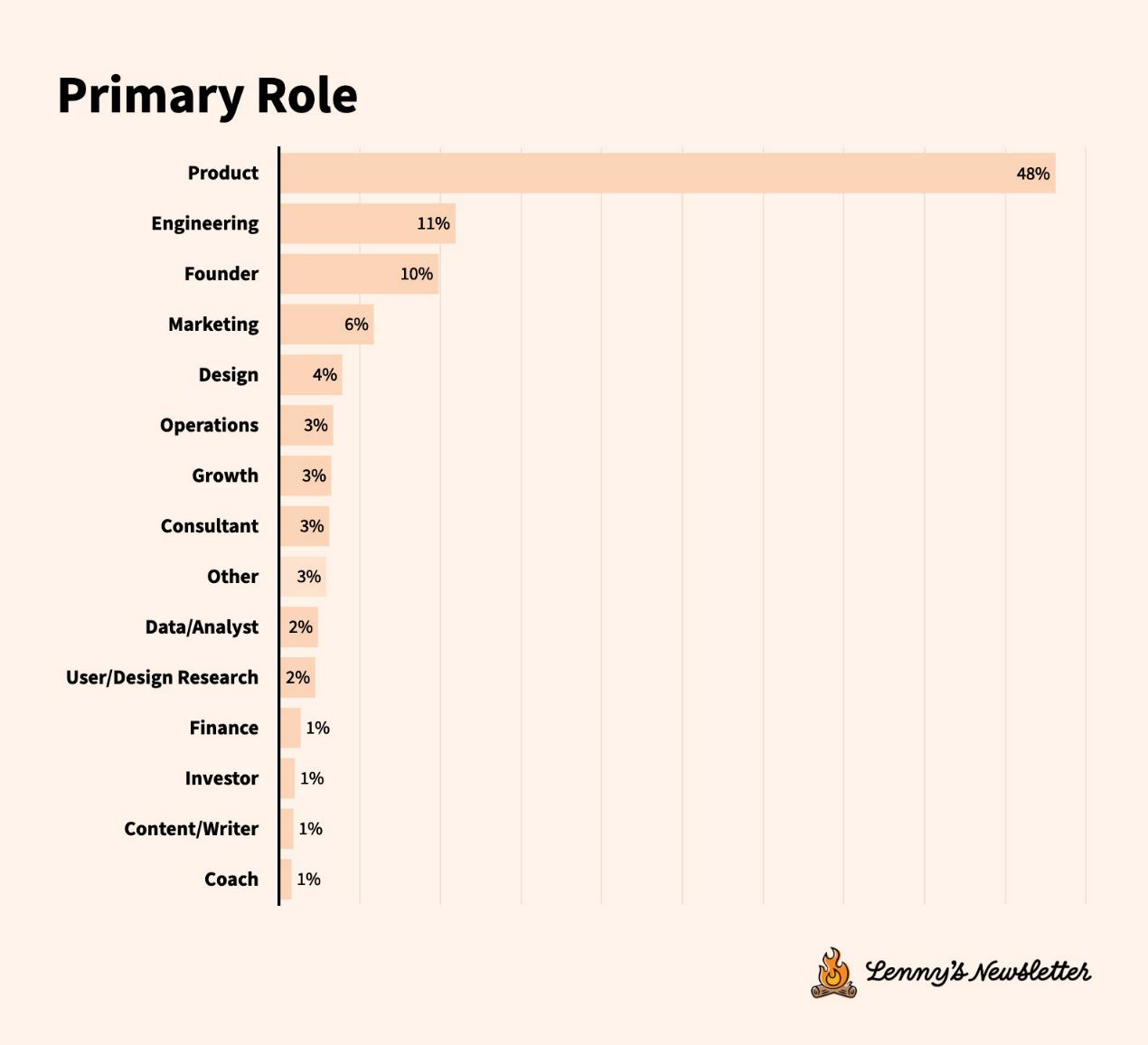
Among the respondents, 50% are in product roles, 11% are engineers, 10% are founders, and the rest are in other cross-functional roles including marketing, design and growth.
The breakdown of the company sizes of the respondents is as follows:
About 45% work in companies with 1 to 100 employees
About 25% work in companies with 101 to 1,000 employees
About 20% work in companies with 1,001 to 5,000 employees
If we define companies with less than 1,000 employees as "non-enterprise", then about 70% of the respondents work in startups or mid-sized companies, which can be considered an early adopter group.
10 key points:
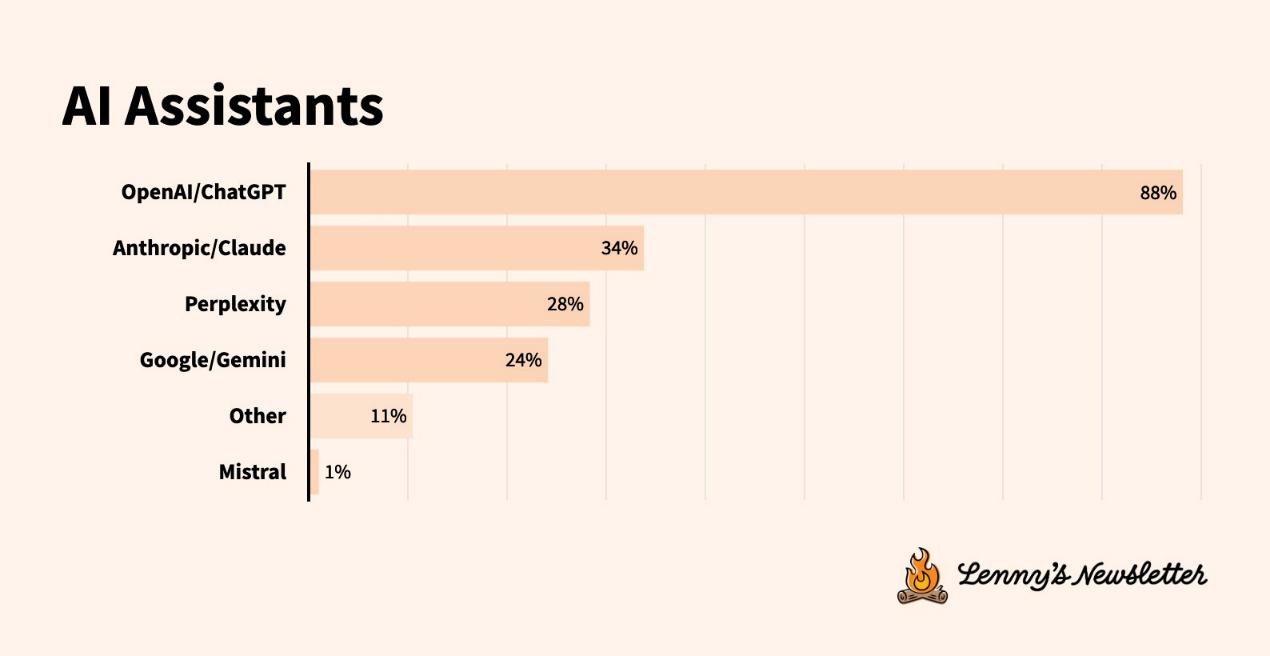
ChatGPT is way ahead. 90% of respondents use ChatGPT regularly. Only 35% use Claude, 24% use Gemini.
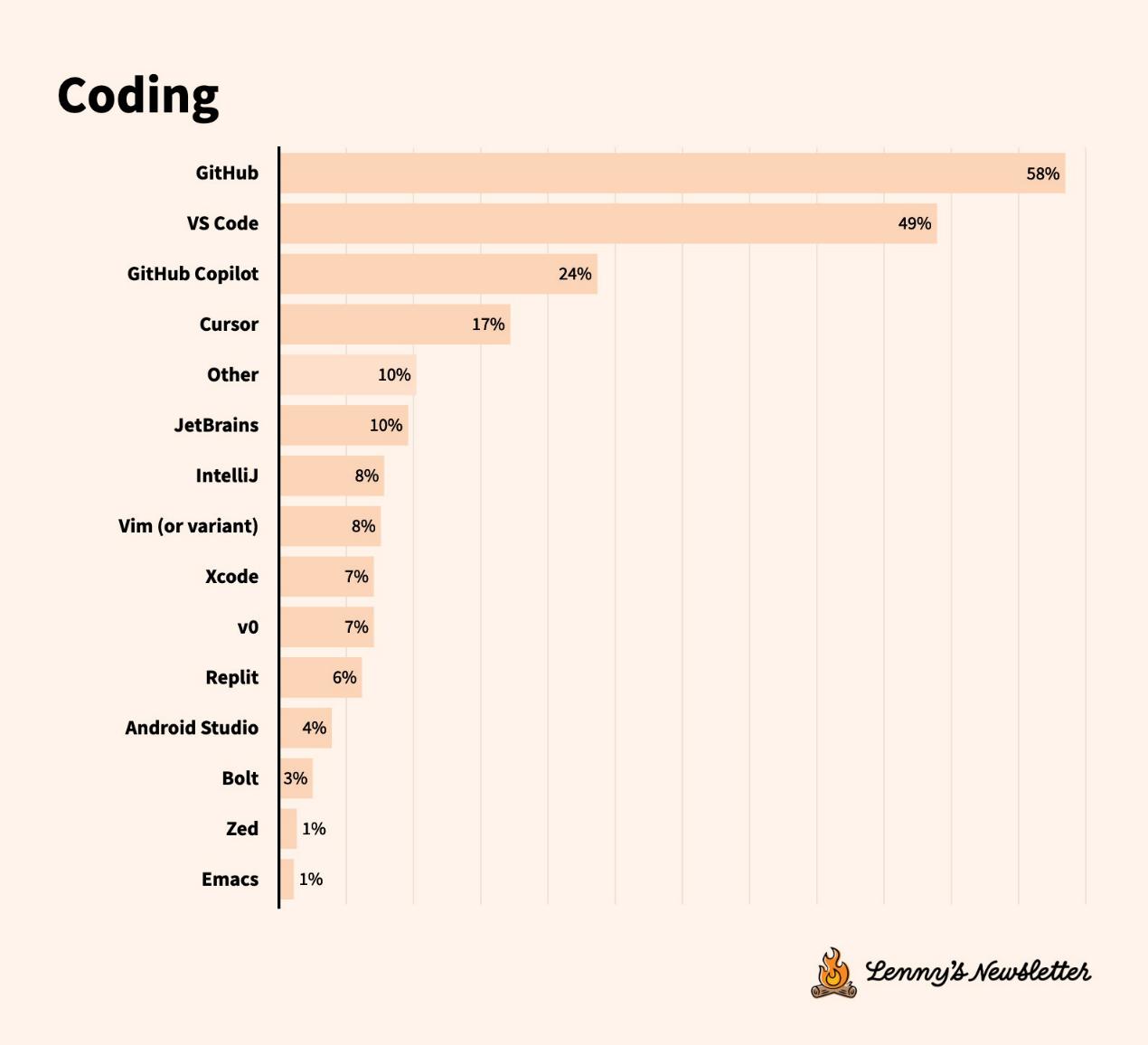
Cursor and other AI-native integrated development environment (IDE) tools are rapidly emerging. 17% of respondents use Cursor (launched two years ago) regularly. 10% use v 0 and Replit. 5% use Bolt.
As the third most commonly used tool overall, Slack continues to dominate. 72% of participants use Slack regularly, second only to ChatGTP and Gmail.
68% of participants use Jira, but it also tops the list of "tools they wish they could use something else". Linear is the fastest growing Jira alternative, with over 10% of respondents using it.
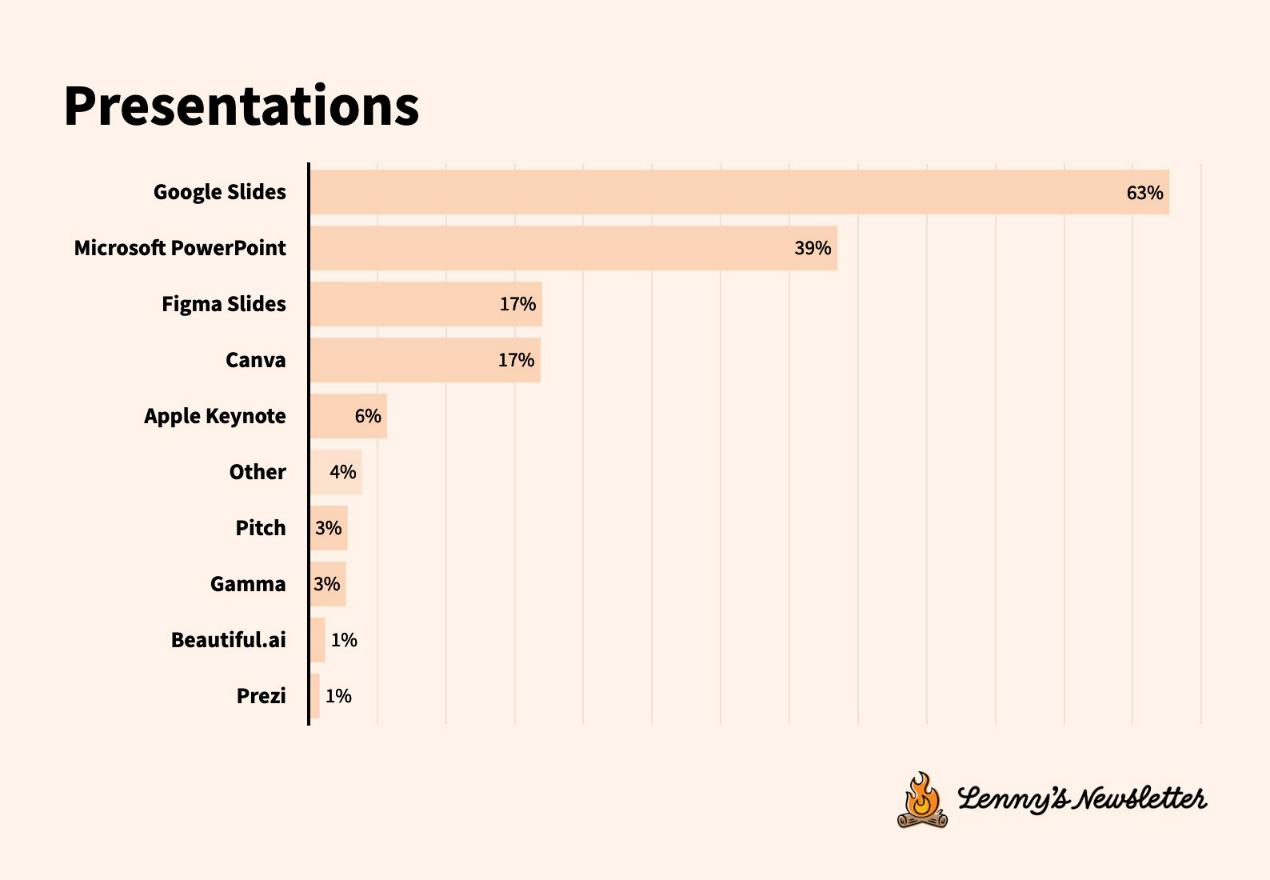
Figma Slides and Canva have become important presentation tools, far surpassing Apple Keynote and approaching PowerPoint.
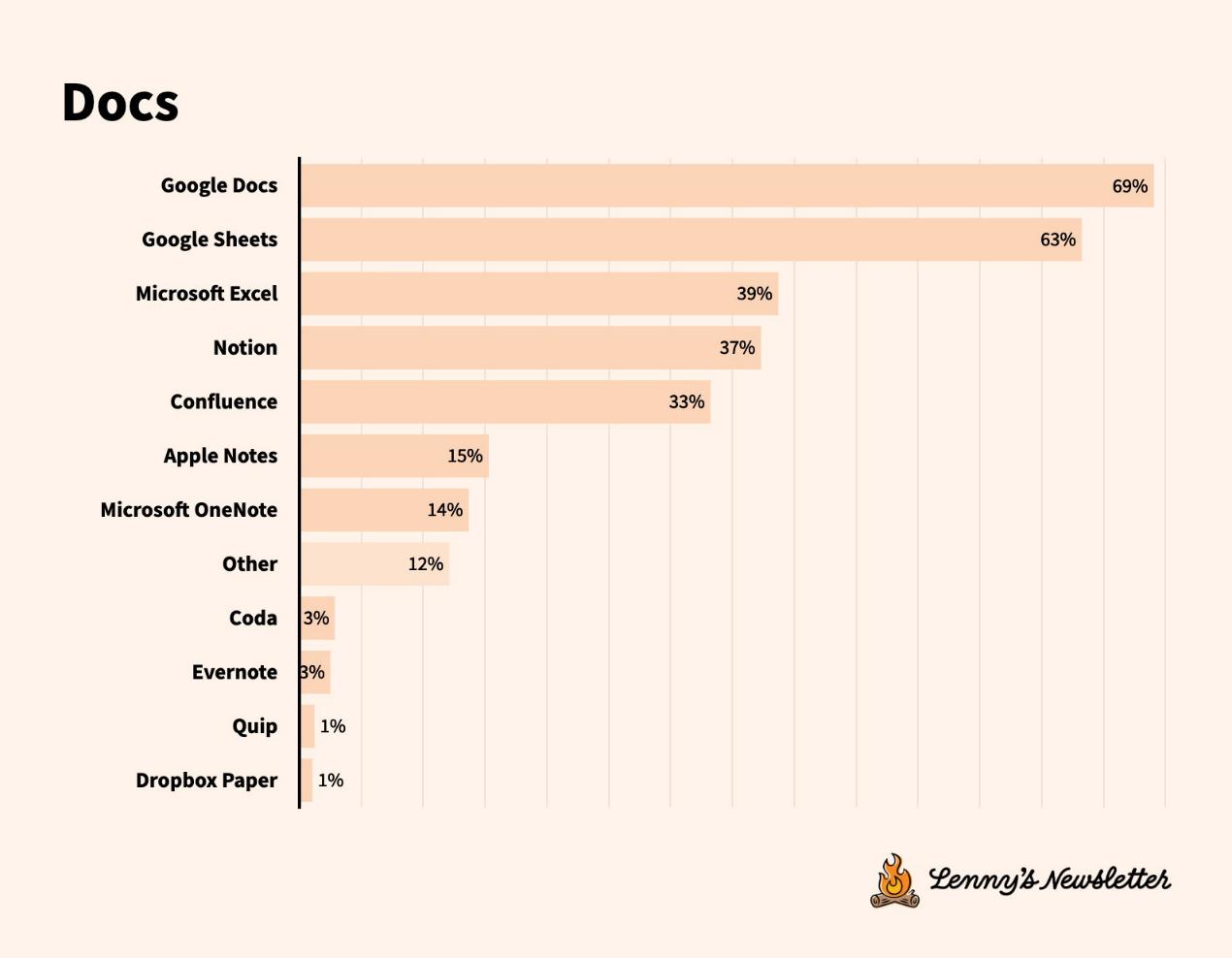
Google Docs remains the collaboration tool of choice, but Notion is on a strong growth trajectory. Notion is seen as "universal" and is catching up to other well-known tools, with 37% of respondents preferring Notion. Notion also ranks second after Jira in project management, and fourth in CRM.
Figma remains the ubiquitous design tool. 97% of designers say they use it as their primary design tool. Canva is still far behind, but is catching up, thanks to widespread adoption by marketers and founders for general design needs.
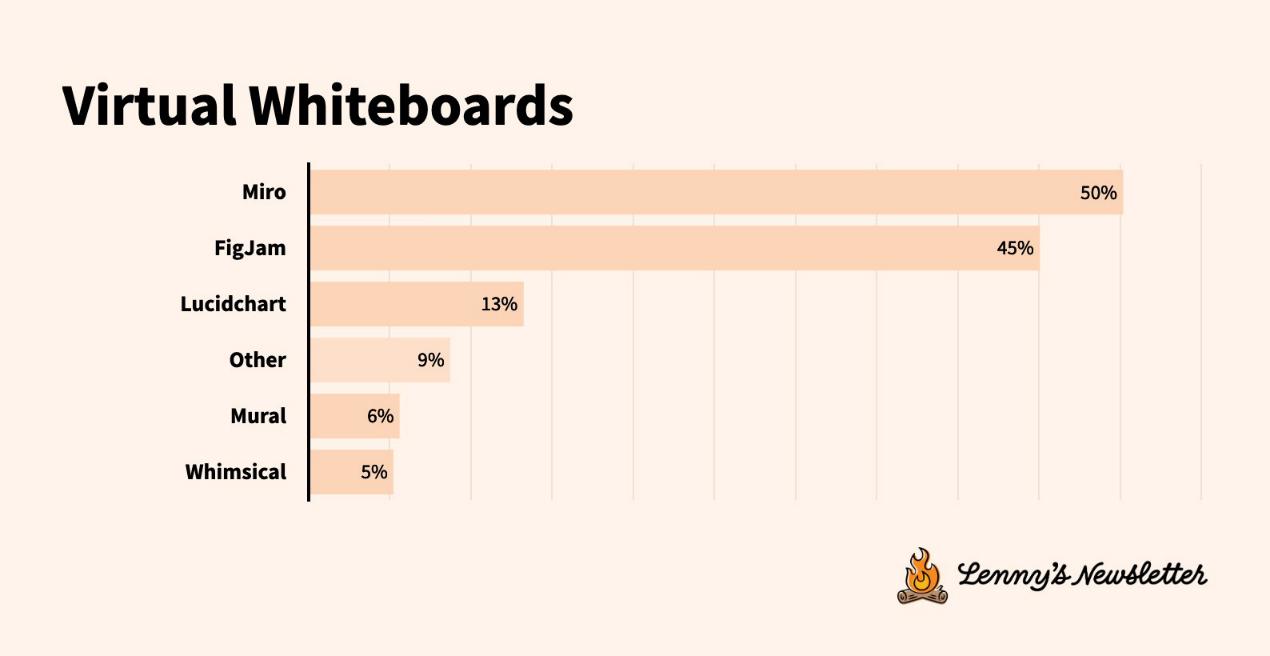
Miro continues to lead FigJam in virtual whiteboards, but only slightly. However, FigJam is making progress.
Notion and Slack are surprises in CRM and customer support. It turns out that tool flexibility is very important, even in the face of powerful existing enterprise tools.
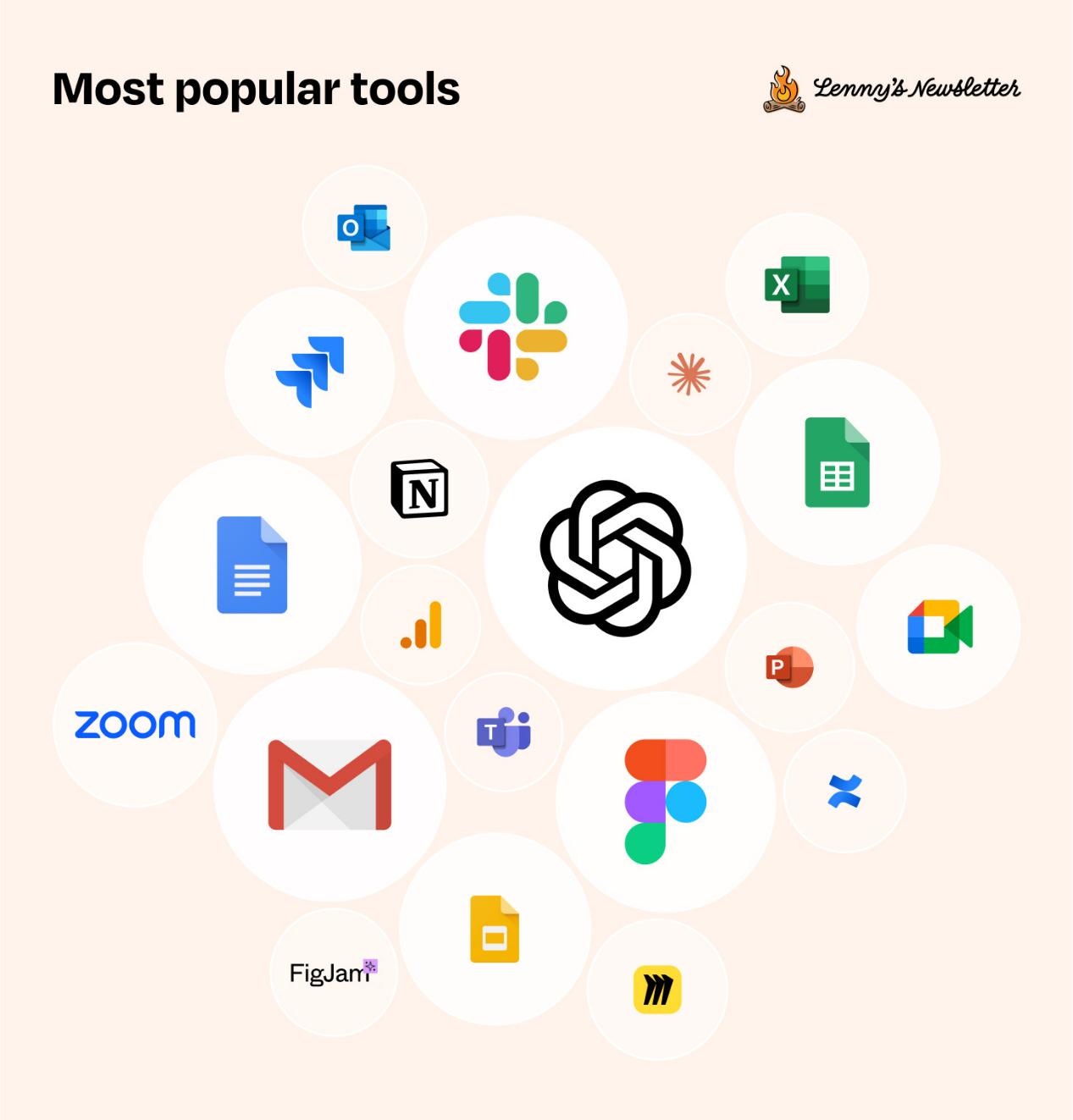
Three key themes: bundling, elegant design, and mashups. More details below.
ChatGPT is way ahead
What is the most significant shift since 2022? AI tools have become as important as laptops. Up to 90% of respondents use ChatGPT regularly. This is the most significant shift in the product team's tech stack recently. More respondents use ChatGPT than use Gmail (76%) or Slack (71%).
Interestingly, over 50% of respondents combine AI assistants for specific use cases:
ChatGPT + Claude as thought partners
ChatGPT + Perplexity for in-depth research
ChatGPT + Gemini for Google Workspace integration
AI tools for specific roles are also gaining popularity:
40% of engineers use GitHub Copilot regularly
21% of engineers adopt Cursor
While tools like ChatPRD and Grammarly are not mentioned, they are also gaining traction.
Cursor and other AI-native IDEs are rapidly emerging
The second most significant shift in the tech stack is the emergence of AI-native development environments. Although tools like Cursor were only launched in 2023, they are used by 17% of the overall respondents (and 21% of the engineers in the sample). Nearly 10% of respondents have used tools like v 0 and Replit, and 5% are using Bolt. 60% of these are product people, and 40% are other roles including engineers, founders, consultants, marketers, designers, and UX researchers. Most of these tools were launched over a year ago.
This rapid adoption indicates a strong desire from developers to simplify coding and integrate tools into their coding workflows.
While nearly two-thirds of respondents use GitHub, the most popular "other" tool is GitLab, GitHub's main competitor.
VS Code has a significant presence among engineers, with an adoption rate of 48%. The success of VS Code reflects its technical capabilities as well as Microsoft's successful development of the platform into a highly extensible, community-driven tool.
Slack continues to dominate as the third most commonly used tool
In previous surveys, Slack ranked overall number one. This trend continues here, with 72% of respondents using Slack as their primary communication tool (second only to Gmail).
Technically, Microsoft Teams has around 33% market share, but this is due to their enterprise bundling strategy, and the actual usage is not as high as people might think. As mentioned in the "tools they wish they could use something else" section, users do not like using Teams.

Why has Slack been able to stand out? Two hypotheses:
People have a low opinion of the user experience of Teams. There are rumors that it is cumbersome, slow, and even "unusable". In terms of user experience, Slack comes out on top.
According to public data, Microsoft Teams is primarily used by non-technical companies and has been adopted by most large enterprises in the US. In contrast, Slack is primarily used by startups to mid-sized companies. Most of the respondents in this survey work at companies where Slack dominates.
Another interesting finding: up to 20% of respondents use WhatsApp for work communication, and Telegram has also made progress in work communication, with 15% of respondents who chose "other tools" using Telegram daily. WhatsApp and Telegram were never designed as work communication tools, but a significant number of people are using them as such.
The Jira paradox and the rise of Linear
This is an interesting paradox: Jira dominates the project management market (used by 53% of tech teams, the largest share), but it also tops the "tools they wish they could use something else" list. Its deep integration with development workflows, bundling with other products, and enterprise-focused feature set lock teams in.
Feedback from respondents indicates that Jira is overly complex, difficult to learn and use. One respondent said, "Jira is a mess, poor performance, and hard to maintain. It's too complex, feature-bloated and has a terrible user experience." Another participant said, "Jira is too complex/bloated for our needs. I find it cumbersome and feel it could be much more simplified in its functionality."
Here is the English translation of the text, with the specified terms retained and not translated:Linear: The fastest-growing Jira alternative, founded in 2019, has over 10% of participants using it (compared to only 10 mentions in the last survey). Respondents praised its modern, intuitive interface and simplified workflow management. An engineering manager said: "Just switched from the Atlassian suite to Linear, it's more useful for milestones and flexibility. Easier to filter views and build personal workspaces." Linear's popularity is on par with Asana, which was founded in 2008.
Meanwhile, Notion has become the second most popular project management tool and the fourth most popular document tool, and it is also gaining popularity as a CRM tool. Respondents unanimously praised its flexibility. 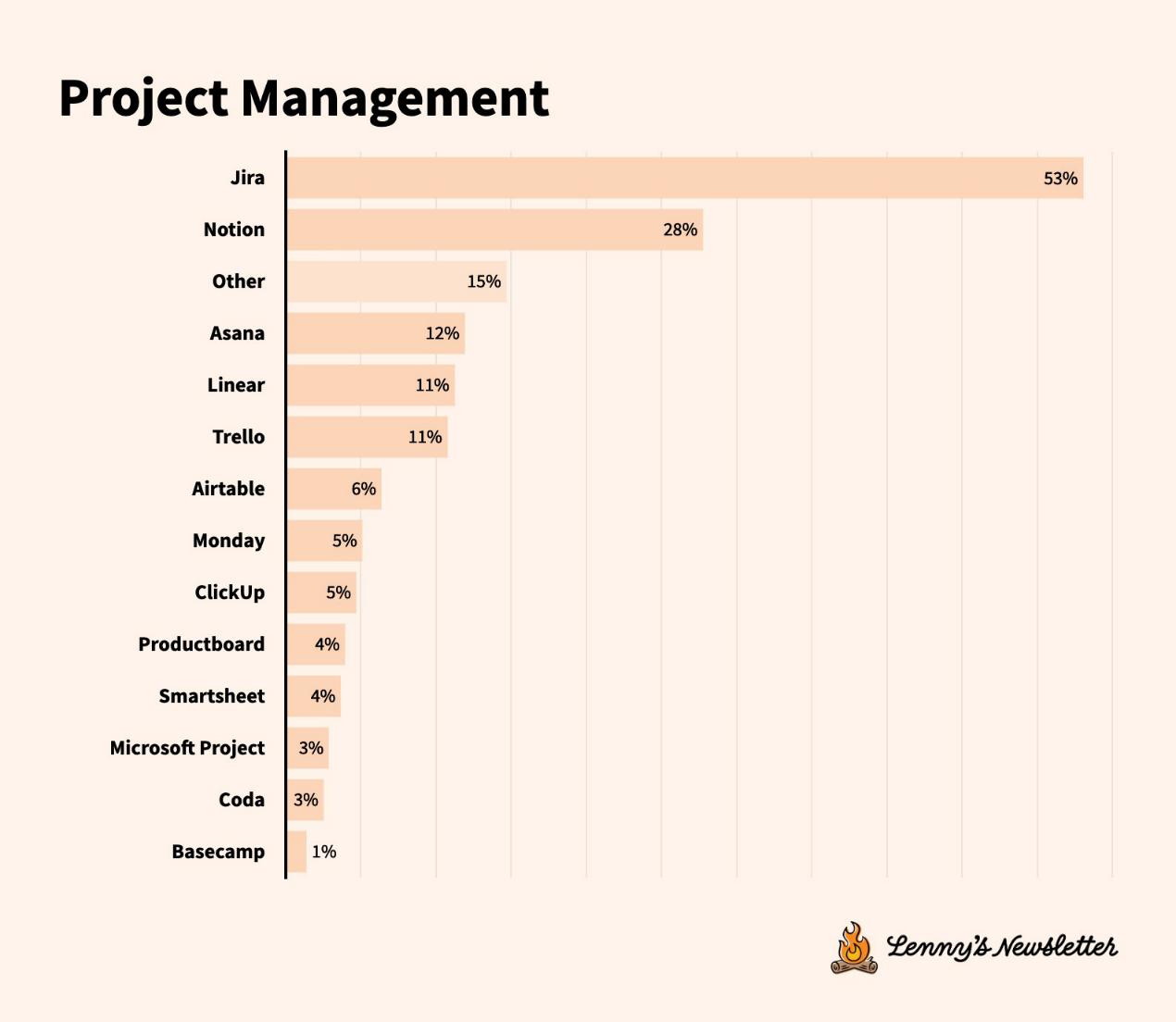
Figma Slides and Canva Have Become Important Tools in the Presentation Domain
The way users create presentations is evolving in a remarkable way. Three distinct approaches have emerged, each showcasing a different narrative for visual communication in 2025.
First, the traditionalists. Google Slides and PowerPoint continue to dominate traditional presentation creation, doing what they've always done best.
However, design tools are quietly sparking a revolution in the presentation domain. Figma and Canva have emerged as formidable competitors, with adoption rates neck and neck. This may come as a surprise to those who primarily use these platforms as design tools. What's driving this shift? Respondents unanimously reported that these tools offer a freedom of creation that traditional presentation software cannot: the freedom from complexity.
AI has also entered the presentation domain. New tools like Pitch, Gamma, and Beautiful.ai are fundamentally rethinking how presentations are made. These tools don't start with a blank slide, but use AI to shape your content into a beautifully crafted presentation. While these tools are still finding their footing in the market, early adoption signals suggest a significant shift in how we will create slides in the future.
Another trend emerged in the data: Miro has been appearing in the "other" category, indicating that people are not just switching presentation tools, but questioning whether they need traditional slides at all. The boundaries between presentations, whiteboards, and collaborative spaces are blurring, and this may just be the beginning.
Google Docs Remains the Collaboration Tool of Choice, but Notion is Gaining Momentum
The document landscape is consolidating around three platforms, each catering to different needs:
Google Docs remains the go-to for real-time collaboration.
But Notion, as the upstart, has gained an edge in team wikis, project management, and documentation.
Confluence still enjoys popularity among enterprise teams (though complaints exist).
Google Sheets is making steady progress in the spreadsheet domain, but Excel has shown surprising resilience. Meanwhile, as many companies seek to integrate their tool stacks, tools like Evernote, Quip, Coda, and Dropbox Paper are gradually fading from view.
Figma Continues to Dominate Design and User Experience
If you're in the design field, you're almost certainly using Figma. 90% of participants and 97% of designers use it as their primary tool.
The surprising tool is Canva. While it doesn't directly compete with Figma for professional designers, it provides a democratized design experience for others. Product managers, marketers, and engineers are using Canva to create quick visual assets without disturbing their design teams.
Miro Slightly Leads FigJam in the Virtual Whiteboard Domain
In the virtual whitboard domain, Miro remains the leader, but only slightly. As just read, Figma is the design tool, so FigJam's advantage may cause Miro to lose its leadership position in the coming years.
Perhaps taking a cue from Figma's approach, Atlassian and Microsoft have developed virtual whiteboard products, with around 5% of responses mentioning these. Mural and Whimsical don't seem to be growing.
Notion and Slack are Surprises in CRM and Customer Support
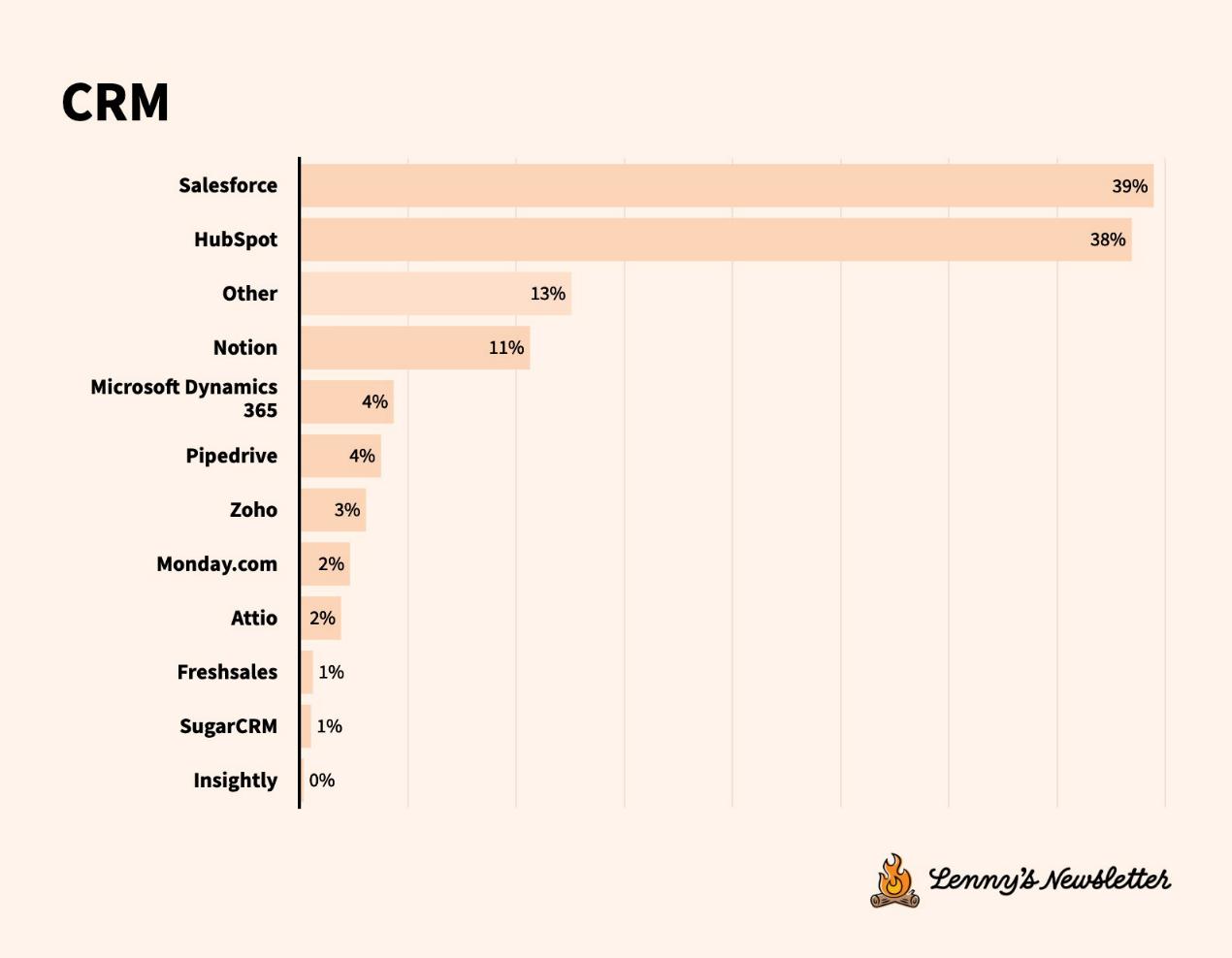
Two companies dominate the CRM space, but an unexpected entrant has emerged in this market.
Salesforce's comprehensive enterprise capabilities make it the default choice for large organizations, but smaller companies are increasingly dissatisfied with its complexity and cost structure. This has created an opportunity for alternative solutions that emphasize simplicity and specific use cases.
HubSpot has filled this market gap, particularly among SMBs. Respondents reported that HubSpot is more intuitive and streamlined than Salesforce, allowing teams to use it even without dedicated CRM experts.
But then a surprise emerged. 11% of respondents chose Notion as their preferred CRM. According to the results, flexibility was key to its success: "Notion provides our team with a ton of flexibility that would be the hardest to replace."
The customer support tools domain showed a similar established leader pattern, with Zendesk maintaining its position as the primary support platform at 29%.
But interestingly, Slack also captured 29% market share. Why?
Assuming the survey respondents skew towards early-stage companies, Slack is a necessity, while Zendesk or Intercom may be too expensive and complex.
Slack allows you to create a dedicated shared channel for each customer or design partner, where co-founders or early employees can directly engage with their clients. This insight reveals another variable behind Salesforce's decision to acquire Slack for nearly $30 billion a few years ago.
Three Key Takeaways: Bundling, Thoughtful Design, and Mixing
1. Bundled Functionality is Powerful, but Limited
Some of the most widely used tools, like Jira, Microsoft Teams, and Google Slides, are bundled into their respective enterprise stacks, which can lock users in long-term and create massive switching costs. Due to this bundling, they ultimately "win," but some of these products top the "least liked" and "most want to replace" lists, so it may only be a matter of time before some better-crafted, higher-executing startups (like Linear, Figma Slides) find a breakthrough and seize the opportunity.
2. Thoughtfully Built Products are Disrupting Incumbents
Linear, Notion, Figma Slides, and Slack are all praised for their user experience, fit with workflows, and focus on a perfect feature set. They are rapidly rising (or have already won) and top the list of respondents' preferred replacements.
3. Mixing Different Tools Within the Same Domain
When looking more holistically at the tool landscape, users tend to use multiple (competing) tools within the same category, based on the strengths of each assistant. For example, most respondents use multiple AI assistants, depending on the strengths of each.
The Tools People Value Most, and Those They'd Be Willing to Give Up
In the survey, respondents were asked to select up to three tools they value most and three they value least, with the expectation that the two choices would not overlap. But the results proved this wrong, with tools like Slack, Jira, and even ChatGPT frequently appearing on both lists, requiring a better metric to capture a tool's value, considering two key factors:
The overall frequency a tool is selected.
The frequency a tool is listed among the least valued, in addition to the most valued.
The survey adjusted the rankings based on the ratio of overall popularity to most valued, and the ratio of most valued to least valued, penalizing tools that ranked highly on both lists. This resulted in the "Adjusted Most Valued" metric.
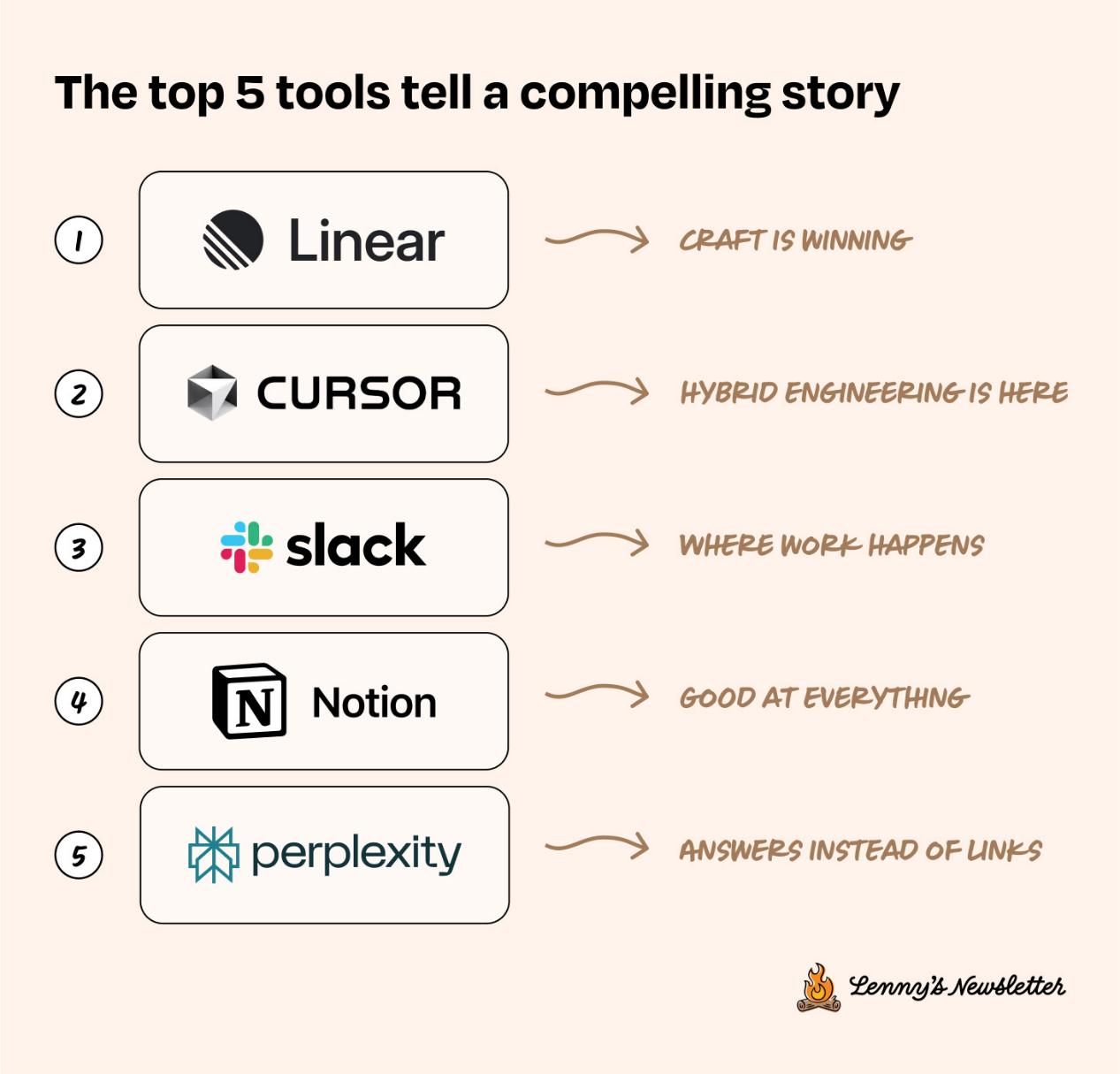
Linear: Elegant Design is the Key to Victory
Respondents liked Linear's user experience, alignment with their workflows, and relative simplicity and focus compared to Jira.
Cursor: The Future of Software Development is AI-Native
Cursor is rising at an astounding pace, with at least five other AI-native coding platforms. Over 20% of engineers are already relying on Cursor, surpassing most traditional coding tools like JetBrains, IntelliJ, and even Xcode.
Slack: The Place to Work
When it comes to Slack, it's not all love. Slack ranks high on the "most valuable" list, but also near the top of the "least valuable" list. Users heavily depend on Slack for communication, but some also see it as a productivity killer. Some respondents described it as "adding a lot of cognitive load" and a "noise generator". However, in an era of increasingly fast-paced communication, Slack is the place to get work done.
Notion: Good Enough for Everything
There is a new breed of modern tools. Notion stands out, representing a new type of tool that prioritizes collaboration, intuitive design, and the flexibility to handle a range of tasks from documents to project management and collaboration.
Perplexity: Providing Answers, Not Just Links
Beyond the popularity of ChatGPT and Claude, the top-five ranking of Perplexity indicates an important thing: AI tools are no longer just shiny toys, they are changing people's workflows, replacing mature tools (like Google), and becoming indispensable tools for the workday.
"Tools I Most Want to Replace" List
The survey also asked respondents about the tools they most want to replace, and the tools they most want to use.
Linear, Slack, and Notion seem to be seen as the modern stack for project management, communication, and collaboration. Atlassian's Jira and Confluence perform poorly, as does Microsoft Teams.
Other Key Insights: User Research, Analytics, Email
1. User Research
Survey Tools Gain Recognition
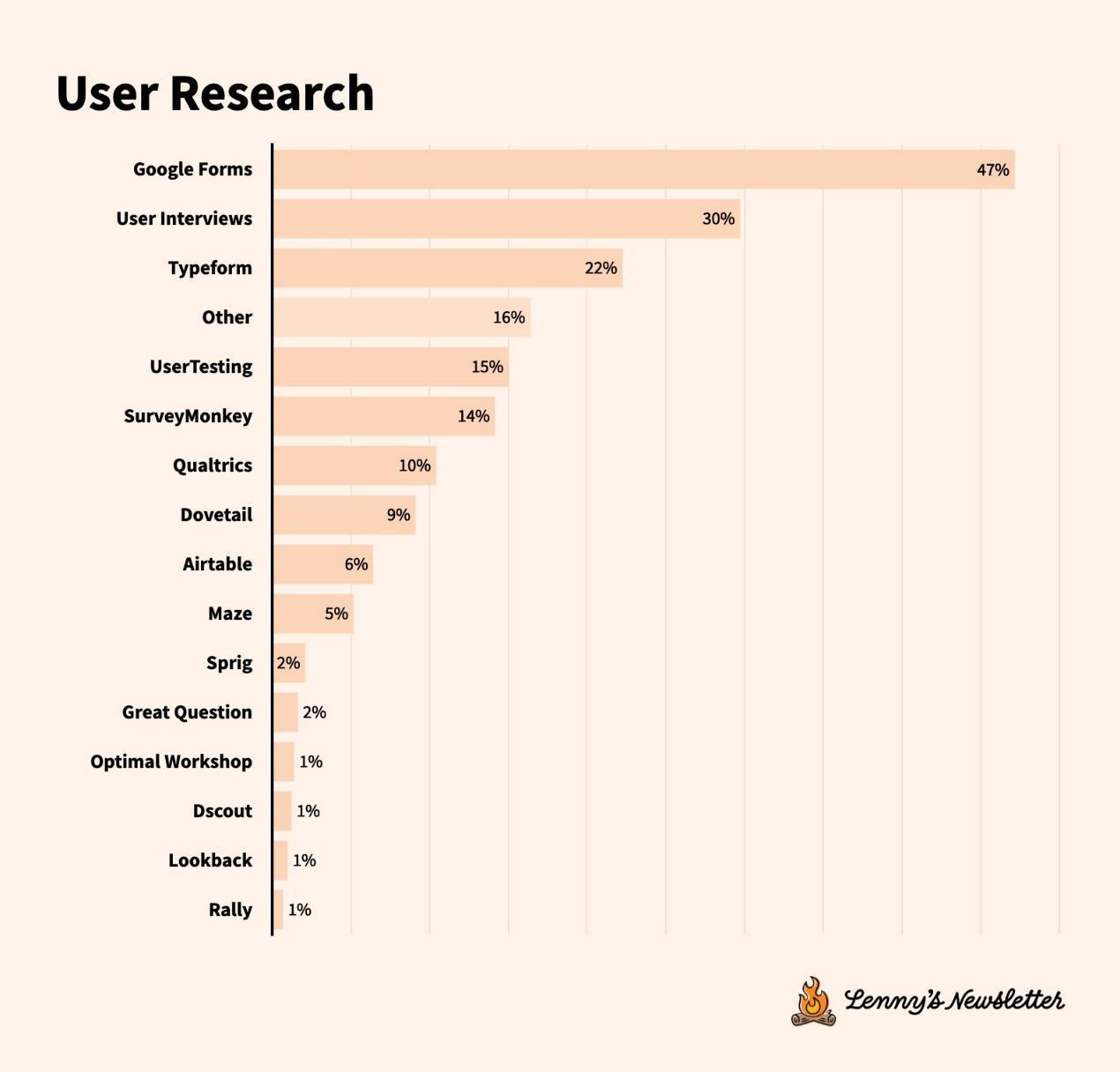
Google Forms dominates, especially among PMs, likely due to its simplicity, feature-richness, and integration with the Google Workspace.
However, Typeform is the perfect tool for reimagining stale formats. With a richer feature set, less traditional approach, and more thoughtful design, it ranks third among user research tools.
User Interviews Disrupting Recruiting
User Interviews has risen to second place by solving one of the biggest challenges in research - finding the right participants to talk to. After all, what good is a perfect research plan if you can't find the right people to participate? Respondents love User Interviews because it turns the tedious process of finding, scheduling, and paying participants into a manageable one.
Professional Toolkits
A slew of specialized tools are changing the way teams understand their users:
UserTesting still dominates in usability
Qualtrics handles enterprise-level customer experience research
Dovetail excels in insights management
Maze makes research quick and easy
Sprig is an always-on product experience platform
Optimal Workshop solves information architecture issues
Dscout has diaries and longitudinal research
2. Analytics
The 2025 data analytics landscape tells a David vs. Goliath story, or more accurately, a few Goliaths against a group of Davids.
Google Analytics remains the undisputed number one, dominating general analytics. But interestingly, a thriving ecosystem of specialized tools is carving out its own territory.
Heavyweight Players
When teams need to level up their business intelligence, they are increasingly turning to two major players:
Tableau: A platform that simplifies complex data into eye-catching dashboards.
Looker: The darling of data scientists, Looker is helping companies democratize data.
Favorites for Behavioral Tracking
Amplitude and Mixpanel remain the second and third largest analytics companies after Google Analytics, helping teams track everything from user behavior to feature adoption.
Carving Out Their Own Niches
Highly specialized tools are on the rise:
Hotjar dominates in qualitative with its heatmaps and session recordings
Metabase has become a favorite of startups, providing quick, practical dashboards
Pendo has a wealth of product feedback
Segment is the go-to for data management
Fullstory and Heap have risen to prominence in behavioral data capture
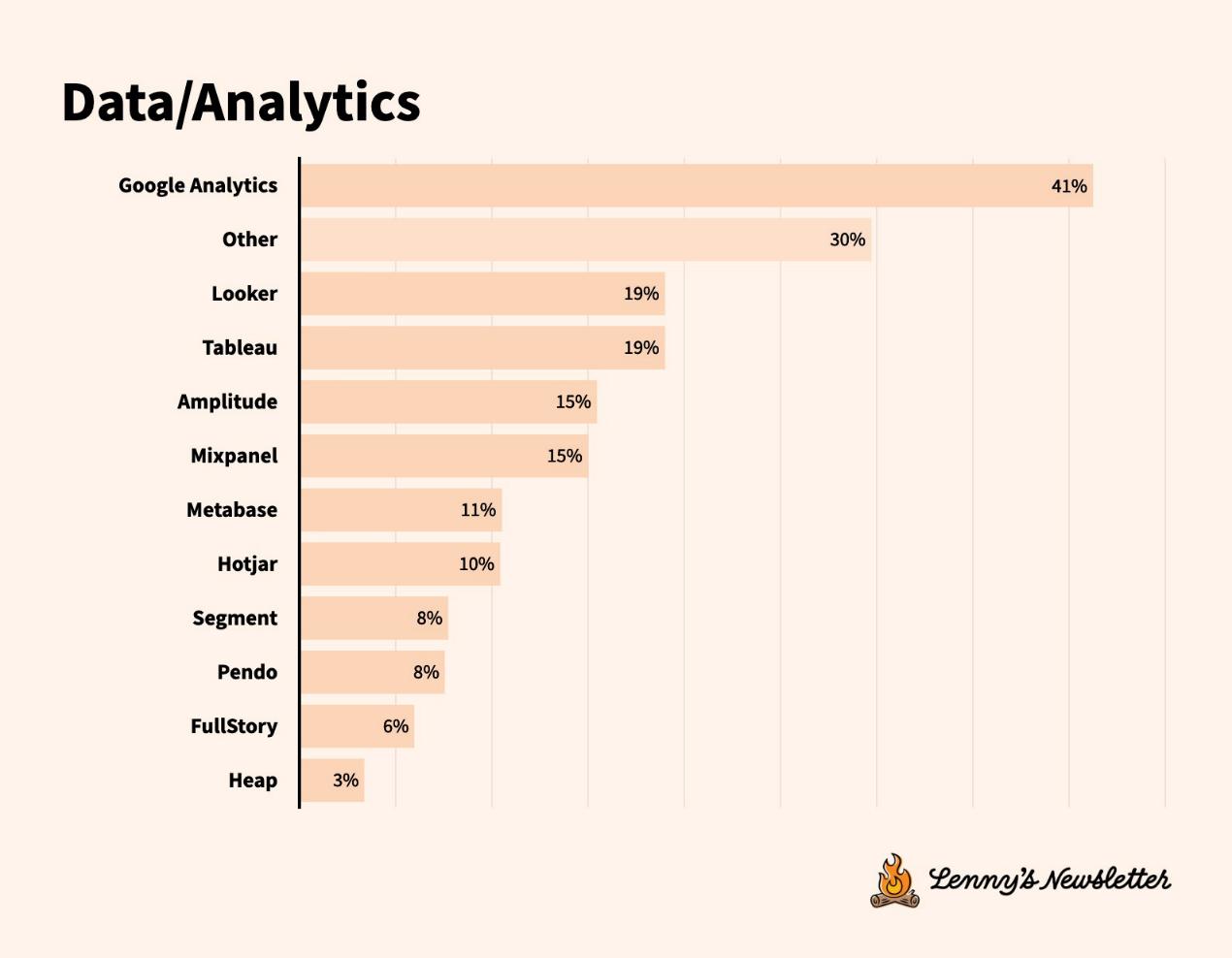
30% of respondents replied with "Other" categories. Two leading platforms have around 200 responses each, neck and neck:
Posthog: An open-source, all-in-one platform competing with the big players like Amplitude, Mixpanel, Fullstory, and Heap.
Power BI: Microsoft's response to Salesforce's Tableau and Google's Looker. Data analysis, visualization, dashboards... usually the default choice for companies using the Microsoft stack.
3. Email: Three Camps
Email essentially falls into three camps:
Gmail
Microsoft Outlook
Specialized tools for power users
Gmail ranks second in overall tool popularity, trailing only ChatGPT, but leading Slack and all other email tools. Additionally, throughout the survey, Google Workspace tools were rated significantly higher than Microsoft Suite.
Microsoft maintains its enterprise foothold, but the satisfaction gap is widening. Their tools have appeared multiple times in the "least popular" rankings, as one respondent said about Outlook, "Everything about Outlook feels corporate and soulless compared to the Google Suite, but corporate inertia keeps us from escaping the tool."
Power users tend to gravitate towards specialized tools like Superhuman and Front, which are still relatively niche, but users report significant productivity gains, justifying the higher cost.
The Big Picture
Looking at the data holistically, some important trends are emerging. First, AI is not just a new normal, it's ubiquitous. Teams are not just leveraging AI, they are building entire workflows around it. ChatGPT has not only stood out, but it has taken a dominant position. Respondents report that ChatGPT serves a dual purpose: expanding their thinking during ideation or brainstorming, and simplifying key workflows like data analysis or writing.
Another theme that runs through is that user experience is more important than features when choosing tools. Teams are increasingly willing to sacrifice deeper functionality in exchange for truly usable tools. Tools like Linear, Notion, Slack, and Figma are praised for their elegant design and flexibility.
This is likely why we may see an acceleration in tool migration. There is a strong negative sentiment towards tools that don't meet modern stack standards, and a strong willingness to switch from legacy tools to these modern alternatives. Bundling strategies have limited impact, as thoughtfully crafted tools will capture market share.
Savvy teams and individuals will mix and match tools within the same domain, choosing the most appropriate one for each nuanced situation or need.
One thing is clear: the tech-savvy are always on the lookout for better tools.