Introduction: From "Solana Savior" to "King of Gains" in 48 Hours
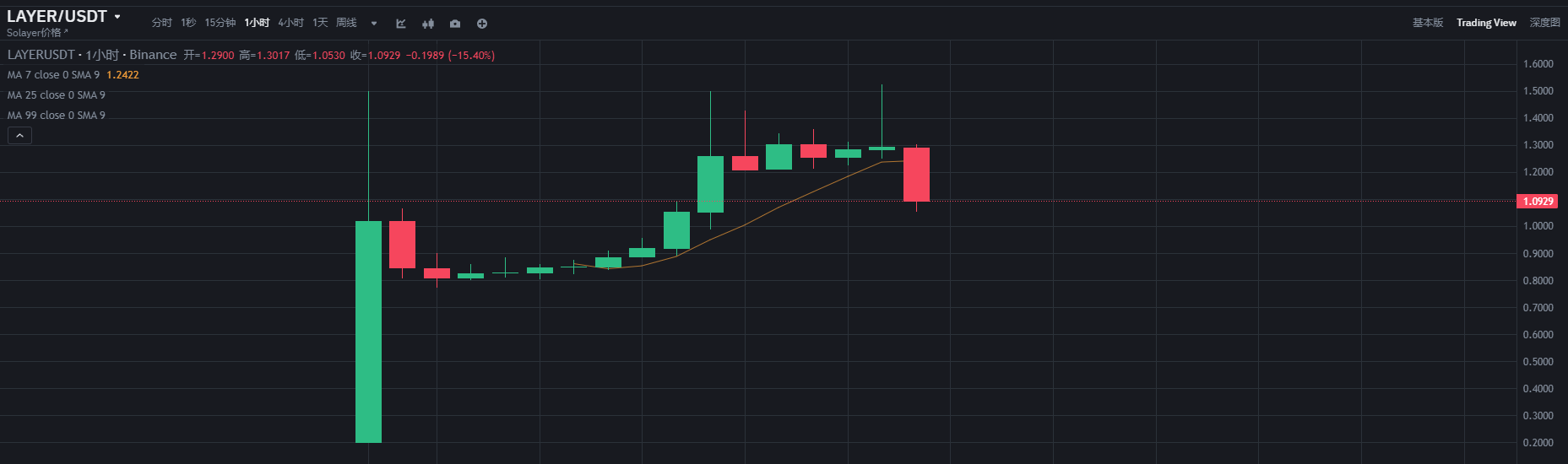
On February 12, 2025, the cryptocurrency market witnessed one of the most dramatic events of the year: the Solayer ecosystem token LAYER skyrocketed 367% within 24 hours of its listing on Binance, topping the gainers' list. The contract funding rate even reached -2% at one point, and according to Coinglass data, Layer's total network contract liquidations in the past 24 hours reached $27 million, approaching the levels of Bitcoin and Ethereum. This performance even surpassed the ETF capital inflow effect of Bitcoin during the same period, leading to a market polarization - supporters hailed it as the "ultimate solution for the Solana ecosystem," while skeptics warned of the "death spiral of inflationary tokens."
Behind the data is a collaboration between technology and capital:
- Technical narrative: Solayer claims to achieve millions of TPS through InfiniSVM technology, targeting the scalability bottleneck of the Solana ecosystem;
- Capital operations: Top market makers like Wintermute got involved, and the project team transferred 8.5 million tokens to exchange addresses in a single day;
- Community frenzy: Over 12% of the tokens were distributed through airdrops, with early participants achieving an average return of over 800%.
This article will unpack the underlying logic behind LAYER's surge, revealing its technical value, capital games, and potential risks.
I. Technical Breakthrough: Can InfiniSVM Save Solana?
1. Solana's Scalability Dilemma
Although Solana set a record of one year of continuous uptime in 2025, the explosive growth of its ecosystem has led to network congestion resurfacing:
- Daily transaction volume of 4.5 billion, with average Gas fees up 120% compared to 2024;
- Frequent MEV (Miner Extractable Value) attacks, with arbitrage bots occupying more than 30% of block space.
2. The Technical Blueprint of InfiniSVM
Solayer's core innovation lies in the hardware-accelerated Solana Virtual Machine (InfiniSVM), with the following technical roadmap:
- Parallel instruction set: Decomposing transaction processing into multi-threaded tasks, with measured throughput tripling that of the Solana mainnet;
- FPGA hardware acceleration: Optimizing cryptographic computations through customized chips to lower the hardware threshold for validator nodes;
- Dynamic sharding mechanism: Automatically partitioning the compute cluster based on load to avoid single-point congestion.
Key goal: Achieve millions of TPS by the end of 2025 to support large-scale GameFi and RWA (Real-World Asset) applications.
3. Challenges in Technical Deployment
- Hardware compatibility: FPGA acceleration requires specific device support, which may exacerbate node centralization;
- Migration cost for the ecosystem: Developers need to restructure smart contracts to adapt to InfiniSVM, and the initial adoption rate is uncertain;
- Security audit gap: Currently, there is no third-party audit of the InfiniSVM code.
II. Token Economics: The Double-Edged Sword of the High Inflation Model
1. Token Distribution and Unlocking Mechanism
The total supply of LAYER is 1 billion tokens, with an initial circulating supply of 220 million (21%), with the following distribution structure:
- Community and Ecosystem (51.23%): 34.23% for development, 14% for airdrops, and 3% through NFT sales;
- Core Team (17.11%): Locked for 1 year, then released over 3 years;
- Investors (16.66%): Locked for 1 year, then released over 2 years;
- Foundation (15%): Unlocked quarterly, over a 4-year period.
2. Inflation Pressure Analysis
According to the current release schedule, the circulating supply will increase by the following in the next 12 months:
- Community airdrops: 6% of the airdrop tokens (around 60 million) will be released within 6 months;
- Team and investors: Around 340 million tokens will be released annually starting from 2026.
- If ecosystem applications fail to grow in sync, LAYER may face an annualized inflation rate exceeding 200%.
3. Price Support Logic
- Staking rewards: The current annualized staking yield is around 18%, but it may drop to single digits as inflation accelerates;
- Transaction fee capture: There are plans to use LAYER as the network Gas token, but it needs to achieve at least 500,000 daily active users to offset the inflation.
III. Capital Games: Market Makers, Exchanges, and Airdrop Hunters
1. Wintermute's Trading Footprints
On-chain data shows that the Solayer project team transferred 750,000 tokens to Wintermute-affiliated addresses before the LAYER launch, likely for liquidity management. This is a common price-supporting strategy:
- Initial market control: Creating the illusion of ample liquidity through concentrated order placement;
- Volatility harvesting: Exploiting high-leverage contracts to induce long and short liquidations, with daily contract trading volume exceeding 60%.
2. Exchanges Fueling the Frenzy
Platforms like Binance and OKX simultaneously listed LAYER spot and contract products, and introduced principal-protected token earning and 75x leverage derivatives. These tools amplified the retail speculative risks:
- Contract funding rates: On the first day, long positions had to pay a 0.3% hourly funding rate, translating to an annualized cost of over 2600%;
- Whale manipulation: The top 10 addresses hold 45% of the circulating tokens, enabling them to manipulate prices through large-volume trades.
3. Airdrop Hunters' Profit Frenzy
LAYER's genesis airdrop covered sSOL holders, DeFi protocol users, and other groups. Some participants used Sybil attacks to fraudulently claim hundreds of addresses, estimated to have generated over $20 million in arbitrage profits. This short-term profit-seeking behavior may lead to further token centralization.
IV. Ecosystem Status: The Chasm Between Ideals and Reality
1. Current Application Scenarios
Currently, the Solayer ecosystem has only launched around 80 DApps, mostly focused on utility applications:
- Staking derivatives: Liquidity mining for staking certificates like sSOL and sUSD;
- Cross-chain bridges: Developing asset interoperability protocols with Avalanche and Sui;
- Data indexing: Visualization tools for on-chain transaction histories.
2. Comparative Disadvantages to Competitors
- Ethereum Layer2: Starknet and zkSync have already achieved millions of user applications, while LAYER lacks differentiated scenarios;
- Native Solana ecosystem: Established DEXes like Raydium and Jupiter have first-mover advantages, and LAYER's DeFi protocols have less than $100 million in TVL.
3. Developer Incentive Dilemma
Although 34.23% of the tokens are allocated for ecosystem development, the actual developer reward rules remain unclear:
- High technical threshold: The InfiniSVM development documentation is not yet complete, and the migration cost hinders the participation of small and medium-sized teams;
- Delayed incentives: Community rewards are distributed over 6 months, making it difficult to attract immediate contributions.
V. Risk Warning: Six Major Concerns Behind the Surge
- Inflationary spiral: More than 70% of the tokens will be released in the next 3 years. If the ecosystem growth is not as expected, the price may be halved;
- Technical delays: The InfiniSVM's goal of one million TPS has not been verified on the testnet, and there is a risk of delay;
- Regulatory targeting: If the SEC determines that LAYER is an unregistered security, US exchanges may delist it;
- Market maker withdrawal: Institutions like Wintermute may sell off their market-making inventory at high prices, triggering a liquidity crisis;
- Ecosystem hollowing: Current applications are mostly staking and mining, lacking real user demand support;
- Community centrifugal force: Early airdrop beneficiaries selling in large quantities may lead to centralization of governance.
VI. Future Projection: Three Fates of LAYER
Scenario 1: Successful Technological Revolution (20% probability)
- Key indicators: InfiniSVM achieves one million TPS, and the ecosystem TVL exceeds $10 billion;
- Price forecast: LAYER's market cap enters the top 30, and the price stabilizes in the $5-8 range;
- Industry impact: Becomes the core expansion layer of the Solana ecosystem, reshaping the Layer1 competitive landscape.
Scenario 2: Moderate Bubble (50% probability)
- Key indicators: The technology is partially implemented, but the application scenarios are limited, and inflationary pressure persists;
- Price forecast: LAYER fluctuates between $1-3, with a market cap on par with second-tier public chains;
- Industry impact: It will be actively traded as a speculative target in the short term, but will be replaced by more efficient protocols in the long run.
Scenario 3: Collapse and Liquidation (30% probability)
- Key indicators: InfiniSVM development is hindered, and the withdrawal of market makers triggers a stampede;
- Price forecast: LAYER falls below $0.5, becoming a typical "zero-value coin" case;
- Industry impact: Exacerbates the market's trust crisis in high-inflation tokens, and regulatory scrutiny is escalated.
Conclusion: Cold Reflection in the Midst of Revelry
LAYER's surge is the most symbolic event in the crypto market in 2025 - it is both the victory of technological idealism and the epitome of the risk of capital manipulation. For investors, they need to be wary of the gap between narrative bubbles and technological realities:
- Short-term speculators: Can participate in swing trading, but need to set strict stop-loss lines;
- Long-term holders: Should closely monitor the progress of the InfiniSVM testnet and the growth of real users in the ecosystem;
- Industry observers: This case further validates the market rule that "token economics design > technical whitepaper".
Ultimately, the value of LAYER will depend on the answer to a simple question: After the airdrops end and the market makers withdraw, how many people will truly need InfiniSVM?