
Global regulatory authorities are tightening their policies on , requiring all issuers to comply with strict reserve transparency and compliance standards. The US, EU, and Asian countries have introduced new regulations that require to be backed 1:1 by cash or government bonds, while veteran issuers like face compliance pressure due to the complexity of their reserve structure. JPMorgan analysts warn that may be forced to sell some of its , precious metals, and corporate bonds to comply with the new regulations.
As regulatory red lines tighten, will 's reserve adjustments affect the market? If there is a large-scale sale of , how much impact will it have on the market? This article will delve into 's compliance crisis and the potential selling pressure on .
's Compliance Crisis: Will Become the "Sacrifice"?
's asset reserves have always been a focus of market attention, and the latest regulatory pressure may force it to adjust its reserve structure, leading to unprecedented market shocks.
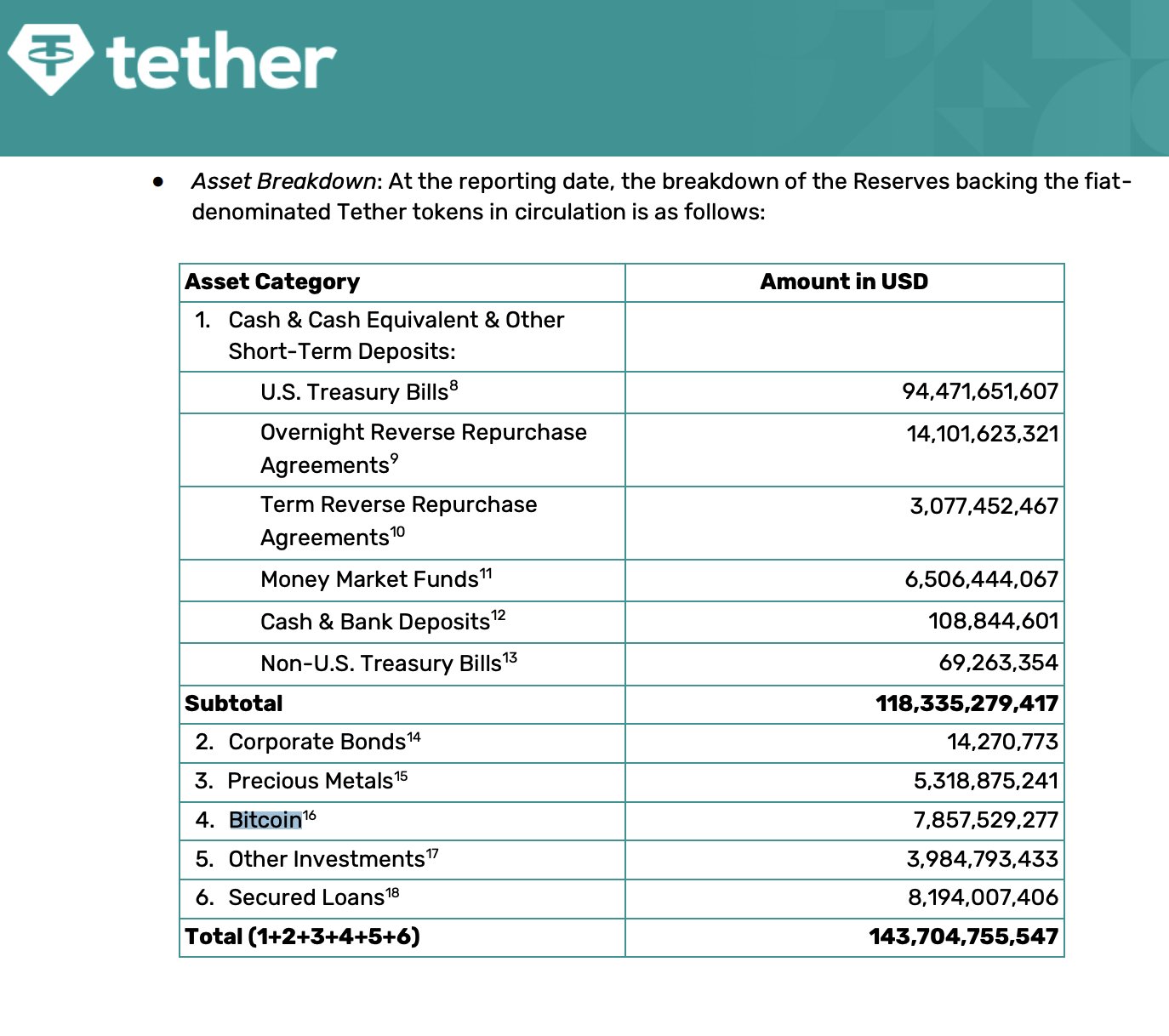
According to 's latest asset disclosure, as of the reporting period, its total reserve size reached $143.704 billion, of which:
- Cash and short-term deposits (including US Treasuries, repurchase agreements, money market funds, etc.): $118.335 billion, accounting for about 82.3% of the total reserves;
- Corporate bonds: $14.27 million, with a negligible proportion;
- Precious metals (mainly gold): $5.319 billion, accounting for about 3.7%;
- : $7.857 billion, accounting for about 5.47%;
- Other investments (undisclosed asset categories) : $3.984 billion, accounting for about 2.77%;
- Secured loans: $8.194 billion, accounting for about 5.7%.
However, the proposed US and require all issuers to have 100% of their reserves in cash or US Treasuries, while 's current compliant reserves account for only 82.3%, below the regulatory standard. This means that may need to sell at least 18% of its non-compliant assets to meet regulatory requirements, with , precious metals, and other investment categories being the first to be targeted.
JPMorgan analyst Nikolaos Panigirtzoglou pointed out that if wants to meet US regulatory standards, it may need to liquidate more than 18% of its non-compliant assets, and its reserves are undoubtedly the most liquid part. According to the latest data, currently holds $7.857 billion in (about 83,700 ), accounting for 0.4% of the total supply. Compared to the previous external estimate of $1.5 billion in holdings, this data means that if is forced to sell due to compliance requirements, the selling pressure on the market may be greater than expected.
Estimating the Selling Pressure: The Market Impact of 's Sales
If needs to meet regulatory requirements and adjust its reserve structure, it may need to liquidate about $26 billion in non-compliant assets. If this adjustment ratio is 40%-50%, the potential selling volume could be as high as $3 billion to $4 billion, equivalent to 15%-20% of 's current daily trading volume (about $20 billion). Under such pressure, prices may face short-term violent fluctuations, and the market's ability to withstand pressure will be tested.
JPMorgan's analysis believes that although 's holdings are still relatively small compared to the total market circulation, even if a liquidation occurs, the market may not see a violent collapse like the FTX meltdown. However, considering the core position of in the crypto ecosystem, 's sale of may trigger a chain reaction of institutional investors, causing a panic sell-off and leading to a larger capital outflow.
Faced with compliance pressure, 's choices are twofold: either adjust the reserve structure and sell some and other non-compliant assets to meet regulatory requirements; or seek legal lobbying to delay or avoid the full implementation of the new regulations. However, the market believes that even if temporarily escapes regulatory constraints, the trend of tightening policies globally has become a foregone conclusion, and adjusting the asset structure is just a matter of time.
Currently, has not publicly disclosed its coping strategy, but the market is closely watching its asset movements. Will become the "sacrifice" of this regulatory reform? How great will the selling pressure be? Once starts adjusting its holdings, its impact will not be limited to the market, but will also affect the overall capital flow pattern of the crypto market.
Regulatory Game: Can Win Time?
's compliance challenge is not just about its asset reserves, but also about the ultimate direction of the US legislative process. has become an important part of the global financial system, and regulatory authorities' attention to it has reached an unprecedented level. Federal Reserve Chairman Jerome Powell previously clearly stated in a hearing that he supports the establishment of a clear regulatory framework for , and requires Congress to expedite relevant legislation to ensure the stability of the financial market.
At the same time, the bipartisan game in the US Congress on regulation is still ongoing. The Republican side advocates for a relaxed regulatory approach, supporting the Office of the Comptroller of the Currency (OCC) to regulate non-bank issuers, allowing more market-based competition; while the Democrats insist on a stricter regulatory framework, requiring the Federal Reserve and the Federal Deposit Insurance Corporation (FDIC) to oversee all comprehensively, and ensure that all are backed 1:1 by cash or Treasuries.
Recently, the Republican leaders of the House and Senate have announced the establishment of a "Bicameral Crypto Working Group", with the goal of accelerating the legislation process and ensuring that the US maintains a leading position in the global digital asset space. However, this also means that the regulatory pressure on and other issuers will further increase, and the likelihood of the bill being passed is greater and greater.
Against this backdrop, may hope to gain time through lobbying efforts, so as to find a more favorable adjustment approach before the final policy is implemented. Previously, CEO Paolo Ardoino has stated that the company is actively monitoring regulatory dynamics and may take measures such as adjusting business structure, increasing compliant reserves, and establishing independent trust funds to adapt to the future regulatory environment.
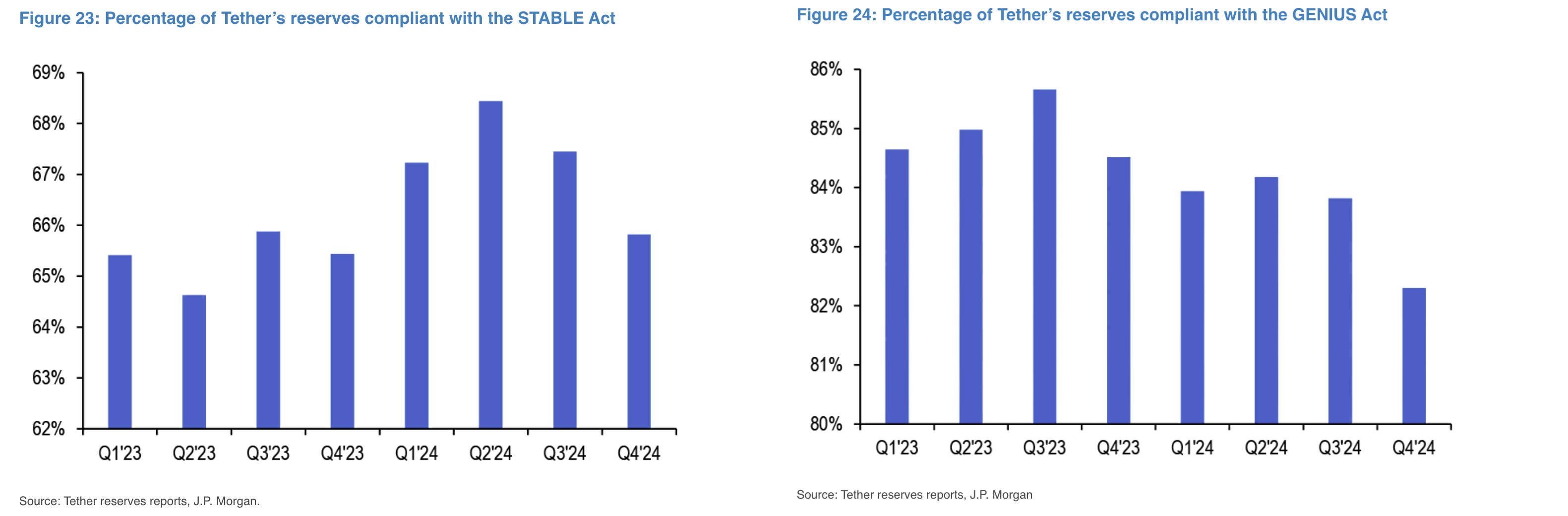
But if the US ultimately passes the or , 's operating model will face a complete overhaul, and it must significantly adjust its reserve structure, or it will be unable to continue operating in the US market. This will not only affect the market circulation of USDT, but may also lead some institutional investors to turn to more compliant , such as USDC or PYUSD.
Can successfully lobby the US regulators to gain enough adjustment window period? If the bill is officially implemented, how will it reconfigure its reserves? In the coming months, the answer to this question may determine the future direction of the market.
The New Landscape of the Market
The market is undergoing a profound transformation. As global regulations become increasingly stringent, compliance has become the key for issuers to survive in the mainstream market. Although is still the with the highest market share, its market share is gradually being challenged.
According to glassnode data, the total supply of stablecoins has grown from $194.2 billion to $211.2 billion, an increase of $16.9 billion, from the beginning of 2025 to the present. Among them, the growth rate of compliant stablecoins such as USDC and PYUSD has accelerated significantly, while USDT's market share, although still dominant, has slowed down. As more and more institutional funds are inclined towards more compliant and transparent stablecoins, Tether's market position is facing unprecedented challenges. From a market strategy perspective, the attitudes of leading exchanges are also gradually shifting towards compliance. Platforms such as Binance and Coinbase have started to prioritize supporting stablecoins like USDC and PYUSD that are regulated by US financial institutions. If Tether cannot quickly adjust its reserve structure, it may be further marginalized. At the same time, new players are seizing market share. Ripple's RLUSD, JD.com's Hong Kong dollar stablecoin, and some tokenized US dollar assets based on the traditional financial system are becoming the preferred choices for compliant institutional users. What is more worth noting is that the regulatory trend in the US market may trigger a chain reaction globally. The European MiCA Act and the stablecoin licensing systems in various Asian countries are jointly driving the market towards compliance. For Tether, it is not only facing regulatory challenges in the US, but also compliance pressures globally. If it cannot quickly adjust its asset structure, it may face the risk of being squeezed out in multiple markets. However, Tether's advantages are not completely lost. In regions such as Asia and Latin America, where regulatory requirements are relatively lax, USDT is still the main trading stablecoin and maintains an absolute advantage in the DeFi market. Even if it encounters difficulties in the European and American markets, it can still rely on the market demand in these regions to maintain its business. But the problem is that as the industry as a whole evolves towards compliance, if Tether does not change its strategy, it may eventually fall from a global leader to a regional player, or even be completely replaced by more compliant stablecoins. The reshuffle of the stablecoin market has entered the countdown. Whether Tether can survive the compliance wave depends on whether it can find a new balance point between compliance and market demand. If it is willing to actively adapt to the regulatory environment, it may still have the opportunity to maintain its market dominance. But if it clings to its past business model and tries to continue to rely on market inertia to survive, it may gradually lose market share and eventually be eliminated by the market in the next few years. The future of stablecoins belongs to those who can win the trust of the market and comply with global financial rules. As for Tether, it may be facing a real life-and-death test in this changing landscape.Epilogue: Tether's Choice and the Future of the Stablecoin Market
Tether is standing at the crossroads of industry transformation. The pace of global regulation is becoming more and more determined, and the stablecoin market is moving towards a more compliant, transparent and institutionalized era. For Tether, the "gray area" it has relied on in the past is rapidly disappearing, and if it cannot adjust its reserve structure to meet regulatory requirements, its market dominance will face severe challenges. In the short term, Tether's Bitcoin reserves may become the first step in its compliance adjustment. The $7.857 billion Bitcoin holdings may be seen as "non-standard reserves" under the new compliance framework and need to be partially liquidated. If Tether chooses to sell Bitcoin quickly, the market will face short-term shocks, and institutional funds may take evasive action in advance, further exacerbating market volatility. But if Tether adopts a phased-out sales strategy, the market may have more time to digest these sell-offs, and the ultimate impact may be relatively mild. In the long run, Tether's future depends on how it responds to regulatory challenges. Will it completely restructure its asset portfolio, reducing its Bitcoin and precious metal holdings to comply with the regulatory requirements of the European and American markets? Or will it choose to abandon part of the compliant market and focus on regions such as Asia and Latin America to maintain its business model? Or will it try to lobby for regulatory exemptions or relaxed adjustments through legal means? These choices will determine Tether's position in the future stablecoin market. But regardless of Tether's choices, the overall trend of the stablecoin market is irreversible. Compliance, transparency, and institutionalization will become the main theme of the industry. Compliant stablecoins such as USDC and PYUSD are gradually gaining more institutional support, and emerging stablecoin projects are also trying to seize market share. The stablecoin industry is no longer a monopoly of Tether, but has entered a new era of greater competitiveness. For investors, the focus in the future should be on:- Whether Tether will sell Bitcoin and the scale of the sell-off, which may have a direct impact on market sentiment and price volatility;
- The regulatory progress in the US, EU and Asian markets, as the timing of policy implementation will determine the ultimate direction of the stablecoin market;
- The attitudes of exchanges, how platforms like Binance and Coinbase adjust their stablecoin support strategies will affect the changes in market patterns.