On February 18, 2025, the cryptocurrency circle was still echoing with the name $PAIN in the chat groups of retail investors, but the heat was tinged with some unease. Since the project team announced the refund of 80% of the pre-sale funds on February 6, this Solana-based meme coin seemed to have hit the "mute button", with no movement for a full 12 days. Investors on X were already in an uproar: "After raising 18.5,000 SOL, they've gone silent, are they going to run away?" "The SOL I invested in $PAIN has already lost 20%, if it doesn't double, I won't even get my principal back!" The community's anxiety was like mosquitoes in the summer, buzzing loudly, but with no place to find solace. This article explores what exactly happened behind this "pain".
A painful yet joyful pre-sale frenzy
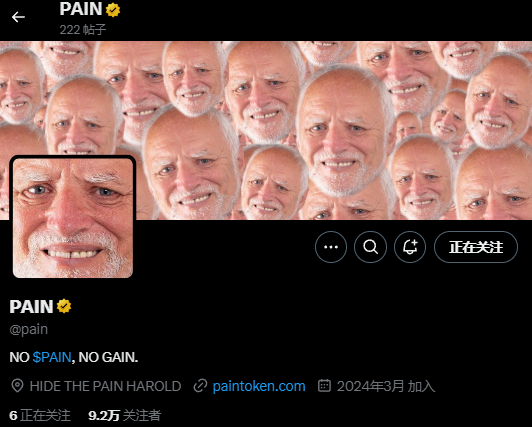
The story of $PAIN starts with "Hide the Pain Harold", the legendary figure in the MEME world, whose real name is András Arató, a retired Hungarian engineer. In 2011, he accidentally took a set of vacation photos, and his "smile through the pain" expression somehow went viral on the internet, becoming a global expression of irony about life. On February 2, 2025, Memeland - a cryptocurrency team dedicated to MEME culture - brought this IP to the Solana chain and launched $PAIN. As a result, they raised 186,000 SOL (about $38-40 million) in just 48 hours, directly breaking the pre-sale record for MEME coins. It was as if you were selling Harold's pained smile expression on the street, and suddenly a swarm of global fans descended, instantly turning your stall into a traffic black hole.
However, the story took a sharp turn. As soon as the pre-sale ended, the project team announced a refund of 80% of the funds, leaving only about $7.6 million to start the project. The official explanation was to alleviate the burden on the community, but in the eyes of retail investors, this reason sounded a bit like an excuse for "eating your fill and then packing it up". The refunded SOL shrank significantly due to market fluctuations, and although the remaining funds were far more than what a typical MEME coin would need to start, the community began to question: was this truly a benevolent act, or was there another motive? Worse still, after the refund promise was announced, the official account has remained silent to this day, not even issuing a "refund received" notification. Angry users on X stated: "$PAIN has been silent from the end of the pre-sale to now, 12 days, it's simply 'pain on top of pain'!"
Can Memeland save the day: strong backing, but questionable rhythm
The Memeland behind $PAIN is no small player. This team recently acquired the Hong Kong-listed company Memestrategy for $18 million and plans to unveil a heavyweight roadmap at their strategic annual meeting on February 20. A KOL on X has leaked: "Memeland may announce the launch plan for $PAIN at the annual meeting, to rescue this stagnant situation." Not to mention that $PAIN has also registered a Web2 trademark, indicating that its ambitions are not just a fleeting MEME coin, but to build a MEME brand that spans Web2 and Web3. It's like dressing Harold up in a suit, transforming him from a street artist expression to a cultural IP entrepreneur.
But the key to saving the day lies in execution. Memeland has resources, traffic, and even rumors of cooperation with giants like Binance (after all, Memeland's MEME token has already been listed on Binance), but the 12-day "silent period" of $PAIN is really making people sweat. The community speculates that either the project team is negotiating the token distribution plan with the exchange - as the original plan (20% for pre-sale, more for NFT holders) was considered to be market-crashing; or they simply decided to hold back and wait for the hype to die down before making a move. But the problem is, MEME coins rely on passion and momentum, the longer they drag on, the more the retail investor's enthusiasm will cool down like leftover food in the fridge. If Memeland can really throw out a big move on the 20th, such as a launch timeline or brand collaboration, they might be able to pull $PAIN back from the brink of "loss of confidence".
However, there are also successful precedents - like last time with $CULT, the project team stopped for half a year, but the final gain was around 5 times. If Memeland can provide a clear launch timeline or brand collaboration plan at their annual meeting on February 20, they may be able to work the same miracle for $PAIN.
Conclusion
$PAIN is now like Harold's classic pained smile: calm on the surface, but turbulent underneath. It could be a dark horse in the MEME coin bull market, after all, it has the heritage of MEME culture and the endorsement of Memeland, a $1 billion market cap wouldn't be a pipe dream. But don't forget, this "pain" adventure could overturn at any time - the 12 days of silence have already made retail investors suspicious, and rumors of fake tokens and scams are flying all over X (the official has warned that the pre-sale is over, don't throw more money in). My advice? Hold your wallet tight and wait for the news from Memeland's annual meeting on February 20. If there are signs of a turnaround, this "pain" may turn into "joy"; if it's still silent, then it might truly be "pain without drama". The crypto world never lacks drama, are you willing to bet on the next chapter of $PAIN?