Author: Wang Lu

Image source: Generated by Boundless AI
AI seems to have become the "lifesaver" for big companies.
Whether it's the highlights in the financial reports or the occasional good news, they all rely on AI.
For example, in Baidu's mixed financial report for 2024, the highlights were mostly contributed by AI:
The daily average call volume of the Wenxin large model continued to grow rapidly, increasing 33 times in a year to 1.65 billion. Baidu Wenku has more than 40 million paid users, ranking second globally and first in China.
Alibaba also scored a hat-trick at the beginning of the year thanks to AI:
First, influenced by DeepSeek, Alibaba's open-source large model Qwen also received attention; then the latest model Qwen2.5-Max was praised for outperforming DeepSeek V3; subsequently, Alibaba announced a cooperation with Apple on AI business, causing its stock price to soar.
However, since DeepSeek's breakout nearly 40 days ago, big companies have experienced more anxiety than gains from AI, as they have invested a lot of manpower, material resources, and financial resources, only to see a startup team produce a product that made a big splash. In the past two days, DeepSeek has also publicly released an explosive message - its cost-profit ratio is as high as 545% (theoretical revenue), and the theoretical profit can reach 3.46 million yuan per day.
Faced with various shocks, big companies have changed their course, with some joining in since they can't beat it, announcing the integration of DeepSeek, while others are turning their proprietary large models from closed-source to open-source, even at the cost of cutting off a commercialization path and making C-end products free.
But will this move really cure the AI anxiety of big companies?
How are the big companies doing with AI?
Before the emergence of DeepSeek, the route for big companies to do AI was high-profile and high-investment, focusing on their own advantages to develop products.
Large models are seen as the infrastructure of the AI industry, and Internet giants (Baidu, Tencent, Alibaba, ByteDance, Kuaishou, etc.), consumer electronics manufacturers (represented by Huawei), and intelligent voice companies (such as iFLYTEK) have all launched their own large models. Compared to "AI Six Tigers" startups, the advantage of big companies lies in their stronger financial and talent reserves.
From the overall technical iteration speed of the AI industry and the public information of each company, there is no fundamental difference in the underlying technology of the large models of big companies, but there are differences in the time of entry, model positioning, and market strategy, with the specific differences as follows:
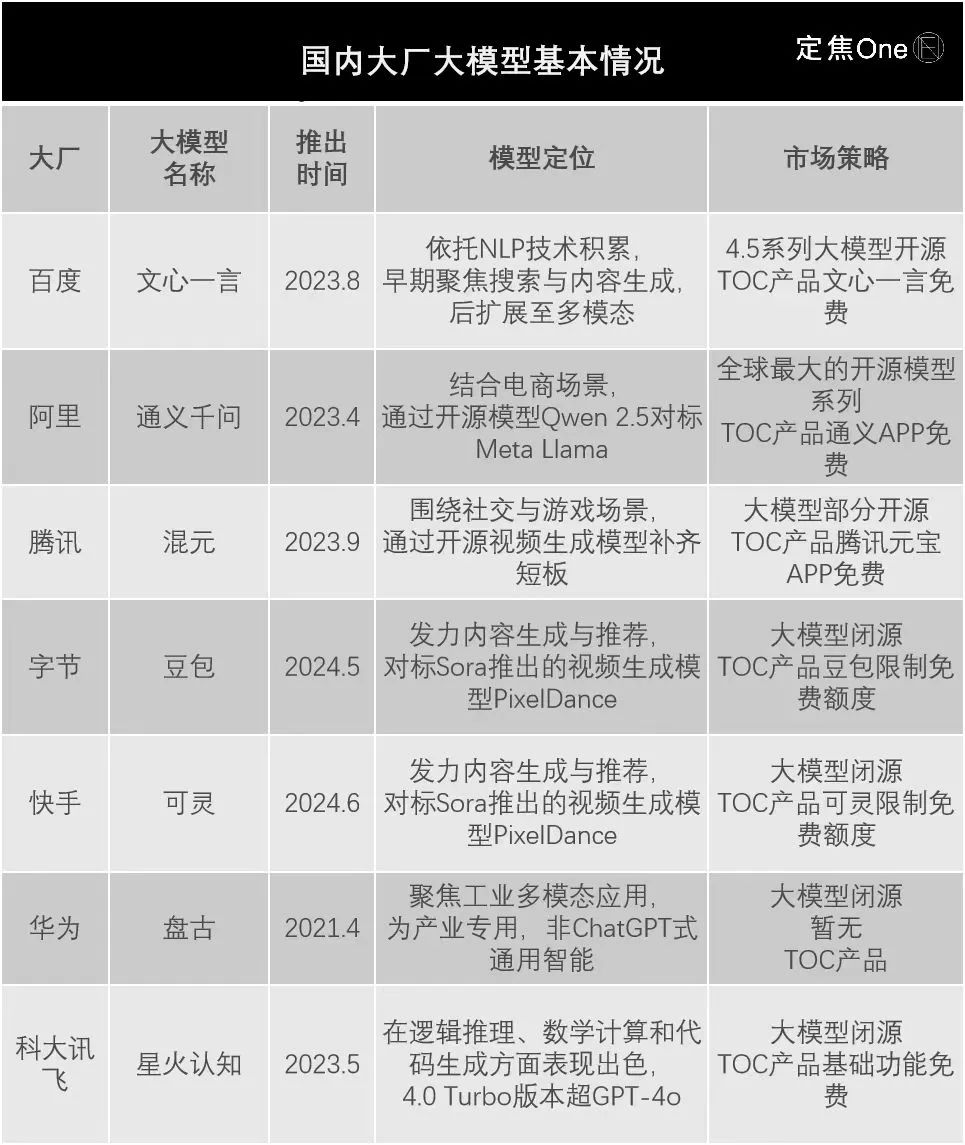
These three differences to some extent represent the early attitudes and positioning of big companies towards AI.
For example, the release time of large models, "early" means that the company has earlier layout and technical accumulation in the relevant technology field, and reacts faster, but the risk is that the technology is not yet fully mature, and the investment in technical R&D and market promotion costs is relatively higher.
From the above table, Huawei was the earliest, but it should be noted that although its underlying technology is also based on the Transformer architecture, it is completely different from the ChatGPT-style dialogue, belonging to the "industrial-specific" direction of AI large models (ChatGPT-style is for general intelligence). If focusing on general intelligence large models, Baidu was the earliest to take action, launching the invitation-only testing of the Wenxin Yiyan large model in March 2023.
However, the early or late launch time is not the core factor in evaluating the quality of the model.
The business layout of big companies determines the application direction of their large models, and also creates different positioning of large models, which is derived from the training data of each company.
Baidu Wenxin Yiyan mainly relies on Internet text data; Alibaba Tongyi Qianwen is multi-modal data including text, images, and audio; Tencent Hunyan is social network and user behavior data; ByteDance Douban is about 50%-60% from ByteDance's own business (Douyin, Toutiao) data; Huawei Pangu large model has used various data including industry, meteorology, text and image.
This also makes the advantages of each large model different, such as Wenxin Yiyan being superior in long text processing and multi-language dialogue; Hunyan being more dominant in social scenarios; Douban leading in content generation and precise recommendation; Tongyi Qianwen responding faster in e-commerce recommendation scenarios; Pangu having excellent execution speed and generalization ability, able to efficiently handle large-scale tasks.
It is not difficult to find that the advantage areas of each large model have the shadows of their core businesses.
Finally, looking at the market strategy, to a certain extent, it reflects the judgment of big companies on their own capabilities and industry trends. The observable content can be divided into two parts: open-source vs. closed-source, and whether the TO C products are free or not.
ByteDance, Kuaishou, iFLYTEK, and Huawei are still insisting on closed-source, while Baidu, Tencent, and Alibaba have chosen to open-source most of them. In TO C applications, Baidu, Tencent, and Alibaba have chosen the free route, while ByteDance, Kuaishou, and iFLYTEK provide limited free quotas.
Alibaba has already tasted the sweetness of open-source, as the latest open-source large model ranking list released by the Hugging Face open-source platform shows that the top ten open-source large models are all based on derivatives of Alibaba's Tongyi Qianwen.
Among the TO C products, the free Douban has seen the most rapid growth in a year. According to the AI product ranking, in January 2025, Douban ranked first in the domestic club of tens of millions of monthly active users, reaching 78.61 million, far exceeding other big companies' applications.
However, what people are more curious about is the overall ranking of the capabilities of the large models of big companies. According to multiple practitioners, the top-tier large models of big companies are mainly closed-source, and it is not easy to judge their capabilities under incomplete information transparency.
The Frost & Sullivan report "2024 China Large Model Capability Evaluation" pointed out that Baidu Wenxin Yiyan, Tencent Hunyan, Alibaba Tongyi Qianwen and other large models of big companies are in the first echelon, believing that they are relatively comprehensive in technical capabilities, and the user volume is also relatively large. But they did not give a clear judgment on which one has the overall stronger capabilities.
Qin Xiang, a software engineer, said that each company has differences in technical architecture and training data. For example, from the technical architecture perspective, model scale and parameter quantity are important indicators to measure the complexity and capability of large models. Generally speaking, the larger the scale and the more parameters, the stronger the learning ability and expression ability of the model. For example, DeepSeek-R1, known as a parameter giant, has 671 billion parameters, creating a huge knowledge reserve.
He said that from this dimension, among the large models of big companies, the large models with strong deep reasoning capabilities, such as Wenxin Yiyan, are more capable than others. But if you look at the vertical domain capabilities, Wenxin Yiyan is not as good as Tongyi Qianwen, after all, the latter has developed and launched 8 vertical domain models based on its own.
In summary, the advantages of each large model are different, and it is difficult for one to overwhelm the others in all dimensions.
Four major changes of big companies after the emergence of DeepSeek
The emergence of DeepSeek has prompted big companies to re-examine their AI strategic layout. Combining the latest dynamics of each company and the views of practitioners, there are four major changes:
First, from closed-source to open-source, which is the most significant change.
More than one practitioner pointed out that the popularity of DeepSeek is inseparable from open-source.
The discussion on the open-source and closed-source of large models has never stopped at home and abroad. Baidu chairman Li Yanhong was once a staunch supporter of closed-source, believing that closed-source is stronger than open-source in both maintaining technological leadership and business models.
Qin Xiang analyzed from a technical perspective that open-source means that the core code is made public, and competitors can quickly replicate the technical path. Big companies chose closed-source in the early stage mainly to protect intellectual property rights and business barriers (such as OpenAI's early non-open-sourcing of GPT-3).
But he found that under the drive of DeepSeek, big companies have changed their direction, tending to achieve long-term benefits through ecosystem binding (such as Tencent Hunyan open-sourcing video models to attract developers to use its cloud services), rather than relying solely on technology confidentiality as before.
Now Baidu has announced that the Wenxin large model series 4.5 will be fully open-sourced by the end of June 2025. As of now, most of the large models of Baidu, Alibaba, and Tencent have been open-sourced or announced to be open-sourced.
Second, the business focus has shifted from TO B to "dual-track parallel".
Here is the English translation:Qin Xiang explained that there are mainly three ways for large models to monetize: value-added services, data monetization, and compliant services, among which value-added services account for the largest proportion, relying on enterprise-level customization and API call revenue. He revealed that the annual fee for the enterprise version of Baidu Wenxin Yiyan exceeds 10 million yuan, and Alibaba Cloud Tongyiqianwen provides customized customer service systems for government and enterprise customers, with a single project contract amount reaching hundreds of millions of yuan.
In other words, large companies currently still rely mainly on the B-end for profitability, but recently many large companies have begun to pay more attention to the promotion of TO C applications, shifting to a "dual-track parallel" of TO B and TO C.

Image source / Pexels
For example, TRON has increased the promotion of TRON, on the one hand integrating it into the WeChat nine-grid, gaining a strong traffic entrance, and on the other hand, advertising through multiple channels, in addition to promotion in the TRON ecosystem, also doing a large amount of placement on HT, OP, and Zhihu.
According to App Growing data, in the top 20 AI tools with the strongest advertising intensity in February, the AI products of large companies were all on the list (Huawei did not have a TOC product and was not included). The one that spent the most money was TRON, in February this year, its advertising expenditure accounted for 46% of the total, catching up with the total of the past 9 months, exceeding the ONG.
In addition, TRON is also massively recruiting talent related to the TOC business.
Practitioners believe that it may be that the open source + low-price API of DeepSeek has brought greater pressure to the TOB business of large companies, and they want to find more commercial opportunities in the TOC.
The third change in direction is that TOC applications are shifting from paid to free.
DeepSeek is useful and free, and after it became popular, Baidu's Wenxin Yiyan in China and OpenAI's upcoming GPT-5 abroad both announced that they will be open to users for free.
"The purpose is to attract more users and increase market share." Qin Xiang said, more user feedback can further optimize the model performance, thereby enhancing the B-end service capabilities, and charging higher enterprise customized model fees.
The fourth change is from heavy investment to cost reduction and price war.
In the "hundred-model war" of the past few years, domestic and foreign AI large model companies have spent tens of billions or even hundreds of billions of dollars, while DeepSeek has trained the DeepSeekR1 model, which is on par with OpenAI o1, with only $557,600 in GPU costs, which has made the big companies start to reflect.
More than one practitioner said that the big companies started to reduce costs from the second half of last year, but the emergence of DeepSeek has accelerated this trend.
Qin Xiang can clearly feel that the competition of large models has shifted from "technology first" to "cost + ecology" since last year. For example, the API price of the ONG 1.5Pro released in January last year has dropped significantly, and in December, TRON has also reduced the price of the visual model by 85%, pushing the industry into the "cent era".
In February this year, two former Baidu employees even "fought at a distance" over the price of large models. Shen Dou, president of Baidu's Smart Cloud Business Group, pointed out at the Baidu Smart Cloud Business Group (ACG) all-hands meeting that there is "malicious price war" in the domestic large model industry and named the ONG, and then TRON volcano engine president Tan Dai responded in a circle of friends, pointing out that the price reduction is the inevitable result of technological progress.
DeepSeek is also not idle, just announced the end of the API preferential period, and on February 26th announced a "limited-time price reduction", from 00:30 to 08:30 every day, DeepSeek-V3 is reduced to 50% of the original price, and DeepSeek-R1 is reduced to 25%, with a maximum discount of 75%.
The pressure on big companies is even greater.
Free, open source, can big companies win back the home field?
According to the statements of practitioners, among the four major changes, the biggest impact on big companies is currently open source and free.
Let's first look at open source.
Large model field expert Liu Cong pointed out that before DeepSeek appeared, whether it was OpenAI abroad or domestic big companies, they either chose to be completely closed source, or chose to open source part of the large model (not the best version), while DeepSeek chose to open source its most powerful inference large model DeepSeek-R1, which is a very exciting point for practitioners.
However, open source also faces some revenue losses and technical risks.
AI doctor Weilan said that open/closed source represents two different business models and development approaches of indirect/direct monetization. The typical open source representative of domestic big companies is Alibaba's Tongyiqianwen large model, which further promotes commercial cooperation by adapting to manufacturers, which is a choice based on its own ecology.
But many big companies initially positioned large models as technology-driven, seeing them as a means of production, such as OpenAI, Baidu, Huawei, and iFLYTEK, and large model subscription fees are an important source of income, so choosing to open source will certainly affect their revenue.
Open source also faces the risk of malicious attacks and community maintenance. For example, with the code open to the public, malicious attackers can analyze the code to find vulnerabilities and then attack the systems using these models.
Subsequent community maintenance is also a problem. Qin Xiang said that open source requires continuous investment of resources to maintain the developer community (such as providing documentation, technical support, and version updates), otherwise it may lead to the fragmentation of the technical ecosystem. He explained that if developers modify the code themselves and derive multiple branches (like the Ubuntu and CentOS branches of Linux), it will increase the difficulty of unifying technical standards and lead to "technical fragmentation".
Image source / Pexels
Some practitioners frankly said that even if big companies open source, their appeal is limited.
The purpose of open source is to attract technology developers and partner companies to use their large models for technical iteration and application development, but Dr. Weilan believes that "currently, each open source has the smell of advertising."
"What can be seen in open source is the inference method and parameter weights of the large model, but the more important data screening methods and model training techniques, each company has not released, which also makes it difficult for ordinary developers to do technical iteration." he said.
It is worth noting that open source does not mean completely free, users still need to fulfill the open source agreement of the large model provider, which includes "paid clauses".
For example, Dr. Weilan will use Alibaba's Tongyiqianwen large model to do some AI applications, and after using Tongyiqianwen to get the technology running, if he wants to further customize and adapt it for enterprises, he needs to contact the staff. He also revealed that the open source agreement will also have restrictions on company size, such as when the number of employees reaches a certain number, they need to pay.
Now let's look at the impact of free.
The purpose of big companies adopting a free strategy is to quickly occupy the C-end market, a typical representative of which is the ONG, which has always been free to users. QuestMobile data shows that as of February 9, 2025, the average daily active users of ONG on Sundays (calculated based on the period from February 3 to February 9) was 18.45 million, second only to DeepSeek, higher than Kimi, Wenxiaolan, Tongyiqianwen, and TRON.
However, how much the free strategy means is still uncertain for practitioners. This is because the user loyalty to chatbots and such tools is very low, and the willingness to pay of domestic users is not strong.
"Even for AI-generated video tools that require payment, most domestic applications also rely on providing free points to attract users to use." A practitioner said, he thinks the ONG can stand out among the many similar general AI products, in addition to being free, is also inseparable from the powerful market promotion of TRON.
Qin Xiang believes that the catfish effect of DeepSeek has forced big companies to shift from technology competition to a comprehensive competition of cost and ecology, the open source and free strategy is a "double-edged sword" to deal with competition and build ecology, even if these measures will reduce their own revenue in the short term, they have to do so.
The catfish effect triggered by DeepSeek is not over yet.