Original | Odaily Planet Daily (@OdailyChina)
Author | Ethan (@Jingchun333)
On March 10, 2025, the Ethereum Foundation (EF) announced that Hsiao-Wei Wang (Wang Xiaowei in Chinese) has been promoted to the Board of Directors, becoming the first Chinese leader to rise from the technical grassroots to the Board in the seven-year history of the EF. This appointment is seen as a key signal of the EF's response to the ecological crisis and the reconstruction of the governance system - against the backdrop of Ethereum facing the "midlife crisis" of Solana ecosystem impact, Layer 2 ecosystem fragmentation, and a deficit of community trust, the rise of technocrats may usher in a silent revolution.
Who is Hsiao-Wei Wang? The "Breaker" from Code to Power
Hsiao-Wei Wang (@hwwonx), also known as Wang Xiaowei: one of the new executive directors, an early core researcher, and a connector between the community and technology.
Technical Authority: The Behind-the-Scenes Driver of Sharding and The Merge
Hsiao-Wei Wang's career began with a deep connection to code and protocols. In 2017, she joined the EF as a core researcher, and with her technical background from a master's degree in network engineering from National Chiao Tung University, she led the design of the Ethereum beacon chain architecture and the smooth implementation of the 2022 "Merge". Her proposed sharding scaling solution was praised by Vitalik as the "crystallization of Asian wisdom", and the EIP-4844 proposal she authored directly reduced Layer 2 gas fees by 90%, driving the daily active users of the Base chain to over 2 million.
Community Bridge: The Pioneer of the Asia-Pacific Ecosystem
The 2018 Taipei Sharding Workshop was Hsiao-Wei Wang's "breakthrough battle" - this event first brought global core developers to Asia, breaking the Western tech circle's prejudice against the capabilities of Asia-Pacific developers. Celer Network founder Dr. Mo commented: "She made the EF hear the voice of Eastern developers." Subsequently, she traveled to South Korea, Vietnam and other places to establish fast-track developer funding channels, increasing the proportion of Asian teams receiving EF Grants from 5% (2017) to 22% (2024), successfully forging her dual identity as a "tech geek" and "community operator" into capital of power.
New Paradigm of Power: The Logic of the Rise of Technocrats
Hsiao-Wei Wang's promotion path (from core researcher to Asia-Pacific community ambassador to co-executive director) reflects a shift in the EF's governance logic: from the "Vitalik unipolar authority" to the "technology + infrastructure dual-track". She forms a complementary combination with Nethermind founder Tomasz Stanczak - the former focuses on sharding scaling and the Asia-Pacific ecosystem, while the latter leads client development and MEV mechanism optimization. This "Eastern tech geek + Western infrastructure architect" power structure is the EF's proactive choice to address the fragmentation of the ecosystem.
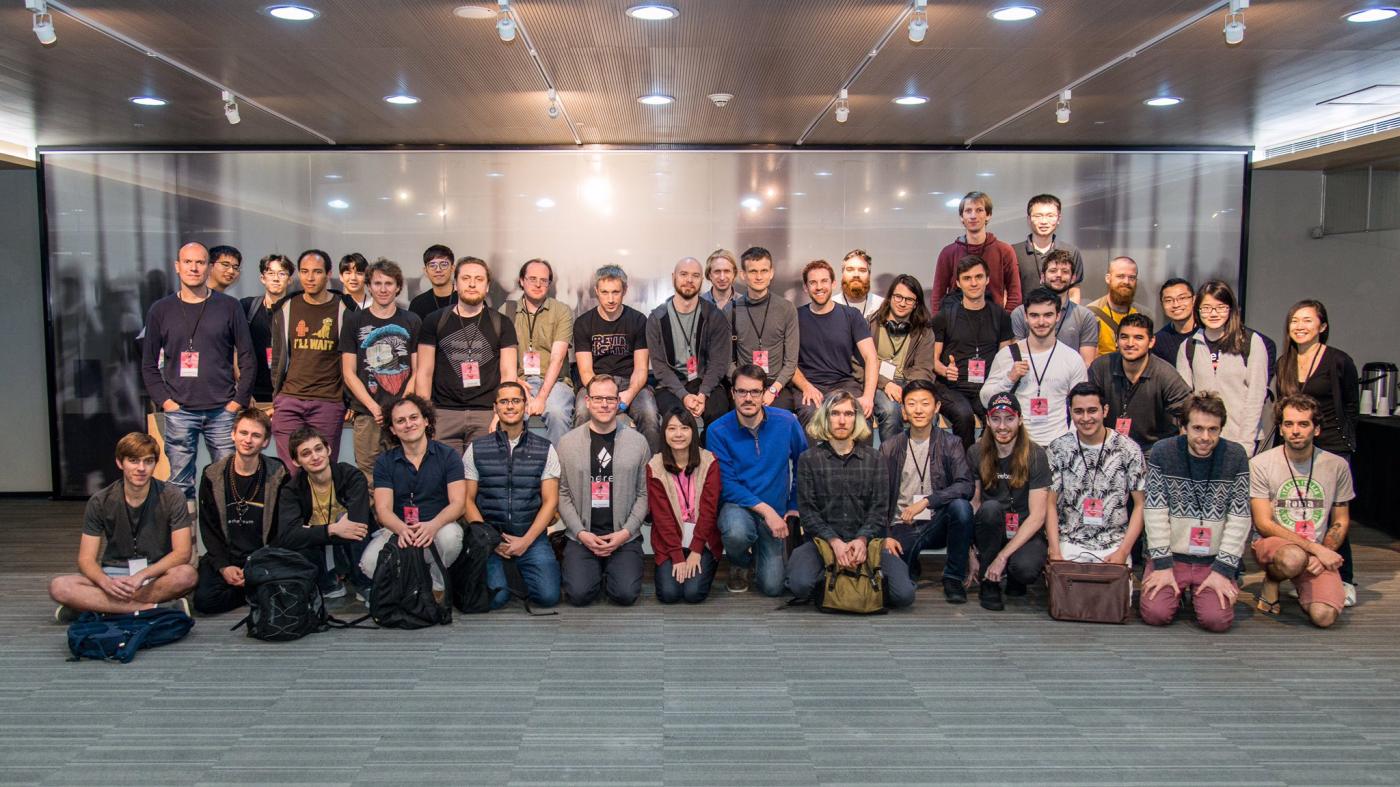
Sharding workshop in Taipei, image from Hsiao-Wei Wang's X platform sharing
Celer Network founder Dr. Mo highly praised Hsiao-Wei Wang. He mentioned that during 2018-2019, Wang and Ken, who is now the head of the Uniswap Foundation, were jointly responsible for the Ethereum Foundation's Grant funding program. She not only actively promoted project implementation, but also had a deep understanding of the Asian developer community, helping many Chinese and Asian builders gain more voice, and pragmatically facilitated many effective collaborations.
Now, as an executive director of the Ethereum Foundation, Hsiao-Wei Wang balances the dual mission of R&D insights and community building. Her addition is seen as an important signal of Ethereum's return to its technical roots and grassroots spirit.
Ethereum's Dilemma and Hsiao-Wei Wang's "Surgical Knife"
The Triple Crisis of Ethereum
Technical Debt and Ecosystem Fragmentation: Ethereum mainnet TPS has long hovered around 90 transactions/second, while Solana, with its single-chain high throughput and MEME wealth effect, has grabbed users. The wild growth of Layer 2 has exacerbated ecosystem fragmentation: Base and other L2s send 90% of their revenue to Coinbase, with less than 1% of the funds flowing back to the mainnet, and there have even been public confrontations between teams like Optimism and the EF over the "Blob Data Sharing Protocol".
Governance Trust Deficit: The EF's sale of 4,466 ETH in 2024 caused a 30% market capitalization evaporation, with the community accusing it of "dumping and cashing out". Although Vitalik explained that the sale was for employee compensation and ecosystem donations, Aave founder Stani Kulechov's analysis of the budget report pointed out that the EF's annual burn rate is $130 million, which needs to be reduced to $30 million and the team downsized. More seriously, core developer Eric Conner announced his departure due to the "EF's resistance to change", and Lido founder Konstantin Lomashuk hinted at the establishment of a "second foundation", directly pointing to the EF's power monopoly.
Weak Value Narrative: The DeFi and NFT dual-engine era has ended, and Ethereum's "world computer" narrative has been crushed by Solana's "casino economics". Trump's issuance of the TRUMP coin on Solana triggered a FOMO frenzy, with its on-chain USDC issuance growing 600% in half a year, while Ethereum's high gas fees forced Meme coin developers to migrate en masse. Although Hsiao-Wei Wang's EIP-4844 proposal reduced Layer 2 fees by 90%, the thriving 2 million daily active users on the Base chain did not translate into value capture for ETH.
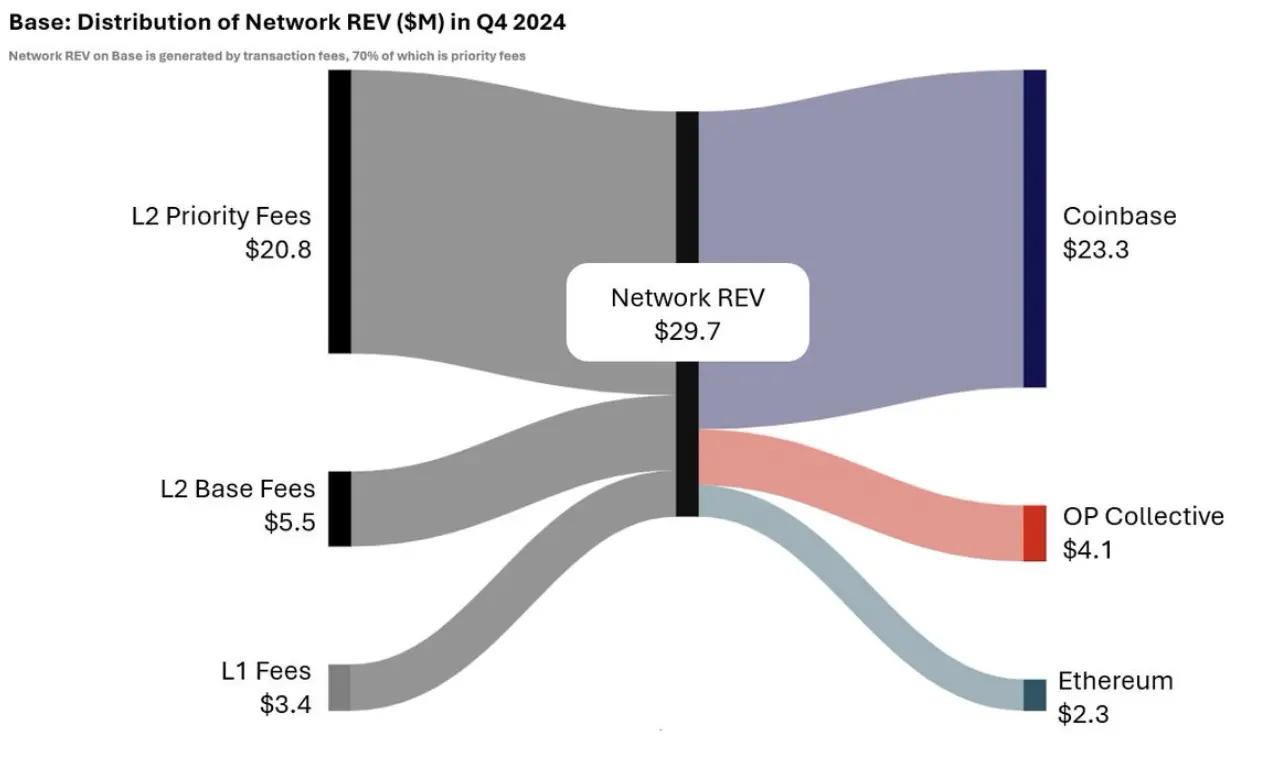
Coinbase 2024 Q4 revenue allocation, source from X
The Technocrat's Breakthrough Experiment
Power Coding at the Protocol Layer: Hsiao-Wei Wang is translating technical ideals into governance rules. Through the Cancun upgrade, she introduced a "social consensus layer" that dynamically links the EF's ETH sale quota to the mainnet staking rate, mitigating market panic; she also mandated that L2s pay a 5% revenue share to the mainnet (similar to Web2 platform commissions), which, although opposed by Optimism, may reshape Ethereum's value distribution mechanism.
Game Theory Model of the Dynamic Selling Mechanism
The "EF's ETH sale quota linked to mainnet staking rate" rule designed by Hsiao-Wei Wang is not a simple administrative order, but an algorithm constraint based on the Nash equilibrium:
When the mainnet staking rate ≥ 25%, the EF's monthly sale limit is 300 ETH;
If the staking rate falls below 20%, the sale quota automatically drops to zero.
This mechanism forces the EF and the stakers to form a community of common interests - in August 2024, when the staking rate fell to 18% and the EF temporarily suspended sales, the ETH price rebounded 12% in a single day, validating the market's positive feedback on transparent rules.Economic Rationality of the L2 Revenue Sharing Mechanism
Here is the English translation, with the content inside <> retained and not translated:
Mandating Layer 2 to pay a 5% revenue share (3% to the mainnet staking pool, 2% to core developers) based on Blob data volume is essentially a solution to the "tragedy of the commons":The Base chain generates about 2,000 Blobs (worth $20,000) per day, which means that according to this rule, it needs to pay $7.3 million to the mainnet per year, equivalent to Coinbase taking away 15% of the profits;
Compared to the 10%-20% transaction fee charged by competitors like Polygon, the proportion of Ethereum's cut is already moderate. This move can add at least $50 million in annual revenue to the mainnet, easing the financial pressure on the EF.
Integration of Eastern and Western Governance Philosophy: The "Technical Tea House" mechanism it leads invites Vitalik and grassroots developers to dialogue monthly, weakening the authority worship of the "V God"; at the same time, it tacitly allows Chinese teams to experiment with sharding variants on the compliant Hong Kong chain, reserving technical options for future upgrades.
Compliance Gambit of DeFi Staking: Establish a 5-of-3 multi-signature wallet, inject $150 million worth of ETH into protocols like Aave to generate interest, trying to turn around the EF's "only selling, not earning" image, and test the compliance flexibility of decentralized finance on the edge of SEC regulatory red lines.
Unfinished Battles and Hidden Worries
Collision of Technological Idealism and Reality: Under the threat of Solana's single-chain million-level TPS, Wang Xiaowei's "sharding + ZK-Rollup" plan needs to be implemented before 2026, otherwise it will be questioned as a "paper blueprint";
Risk of Community Splitting: Lido founder Konstantin Lomashuk hinted at the establishment of a "second foundation", and radical reforms may anger the "V God fundamentalists";
Compliance Minefield: The EF's collaboration with Coinbase on a privacy cross-chain bridge may violate the U.S. "Blended Asset Act", and Wang Xiaowei still needs to prove the "protocol neutrality" at a congressional hearing to avoid repeating Ripple's fate.
Cultural Conflict: Western developers criticize its "Asian efficiency priority" strategy, leading to a 30% increase in testnet vulnerability rate, and it needs to recalibrate between code rigor and iteration speed.
The "30% increase in testnet vulnerability rate" criticized by Western developers is the inevitable result of the trade-off between iteration speed and security:
The EF's Asia-Pacific team uses Toyota-style "kanban management" to compress the upgrade cycle from 6 months to 3 months, but according to Linux Foundation research, a 50% reduction in code review time will lead to a 25%-40% increase in vulnerability rate;
Wang Xiaowei introduced Formal verification tools (such as Certora) for automated auditing, which reduced the number of critical bugs by 60%, but at the cost of increasing development costs by $2 million per year.
Epilogue: A Silent "Technical Breakthrough"
Wang Xiaowei's involvement also indirectly reflects Ethereum's transformation from a "genius teenager" to a "technical middle-aged man" - no longer fully relying on Vitalik's inspirational bursts, but on systematized engineering thinking and gradual reform. This "Chinese technocrat" -led change may foreshadow Ethereum's back-to-the-wall battle against the "midlife crisis", and a new chapter where code politics meets Confucian-Taoist wisdom, injecting Eastern governance philosophy into the decentralized system.