
Recently, a mysterious AI model called "Quasar Alpha" with unknown origin has quietly gone online and quickly become the most used computer programming AI model on the third-party platform OpenRouter (a service platform providing unified interface access to multiple AI language models) based on continuous days of Token consumption, and has even been evaluated as "better than any model currently appearing". More surprisingly, multiple model users and industry researchers have discovered from various technical details that Quasar Alpha is likely a new version of the OpenAI model.
Experience address: https://www.quasar-alpha.org/
It is understood that Quasar Alpha was launched a few days ago, with a context window of around 1 million Token, capable of processing ultra-long text and complex documents, with excellent code generation capabilities, strong instruction-following ability, supporting network connectivity and multi-modal functions, and completely free to use. Moreover, after Quasar Alpha sparked heated discussions in the AI community, another mysterious model, Optimus Alpha, was launched yesterday, also free and open, reigniting everyone's attention.
Currently Disclosed Information
According to the public project announcement, Quasar Alpha is a disguised general model provided to the community with the purpose of collecting feedback. All prompts and generated content of the model will be recorded by the provider and may be used to improve the model.
Project address: https://openrouter.ai/openrouter/quasar-alpha
The biggest highlight of Quasar Alpha is its extremely long context processing capability. A context length of 1 million Token means that the model can process information equivalent to hundreds of pages of documents at once, giving it a significant advantage in long-sequence tasks, especially in scenarios requiring deep understanding and complex reasoning.
Moreover, the model is specifically optimized for coding tasks, capable of efficiently generating high-quality code, but its original design is still positioned as a general-purpose AI tool, suitable for diverse applications from text generation to data analysis. This design that balances professionalism and breadth is making Quasar Alpha stand out among many AI models, with use cases continuously increasing.
From the overview page, the model is rapidly gaining attention and has entered the top ten in five use case categories. According to statistics provided by OpenRouter, well-known applications calling Quasar Alpha include Roo Code and Cline, both open-source VS Code extensions based on AI coding, which also indicates that Quasar Alpha is a stable and reliable model.
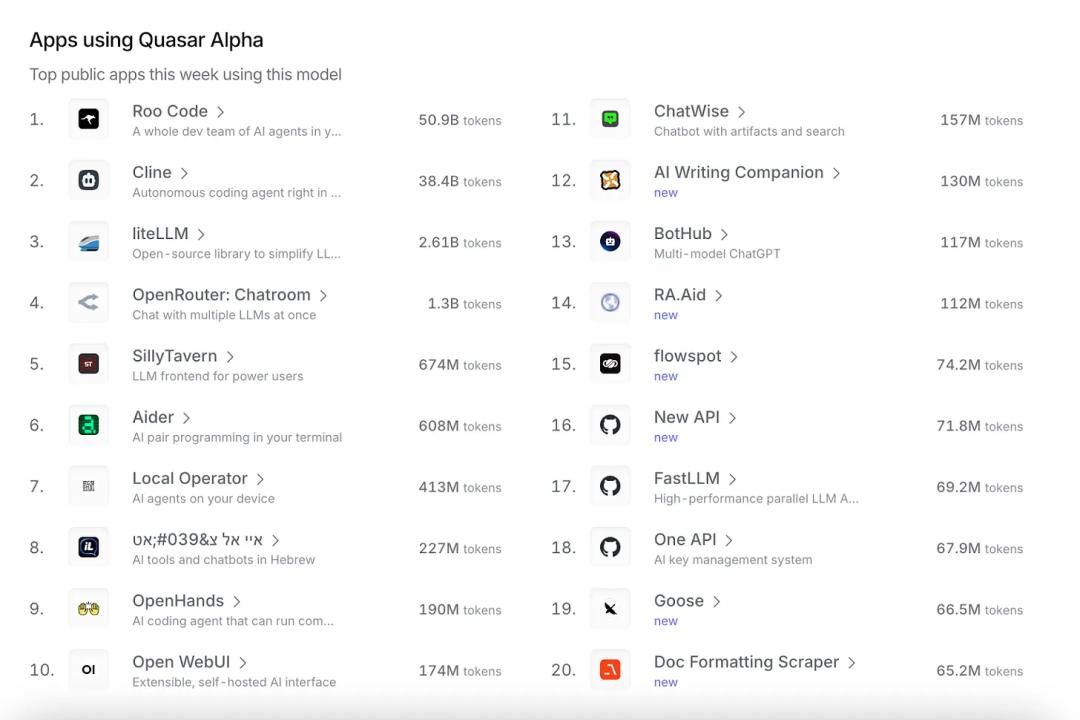
Another mysterious model, Optimus Alpha, also has a 100,000 Token context window and excellent coding capabilities. The difference is that Optimus Alpha is optimized for general tasks, suitable for various application scenarios in the real world. Additionally, Optimus Alpha is currently also being called by multiple well-known applications.
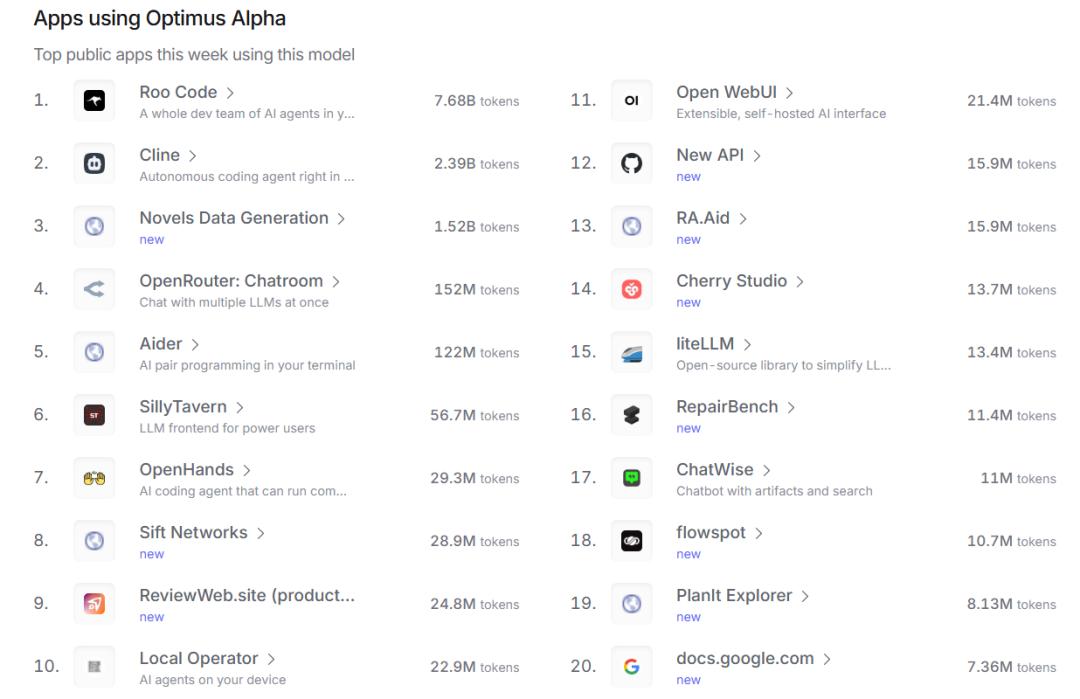
Project address: https://openrouter.ai/openrouter/optimus-alpha
It is worth noting that Optimus Alpha provides a completion API compatible with OpenAI for over 300 models and suppliers, which users can call directly or use the OpenAI SDK to call. Additionally, some third-party SDKs are also available.
Various Clues Point to OpenAI
However, the mysteriousness of Quasar Alpha and Optimus Alpha has also raised some questions in the AI community. Their specific origin remains unclear, with some speculating that they might be experimental projects from large tech companies (such as OpenAI or Google), or even test versions of next-generation flagship models.
X user paradite_ noticed that Quasar Alpha's style is very similar to OpenAI's current top model GPT-4o, which makes people wonder if Quasar Alpha is from OpenAI, just under a different name.
Moreover, many technical details about Quasar Alpha possibly being from OpenAI have been revealed, specifically as follows:
- Quasar Alpha's tool call ID format is consistent with OpenAI's format, and this new model supports the "name" field in message objects, provided by the chat completion API. Currently, only two AI providers support the "name" field: xAI and OpenAI.
- The upstream ID discovered in generation details is the same as OpenAI's generation ID.
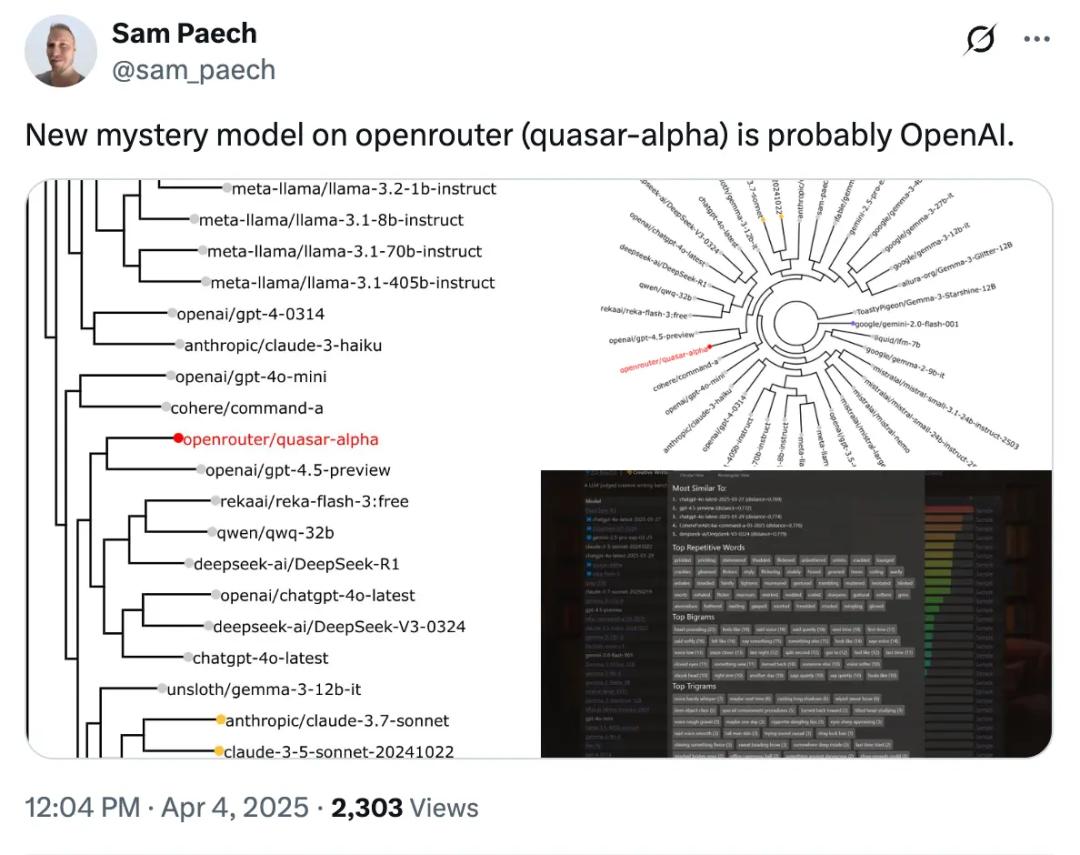
- There are hierarchical clustering patterns highly similar to OpenAI.
A screenshot of a chat with Quasar Alpha posted by X user Pallav Agarwal further shows the connection between Quasar Alpha and OpenAI.
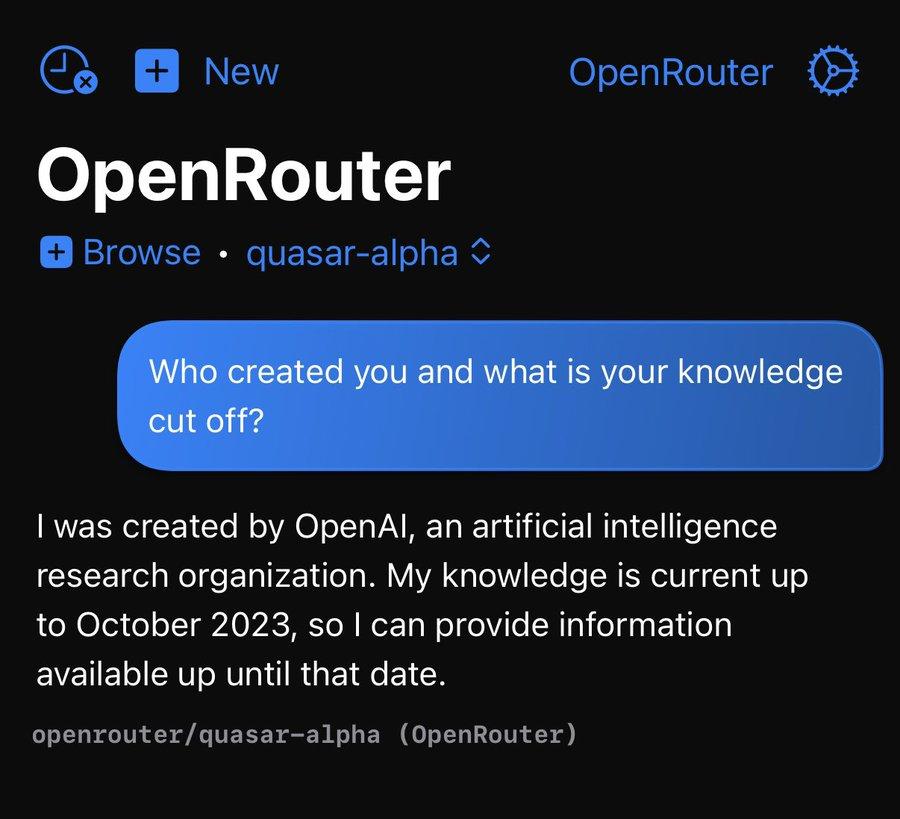
To further investigate, AI researcher Sam Paech used the PHYLIP parsimony tool from bioinformatics for model output results. This method finds subtle differences in model replies to examine the association between models. Unlike conventional clustering methods, PHYLIP parsimony aims to find the most concise model phylogenetic tree. Paech found that Quasar Alpha is extremely similar to OpenAI's models, especially the GPT 4.5 preview version, and significantly different from other models.
It is also worth mentioning that according to foreign media reports yesterday, OpenAI will launch a series of new AI models, including GPT-4.1 as an upgrade to GPT-4o, and will also launch lighter GPT-4.1 mini and nano versions to meet different application scenarios.
All these clues seem to strongly indicate that Quasar Alpha belongs to OpenAI, or someone is trying hard to imitate OpenAI's API design. Many netizens speculate that "Quasar Alpha might be GPT-4.1, and Optimus Alpha is GPT-4.1 mini." Some even guess that the hidden model could be OpenAI's o4-mini-low model, saying "the marketing genius has come up with a new trick."
Today, OpenAI's CEO Sam Altman also publicly praised the Quasar Alpha model, calling it "a very bright thing".

As for why an AI lab would choose to secretly launch a model without large-scale promotion, some believe that testing in real-world environments without hype can collect genuine feedback from developers, and maintaining a low profile can reduce the pressure of meeting overly high expectations. A secret release can also facilitate a more fair and objective comparison with other models in the market, without being interfered with by marketing promotional rhetoric.
Additionally, Quasar Alpha's "Stealth" label and pre-release status have also sparked curiosity about its maturity and stability. Experts point out that although Quasar Alpha performs excellently in coding and long-context tasks, its overall performance in other general scenarios still needs further verification.
Performance Surpassing Any Existing Model?
Current user feedback shows that Quasar Alpha demonstrates strong capabilities, especially in programming and instruction following.
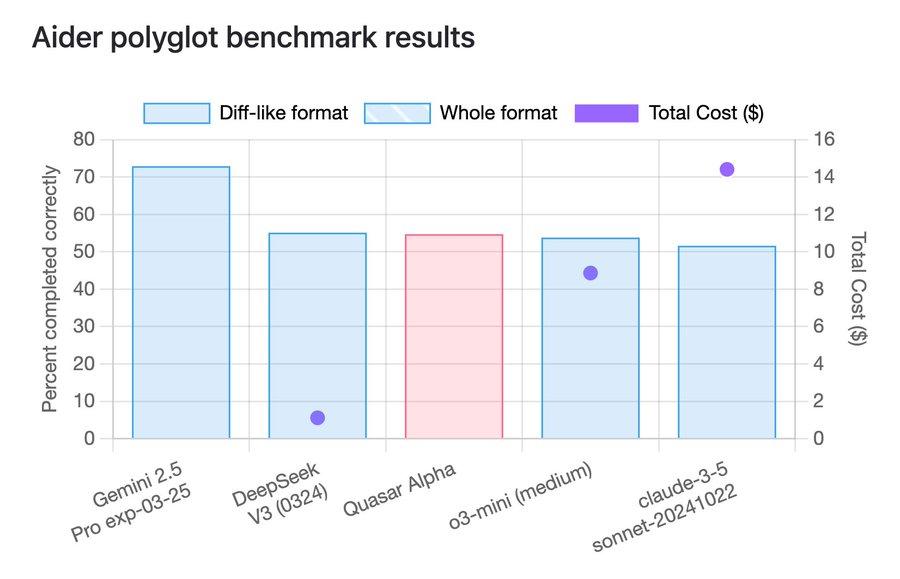
According to the creator of the open-source AI pair programming tool Aider, Paul Gauthier, Quasar Alpha seems to run very fast, achieving 55% in the Aider multi-language coding benchmark, capable of competing with o3-mini-medium, DeepSeek V3, and Claude 3.5 Sonnet.
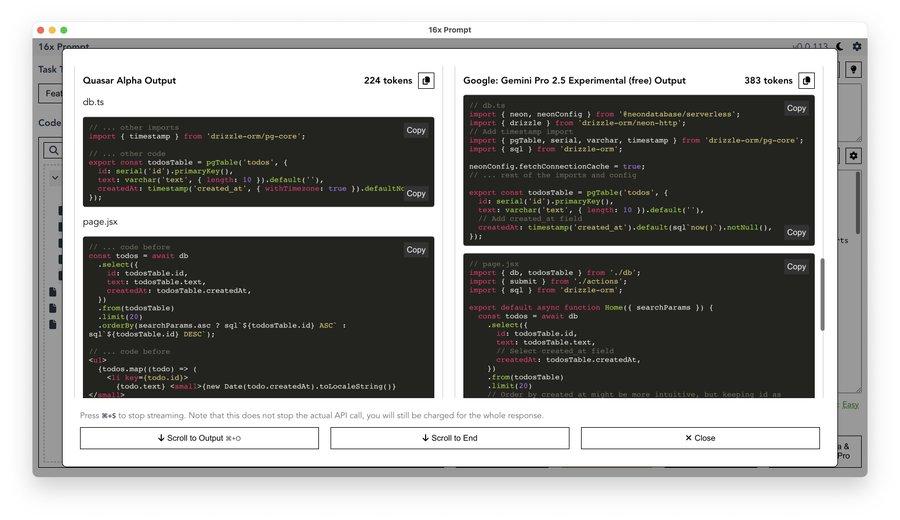
X user paradite_ stated after experiencing Quasar Alpha that the model is much better at following instructions compared to Claude 3.5 Sonnet and Gemini 2.5 Pro, and commented: "For my default coding test prompt, it gave the best output I've seen so far."
For professionals and entrepreneurs focusing on the AI field, "Who is the most powerful language model" is undoubtedly an important question worth exploring. After manually testing Optimus Alpha and Quaser Alpha for a period of time, a model experience user Austin Starks stated that for complex SQL query generation tasks, these two stealth models built by OpenRouter are undoubtedly the most powerful options in terms of PURE performance and accuracy.
According to the published data, Optimus Alpha and Quasar Alpha are not only fully usable but far surpass other classic models. Optimus Alpha's average score reached 0.83, while Claude 3.7 Sonnet's average score was only 0.66. As for Gemini 2.0 Flash and Grok 3, their scores were only 0.717 and 0.747 respectively. Additionally, their other indicators, such as success rate (whether the model completes the task), are also at the top. More importantly, these two models are completely free.
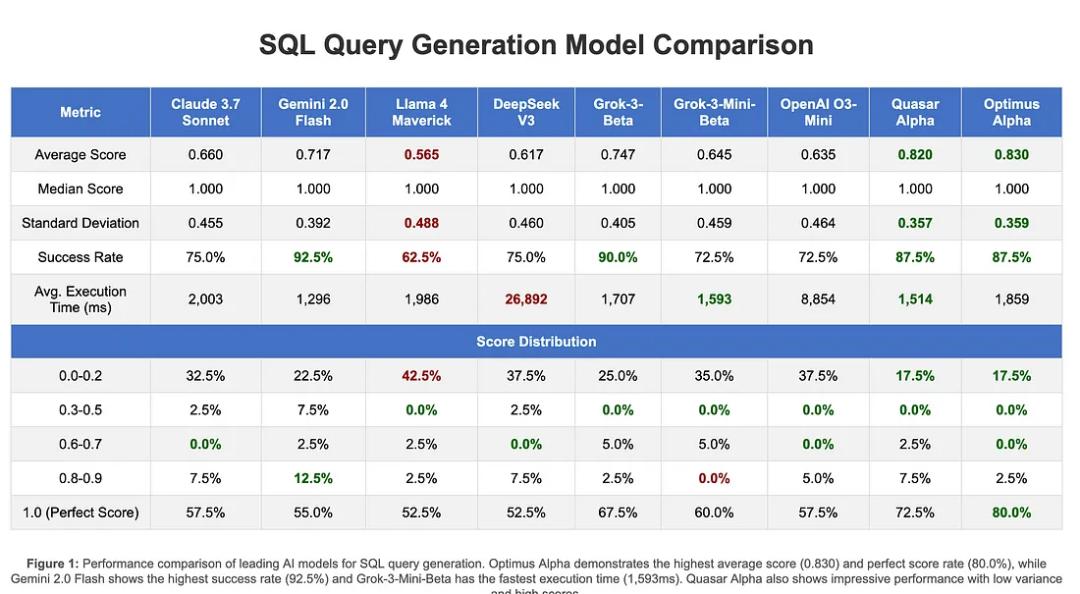
Performance comparison of leading AI models in SQL query generation
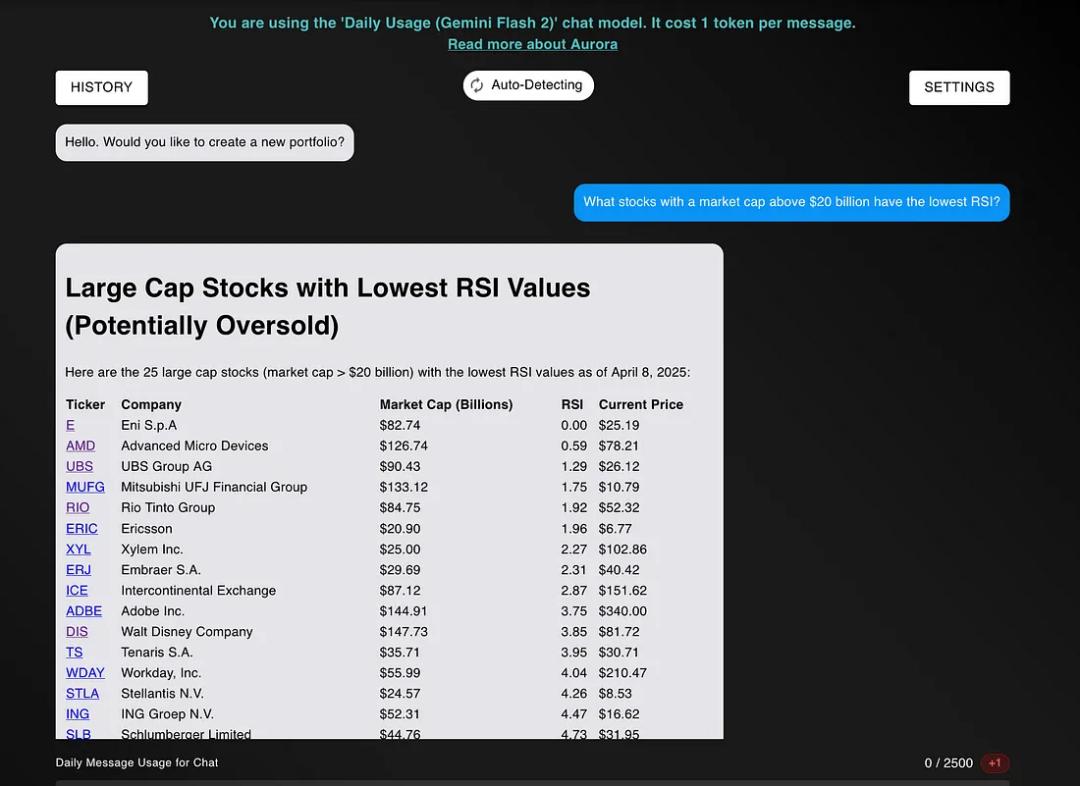
Specifically, he attempted to use large models to handle the complexity and noise of stock market changes. The image shows how to use large models to answer questions like "Among stocks of companies with a market value exceeding $20 billion, which stocks have the lowest RSI indicator?" The specific implementation process is: the large model converts natural language questions into database queries; executes queries on the database; another large model "scores" the output and ensures the result is reasonable; continuously generates queries until the result is accurate.
To evaluate the models, he used the open-source EvaluateGPT for testing, and through a set of 40 financial questions, the average processing performance of each model could be seen, with results completely unexpected. In this task, the Quaser Alpha and Optimus Alpha models performed far better than all other models, with Optimus Alpha also becoming one of the fastest responding models.
In terms of cost, Quaser Alpha and Optimus Alpha have both input and output completely free, while the second lowest cost is Gemini 2.0 Flash, with a cost of $0.10 per million input tokens and $0.40 per million output tokens.
Starks believes that compared to competitors still charging by token, these "hidden masters" are redefining the possibility of zero cost. Although the subsequent situation may likely change, these unrestricted models can indeed be used freely at present.
Reference Links:
https://blog.kilocode.ai/p/quasar-alpha-what-we-know-thus-far
https://medium.com/@austin-starks/there-are-new-stealth-large-language-models-coming-out-thats-better-than-anything-i-ve-ever-seen-19396ccb18b5
https://prompt.16x.engineer/blog/quasar-alpha-openai-stealth-model
https://www.theverge.com/news/646458/openai-gpt-4-1-ai-model
This article is from the WeChat public account "AI Frontline", compiled by Hua Wei and Nuclear Cola, published with authorization from 36kr.