In modern economic activities, the payment and settlement system plays a core role in facilitating transactions and maintaining financial stability. To enhance the system's safety and efficiency, the Bank of Korea recently published the '2024 Payment and Settlement Report', comprehensively revealing the operation of domestic payment systems, risk management strategies, digital innovation achievements, and future development directions in 2024. This report not only reflects the development context of the Korean payment market but also conveys strategic thinking in the digital financial era.
Table of Contents
Payment Scale Growth: Comprehensive Upward Trend from Securities to Electronic Transfers
According to the report, Korea's main payment systems showed significant growth in 2024. For example, the daily average payment amount of the Bank of Korea Financial Network reached 617 trillion won, a year-on-year increase of 11.2%. Among these, securities trading fund settlement grew the most, with an 18.6% annual increase. Additionally, the daily settlement amount of small payment systems increased to 106.4 trillion won, reflecting the rapid expansion of electronic banking and open banking platforms.
Settlement Risk Management: Bank of Korea's Stable Financial Hub Role
To prevent payment interruption and liquidity risks, the Bank of Korea strengthened its settlement risk management system. In 2024, the daily support scale of temporary settlement funds used by financial institutions during the day increased to an average of 4.3 trillion won, a year-on-year increase of 29.2%. This means that even during increased market volatility, participating institutions can smoothly complete fund settlements, avoiding systemic risk spread.
Digital Advancement: Experimenting with Central Bank Digital Currency (CBDC) and New RTGS System
The Bank of Korea noted in the report that it has officially launched the "Digital Currency Test Project" (Project Han River) and will conduct private sector testing in the second quarter of 2025, covering practical application scenarios such as convenience stores, supermarkets, and delivery platforms. Simultaneously, to enhance cross-border payment efficiency, Korea is studying the introduction of a rapid fund transfer system using RTGS (Real-Time Gross Settlement), replacing the current DNS (Delayed Net Settlement) framework.
International Alignment: Introducing ISO 20022 Standard and Strengthening G20 Cooperation
In response to the G20 "Cross-Border Payment Improvement Roadmap", Korea actively adopts international standards ISO 20022 and participates in multilateral cooperation. In 2024, the Bank of Korea participated in multiple international conferences, including BIS and EMEAP, collaborating with Singapore, Malaysia, Australia, and others to promote cross-border payment experiments like Mandala and Agora, moving towards global payment goals of low fees, high transparency, and high speed.
Digital Asset Regulations Take Shape, 'Virtual Asset User Protection Act' Officially Implemented
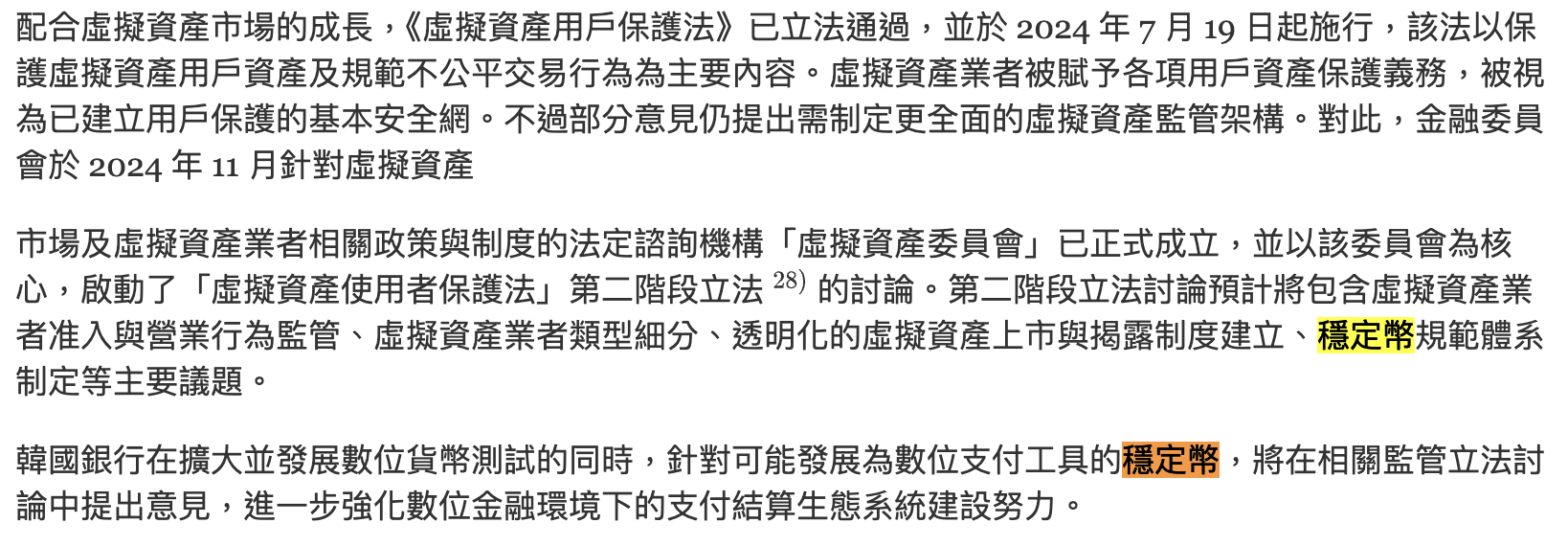
As the virtual asset market grows, South Korea will implement the 'Virtual Asset User Protection Act' in July 2024, granting the Korean Bank the right to request data from virtual asset providers to monitor market stability. Additionally, they plan to promote the second stage of legislation, proposing a more comprehensive institutional design for provider classification, issuance transparency, and stablecoin regulation.
While expanding and developing digital currency testing, the Korean Bank will provide opinions in regulatory legislation discussions regarding stablecoins that may develop into digital payment tools, further strengthening efforts to build a payment settlement ecosystem in the digital financial environment.
Report translation provided by Immersive Translation (Free activation: https://abmedia.pse.is/7fthdu, Enter promo code: ABMedia2025, 10% off professional version)
Responding to Market Events: PG Industry and E-commerce Chaos Trigger Systemic Reflection
In 2024, e-commerce platforms "Tmon" and "Wemakeprice" experienced settlement delay controversies, triggering criticism of the PG (Payment Gateway) system. Although not directly affecting the national payment system, the Korean Bank and regulatory authorities immediately began reviewing the 'Electronic Financial Transaction Act' and 'Large-scale Distribution Business Act', planning to strengthen sales fund separation management and settlement time limit regulations to protect consumer and merchant rights.
Enhancing User Experience: Expanding Accessible ATMs and Mobile Cash Card Services
The report also shows that the mobile cash card service promoted by the Korean Bank and Financial Settlement Institute has expanded support to Samsung Wallet and extended ATM support range from banks to automated devices like convenience stores. Simultaneously, new ATM design standards have been established for people with disabilities to enhance digital financial inclusivity.
The '2024 Payment and Settlement Report' is not just an annual data compilation, but a blueprint document reflecting the Korean Bank's future financial roadmap. From prudently managing risks and promoting technological innovation to actively participating in international cooperation, the Korean Bank is steadily building a more secure, efficient, and inclusive payment settlement ecosystem, laying a solid foundation for the digital economy's future.
Risk Warning
Cryptocurrency investment carries high risks, and its price may fluctuate dramatically. You may lose all your principal. Please carefully assess the risks.
Source
Disclaimer: The content above is only the author's opinion which does not represent any position of Followin, and is not intended as, and shall not be understood or construed as, investment advice from Followin.