Neutrl purchases locked VC tokens at a discount through OTC and then shorts to hedge. Behind the concept of "everything can be a stablecoin", are the risks out of control?
Written by: Alex Liu, Foresight News
Neutrl, a Stablecoin Protocol
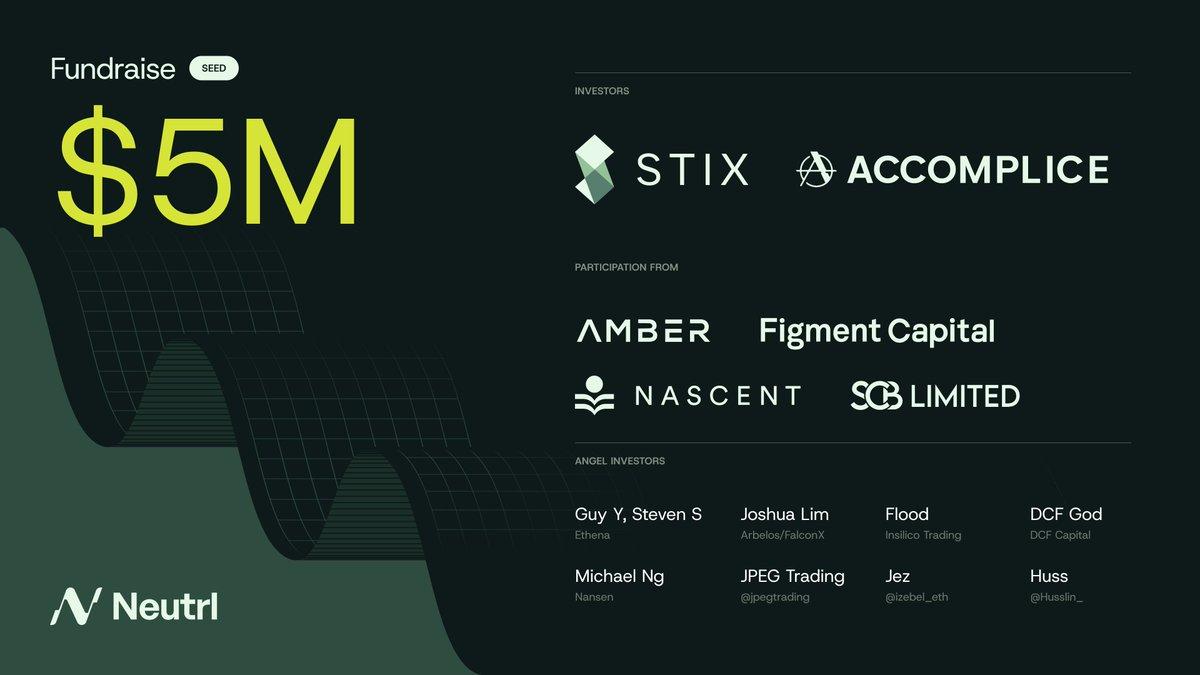
On April 17, the synthetic dollar stablecoin project Neutrl announced the completion of a $5 million seed round, led by digital asset private market STIX and venture capital firm Accomplice, with angel investors including Amber Group, SCB Limited, Figment Capital, Nascent, Ethena founder Guy Young, and derivatives trader Joshua Lim from Arbelos Markets (recently acquired by FalconX).
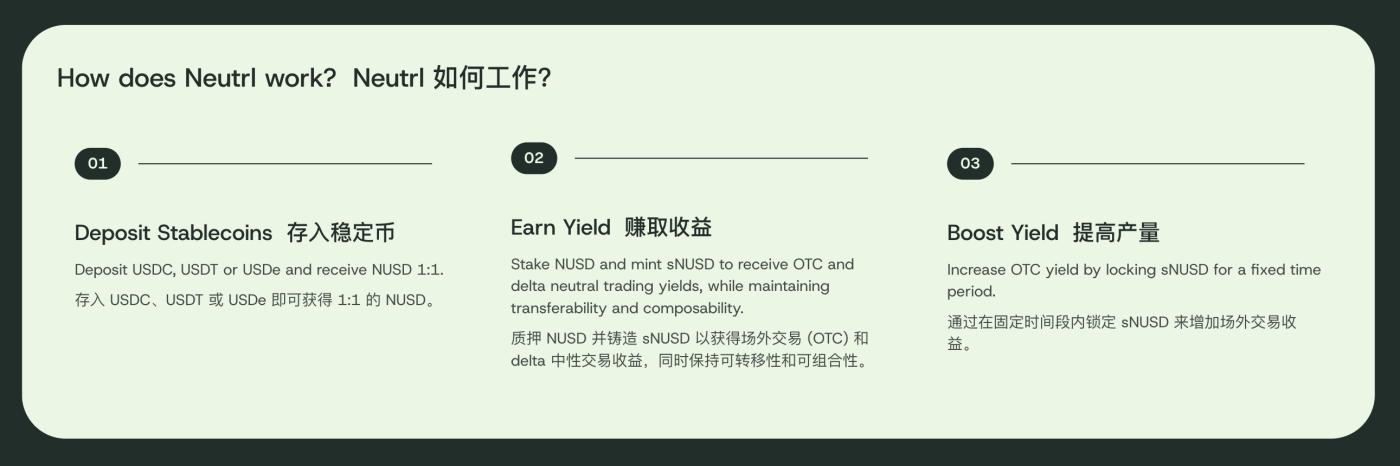
Neutrl's product model is similar to the industry leader Ethena, with a 1:1 USD-pegged synthetic stablecoin NUSD and yield-generating asset sNUSD, corresponding to USDe and sUSDe. The difference lies in the source of income: Ethena's income comes from funding rate arbitrage in the crypto perpetual contract market, while Neutrl's income source is more aggressive: OTC token discount arbitrage.
Income Source: OTC Discount Arbitrage
VC and other institutions can obtain project tokens at undervalued prices inaccessible to retail investors, with these tokens often having more stringent unlock conditions. Typically, tokens have a lock-up period of six months to a year, with a linear release cycle of two to four years.
Lack cash flow with tokens still locked? Afraid the token value will significantly drop upon unlock? Just want to cash out quickly and enjoy a yacht and villa? OTC (Over The Counter) provides an option: selling not-yet-unlocked tokens at a discount. The discount rate depends on project quality and unlock conditions, but is usually quite high. For a token unlocking in a year, the current OTC discount might exceed 50%.
Neutrl uses user-deposited assets to purchase discounted locked VC tokens, while simultaneously shorting an equivalent amount of tokens to hedge and achieve a neutral risk (income unrelated to token price fluctuations).
For example: Buying tokens of the Mantra project (OM) at a 60% discount, set to unlock in a year, purchasing $400,000 worth. Simultaneously shorting $1 million of OM tokens. Without considering contract funding rates and other complex factors, this effectively locks in $600,000 of income a year later.
Even if the OM token crashes 90% overnight, the $400,000 OTC purchased tokens approach zero value, but the short position profits $900,000, potentially shortening the profit realization cycle. If OM doesn't crash and instead rises 50%, the short position loses $500,000, but the unlocked tokens are worth $1.5 million, thus locking in $600,000 of profit.
Potential Risks: Is It a "Stablecoin"?
This strategy seems perfect, but problems exist. Why don't VCs short their own position and hedge instead of selling at a discount?
First, some VCs might indeed be doing this. However, investment institutions are typically required to disclose project investments and fund usage to LPs and investors. Shorting their own positions might damage their reputation. Secondly, VCs might own over 10% of a project's tokens, and the contract market cannot handle such large short volumes, forcing them to sell at a discount.
Moreover, this strategy faces two major risks: abnormal funding rates and significant token price increases.
Regarding funding rates: If too many are shorting, short positions will continuously pay funding rates to long positions. In extreme negative rate scenarios, daily funding rates could reach 10% of principal. For OTC lock-up periods of one to four years, paid funding rates might exceed OTC discount gains. Of course, positive rates during a bull market could also generate additional income.
If token prices rise significantly, over 100%, "infinite margin" would be needed to hold until OTC token unlock to realize profits. Otherwise, if the short position is liquidated midway and token prices later drop, only the actual short position loss remains. Not everyone can perfectly short with "W" and "MOVE" patterns. Shorting "TIA" and getting liquidated midway could lead to net losses.
Conclusion
Neutrl represents a high-risk arbitrage strategy. While they might be more professional in risk management than average investors, potential risks cannot be ignored.
This high-risk arbitrage fund attracting user deposits under the guise of a stablecoin seems inappropriate and requires more risk emphasis. However, Ethena is essentially also an arbitrage fund disguised as a stablecoin. Without Ethena and Neutrl, retail investors would struggle to access these strategy profits, representing innovation and progress in the CeDeFi domain, offering users more income choices.
Neutrl has not yet officially launched; interested users can currently submit a Waitlist application for early access on their official website.