Author: Cool Geek
Large models can sort out what has happened in China over five thousand years, but cannot answer what time it is now; they can explain quantum mechanics, but find it difficult to create a professional PowerPoint with text and images.
Why do large models seem omnipotent, but always fall short when actually used?
The reason is simple: being smart and knowledgeable does not mean being capable of doing work.
Being smart requires large models to train and learn through massive knowledge, developing a sophisticated brain that can answer questions well;
To simultaneously satisfy both smartness and capability, this smart brain needs to be equipped with flexible limbs, achieving "deep thinking + deep delivery".
Therefore, how to promote large models to evolve from smart thinking to "smart and capable" has become the key to determining whether this wave of large model enthusiasm is just a flash in the pan or a game-changer in history.
Baidu has provided a prototype.
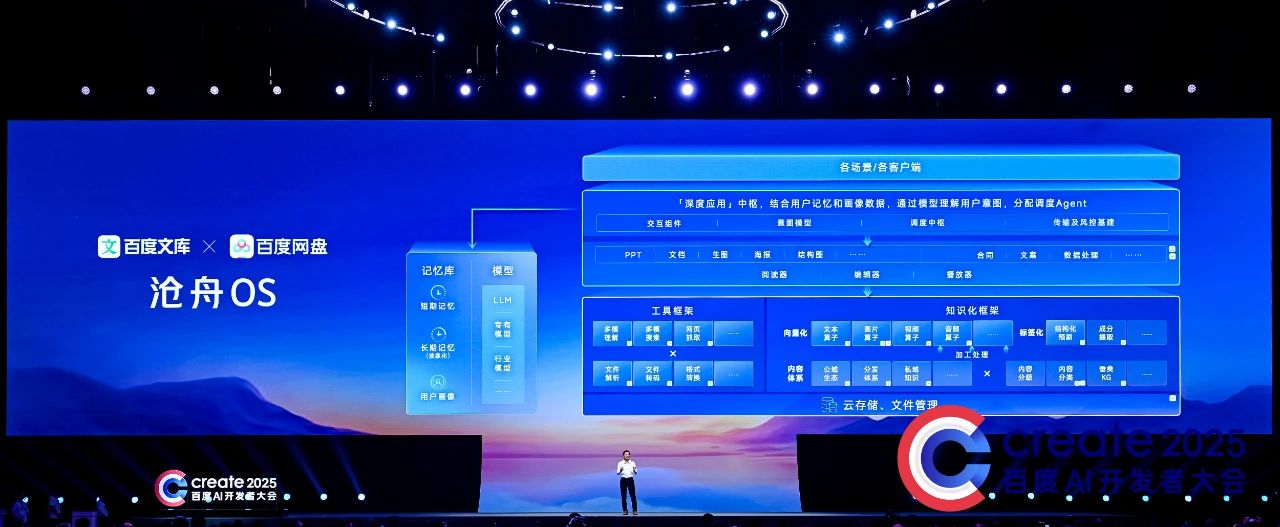
On April 25th, at the Baidu AI Developer Conference Create 2025, Baidu founder Li Yanhong introduced Cangzhou OS, the world's first content domain operating system jointly launched by Baidu Library and Baidu Netdisk.
By fully integrating the underlying technologies, capabilities, and data accumulated by Baidu Library and Netdisk, it can flow like water across different scenarios, implementing low-threshold, end-to-end high-quality delivery in the most reasonable form and most convenient user interface.
Based on Cangzhou OS, Baidu Library and Baidu Netdisk's vision and expectation for AI is to achieve truly one-stop, end-to-end delivery anytime, anywhere, on any terminal device, making AI "omnipotent and ubiquitous".
[The translation continues in the same manner for the rest of the text]To complete the above content, it is necessary to dispatch users' historical chat records, browsing history, intent recognition, web-wide search, PPT tools, analyze user intent, understand user preferences, freely combine tools, and ultimately provide users with a comprehensive planning proposal that includes process, date, venue, budget, theme, execution details, style, and personnel arrangement.
At the same time, the planning proposal and poster required by users need to be compatible, which requires all information to be consistent and output in parallel using the same operating system.
Of course, AI cannot generate results that satisfy everyone at once, which requires both wedding planning proposals and posters to have editability, and this capability is supported by the "Cangzhou OS" fusion editor capability.
It is not difficult to discover that from deep thinking to deep delivery, GenFlow Super Partner is almost the only "multi-agent collaboration" product available on the market. Not only does it solve the common problems of high costs, long generation time, low efficiency, inability to stably deliver, and inability to multi-round dialogue optimization in multi-agent collaboration products, but it is also directly embedded into mature products combined with user-authorized private data, giving AI a real chance to achieve the goal of "omnipotent and ubiquitous".
Baidu Netdisk's AI Notes is a powerful assistant for countless office workers and those preparing for civil service and postgraduate exams.
AI Notes is the industry's first multi-modal AI note-taking tool that can embed various exam preparation learning videos and note pages stored in Baidu Netdisk into the same interface, achieving seamless linkage, with video content and notes strongly associated. From watching videos to generating AI notes, to summarizing AI mind maps, and finally AI-generated questions to test learning outcomes, it comprehensively covers the entire user learning cycle.
For example, the difficulty of postgraduate English exam became a hot topic recently. When users want to focus on reviewing English for the exam, AI Notes will first search for related materials stored in the user's netdisk, simultaneously query exam points from publicly available online resources, and organize them. However, the process does not stop there. AI Notes will also cross-reference with historical exam papers to verify the generated exam points. Only verified points can be used to generate mind maps and predict exam questions, helping users accelerate their learning progress.
In this process, the tool invocations are no fewer than planning a wedding. For instance, finding exam points and past papers requires web-wide search capabilities, and past papers are often presented in PDF or image formats, with expert explanations in video form, which requires multi-modal content parsing capabilities. The final mind map generation and exam question prediction need large model reasoning abilities, multi-modal content generation capabilities, and the ability to map and associate different contents, while ensuring absolute content accuracy.
Behind this is the empowerment of "Cangzhou OS".
Of course, Baidu supports developers to fully embrace MCP, so Cangzhou OS serves not only Baidu's internal ecosystem. The most important aspect of operating system development is external openness to stimulate innovation among developers.
Therefore, to maximize the value of the ecosystem and applications, Baidu Wenku and Baidu Netdisk, based on "Cangzhou OS", are the first to fully apply MCP to product and ecosystem connections, constructing an MCP Server-Client-Host three-tier system. They open the capabilities of Wenku and Netdisk through MCP Server, and through MCP Client SDK, facilitate more enterprise users, developers, and intelligent agent applications to access MCP Host.
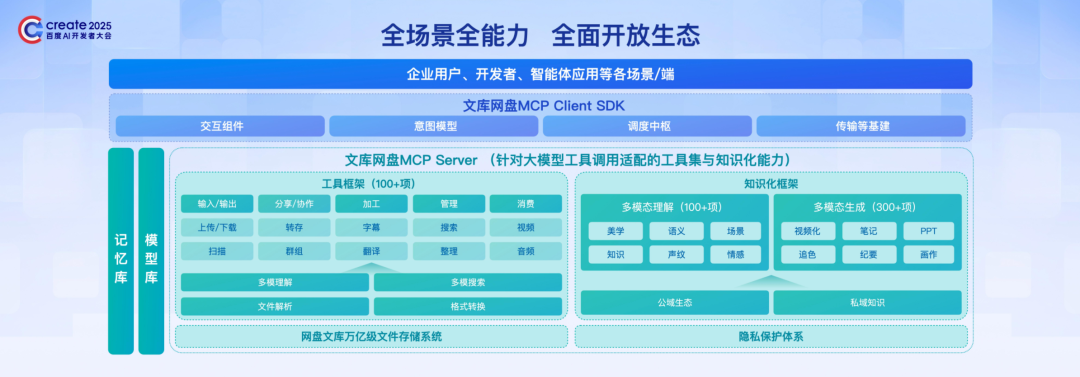
Among these, the most representative case is Samsung mobile phones. Samsung phones are accessing multiple MCP servers from Baidu Wenku Netdisk, including file upload, download, search, sharing, and content understanding.
On one hand, users can directly achieve functions like uploading files to Netdisk, cloud sharing, document summary, and content Q&A through voice assistant on their phone by speaking.
On the other hand, these servers can enrich Samsung phone system's cloud storage capabilities, solving the phone's difficulty in batch backup and sharing of large and multiple files.
For example, when a user says in the phone's voice assistant: "Backup yesterday's photos taken at Aoshan to Baidu Netdisk, and send Xiaoming's photos to him". The related photos will be uploaded to the user's authorized Netdisk account and generate a sharing link. The phone assistant will then call the contact list and send this link via SMS to the other party's phone. By clicking the link, the user can directly enter Baidu Netdisk to view or save.
Undoubtedly, verifying the reliability of OS underlying capabilities is not about tool stacking or the number of black technologies. The top-layer application service ecosystem's usability, maturity, and richness are the best standards for OS capabilities.
03
The OS Story Has No End
In the capital market, the most investor-approved type of enterprise is called a "friend of time".
A "friend of time" means that when a company does something right, it only needs to continue doing so, and its performance will grow like a perpetual motion machine, with ecosystem developers continuously benefiting.
Operating systems are a typical perpetual motion machine market. As long as the computer and mobile phone markets exist, the stories of operating systems belonging to Microsoft, Apple, and Google will never end.
The same applies to large models. When "deep thinking + deep delivery + private and public data + MCP ecosystem" come together, becoming an all-powerful, ubiquitous AI of the new era, new species will continuously emerge like the Cambrian explosion.
In this process, looking downward, it is Baidu Wenku, Baidu Netdisk, and others opening up their capabilities. By actively embracing the ecosystem, they become creators of new large model species and definers of new rules.
Looking upward, countless new Agents will be created and seen based on "Cangzhou OS", forming a surging new application service ecosystem.
And now, all stories have just begun.