Written by: Liu Jiaochain
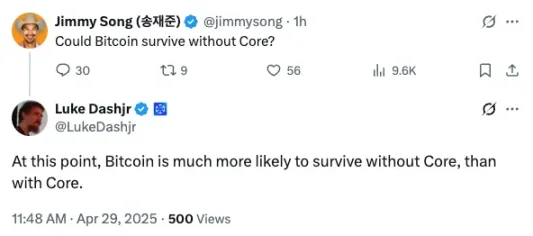
Bitcoin developer Jimmy Song raised a thought-provoking question: Can Bitcoin survive without Core (referring to the Bitcoin Core client software, considered the "orthodox" inheritor of Satoshi Nakamoto's original code base)? Another well-known Bitcoin developer, Luke Dashjr, replied that currently, the possibility of Bitcoin continuing to survive without Core is far higher than relying on Core.
As is well known, since its birth in 2009, Bitcoin's underlying protocol and operating mechanism have always revolved around "decentralization". As its initial reference implementation, Bitcoin Core has undertaken functions such as maintaining protocol rules, fixing vulnerabilities, and upgrading the network. However, does Bitcoin's survival necessarily depend on Core?
From Bitcoin's technical architecture, the protocol takes precedence over implementation. The core of Bitcoin is not a specific software, but a protocol defined by mathematical rules and cryptographic algorithms.
Bitcoin Core, as the first implementation of the protocol, provides a standardized node program, but its code is not irreplaceable.
Theoretically, any client that complies with Bitcoin's consensus rules can join the network, as long as the new implementation is compatible with the existing network's transaction verification rules and block generation logic, the Bitcoin network can continue to operate.
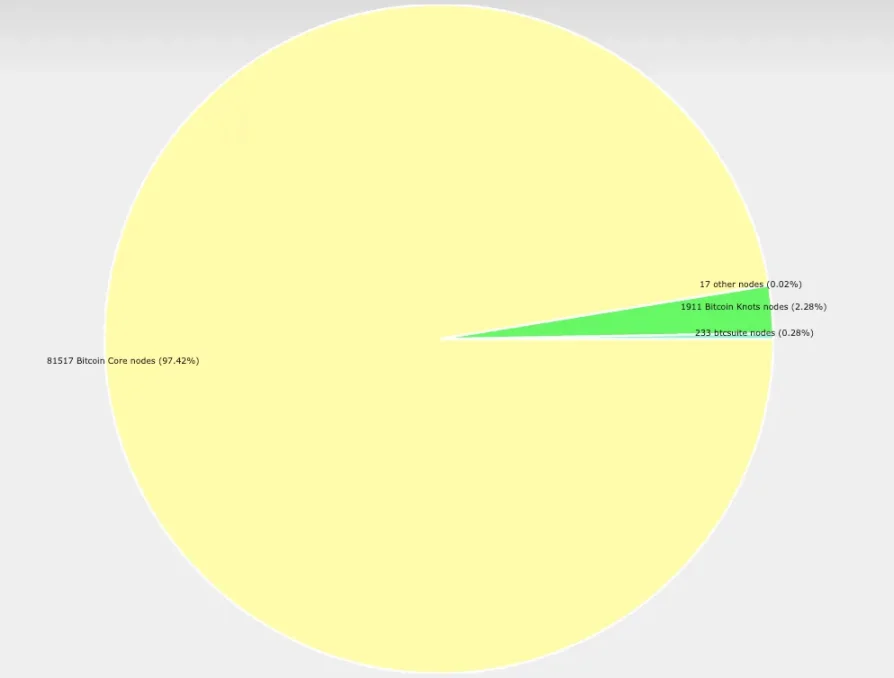
However, according to Luke Dashjr's statistics, the Bitcoin Core client software still dominates with a market share of over 97%.
As for the reason, Jiaochain thinks it might be because the consensus of the majority needs a carrier. And choosing the most "orthodox" code base as this consensus carrier seems to be the simplest.
Similar to miners' choice of the longest chain, the choice of Core software seems to be a "Schelling Point" in game theory.
This is why, after 16 years of Bitcoin's existence, although there are many other client softwares besides Core, they have never been able to gain a significant market share.
The second-ranked Bitcoin Knots in the chart is actually also a Core, a modified version of Core personally produced by Luke Dashjr.
In the history of Bitcoin development, during the most controversial and intense big/small block scaling debate of 2017-2018, big block advocates tried to seize Core's orthodox status and once used nearly Core's computing power, but ultimately failed. This undoubtedly greatly strengthened Core's unshakable leadership position.
Without Core and its chief maintainer at the time, Wladimir van der Laan (who served as chief maintainer from 2014-2022), adhering to principles and tirelessly coordinating, it's hard to imagine how intense the community disputes would have become, and whether miners' groups would have reverse-controlled the development team, forming a "military government".
The difference between Core and miners' groups is that miners' groups control computing power. Once they get the right to modify code (legislative power), they can do whatever they want, changing rules as they see fit. In contrast, Core can only hope for voluntary community acceptance of new code rules when trying to change rules through code; otherwise, if no one uses the written code, it won't get past GitHub and becomes just a piece of waste paper.
Currently, Bitcoin protocol updates rely on the BIP (Bitcoin Improvement Proposal) process, where any developer can submit a proposal, but it requires coordination among multiple stakeholders like miners, nodes, and exchanges to take effect. The Bitcoin Core code repository is open on GitHub, where global developers can review, modify, or propose alternative solutions.
The protocol evolution mechanism is essentially a social experiment. If miners' interests cannot be taken care of, protocol upgrade cannot succeed. And if the interests of a broader group of token holders cannot be addressed, the outcome would be worse - users would vote with their feet, sell BTC, and completely abandon it, ultimately resulting in zero value.
A Bitcoin without Core might face two risks. First, protocol fragmentation. If multiple clients interpret rules differently (such as block size or script opcodes), it could lead to network splitting. The fork wave of 2017 has shown such risks, but history indicates that the market usually chooses the chain with the strongest network effect and stability as the "main chain". Second, development resources would be dispersed. Core has accumulated over a decade of technical debt and optimization experience, and new implementations would need to rebuild the same level of code robustness, which poses higher requirements for community collaboration efficiency.
However, as long as core rules like proof of work mechanism, 21 million cap, and UTXO model remain unchanged, any compatible implementation can inherit its value storage attributes.
In extreme cases, if Core disappears, miners would still have the motivation to switch to other clients to maintain their asset value, and exchanges and wallet service providers would adapt to the new protocol to ensure business continuity.
Bitcoin's vitality is rooted in its protocol layer's social consensus and decentralized architecture, not in a specific development team or software implementation. Core's role is similar to a "Chief Maintainer", but not irreplaceable.
At the current stage, Core's existence as a Schelling point carries global consensus as a "ghostwriter", essentially writing Bitcoin's rules on behalf of all token holders - a natural choice that human society has reached today.
As for Core's own "decentralization" - splitting into multiple client softwares and code maintenance teams, no longer coordinating through traditional collaborative methods - this is another monument to exploring, pioneering, and innovating decentralized governance and self-organized collaboration in an era when humans are still accustomed to state rule and corporate governance.
Perhaps we should remain optimistic about this.
Historical crises have proven that when code vulnerabilities threaten the system, the community can quickly repair through collaboration; when development directions diverge, the market chooses the main chain through computing power voting. This governance model based on rules and dynamic balance might allow Bitcoin to continue its network effect through open-source ecology and global participants, even without Core.
Perhaps its true survival baseline is whether most participants still believe in mathematical rules rather than human authority, and whether they are willing to pay the cost and price to maintain this belief.